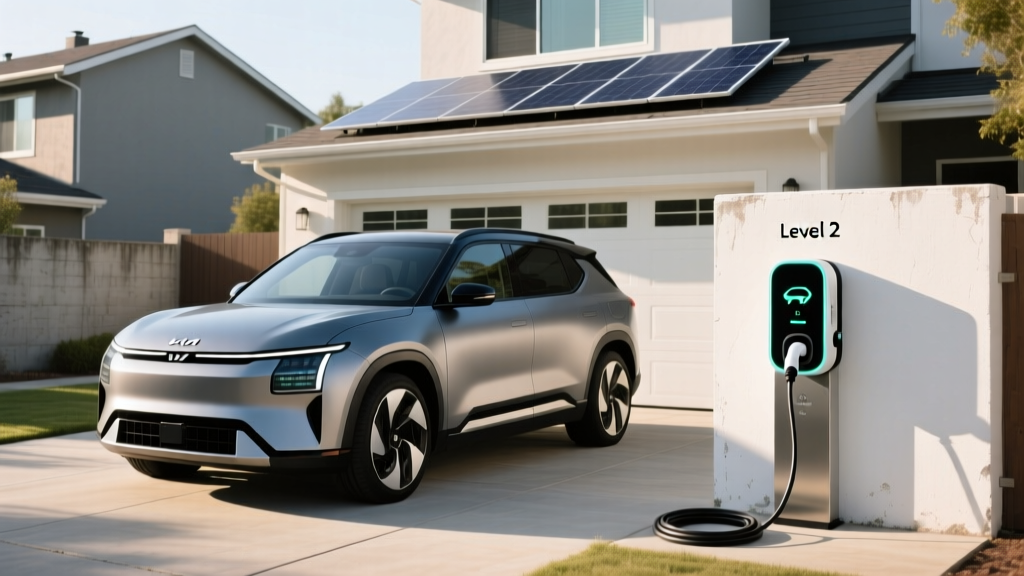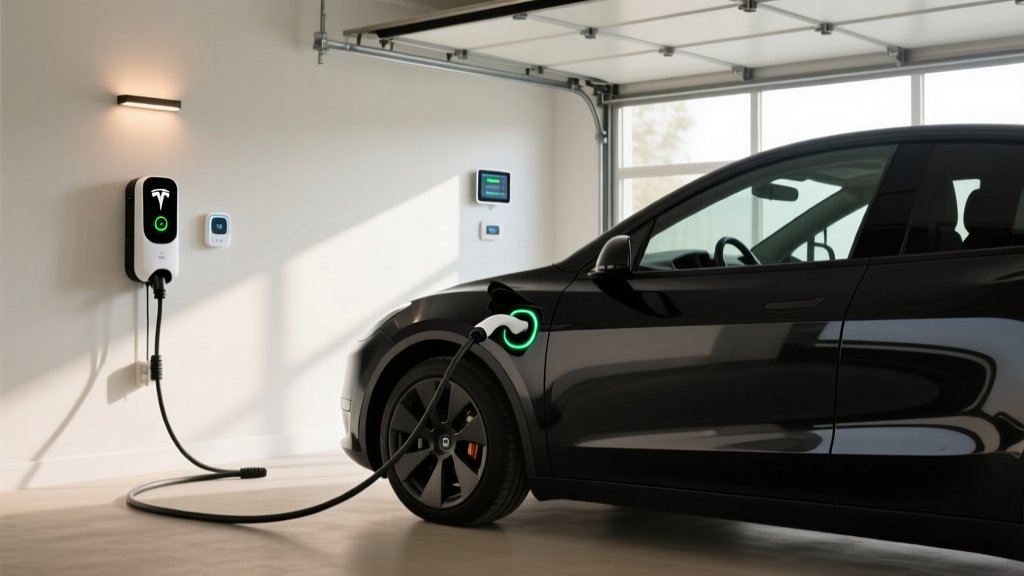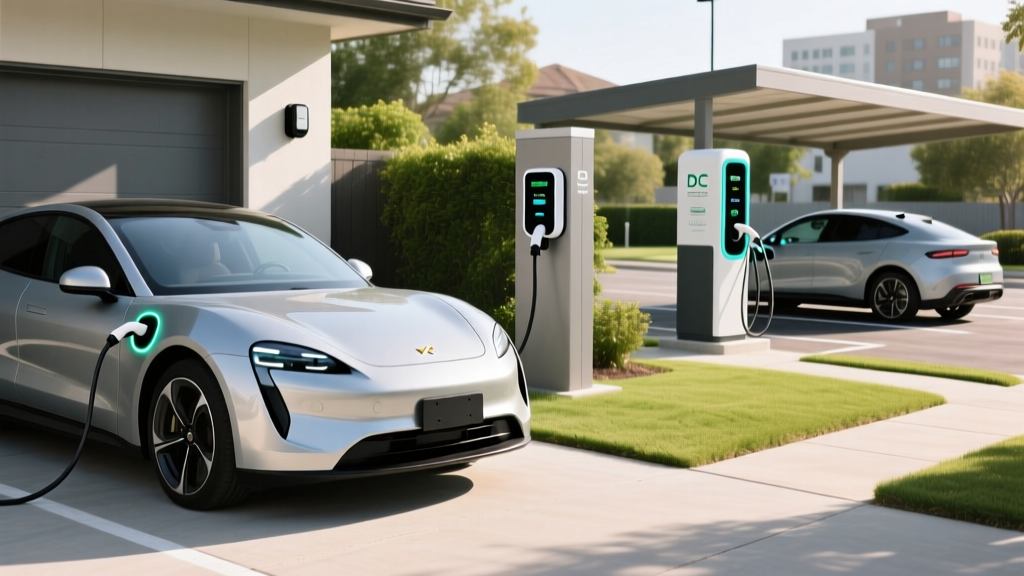
If you've spent years behind the wheel of a 1997 Pontiac Grand Prix GTP Supercharged — that 3.8L L67 V6 pushing 240 hp and 280 lb-ft of torque through a 4T65-E transmission — you already know what forced induction feels like. What you might not know is how electrified "refueling" works when you finally make the jump to a battery-electric vehicle. The supercharger whine is gone, but the physics of energy transfer are very much alive.
This guide breaks down everything a former GTP owner (or any gas-car veteran) needs to understand about EV charging in 2026: the three charging levels, real home installation costs including panel upgrades, connector standards, per-mile energy costs versus your old 3800 V6, and which hardware to actually buy.
Charging Levels Explained: kW Speed and Miles Per Hour
The single most important distinction in EV literacy is kW (kilowatts) versus kWh (kilowatt-hours). Think of it like your Grand Prix's fuel system: kW is the flow rate of the gas pump (gallons per minute), while kWh is the total capacity of the fuel tank. A 75 kWh battery holds 75 kilowatt-hours of energy; a 11.5 kW Level 2 charger delivers energy at a rate of 11.5 kilowatts. Never use these interchangeably.
| Level | Voltage | Max Power (kW) | Miles of Range Per Hour | Typical Use Case |
|---|---|---|---|---|
| Level 1 (120V) | 120V AC | 1.2–1.9 kW | 3–5 mi/hr | Overnight top-ups, PHEVs, emergency |
| Level 2 (240V) | 240V AC | 7.2–19.2 kW | 20–60 mi/hr | Home daily charging, workplace, public AC |
| DC Fast Charge | 400–800V DC | 50–350 kW | 150–1,200 mi/hr (peak) | Road trips, highway corridors |
For context: your old GTP got roughly 18-20 mpg combined per fueleconomy.gov. Filling its 18.5-gallon tank at a gas station took about 3 minutes for ~370 miles of range. A 350 kW DC fast charger can add roughly 200 miles in 15-20 minutes to a compatible 800V architecture vehicle like the Hyundai Ioniq 5 or Porsche Taycan — but only at peak rate. Charging curves taper significantly above 80% state of charge (SoC), which is why manufacturers quote 10-80% times rather than 0-100%.
How Fast Will Each Charging Level Add Range?
Charging speed depends on both the charger's output (kW) and the vehicle's onboard charger or DC charge acceptance rate. Here are real-world time estimates for common battery sizes:
| Battery Size | Level 1 (1.4 kW) | Level 2 (11.5 kW) | Level 2 (19.2 kW) | DC Fast (150 kW peak) | DC Fast (350 kW peak) |
|---|---|---|---|---|---|
| 60 kWh (e.g., base Nissan Ariya) | ~30 hours | ~3.6 hours | ~2.2 hours | ~28 min | ~20 min* |
| 77 kWh (e.g., Ford Mustang Mach-E ER) | ~38 hours | ~4.7 hours | ~2.8 hours | ~34 min | ~25 min* |
| 100 kWh (e.g., Rivian R1S, Lucid Air) | ~50 hours | ~6.1 hours | ~3.6 hours | ~45 min | ~22 min** |
*Vehicle must support 800V+ architecture and peak acceptance above 250 kW. **Lucid Air with 300+ kW acceptance. Most 400V vehicles peak at 150-250 kW and cannot utilize 350 kW chargers at full rate.
The critical takeaway: for daily driving, Level 2 at home is where 90%+ of all EV charging happens. You plug in when you get home, and by morning the car is full — like starting every day with a full tank on your old GTP, except you never visit a gas station.
Home EV Charger Installation: Electrical Requirements and Real Costs
This is where most new EV buyers get blindsided. The charger unit itself is only part of the expense. Here's the full breakdown for a typical 240V/48A Level 2 home installation:
| Component | Low End | High End | Notes |
|---|---|---|---|
| Level 2 Charger (hardwired, 48A) | $400 | $750 | Smart Wi-Fi chargers; dumb units from $250 |
| Electrical Permit | $50 | $300 | Varies by municipality |
| Electrician Labor (standard install) | $500 | $1,500 | Panel to garage, <50 ft run, drywall |
| Electrical Panel Upgrade (if needed) | $1,500 | $4,000 | 100A → 200A service; common in pre-2000 homes |
| Conduit, Wiring, Breaker (60A circuit) | $200 | $600 | 6 AWG copper for 48A continuous load |
| Total (no panel upgrade) | $1,150 | $3,150 | Most homes with 200A service |
| Total (with panel upgrade) | $2,650 | $7,150 | Homes with 100A or maxed-out panels |
What Electrical Upgrades Might I Need?
If your home was built before 2000 — around the same era as your Grand Prix GTP — there's a real chance you have a 100-amp electrical panel. A 48A continuous EV charger requires a 60-amp dedicated breaker (the National Electrical Code mandates circuits be rated at 125% of continuous load). On a 100A panel already serving an electric range, dryer, and central AC, there may not be headroom.
Load calculation is mandatory. A licensed electrician will perform an NEC Article 220 load calculation to determine if your panel can handle the additional draw. If not, options include:
- Panel upgrade to 200A: $1,500–$4,000 depending on utility connection and local code
- Smart load management: Devices like the Emporia Smart Charger or Wall Connector with power-sharing can dynamically throttle charging when other appliances draw power, avoiding a panel upgrade
- Lower-amperage circuit: A 32A charger on a 40A circuit still delivers ~7.7 kW — enough to add ~200 miles overnight for most vehicles
How Much Does It Cost to Install a Home EV Charger?
The honest answer: $1,200 to $3,500 for most homes with adequate panel capacity, and $2,700 to $7,000+ if you need a panel upgrade. Homes with long wire runs (detached garages, finished walls requiring conduit) push toward the higher end. The IRS residential clean energy credit does not currently cover EV charger equipment for most taxpayers after the Inflation Reduction Act restructured incentives — check current-year IRS guidance for any state-level rebates that may apply.
Connector Compatibility: NACS, CCS1, and CHAdeMO in 2026
The connector landscape has consolidated significantly. Here's where things stand:
| Connector | Brands Using It | Notes |
|---|---|---|
| NACS (North American Charging Standard) | Tesla, Ford, GM, Rivian, Volvo, Polestar, Mercedes, BMW, Hyundai/Kia (2025+), Nissan (2025+) | Industry standard as of 2025; compact, no latch |
| CCS1 (Combined Charging System) | Legacy VW/Audi (pre-2025), some Stellantis models, older BMW/Hyundai/Kia | Being phased out; adapters available |
| CHAdeMO | Nissan Leaf (legacy), Mitsubishi Outlander PHEV (older) | Effectively discontinued for new vehicles |
If you're buying a 2025 or 2026 model-year EV, it almost certainly has a NACS port. If you're buying a slightly used 2022-2024 EV, it likely has CCS1. The good news: CCS-to-NACS adapters (from Tesla, Lectron, A2Z, and others, $150-$250) let CCS-ported vehicles charge at Tesla Superchargers, which now number over 30,000 stalls in North America.
For home Level 2 charging, all vehicles use the J1772 connector (or NACS, which handles Level 2 natively on Tesla and newer NACS-equipped vehicles). If your EV has a NACS port, buy a NACS wall charger. If it has CCS1/J1772, buy a J1772 charger. Universal adapters exist but add a point of failure.
Level 2 Charger Equipment Recommendations
After testing dozens of units across multiple homes and vehicles, here are the chargers that deliver reliable daily service:
Tesla Wall Connector (Gen 4)
- Power Output: 48A / 11.5 kW (hardwired, 240V/60A circuit)
- Connector: NACS (J1772 adapter included in box)
- Cable Length: 24 ft
- Smart Features: Wi-Fi, OTA updates, power-sharing with second unit, access control, scheduling via Tesla app
- Price: ~$425
- Best For: NACS-vehicle owners wanting seamless integration; power-sharing lets two chargers share one 60A circuit
ChargePoint Home Flex
- Power Output: Up to 50A / 12 kW (configurable 16A-50A, NEMA 14-50 plug or hardwired)
- Connector: J1772 (NACS adapter sold separately)
- Cable Length: 23 ft
- Smart Features: Wi-Fi, ChargePoint app scheduling, Alexa integration, energy reporting, works with utility demand-response programs
- Price: ~$550–$650
- Best For: CCS1/J1772 vehicle owners who want plug-in flexibility (NEMA 14-50 means you can take it when you move)
Emporia Level 2 Smart Charger
- Power Output: 48A / 11.5 kW (hardwired, 240V/60A circuit)
- Connector: J1772 (NACS version available)
- Cable Length: 24 ft
- Smart Features: Wi-Fi, real-time energy monitoring, solar integration, load management with Emporia Vue panel monitor, utility rate scheduling
- Price: ~$400
- Best For: Homes with solar panels or those needing smart load management to avoid panel upgrades
Grizzl-E Smart (United Chargers)
- Power Output: 40A / 9.6 kW (NEMA 14-50 plug or hardwired)
- Connector: J1772 (NACS version available)
- Cable Length: 24 ft
- Smart Features: Wi-Fi, OCPP protocol, adjustable amperage (16A-40A), extreme cold rated (-40°F)
- Price: ~$450
- Best For: Cold-climate owners; built in Canada and tested for harsh winters
Cost to Charge: Per-Mile Energy Cost vs. Gas
Your '97 Grand Prix GTP Supercharged averaged about 18 mpg combined. At $3.40/gallon (2026 national average), that's roughly $0.189 per mile in fuel alone. Let's compare EV charging costs across scenarios, assuming an efficiency of 3.0 miles/kWh (typical for a midsize crossover like the Hyundai Ioniq 5 or Tesla Model Y):
| Charging Scenario | Rate ($/kWh) | Cost Per Mile (at 3 mi/kWh) | Annual Cost (12,000 mi) |
|---|---|---|---|
| Home, off-peak utility rate | $0.08–$0.12 | $0.027–$0.040 | $320–$480 |
| Home, standard residential rate | $0.14–$0.18 | $0.047–$0.060 | $560–$720 |
| Public Level 2 (workplace, retail) | $0.20–$0.35 | $0.067–$0.117 | $800–$1,400 |
| DC Fast Charging (Electrify America, EVgo) | $0.35–$0.55 | $0.117–$0.183 | $1,400–$2,200 |
| Gas (18 mpg GTP, $3.40/gal) | — | $0.189 | $2,267 |
The math is stark: even at the most expensive DC fast charging rates, an efficient EV matches or beats the per-mile fuel cost of a supercharged V6. At home off-peak rates, you're spending 80-85% less per mile on energy. Over 12,000 miles annually, that's $1,800–$1,950 in fuel savings versus the GTP.
Important caveat: DC fast charging as your primary fuel source eliminates most of the cost advantage. Home Level 2 charging is the economic backbone of EV ownership. If you can't charge at home or work, run the numbers carefully before buying.
Safety, Code, and Installation Best Practices
EV charging draws sustained high current for hours — unlike a dryer that cycles on and off. This makes proper installation non-negotiable:
- Dedicated circuit: Your Level 2 charger must be on its own dedicated breaker. No sharing with other outlets or appliances.
- GFCI protection: NEC 2023 and later require GFCI protection for all EV charging outlets (NEMA 14-50 receptacles). Hardwired installations with GFCI built into the charger unit may satisfy this — confirm with your local inspector.
- Outdoor rating: If your charger is mounted outside or in an open carport, it must carry a NEMA 4 (weatherproof) rating. All chargers recommended above meet this standard.
- NEMA 14-50 receptacle quality: If using a plug-in charger rather than hardwired, specify a commercial-grade or industrial-grade 14-50 receptacle (Hubbell, Bryant, or Cooper — ~$50-$80). Consumer-grade outlets from big-box stores have shown thermal failures under sustained EV charging loads.
- Permit and inspection: Always pull an electrical permit. An unpermitted installation can void homeowner's insurance coverage in the event of a fire and create issues at resale.
According to NFPA's National Electrical Code, a 48A continuous EV load requires a 60A breaker with appropriately sized conductors (6 AWG copper THHN in conduit, or 4 AWG NM-B cable). Your electrician should verify voltage drop over the wire run — runs exceeding 100 feet may need upsized wire to maintain safe voltage at the charger.
Real-World Charging Tips From Actual EV Ownership
Here's what no spec sheet tells you:
Preconditioning matters. If your EV supports it (Tesla, Ford, Hyundai/Kia, BMW, and most 2024+ models), navigate to a DC fast charger using the car's built-in navigation. The vehicle will preheat or precool the battery to optimal temperature, which can double your peak charge rate in cold weather. Arriving at a 350 kW charger with a cold battery might net you only 50 kW without preconditioning.
The 80% rule for road trips. Charging from 10-80% at a DC fast charger might take 18-25 minutes. Charging from 80-100% at that same charger can take just as long due to the charge curve taper. Plan road-trip stops to charge to 80% and drive on — you'll reach your destination faster.
Cold weather reduces range 20-35%. If your EV's EPA range sticker says 300 miles, expect roughly 200-240 miles in sustained sub-30°F driving with cabin heat running. Vehicles with heat pumps (standard on most 2024+ models) lose less range than those with resistive heaters. The EPA range figure on fueleconomy.gov is measured at moderate temperatures.
Schedule charging for off-peak hours. Most utilities offer time-of-use (TOU) rates. Setting your charger to begin at 11 PM or midnight can cut your per-kWh cost in half versus peak afternoon rates. Every charger recommended above supports app-based scheduling.
Frequently Asked Questions
Can I just plug an EV into a regular 120V outlet?
Yes, but Level 1 (120V) charging delivers only 1.2-1.9 kW — roughly 3-5 miles of range per hour. For a 75 kWh battery going from empty to full, that's 40-60 hours. It works for plug-in hybrids with small batteries (10-20 kWh) or as emergency backup, but it's not practical as a primary charging method for a full battery-electric vehicle.
Do I need a Tesla Wall Connector if I don't own a Tesla?
No. The Tesla Wall Connector works with any NACS-equipped vehicle (which includes Ford, GM, Rivian, and most 2025+ EVs). If your vehicle has a CCS1/J1772 port, you'd use the included J1772 adapter, but a native J1772 charger like the ChargePoint Home Flex provides a cleaner experience. Match the charger connector to your vehicle's port.
Will charging at home raise my electric bill significantly?
Yes, but it replaces your gas budget. Charging a 75 kWh battery from empty to full at $0.12/kWh costs about $9.00 — for roughly 225-250 miles of range. Driving those same miles in a Grand Prix GTP at 18 mpg and $3.40/gallon would cost $42.50 in fuel. Your electric bill goes up; your total energy spend goes down substantially.
How long do home EV chargers last?
Quality Level 2 chargers (Tesla, ChargePoint, Emporia, Grizzl-E) typically carry 3-year warranties and last 8-15 years in real-world service. They have no moving parts. The most common failure point is the cable or connector handle from physical abuse. Most manufacturers sell replacement cable assemblies.
Is it safe to charge an EV in the rain or snow?
Yes. All EV chargers rated for outdoor use (NEMA 4) are sealed against rain, snow, and dust. The connector and vehicle inlet are designed to make a weatherproof seal before any current flows. You can safely plug and unplug in any weather condition.
What about the federal tax credit for EV chargers?
The Alternative Fuel Vehicle Refueling Property Credit (IRC §30C) was revived under the Inflation Reduction Act but is limited to qualifying census tracts (low-income or non-urban areas) and caps at $1,000 for residential installations. Check the IRS §30C page and consult a tax professional to confirm whether your address and installation qualify.