Understanding Hyundai Ioniq 6 Range and Charging Fundamentals
The Hyundai Ioniq 6 delivers an EPA-estimated range of up to 361 miles on its Long Range RWD trim, making it one of the most efficient electric sedans available. However, maximizing that range requires understanding how charging works, what equipment you need, and how different charging levels affect your daily driving experience.
Before diving into charging options, let's clarify the critical distinction between kW (kilowatts) and kWh (kilowatt-hours)—the most common confusion point for new EV owners. Think of kW as the speed of water flowing through a hose (charging power), while kWh represents the total volume of water in the tank (battery energy capacity). Your Ioniq 6's 77.4 kWh battery stores energy; a 350 kW DC fast charger delivers power to refill it.
Charging Levels: Speed, Cost, and Practical Use Cases
The Hyundai Ioniq 6 supports three charging levels, each serving different needs. Understanding these helps you plan charging around your lifestyle rather than the other way around.
| Charging Level | Voltage/Current | Power Output | Miles Added Per Hour | Best Use Case |
|---|---|---|---|---|
| Level 1 (120V) | 120V / 12A | 1.4 kW | 3-5 miles | Emergency/overnight trickle |
| Level 2 (240V) | 240V / 40-48A | 9.6-11.5 kW | 25-35 miles | Daily home charging |
| DC Fast Charging | 400V DC | Up to 350 kW peak | 200+ miles in 18 min | Road trips, rapid top-ups |
Level 1 charging uses a standard household outlet and the portable cord that came with your Ioniq 6. At 1.4 kW, you'll add roughly 4 miles per hour—meaning a full charge from empty takes over 50 hours. This works only for plug-in hybrids or emergency situations where you're adding 30-40 miles overnight.
Level 2 charging is the practical standard for daily EV ownership. A 240V circuit (like your dryer outlet) delivers 9.6-11.5 kW depending on your charger and the Ioniq 6's onboard charger capacity. The Ioniq 6 accepts up to 10.9 kW on Level 2, meaning a 10-80% charge takes approximately 7-8 hours—perfect for overnight charging while you sleep.
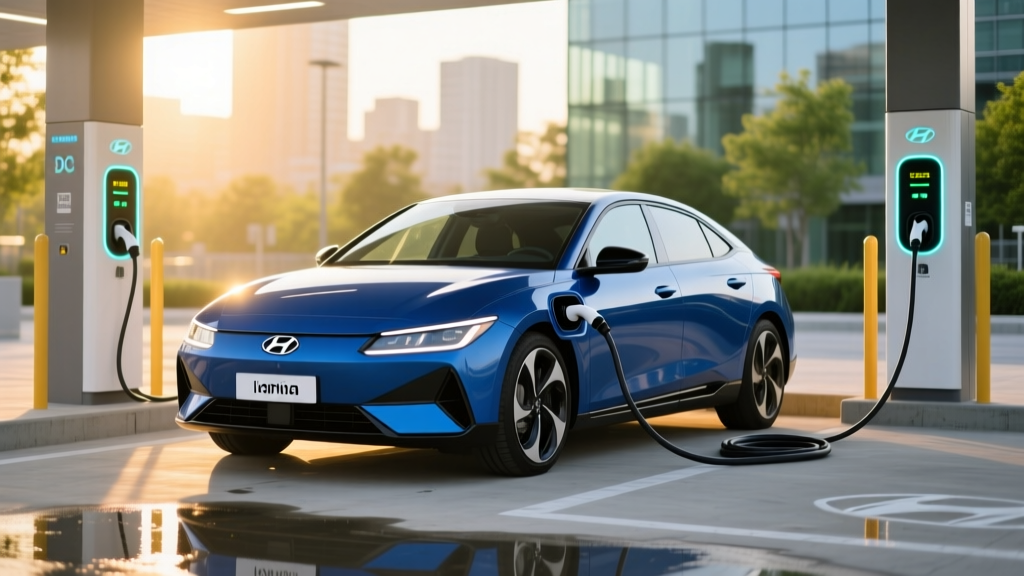
DC Fast Charging bypasses the onboard charger entirely, feeding DC power directly to the battery. The Ioniq 6's 800V architecture (shared with the Ioniq 5 and Kia EV6) enables peak charging rates up to 350 kW on compatible stations. However, real-world charging follows a curve: you'll see 235-250 kW sustained from 10-80% state of charge, then significant tapering above 80% to protect battery health. Expect a 10-80% charge in approximately 18 minutes at a 350 kW station, or 25-30 minutes at a 150 kW station.
Home Charger Installation: Requirements and Costs
Installing a Level 2 home charger transforms EV ownership from inconvenient to effortless. However, the installation involves electrical work that varies significantly based on your home's existing infrastructure.
Electrical Requirements for Ioniq 6 Home Charging
For optimal Level 2 charging, you'll need a dedicated 240V circuit with appropriate amperage. The Ioniq 6's 10.9 kW onboard charger works best with a 48-amp circuit (delivering 11.5 kW), though a 40-amp circuit (9.6 kW) remains a popular, cost-effective choice.
- 40-amp circuit: Requires 50-amp breaker, 6-gauge copper wire, delivers 9.6 kW
- 48-amp circuit: Requires 60-amp breaker, 4-gauge copper wire, delivers 11.5 kW
- Hardwired vs. plug-in: Chargers above 40 amps typically require hardwiring; 40A units can use NEMA 14-50 outlets
Installation Cost Breakdown
| Component | Cost Range | Notes |
|---|---|---|
| Level 2 Charger Equipment | $400 - $700 | Smart chargers with WiFi, load management |
| Electrician Labor | $500 - $1,500 | Varies by circuit length, accessibility |
| Permit Fees | $50 - $200 | Required by most municipalities |
| Electrical Panel Upgrade | $1,500 - $3,000 | Only if panel lacks capacity (older homes) |
| Total (no panel upgrade) | $950 - $2,400 | Typical scenario for homes built after 2000 |
| Total (with panel upgrade) | $2,450 - $5,400 | Homes with 100-amp service or maxed panels |
The single biggest cost variable is whether your electrical panel needs an upgrade. Homes with 200-amp service and available breaker spaces typically require only the circuit run and charger installation. However, older homes with 100-amp panels or panels already near capacity may need a service upgrade—a significant investment but one that adds value to your home beyond EV charging.
Always hire a licensed electrician familiar with EV charger installations. They'll perform a load calculation to determine if your panel can handle the additional 40-48 amps, pull necessary permits, and ensure the installation meets National Electrical Code (NEC) requirements including GFCI protection for outdoor installations.
Connector Compatibility and Charging Networks
The Hyundai Ioniq 6 uses the CCS1 (Combined Charging System) connector for both Level 2 AC charging and DC fast charging in North America. However, the charging landscape is evolving rapidly, and understanding compatibility ensures you can access the broadest network of chargers.
| Connector Type | Used By | Ioniq 6 Compatibility |
|---|---|---|
| CCS1 | Hyundai, Kia, GM, Ford, VW, BMW, most non-Tesla | Native (built-in) |
| NACS (Tesla) | Tesla, Ford (2025+), GM (2025+), Rivian | Requires adapter (available 2025+) |
| CHAdeMO | Nissan Leaf, Mitsubishi (legacy) | Not compatible (obsolete standard) |
As of 2026, Hyundai has not announced native NACS adoption for the Ioniq 6, though adapters allowing CCS vehicles to access Tesla Superchargers are becoming available. For now, your Ioniq 6 accesses major networks including Electrify America, EVgo, ChargePoint, and Ionity (Europe) via the CCS1 connector.
Network reliability varies significantly. Electrify America offers the most 350 kW stations compatible with the Ioniq 6's fast-charge capability, though uptime and maintenance issues persist in some markets. EVgo and ChargePoint provide broader coverage but often at 50-150 kW speeds. Always check station status via apps like PlugShare before relying on a specific charger for a road trip.
Charging Costs: Home vs. Public vs. Gas Comparison
One of the strongest arguments for EV ownership is reduced fuel costs, but the savings depend heavily on where and when you charge. Let's break down real-world costs for the Ioniq 6.
| Charging Scenario | Cost per kWh | Cost for 77.4 kWh (Full Battery) | Cost per Mile (361 mi range) |
|---|---|---|---|
| Home (Off-Peak Utility Rate) | $0.08 - $0.12 | $6.19 - $9.29 | $0.017 - $0.026 |
| Home (Standard Rate) | $0.12 - $0.18 | $9.29 - $13.93 | $0.026 - $0.039 |
| Public Level 2 | $0.20 - $0.35 | $15.48 - $27.09 | $0.043 - $0.075 |
| DC Fast Charging | $0.35 - $0.55 | $27.09 - $42.57 | $0.075 - $0.118 |
| Gasoline Car (30 MPG, $3.50/gal) | N/A | N/A | $0.117 |
At home with off-peak rates, the Ioniq 6 costs roughly 2-3 cents per mile—about 80% less than a comparable gasoline sedan. Even at standard utility rates, you're paying 3-4 cents per mile. However, exclusive reliance on DC fast charging narrows the cost advantage significantly, sometimes matching or exceeding gasoline costs.
Time-of-use (TOU) utility plans maximize home charging savings. Many utilities offer rates as low as $0.06-$0.08 per kWh between 9 PM and 6 AM. Programming your Ioniq 6 or smart charger to charge during these windows cuts costs dramatically while reducing grid strain.
Recommended Home Chargers for Hyundai Ioniq 6
Not all Level 2 chargers are created equal. Here are proven options that pair well with the Ioniq 6's charging capabilities:
ChargePoint Home Flex
- Power Output: Up to 11.5 kW (48 amps) on 60-amp circuit
- Connector: CCS1 (J1772 with CCS combo)
- Cable Length: 18 or 23 feet options
- Smart Features: WiFi, app scheduling, load sharing, Alexa integration
- Price: $699 (18ft) / $749 (23ft)
- Best For: Most Ioniq 6 owners; adjustable amperage (16-48A) works with various electrical setups
Wallbox Pulsar Plus
- Power Output: Up to 11.5 kW (48 amps)
- Connector: CCS1 (J1772 with CCS combo)
- Cable Length: 18 or 25 feet
- Smart Features: WiFi, app control, Power Sharing for multiple chargers, Eco-Smart mode
- Price: $649 (18ft) / $699 (25ft)
- Best For: Budget-conscious buyers wanting full smart features
Enel X JuiceBox Pro 48
- Power Output: 11.5 kW (48 amps)
- Connector: CCS1 (J1772 with CCS combo)
- Cable Length: 25 feet
- Smart Features: WiFi, app scheduling, energy usage tracking, LED status indicator
- Price: $699
- Best For: Users prioritizing build quality and long cable reach
Emporia Level 2 EV Charger
- Power Output: Up to 11.5 kW (48 amps)
- Connector: CCS1 (J1772 with CCS combo)
- Cable Length: 24 feet
- Smart Features: WiFi, app control, integrates with Emporia home energy monitor
- Price: $399
- Best For: Value-focused buyers; lowest cost for 48-amp smart charger
All these chargers support the Ioniq 6's maximum 10.9 kW Level 2 rate and include smart features like scheduled charging (essential for TOU rate optimization) and remote monitoring. Hardwired installation is recommended for 48-amp units, though some offer NEMA 14-50 plug options for 40-amp configurations.
Safety, Code Compliance, and Installation Best Practices
EV charger installation involves high-amperage electrical work that must meet strict safety standards. Cutting corners risks fire, equipment damage, or insurance claim denials.
Key Safety Requirements
- Dedicated circuit: Your EV charger must have its own dedicated breaker—never share a circuit with other appliances
- GFCI protection: Required for outdoor installations and recommended for garages; protects against ground faults
- Outdoor rating: If installing outside, ensure the charger carries a NEMA 4 (weatherproof) rating
- Proper wire gauge: Undersized wiring causes overheating; your electrician will calculate based on circuit length and amperage
- Permit and inspection: Most jurisdictions require electrical permits and final inspection—this protects you and ensures insurance coverage
Never use extension cords with EV chargers, and avoid adapters that convert 120V outlets to 240V—these create serious fire hazards. If your installation location is far from the electrical panel, consider the cost of longer wire runs (copper prices add up quickly) or relocating the charger closer to the panel.
Frequently Asked Questions
How much does it cost to install a home EV charger for my Ioniq 6?
Typical installation costs range from $950-$2,400 if your electrical panel has sufficient capacity. This includes the charger ($400-$700), electrician labor ($500-$1,500), and permits ($50-$200). Homes requiring panel upgrades face $2,450-$5,400 total costs. Get quotes from 2-3 licensed electricians to compare.
How fast will each charging level add range to my Ioniq 6?
Level 1 (120V) adds 3-5 miles per hour. Level 2 (240V, 40-48 amps) adds 25-35 miles per hour, fully charging overnight. DC fast charging at 350 kW stations adds 200+ miles in 18 minutes (10-80% charge), though speeds taper significantly above 80% state of charge.
Which connector and charger is compatible with my Hyundai Ioniq 6?
The Ioniq 6 uses the CCS1 connector for both Level 2 and DC fast charging. Any CCS1-compatible home charger works, including ChargePoint Home Flex, Wallbox Pulsar Plus, and Emporia Level 2. For DC fast charging, look for Electrify America, EVgo, or other CCS networks.
How much does charging cost per mile compared to gasoline?
Home charging costs 2-4 cents per mile depending on your utility rate, compared to 11-12 cents per mile for a 30 MPG gasoline car at $3.50/gallon. Public DC fast charging costs 7-12 cents per mile, reducing the savings advantage. Maximize savings with time-of-use utility plans and overnight charging.
What electrical upgrades might I need for home charging?
If your home has 200-amp electrical service with available breaker spaces, you likely need only the dedicated 40-60 amp circuit installation. Homes with 100-amp service, maxed-out panels, or panels over 40 years old may require a full service upgrade ($1,500-$3,000). A licensed electrician performs a load calculation to determine your panel's capacity.
Does the Hyundai Ioniq 6 qualify for federal tax credits?
As of 2026, the Ioniq 6 may qualify for up to $7,500 in federal tax credits under IRS Section 30D, but eligibility depends on MSRP caps (sedans must be under $55,000), buyer income limits ($150K single / $300K joint), and battery sourcing requirements. Check IRS.gov for current rules and verify eligibility with a tax professional before purchasing.
How does cold weather affect Ioniq 6 range and charging speed?
In temperatures below 40°F, expect 20-30% range reduction (down to 250-280 miles from the 361-mile EPA estimate). Cold batteries also charge slower—DC fast charging may peak at 150-180 kW instead of 235-250 kW until the battery warms. Use the Ioniq 6's battery preconditioning feature (available when navigating to a charger) to mitigate this effect.
For official EPA range and efficiency data, consult fueleconomy.gov. For safety ratings and crash test results, check NHTSA.gov and IIHS.org.