Why the NJ Turnpike Is an EV Corridor Benchmark
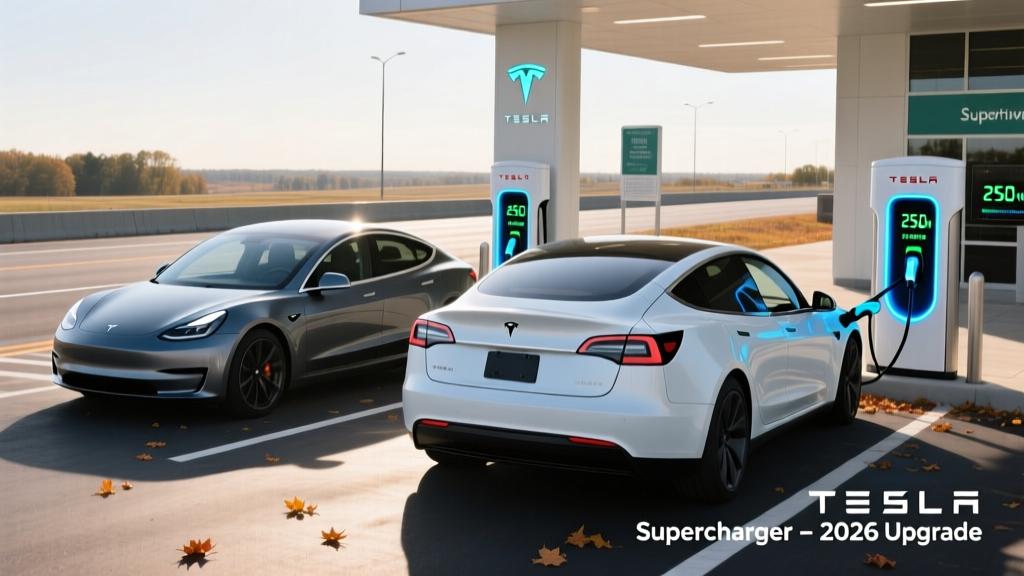
For East Coast EV drivers, the New Jersey Turnpike is as much a charging corridor as it is a commuter artery. Stretching 122 miles from the Delaware Memorial Bridge to the George Washington Bridge, it funnels traffic between Philadelphia, New York, and Boston — and since 2020, Tesla and the New Jersey Turnpike Authority (NJTA) have progressively installed Supercharger plazas at service areas to make that trip electrically viable.
As of early 2026, there are seven active Tesla Supercharger locations directly on or immediately adjacent to the Turnpike, with most plazas upgraded to V3 (250 kW peak) hardware and several adding Magic Dock CCS adapters for non-Tesla EVs. If you're planning a Philly-to-NYC run, a shore trip, or a longer I-95 corridor drive, here's exactly what you'll find, how fast you'll charge, and what it costs.
Every New Jersey Turnpike Tesla Supercharger Stop (Northbound & Southbound)
Tesla Superchargers on the NJ Turnpike are located at or near the NJTA service areas. Because the Turnpike separates northbound and southbound roadways (and in some sections, car/truck lanes), access varies by direction. Here's the 2026 lineup:
| Service Area | Milepost | Direction | Stalls | Peak kW | CCS (Magic Dock) |
|---|---|---|---|---|---|
| Clara Barton (NB) | ~5 | Northbound | 12 | 250 kW (V3) | Yes (select stalls) |
| John Fenwick (SB) | ~5 | Southbound | 12 | 250 kW (V3) | Yes (select stalls) |
| James Fenwick / Walt Whitman | ~30 | Both | 16 | 250 kW (V3) | Yes |
| Molly Pitcher (NB) | ~72 | Northbound | 12 | 250 kW (V3) | Yes |
| Joyce Kilmer (SB) | ~78 | Southbound | 12 | 250 kW (V3) | Yes |
| Thomas Edison (NB) | ~92 | Northbound | 20 | 250 kW (V3) | Yes |
| Alexander Hamilton (SB) | ~97 | Southbound | 12 | 250 kW (V3) | Yes |
Stall counts and availability are subject to change as the NJTA and Tesla expand plazas. Always check your vehicle's in-dash navigation or the Tesla app for live stall status before diverting.
How Fast Will You Actually Charge on the Turnpike?
Tesla's V3 Superchargers are rated for a peak 250 kW, but peak is not sustained. The actual charge curve depends on your battery's chemistry (NMC vs LFP), state of charge (SoC), and temperature. Here's what to expect at a V3 stall:
- 10–30% SoC: Near peak power (200–250 kW on NMC packs preconditioned above 68°F)
- 30–60% SoC: Steps down progressively (150–200 kW typical)
- 60–80% SoC: Further taper (80–120 kW)
- 80–100% SoC: Dramatic taper (<50 kW) — avoid unless destination-charging
- Tesla Model 3 Long Range (75 kWh usable, NMC): ~25–28 minutes
- Tesla Model Y Long Range (75 kWh usable, NMC): ~26–30 minutes
- Tesla Model S (100 kWh, NMC): ~32–38 minutes
- Tesla Cybertruck (123 kWh, NMC): ~38–45 minutes
- Non-Tesla EV via Magic Dock (e.g., Hyundai Ioniq 5, 77.4 kWh): ~22–28 minutes (capped by adapter overhead)
Cold weather (below 40°F, common on the Turnpike December–March) adds 20–35% to these times unless you precondition the battery via in-dash navigation routing to the Supercharger. Always navigate to the stall — don't just drive there — so the car warms the pack.
CCS and Non-Tesla Access: Magic Dock on the Turnpike
Tesla's Supercharger network began opening to non-Tesla EVs in 2024 via the Magic Dock — a built-in CCS1 adapter at select stalls. On the NJ Turnpike, most service-area plazas now include at least 2–4 Magic Dock-equipped stalls.
Key points for non-Tesla drivers:
- Price premium: Non-Tesla vehicles typically pay 10–25% more per kWh than Tesla owners unless they enroll in the Tesla app membership ($12.99/month as of 2026).
- Cable length: Magic Dock cables are short (~6 feet). Your CCS port must be on the driver's-side rear quarter panel or front corner for most stalls to reach. Vehicles with rear-passenger-side CCS ports (some older Nissan LEAFs, early Ioniq 5 builds) may not reach comfortably.
- Charging speed: The Magic Dock adapter introduces minor communication overhead, and non-Tesla EVs rarely sustain Tesla's peak curve. Expect your vehicle's rated peak minus ~15–20% in practice.
Cost to Charge: Turnpike Superchargers vs. Home vs. Gas
As of early 2026, Tesla Supercharger pricing on the NJ Turnpike ranges from $0.38 to $0.48 per kWh depending on the service area and time of day (some plazas now have on-peak/off-peak pricing). Here's how that compares:
| Scenario | Cost per kWh | Cost per mile (Model Y, 3.5 mi/kWh) | Cost for 100 miles |
|---|---|---|---|
| NJ Turnpike Supercharger (peak) | $0.48 | $0.137 | $13.70 |
| NJ Turnpike Supercharger (off-peak) | $0.38 | $0.109 | $10.90 |
| Home Level 2 (NJ avg residential, $0.17/kWh) | $0.17 | $0.049 | $4.90 |
| Gas car (28 MPG combined, $3.20/gal) | — | $0.114 | $11.40 |
For a Philadelphia-to-NYC trip (~95 miles on the Turnpike), a Model Y owner paying peak Supercharger rates will spend roughly $13. Off-peak drops that to ~$11, which is competitive with a 28-MPG gas car at current New Jersey fuel prices. The real savings come from home charging, which cuts per-mile cost by 60–70%.
Beyond the Turnpike: Connecting to I-95, the Garden State Parkway, and NYC
The NJ Turnpike Superchargers are strategically spaced, but long-distance EV trips require planning beyond the corridor itself. Here's how they connect:
- Southbound to Philadelphia: Clara Barton/John Fenwick (milepost ~5) is your last Turnpike stop before the Delaware Memorial Bridge. From there, Superchargers in Wilmington, DE and Chester, PA bridge the gap to I-95 south.
- Northbound to NYC: Alexander Hamilton (milepost ~97) is the final Turnpike stop before the Lincoln Tunnel/Holland Bridge approaches. Manhattan has limited Supercharger access — plan to charge before entering the city or use destination chargers.
- Shore trips: The Garden State Parkway has its own charging infrastructure (Electrify America and Tesla Destination Chargers at select stops). If heading to the Jersey Shore, divert at Exit 82 (Toms River area) or Exit 63 (Barnegat).
Planning Your Turnpike EV Trip: Practical Tips
- Always precondition: Route through your car's navigation to the Supercharger destination. This warms the battery and can cut 10–80% time by 25%+ in cold weather.
- Charge to 80%, not 100%: The taper above 80% adds 15–25 minutes for only ~40 miles of range. Charge to 80%, drive 150 miles, repeat.
- Check live stall status: The Tesla app and in-dash nav show real-time stall availability. Thomas Edison (NB, 20 stalls) is the most reliable backup if Molly Pitcher is full.
- Know your adapter situation: If you drive a non-Tesla EV, confirm your CCS port location relative to the Magic Dock cable reach before pulling in.
- Use off-peak hours when possible: Some Turnpike plazas now discount rates between 11 PM and 6 AM — check the Tesla app for your specific stop.
Home Charging: The Real Turnpike Trip Alternative
Most NJ Turnpike EV commuters don't need Superchargers at all — a Level 2 home charger covers daily driving with a full battery every morning. If you're considering home installation, here's what to budget:
| Component | Typical Cost Range | Notes |
|---|---|---|
| Level 2 charger (40A–48A) | $350–$700 | ChargePoint Home Flex, Tesla Wall Connector, Emporia Level 2 |
| Electrical panel assessment | $0–$150 | Many electricians include this free with a quote |
| 240V/50A dedicated circuit run (<50 ft) | $600–$1,500 | Varies by conduit length, wall type, garage vs. outdoor |
| Panel upgrade (100A → 200A) | $1,500–$3,500 | Needed in older NJ homes with 100A service |
| Permit & inspection (NJ municipality) | $50–$200 | Required by NJ Uniform Construction Code |
| Total (no panel upgrade) | $1,000–$2,350 | Most common scenario for homes built after 1990 |
| Total (with panel upgrade) | $2,500–$5,850 | Common in pre-1970 NJ homes |
New Jersey offers some of the strongest utility rebates in the country for home charger installation. Check with PSE&G, JCP&L, or Atlantic City Electric for current rebate programs, which can offset $300–$1,500 of installation costs. The federal residential clean energy credit (30% of equipment and installation, up to $1,000) is also available through 2032 — consult a tax professional for eligibility.
Frequently Asked Questions
How much does it cost to install a home EV charger in New Jersey?
A standard Level 2 home charger installation (240V, 50A circuit, no panel upgrade) costs $1,000–$2,350 in New Jersey, including equipment, electrician labor, and permit. If your home has older 100A electrical service, a panel upgrade to 200A adds $1,500–$3,500, bringing the total to $2,500–$5,850.
How fast does each charging level add range?
Level 1 (120V, 12A): ~1.4 kW — adds roughly 4–5 miles per hour. Suitable only for overnight trickle charging.
Level 2 (240V, 40A–48A): 9.6–11.5 kW — adds 30–42 miles per hour. Fully charges most EVs overnight in 6–10 hours.
DC Fast Charging (V3 Supercharger, 250 kW peak): Adds up to 200+ miles in 15 minutes under ideal conditions, with 10–80% in ~25–30 minutes for a Model Y.
Which connector do I need for the NJ Turnpike Superchargers?
Tesla vehicles use the native NACS (North American Charging Standard) connector, which fits all Supercharger stalls directly. Non-Tesla EVs with CCS1 ports can use select Magic Dock-equipped stalls — no separate adapter needed, as the dock has a built-in CCS adapter. CHAdeMO vehicles (Nissan LEAF, Mitsubishi Outlander PHEV) cannot use Tesla Superchargers.
How much does charging cost per mile vs. gas on the NJ Turnpike?
At peak Supercharger rates ($0.48/kWh), a Tesla Model Y costs about $0.14 per mile — slightly more than a 28-MPG gas car at $3.20/gallon ($0.11/mile). At off-peak rates ($0.38/kWh), the Model Y drops to ~$0.11/mile, matching gas. Home charging ($0.17/kWh) cuts cost to ~$0.05/mile, a 55–60% savings over gas.
What electrical upgrades might my NJ home need for a Level 2 charger?
Homes built after 1990 with 200A electrical service typically need only a dedicated 50A, 240V circuit — no panel upgrade required. Homes with 100A service (common in NJ construction pre-1970) will likely need a panel upgrade to 200A to safely support a 40A–48A EV charger alongside existing loads like central AC and electric ranges. A licensed electrician can assess your panel's available amperage during a site visit.