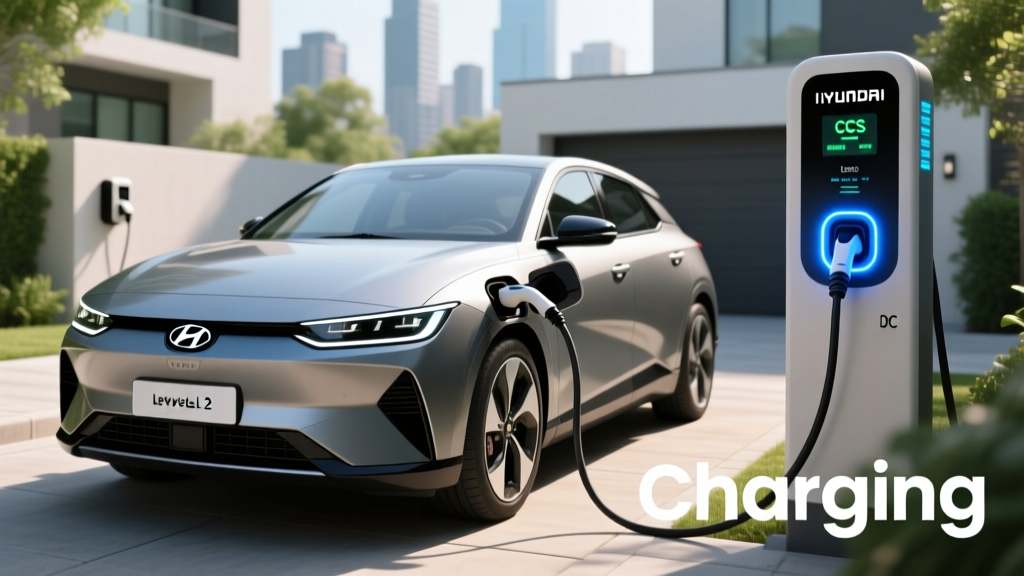
The Hyundai Ioniq 5 remains one of the fastest-charging EVs on the market thanks to its 800-volt battery architecture — a feature that sets it apart from nearly every competitor in the $40,000–$55,000 price bracket. But knowing the peak number on a spec sheet and actually experiencing that Hyundai Ioniq 5 charging speed in the real world are two different things. This guide breaks down exactly what you'll see at home, on public Level 2 networks, and at DC fast chargers, with the electrical requirements, costs, and equipment you need to make the most of it.
Ioniq 5 Battery and Charging Specs at a Glance
Before we map out charging scenarios, here are the hard numbers for the current Ioniq 5 lineup. Hyundai offers two battery packs, both using NMC (nickel-manganese-cobalt) chemistry with a liquid-cooled thermal management system that actively conditions the pack during fast charging.
| Spec | Standard Range (RWD) | Long Range (RWD / AWD) |
|---|---|---|
| Usable Battery Capacity | 58 kWh | 77.4 kWh |
| EPA Range | 220 mi | 303 mi (RWD) / 260 mi (AWD) |
| Peak DC Fast Charge Rate | ~175 kW | ~240 kW |
| 10–80% DC Fast Charge Time | ~20 min (350 kW station) | ~18 min (350 kW station) |
| Level 2 AC Onboard Charger | 10.9 kW | 10.9 kW |
| Connector (2025+ US models) | NACS (native Tesla Supercharger access) | |
| Battery Warranty | 10 years / 100,000 miles (70% capacity retention) | |
Charging Levels Explained: Speeds in kW and Miles Per Hour
A quick but essential distinction: kW (kilowatts) measures charging power — how fast energy flows into the battery. kWh (kilowatt-hours) measures energy capacity — the size of the battery itself. Think of kW as the width of the hose and kWh as the size of the bucket. The Hyundai Ioniq 5 charging speed depends on both the charger's kW output and the vehicle's acceptance rate.
| Level | Voltage / Amps | Power Output | Ioniq 5 Miles Added per Hour | Best Use Case |
|---|---|---|---|---|
| Level 1 (120V) | 120V / 12A | ~1.4 kW | ~4–5 mi/hr | Emergency / overnight trickle |
| Level 2 (240V) | 240V / 48A | ~10.9 kW (max onboard) | ~35–40 mi/hr | Home daily charging |
| DC Fast (CCS/NACS) | 400–800V DC | Up to 240 kW peak | ~650+ mi/hr (peak) | Road trips, rapid top-ups |
On a Level 1 standard outlet, a full charge of the 77.4 kWh Long Range battery from 10% to 100% takes roughly 50 hours — practical only as a backup. Level 2 is where daily ownership lives: a full charge from 10% takes about 7 hours, easily covering overnight needs. DC fast charging is where the Ioniq 5's 800V architecture shines, but the real-world charge curve matters more than the peak number.
The Real Charge Curve: What 240 kW Actually Means
Hyundai advertises a peak 240 kW on the Long Range model, but no EV sustains its peak rate for the entire session. The Ioniq 5's charge curve is aggressive by design: it holds near peak power from roughly 10% to 55% State of Charge (SoC), then tapers progressively. From 55–80%, you'll see rates drop to 120–150 kW. Above 80%, charging slows dramatically to protect battery health — often below 50 kW.
This is why the 10–80% metric matters more than 0–100%. At a 350 kW-capable station (like Electrify America's newest stalls or Tesla Supercharger V4), the Long Range Ioniq 5 will add roughly 185 miles of range in that 18-minute window. At a 150 kW station — still common on many networks — that same 10–80% session stretches to about 28–32 minutes because you're capped below the car's peak acceptance rate.
Home Charger Installation: Electrical Requirements and Costs
To unlock the Ioniq 5's full 10.9 kW Level 2 capability at home, you need a 240V circuit with at least a 50-amp breaker (which delivers 40 amps continuous to the vehicle, per electrical code requiring an 80% derating rule). Here's what that involves:
- Circuit: Dedicated 50A/240V breaker in your main panel
- Wire: 6 AWG copper (or 4 AWG aluminum) run from panel to charger location
- Panel capacity: Your main service panel must have room for the additional 50A load. Most modern 200A panels can accommodate this, but older 100A or 150A panels may require an upgrade
- Permit: Required in most jurisdictions — typically $50–$200
- GFCI protection: NEC 2020+ requires GFCI protection for EV outlets; hardwired chargers may have internal GFCI, but plug-in units on a NEMA 14-50 receptacle require a GFCI breaker (adding $50–$120 to the breaker cost)
| Component | Simple Install (panel nearby, no upgrade) | Complex Install (long wire run, panel upgrade) |
|---|---|---|
| Level 2 Charger (Equipment) | $400–$700 | $400–$700 |
| Electrician Labor | $400–$800 | $1,200–$2,500 |
| Electrical Permit | $50–$150 | $100–$200 |
| Panel Upgrade (if needed) | $0 | $1,500–$3,500 |
| Conduit, Wire, Hardware | $100–$300 | $300–$800 |
| Total Estimated Cost | $950–$1,950 | $3,500–$7,700 |
The wide range reflects real variability. A garage with the panel on the same wall might cost under $1,200 all-in. A charger on the far side of the house with a 100A panel that needs upgrading to 200A can exceed $6,000. Get at least two quotes from licensed electricians who have specific EV charger installation experience — ask for a load calculation to confirm your panel can handle the circuit.
Connector Compatibility: NACS, CCS, and Adapter Options
Starting with the 2025 model year, Hyundai transitioned the US-market Ioniq 5 to the NACS (North American Charging Standard) connector — the Tesla-designed plug now adopted by most major automakers. This is a significant shift from the CCS1 connector used on 2022–2024 models.
| Model Year | Built-in Connector | Tesla Supercharger Access | CCS Network Access | Adapter Needed? |
|---|---|---|---|---|
| 2022–2024 | CCS1 | Yes (via Hyundai-provided NACS adapter) | Native | NACS-to-CCS adapter for Superchargers |
| 2025–2026 | NACS | Native | Yes (via CCS-to-NACS adapter) | CCS adapter for older Electrify America / EVgo stations |
If you own a 2025+ Ioniq 5 with NACS, you can plug directly into any Tesla Supercharger (now open to non-Tesla EVs) without an adapter. However, some older public DC fast chargers — particularly older Electrify America and EVgo stalls — still only have CCS1 cables. Hyundai includes a CCS-to-NACS adapter with new vehicles, but confirm this with your dealer at purchase. For 2022–2024 CCS owners, Hyundai has offered a NACS adapter to access Superchargers, though availability and compatibility should be verified with Hyundai's electrified vehicle portal.
For Level 2 home and public AC charging, the J1772 standard remains universal. NACS-equipped Ioniq 5 models include a J1772-to-NACS adapter for AC charging compatibility.
Cost to Charge: Home vs. Public vs. Gas Comparison
Electricity pricing varies enormously by region, utility, and time of day. Below are representative scenarios for the Ioniq 5 Long Range (77.4 kWh battery, ~3.6 mi/kWh real-world efficiency) compared to a comparable gas SUV at 27 MPG combined.
| Scenario | Rate | Cost for Full Charge / Tank | Cost Per Mile |
|---|---|---|---|
| Home (off-peak utility rate) | $0.12/kWh | $9.29 | $0.033 |
| Home (average US residential) | $0.17/kWh | $13.16 | $0.047 |
| Public Level 2 (ChargePoint, etc.) | $0.30/kWh | $23.22 | $0.083 |
| DC Fast Charging (Electrify America) | $0.48/kWh | $37.15 | $0.133 |
| Gas SUV (regular unleaded) | $3.40/gal | $49.98 (14.7 gal tank) | $0.126 |
At home on off-peak rates, the Ioniq 5 costs roughly one-quarter what a comparable gas SUV costs per mile. Even at public DC fast charging rates, the per-mile cost is competitive with gasoline — and significantly cheaper if your utility offers time-of-use (TOU) plans with overnight rates below $0.10/kWh. According to fueleconomy.gov, the Ioniq 5 Long Range RWD achieves 114 MPGe combined, making it one of the most efficient electric crossovers available.
For Ioniq 5 owners who charge at home 80% of the time on a TOU plan and use DC fast charging for the remaining 20% on road trips, a blended annual fuel cost typically falls between $600–$900 — compared to $1,800–$2,200 for the gas equivalent at 12,000 miles per year.
Recommended Home Chargers for the Ioniq 5
Since the Ioniq 5's onboard charger maxes out at 10.9 kW, any Level 2 charger delivering 48 amps (11.5 kW) will fully saturate its capability. Going beyond 48A offers no benefit for this vehicle. Here are proven units that match the Ioniq 5's requirements:
ChargePoint Home Flex
- Power: Up to 12 kW (50A) — adjustable down
- Connector: NACS or J1772 (select at purchase)
- Cable Length: 23 feet
- Smart Features: Wi-Fi, app scheduling, utility TOU integration, Alexa
- Price: ~$599 (NACS version)
- Best For: Flexible amperage settings for older panels
Tesla Wall Connector
- Power: Up to 11.5 kW (48A)
- Connector: NACS native
- Cable Length: 24 feet
- Smart Features: Wi-Fi, OTA updates, power sharing (multiple units on one circuit)
- Price: ~$475
- Best For: NACS-equipped Ioniq 5 owners wanting best value
Emporia Vue Smart Charger
- Power: Up to 11.5 kW (48A)
- Connector: J1772 or NACS
- Cable Length: 24 feet
- Smart Features: Energy monitoring, solar integration, load management
- Price: ~$399
- Best For: Budget-conscious buyers with solar panels
All three units are hardwirable (preferred for avoiding GFCI breaker requirements) and carry NEMA 4 outdoor ratings for garage or exterior installation. The Tesla Wall Connector is particularly compelling for 2025+ NACS Ioniq 5 owners — it's the least expensive quality option and plugs in natively without an adapter.
Safety, Code, and Panel Considerations
EV charging is a high-draw, continuous electrical load — the National Electrical Code (NEC) treats it differently than intermittent appliances. Key requirements and best practices:
- Dedicated circuit: Your Level 2 charger must be on its own dedicated breaker — no sharing with other outlets or appliances
- 80% continuous load rule: A 50A breaker delivers 40A continuous. A 60A breaker delivers 48A continuous. Never set charger amperage above 80% of the breaker rating
- GFCI: For plug-in NEMA 14-50 installations, NEC 2020 and later requires a GFCI breaker ($50–$120 extra). Hardwired installations typically avoid this requirement since the charger has internal ground-fault protection
- Outdoor rating: If your charger is outside, ensure it carries at minimum a NEMA 4 rating (weather-resistant). All three chargers recommended above meet this standard
- Panel load calculation: A licensed electrician will perform a NEC Article 220 load calculation to verify your service panel can handle the EV circuit plus existing loads. If your panel is near capacity, options include a panel upgrade ($1,500–$3,500) or a smart load-management device like the Emporia Smart Panel that dynamically limits charger draw when other circuits are active
Frequently Asked Questions
How much does it cost to install a home EV charger for the Ioniq 5?
A straightforward installation with an adequate electrical panel typically runs $950–$1,950 including the charger, electrician labor, wire, and permit. If your home needs a panel upgrade from 100A to 200A service, total costs can reach $3,500–$7,700. Always get a load calculation from a licensed electrician before committing.
How fast will each charging level add range to the Ioniq 5?
Level 1 (120V) adds about 4–5 miles per hour. Level 2 (240V/48A) adds roughly 35–40 miles per hour — enough to fully replenish overnight. DC fast charging at a 350 kW station adds up to 185 miles in 18 minutes (10–80% SoC on the Long Range model), though speeds taper significantly above 80%.
Which connector and charger is compatible with my Ioniq 5?
The 2025–2026 Ioniq 5 uses the NACS connector natively, giving direct access to Tesla Superchargers and the growing NACS public network. Models from 2022–2024 use CCS1 and may need an adapter for Supercharger access. For home Level 2 charging, all model years accept J1772 AC charging (via included adapter on NACS models).
How much does charging the Ioniq 5 cost per mile compared to gas?
At a typical residential electricity rate of $0.17/kWh, the Ioniq 5 costs about $0.047 per mile — roughly one-third the $0.126 per mile of a 27 MPG gas SUV at $3.40/gallon. With an off-peak utility rate of $0.12/kWh, the cost drops to $0.033 per mile. Even public DC fast charging at $0.48/kWh ($0.133/mi) remains competitive with gasoline.
What electrical upgrades might I need for a home charger?
The most common upgrade is a panel replacement — if your home has a 100A or 150A service panel that's already near capacity, upgrading to 200A service costs $1,500–$3,500. Other potential needs include running new conduit for long wire runs (50+ feet from panel to charger), replacing a Federal Pacific or Zinsco panel (known safety hazards), or installing a smart load-management system to avoid a panel upgrade entirely.
For the latest IRS §30D federal tax credit rules on home charger equipment (up to $1,000 credit under the Alternative Fuel Vehicle Refueling Property Credit), consult IRS.gov or a tax professional. Eligibility depends on census tract qualifications and income limits.