If you've been researching electric vehicles, you've likely typed "how much is Supercharging" into a search bar and found conflicting answers. The reason is simple: Tesla's Supercharger network — and public DC fast charging in general — doesn't charge a single flat rate. Prices fluctuate by location, time of day, membership tier, and even how fast your specific vehicle can accept a charge.
In this guide, we'll break down exactly what Supercharging costs in 2026, how public DC fast charging compares across networks, and why home Level 2 charging remains the cheapest way to fuel an EV by a wide margin. We'll also cover the real cost of installing a home charger, which connectors you need, and how EV charging stacks up against gasoline on a per-mile basis.
Tesla Supercharger Pricing: What You'll Actually Pay
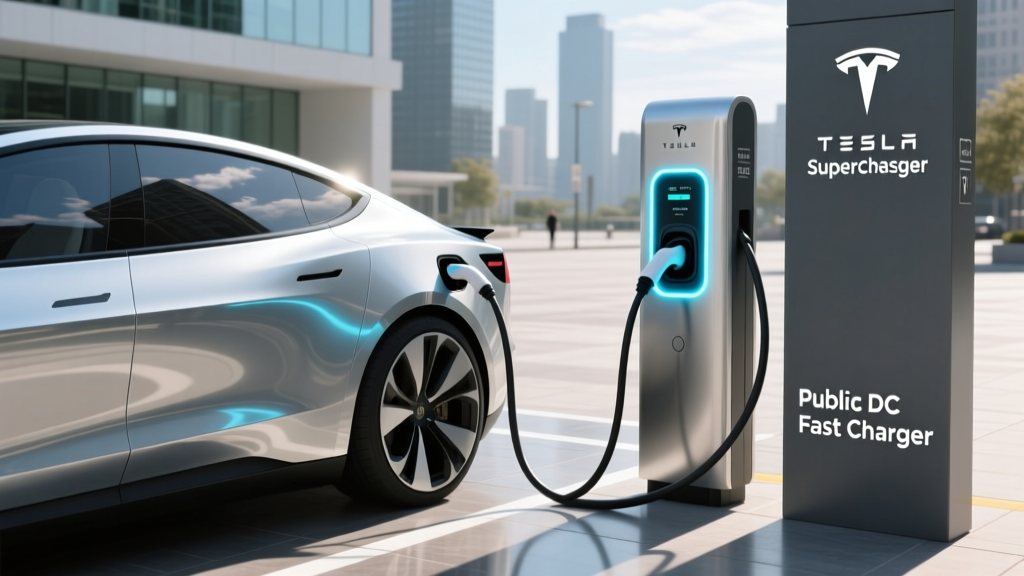
Tesla Superchargers bill by the kWh (kilowatt-hour — the unit of energy, like a gallon of gas). This is distinct from kW (kilowatts — the rate of power delivery, like the speed of the pump). Understanding this difference is essential: you pay for the energy you consume (kWh), while the charger's power rating (kW) determines how quickly that energy flows into your battery.
As of early 2026, Tesla Supercharger rates in the United States typically fall into these ranges:
- Standard rate: $0.32–$0.48/kWh depending on metro vs. rural location
- Off-peak rate (where available): $0.22–$0.30/kWh during overnight or midday windows
- Non-Tesla vehicles (via Magic Dock or NACS adapter): $0.48–$0.66/kWh — often 30–50% higher than the member rate
- Idle fees: $0.50–$1.00/minute if your car remains plugged in after reaching its charge limit at a busy station
Public DC Fast Charging Beyond Tesla: Network-by-Network Costs
Tesla's Supercharger network is the largest in North America, but it's far from the only option. Here's how the major DC fast charging networks price their sessions in 2026:
| Network | Typical Rate ($/kWh) | Membership Discount | Max Power Available | Connector |
|---|---|---|---|---|
| Tesla Supercharger | $0.32–$0.48 | Yes (Tesla owners get lower rate) | 250 kW (V3), 350 kW (V4) | NACS |
| Electrify America | $0.43–$0.56 | Pass+ ($4/mo for 800 kWh discount tier) | 350 kW | CCS1 / NACS |
| EVgo | $0.38–$0.52 | EVgo Plus+ ($4.99/mo) | 350 kW | CCS1 / NACS |
| ChargePoint (DC) | $0.35–$0.55 | Varies by site host | 240 kW | CCS1 / NACS |
| Ionity (Europe) | €0.55–€0.79/kWh | Subscription plans available | 350 kW | CCS2 |
A critical reality of DC fast charging: peak kW is not sustained kW. A vehicle rated for 250 kW peak charging will only sustain that rate for a portion of the session, typically between 10–50% State of Charge (SoC). Above 80% SoC, the charge curve tapers sharply to protect battery health. This means a "10–80% in 18 minutes" claim assumes ideal conditions — battery preconditioned, warm ambient temperature, and a stall that can deliver the full rated power.
Charging Levels Explained: Speed, Power, and Range Added
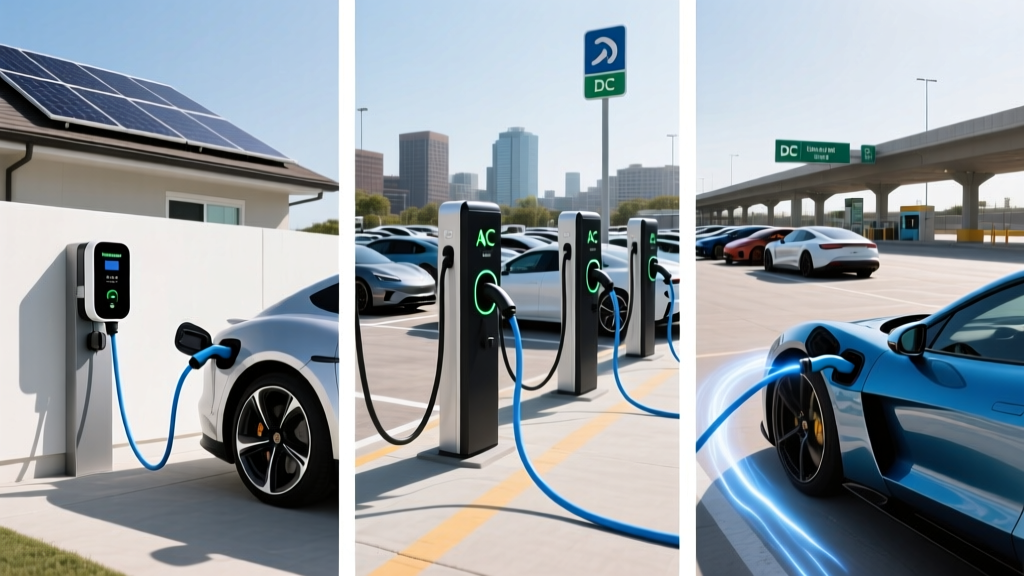
EV charging falls into three categories. The table below shows what each delivers in practical terms:
| Level | Voltage / Amps | Power (kW) | Miles of Range Added Per Hour | Typical Use Case |
|---|---|---|---|---|
| Level 1 | 120V / 12A | 1.4 kW | 3–5 mi/hr | Overnight top-off, PHEV charging, emergency |
| Level 2 | 240V / 32–48A | 7.7–11.5 kW | 25–44 mi/hr | Home daily charging, workplace, public destinations |
| DC Fast Charge | 400–800V DC | 50–350 kW | 150–1,200 mi/hr (peak) | Road trips, quick top-ups, commercial fleets |
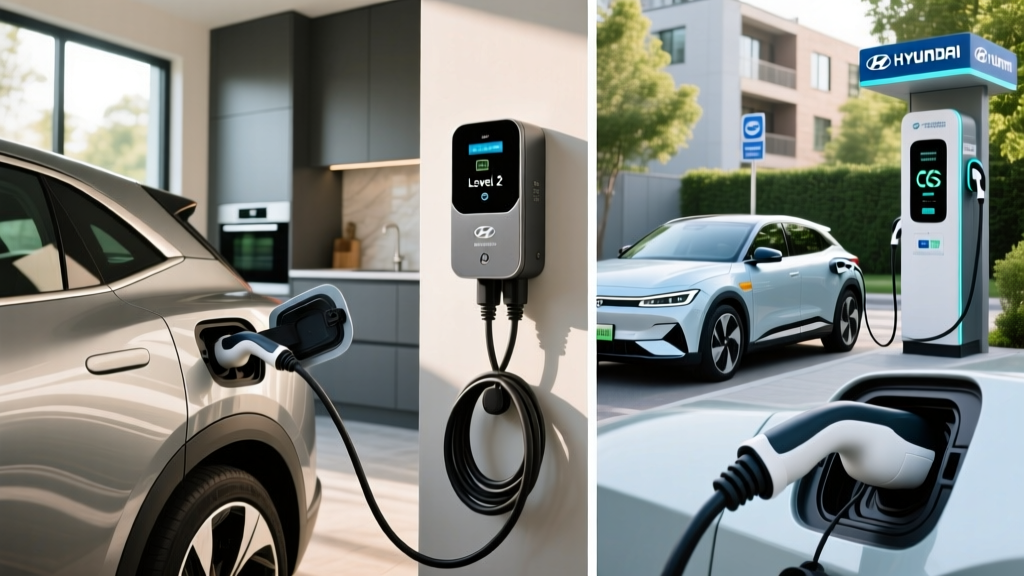
For a vehicle like the Hyundai Ioniq 5 (84 kWh usable, LFP option available) averaging 3.5 miles per kWh, a 48-amp Level 2 home charger delivering 11.5 kW adds roughly 40 miles of range per hour. That same vehicle on a 250 kW DC fast charger can add approximately 200 miles in 18 minutes (10–80% SoC), assuming the battery is preconditioned.
Home EV Charger Installation: Costs, Electrical Requirements, and Gotchas
Home Level 2 charging is where EV ownership economics truly shine — but the upfront installation cost varies enormously depending on your home's electrical infrastructure.
Electrical Requirements for a Level 2 Home Charger
A typical Level 2 home charger requires a 240-volt dedicated circuit — the same voltage your electric dryer or oven uses. The most common configurations are:
- 40-amp circuit / 32-amp continuous draw: Delivers 7.7 kW — sufficient for overnight charging of most EVs
- 50-amp circuit / 40-amp continuous: Delivers 9.6 kW — good for larger batteries (100+ kWh)
- 60-amp circuit / 48-amp continuous: Delivers 11.5 kW — fastest residential Level 2, ideal for heavy daily mileage
The National Electrical Code (NEC) requires that continuous loads (like EV charging) use no more than 80% of a circuit's rated capacity. A 60-amp breaker therefore supports a 48-amp charger — not 60 amps continuous.
Installation Cost Breakdown
| Component | Simple Install (Panel Adjacent) | Complex Install (Long Run / Panel Upgrade) |
|---|---|---|
| Level 2 Charger (hardware) | $350–$700 | $350–$700 |
| Electrician labor | $300–$800 | $1,200–$3,500 |
| Electrical permit | $50–$200 | $50–$200 |
| Conduit, wiring, junction box | $50–$150 | $200–$600 |
| Panel upgrade (100A → 200A, if needed) | N/A | $1,500–$4,000 |
| Total estimated cost | $750–$1,850 | $3,300–$9,000 |
Safety and Code Considerations
- Dedicated circuit required: Your EV charger must have its own breaker — it cannot share a circuit with other appliances
- GFCI protection: NEC 2023 and later require GFCI (Ground Fault Circuit Interrupter) protection for all EV charging outlets; hardwired units may have built-in GFCI
- NEMA 14-50 vs. hardwired: A NEMA 14-50 outlet offers portability (take the charger when you move) but requires a GFCI breaker. Hardwired installations avoid the GFCI breaker requirement and are often more reliable for outdoor use
- Outdoor rating: If mounting outside, ensure the charger carries a NEMA 4 or IP65 weatherproof rating
Connector Compatibility: NACS, CCS1, and CHAdeMO
The North American charging connector landscape has consolidated dramatically. Tesla's NACS (North American Charging Standard) has become the dominant connector, with Ford, GM, Rivian, Hyundai/Kia, Volvo, BMW, and most other major automakers adopting it for new vehicles starting in the 2025–2026 model years.
| Connector | Brands Using It (New Vehicles) | DC Fast Charge Availability | Adapter Needed? |
|---|---|---|---|
| NACS (Tesla) | Tesla, Ford, GM, Rivian, Hyundai, Kia, Volvo, BMW, Mercedes, Nissan (new) | Tesla Supercharger, Electrify America (select), EVgo (select) | CCS→NACS adapter for older CCS vehicles (~$200–$300) |
| CCS1 | Legacy: VW ID.4 (pre-2025), older BMW i4/iX, older Hyundai/Kia models still on road | Electrify America, EVgo, ChargePoint, most non-Tesla networks | NACS→CCS adapter available for accessing Superchargers |
| CHAdeMO | Nissan Leaf (legacy only — discontinued for new sales) | Limited and shrinking network | No practical adapter to NACS/CCS for DC fast charging |
If you're buying a 2026 model-year EV, you'll almost certainly get a NACS port. If you own a 2022–2024 vehicle with CCS1, adapters from companies like Lectron and A2Z EV Solutions allow access to Tesla Superchargers, though at the non-Tesla rate ($0.48–$0.66/kWh).
Cost Per Mile: EV Charging vs. Gasoline
The most meaningful comparison for buyers is cost per mile. Here's how different charging scenarios stack up against a comparable gasoline vehicle:
| Fueling Method | Cost Per Unit | Vehicle Efficiency | Cost Per Mile | Annual Cost (12,000 mi) |
|---|---|---|---|---|
| Home Level 2 (national avg. electricity) | $0.16/kWh | 3.5 mi/kWh (e.g., Model Y) | $0.046 | $552 |
| Home Level 2 (off-peak TOU rate) | $0.09/kWh | 3.5 mi/kWh | $0.026 | $312 |
| Tesla Supercharger (avg.) | $0.38/kWh | 3.5 mi/kWh | $0.109 | $1,308 |
| Public DC Fast (non-Tesla, avg.) | $0.48/kWh | 3.5 mi/kWh | $0.137 | $1,644 |
| Gasoline (25 MPG combined, $3.40/gal) | $3.40/gallon | 25 mi/gal | $0.136 | $1,632 |
| Gasoline (30 MPG combined, $3.40/gal) | $3.40/gallon | 30 mi/gal | $0.113 | $1,356 |
The data tells a clear story: home charging is 3–5× cheaper than gasoline per mile. But if you rely exclusively on public DC fast charging, your per-mile cost is roughly equal to — or even higher than — a fuel-efficient gasoline car. This is why home charging access is the single most important factor in EV ownership satisfaction and economics.
For reference on vehicle efficiency ratings, the EPA's fueleconomy.gov provides official MPGe and kWh/100mi figures for every EV sold in the US.
Charging Time Examples: 10–80% for Common EV Batteries
Charging time depends on three variables: battery size (kWh), the charger's power output (kW), and the vehicle's charge curve. Here are realistic 10–80% times for popular EVs when using a DC fast charger at or near their peak rate:
- Tesla Model Y Long Range (75 kWh, NMC, 250 kW peak): ~25 minutes on V3 Supercharger (tapers significantly above 60% SoC)
- Hyundai Ioniq 5 (84 kWh, 800V architecture, 240 kW peak): ~18 minutes on a 350 kW capable charger — one of the fastest in its class
- Ford F-150 Lightning Extended Range (131 kWh, NMC, 150 kW peak): ~41 minutes — larger battery means longer absolute time despite decent charge rate
- Chevrolet Equinox EV (85 kWh, NMC, 150 kW peak): ~30 minutes on a 150+ kW charger
- Tesla Model 3 Standard Range (60 kWh, LFP, 170 kW peak): ~25 minutes — LFP chemistry allows a flatter charge curve, sustaining higher rates closer to 80%
Recommended Home Level 2 Chargers (2026)
Tesla Wall Connector
- Power: 11.5 kW (48A on 60A circuit)
- Connector: NACS native
- Cable length: 24 feet
- Smart features: Wi-Fi, OTA updates, load sharing with multiple units, Power Sharing
- Price: ~$475
- Best for: Tesla owners and NACS-equipped vehicles seeking the most integrated ecosystem
ChargePoint Home Flex
- Power: Up to 12 kW (50A on 60A circuit, adjustable down)
- Connector: NACS (J1772 version also available)
- Cable length: 23 feet
- Smart features: Wi-Fi, app scheduling, Alexa integration, flexible amperage settings
- Price: ~$599
- Best for: Multi-EV households needing adjustable amperage for older panels
Emporia Level 2 EV Charger
- Power: 11.5 kW (48A on 60A circuit)
- Connector: NACS (J1772 version available)
- Cable length: 24 feet
- Smart features: Wi-Fi, energy monitoring, integration with Emporia Vue home energy panel, solar-aware scheduling
- Price: ~$399
- Best for: Budget-conscious buyers and solar-panel owners wanting energy integration
All three chargers above carry NEMA 4 outdoor ratings, are UL-listed for safety, and support hardwired or NEMA 14-50 plug installation. For homes with 200-amp panels, a 60-amp circuit with a 48-amp charger delivers the fastest practical Level 2 speed. For 100-amp panels, a 40-amp circuit (32A continuous, 7.7 kW) is typically the maximum safe addition without a panel upgrade.
Frequently Asked Questions
How much does it cost to install a home EV charger?
A straightforward Level 2 installation (panel has capacity, short wire run, indoor garage) costs $750–$1,850 including the charger hardware, electrician labor, and permit. Complex installations requiring long conduit runs, trenching, or a panel upgrade from 100A to 200A can reach $3,300–$9,000. Always get a load calculation from a licensed electrician first.
How fast will each charging level add range?
Level 1 (120V) adds 3–5 miles per hour. Level 2 (240V, 48A) adds 25–44 miles per hour depending on vehicle efficiency. DC fast charging adds 150–1,200 miles per hour at peak rate, but sessions are typically measured in minutes (10–80% in 18–41 minutes for most vehicles) because the rate tapers as the battery fills.
Which connector and charger is compatible with my EV?
For 2025–2026 model-year vehicles from Tesla, Ford, GM, Rivian, Hyundai, Kia, Volvo, and BMW, your vehicle has a NACS connector. For 2022–2024 non-Tesla EVs, you likely have CCS1. CHAdeMO is limited to the legacy Nissan Leaf. Check your vehicle's charge port or consult the manufacturer — and note that CCS-to-NACS adapters ($200–$300) can bridge the gap for older vehicles.
How much does charging cost per mile vs. gas?
Home charging at the national average electricity rate ($0.16/kWh) costs approximately $0.046/mile in a vehicle like the Tesla Model Y — roughly one-third the cost of gasoline at $3.40/gallon in a 25 MPG vehicle ($0.136/mile). However, exclusive reliance on public DC fast charging ($0.38–$0.55/kWh) pushes EV per-mile cost to $0.11–$0.16, comparable to or exceeding gasoline.
What electrical upgrades might I need for a home charger?
The most common upgrade is a panel replacement from 100 amps to 200 amps ($1,500–$4,000) if your existing panel lacks spare capacity. You may also need a new conduit run from the panel to the garage or driveway ($200–$600), a GFCI breaker ($80–$150 for NEMA 14-50 installations), or a smart load-management device that shares capacity between your EV charger and other high-draw appliances — potentially avoiding a panel upgrade entirely.
For current federal incentive information on home charging equipment, consult the IRS Alternative Fuel Vehicle Refueling Property Credit (IRC §30C), which may cover up to $1,000 of home charger hardware and installation costs, subject to income limits and census-tract eligibility requirements.