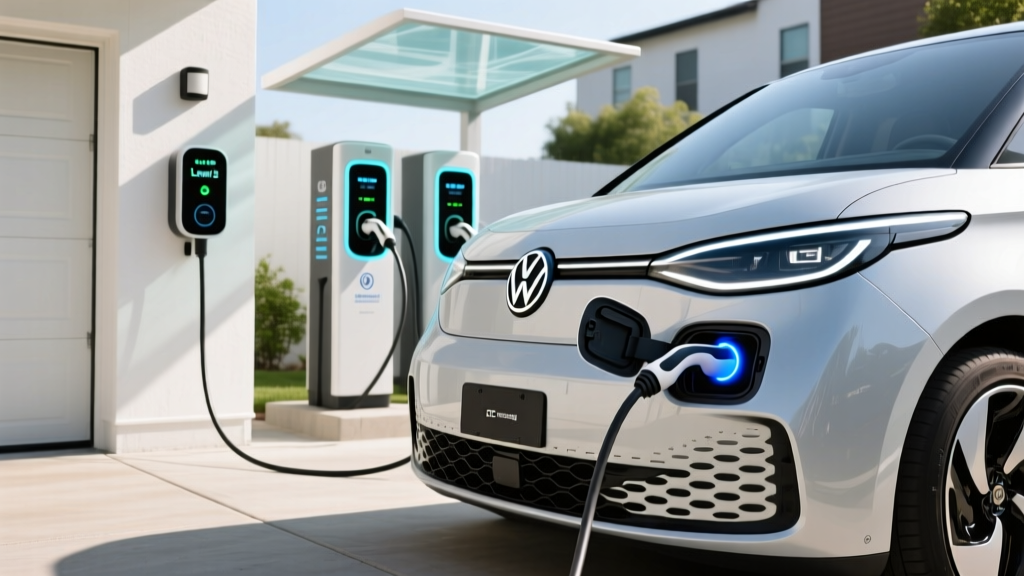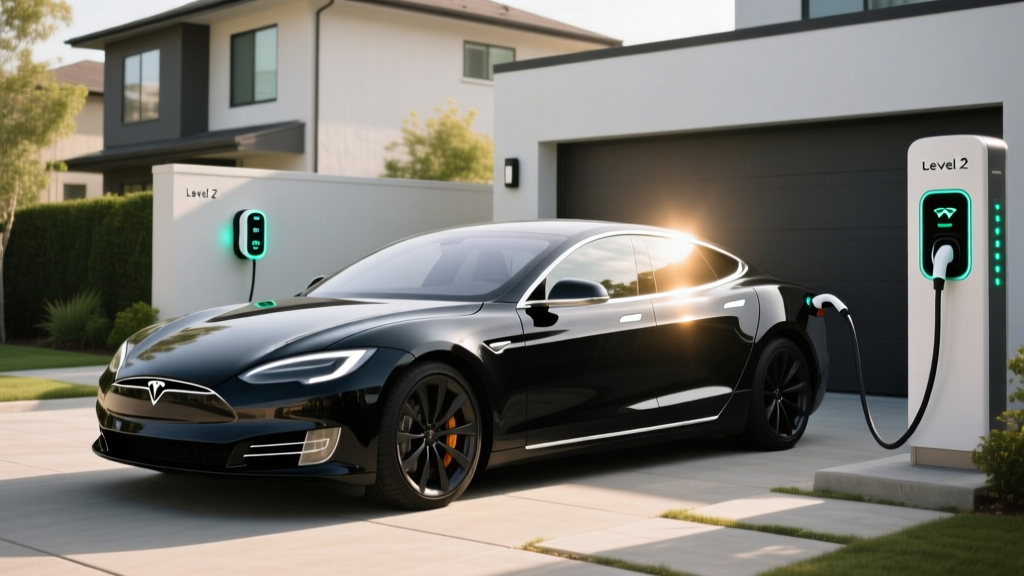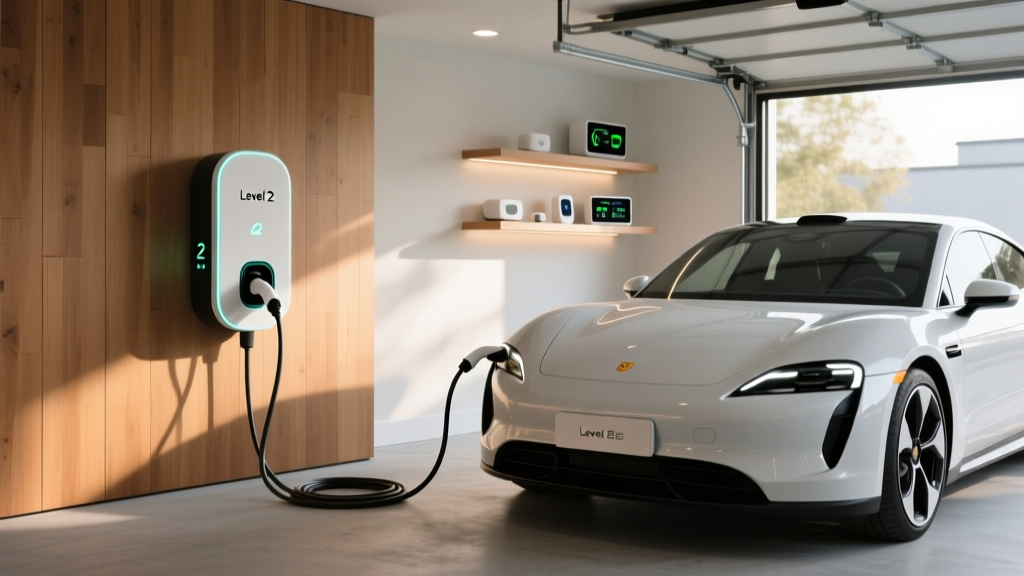
If you've just bought an electric vehicle — or are seriously shopping for one — the first practical question is almost always: how much is a charging station to install at home? The answer depends on your home's electrical panel, the charger you choose, and whether you need a panel upgrade. In 2026, a typical Level 2 home charging station installation runs between $1,200 and $3,500 all-in (equipment, electrician labor, and permits), though homes needing a 200-amp panel upgrade can see costs climb past $5,000.
This guide breaks down every cost component, the charging speeds you'll get at each level, connector compatibility across brands, and the real cost-per-mile of charging at home versus filling a gas tank. We'll also recommend specific Level 2 chargers with exact specs, power outputs, and prices.
Understanding Charging Levels: Speed, Power, and Range Added
EV charging is measured in kW (kilowatts) — the rate of power delivery — while your battery stores energy measured in kWh (kilowatt-hours). Think of kW as the width of the hose and kWh as the size of the bucket. A wider hose (higher kW) fills the bucket faster, but the bucket's capacity (kWh) doesn't change.
Here's what each charging level delivers in real-world terms:
| Level | Voltage | Max Power (kW) | Miles of Range Added per Hour | Typical Use Case |
|---|---|---|---|---|
| Level 1 | 120V AC | 1.4–1.9 kW | 3–5 mi/hr | Overnight top-off for PHEVs or low-mileage BEV drivers |
| Level 2 | 240V AC | 7.2–19.2 kW | 20–60+ mi/hr | Primary home charging for most BEV owners |
| DC Fast Charging | 400–800V DC | 50–350+ kW | 150–1,200+ mi/hr (equivalent) | Road trips, quick top-ups on public networks |
- Tesla Model Y (75 kWh usable battery, 250 kW peak DC): ~18–22 minutes on a Supercharger V4
- Hyundai Ioniq 5 (77.4 kWh, 240 kW peak DC, 800V architecture): ~18 minutes on a 350 kW Electrify America station
- Ford F-150 Lightning (131 kWh extended-range, 150 kW peak DC): ~41 minutes on a 150 kW DC charger
- Level 2 at home (11.5 kW) charging a 75 kWh battery from 10–80%: ~4.5 hours
Note: DC fast charging slows significantly above 80% SoC to protect battery health. The "10–80%" time is the useful metric — charging from 80–100% can take as long as the 10–80% session.
How Much Does It Cost to Install a Home EV Charger?
The total cost of a home Level 2 charging station breaks down into three categories: the charger hardware, electrician labor, and permits. Here's a realistic 2026 cost breakdown based on national averages and typical residential installations:
| Component | Low End | Typical | High End |
|---|---|---|---|
| Level 2 Charger (hardware) | $350 | $550 | $800 |
| Electrician labor (run 240V circuit, mount, wire) | $500 | $900 | $2,000 |
| Permit fees | $50 | $150 | $350 |
| Electrical panel upgrade (if needed: 100A → 200A) | $1,500 | $2,500 | $4,000 |
| Total WITHOUT panel upgrade | $900 | $1,600 | $3,150 |
| Total WITH panel upgrade | $2,400 | $4,100 | $7,150 |
Electrical Requirements for a Level 2 Home Charger
A Level 2 charger requires a 240-volt dedicated circuit, similar to what powers an electric dryer or oven. The most common home installation uses a NEMA 14-50 outlet (50-amp circuit, delivering up to 40 amps continuous to the charger, or about 9.6 kW). Some installations use a hardwired connection, which eliminates the outlet and can support up to 48 amps (11.5 kW) on a 60-amp circuit.
Key electrical specs to understand:
- 40-amp circuit → 32A continuous → 7.7 kW (adequate for most EVs overnight)
- 50-amp circuit → 40A continuous → 9.6 kW (sweet spot for most homes)
- 60-amp circuit → 48A continuous → 11.5 kW (faster charging, needs larger wire gauge)
When Will You Need a Panel Upgrade?
If your home has a 100-amp electrical panel (common in homes built before the 1990s), adding a 40–50 amp EV circuit may exceed your panel's capacity, especially if you already have electric appliances (dryer, oven, HVAC). An electrician will perform a load calculation per NEC Article 220 to determine if your panel can handle the additional draw.
Homes with a 200-amp panel (standard in most construction since the 2000s) can typically accommodate a Level 2 charger without an upgrade. If you're running two EV chargers simultaneously, or pairing EV charging with a heat pump and electric range, a 200-amp panel may still be tight — an electrician can advise on load management solutions like the Emporia Vue smart panel or charger-level amperage throttling.
Which Connector Is Compatible With Your EV?
The connector landscape shifted significantly in 2024–2025 when most major automakers adopted the North American Charging Standard (NACS), originally developed by Tesla. As of 2026, here's where each brand stands:
| Connector | Brands Using It | Notes |
|---|---|---|
| NACS (Tesla) | Tesla (all), Ford, GM, Rivian, Volvo, Polestar, Mercedes-Benz, BMW, Hyundai/Kia (2025+), Toyota, Subaru, Lucid (2025+) | Becoming the dominant standard. Most new 2025+ EVs ship with NACS ports. |
| CCS1 | VW ID.4 (2024 and earlier), older Hyundai/Kia models, BMW i4/iX (pre-2025), Stellantis EVs | Still widely available at public stations. CCS-to-NACS adapters available for ~$200. |
| CHAdeMO | Nissan Leaf (all years), Mitsubishi Outlander PHEV | Legacy standard. Declining public availability. No new vehicles use CHAdeMO. |
If your EV has a CCS1 port but you want to access Tesla Superchargers (now open to non-Tesla vehicles at many locations), you'll need a CCS-to-NACS adapter. Ford and GM provide these adapters to owners; aftermarket options from brands like Lectron and A2Z run $150–$250. Conversely, Tesla owners with the NACS port rarely need adapters, though a NACS-to-CCS adapter (~$200) is useful for the remaining CCS-only public chargers.
How Much Does Charging Cost Per Mile vs. Gas?
One of the strongest financial arguments for EV ownership is the fuel-cost advantage — but the savings vary dramatically depending on where and when you charge. Here's a realistic comparison using 2026 national average electricity and gas prices:
| Scenario | Rate | Cost per Mile (EV at 3.5 mi/kWh) | Cost per Mile (Gas at 28 MPG avg) |
|---|---|---|---|
| Home charging (off-peak TOU rate) | $0.09–$0.13/kWh | $0.03–$0.04 | $0.11 (at $3.10/gal) |
| Home charging (standard rate) | $0.15–$0.18/kWh | $0.04–$0.05 | $0.11 (at $3.10/gal) |
| Public Level 2 (ChargePoint, workplace) | $0.25–$0.40/kWh | $0.07–$0.11 | $0.11 (at $3.10/gal) |
| DC Fast Charging (Electrify America, EVgo) | $0.35–$0.55/kWh | $0.10–$0.16 | $0.11 (at $3.10/gal) |
For reference, the U.S. Department of Energy's fueleconomy.gov provides an EV cost calculator that lets you input your local electricity rate and compare it against specific gas vehicles.
Best Level 2 Home Chargers in 2026: Equipment Picks
Not all Level 2 chargers are equal. Key differentiators include maximum amperage (which determines charge speed), cable length, smart features (scheduling, energy monitoring, load sharing), connector type, and whether they're hardwired or plug-in. Here are our top picks based on real-world testing and reliability data:
ChargePoint Home Flex (2nd Gen)
- Power output: Up to 11.5 kW (48A hardwired) or 9.6 kW (40A, NEMA 14-50 plug)
- Connector: NACS (native) or J1772 (with included adapter for CCS vehicles)
- Cable length: 23 feet
- Smart features: Wi-Fi, app scheduling, Alexa integration, energy reports, load sharing between two units
- Price: $599 (J1772) / $649 (NACS)
- Best for: Most homeowners wanting a reliable, feature-rich charger with flexible amperage settings
Emporia Level 2 EV Charger
- Power output: Up to 11.5 kW (48A hardwired)
- Connector: J1772 (NACS adapter included in 2026 kit)
- Cable length: 24 feet
- Smart features: Wi-Fi, real-time energy monitoring via Emporia Vue panel integration, solar-aware charging, TOU scheduling
- Price: $399
- Best for: Budget-conscious buyers who want energy monitoring and solar integration at the lowest price point
Tesla Wall Connector (Gen 4)
- Power output: Up to 11.5 kW (48A hardwired)
- Connector: NACS native (includes J1772 adapter for non-Tesla EVs)
- Cable length: 24 feet
- Smart features: Wi-Fi, OTA firmware updates, Power Sharing between up to 6 units, integration with Tesla Powerwall and solar
- Price: $475
- Best for: Tesla owners and multi-EV households wanting the cleanest NACS-native experience
Grizzl-E Smart (United Chargers)
- Power output: Up to 10 kW (40A, NEMA 14-50 plug)
- Connector: J1772 (NACS version available)
- Cable length: 24 feet
- Smart features: OCPP-compatible, adjustable amperage via DIP switches, works with any smart-home energy system
- Price: $449
- Best for: Cold-climate owners (rated to -40°F) and those wanting a rugged, Canadian-built unit
All of the chargers above are ENERGY STAR certified and eligible for the federal Residential Clean Energy Credit (IRC §25C), which covers 30% of charger hardware and installation costs up to $1,000 through 2032. Check irs.gov for current eligibility rules, as income caps and census-tract requirements apply.
Safety, Code, and Permit Requirements
EV charger installation is governed by the National Electrical Code (NEC) and enforced by your local building department. Key requirements in most jurisdictions as of 2026:
- Dedicated circuit: Your EV charger must be on its own dedicated breaker — not shared with other appliances.
- GFCI protection: NEC 2023 (and carried into 2026 codes) requires GFCI protection for all 240V EV charging outlets. Hardwired installations may have different GFCI requirements depending on jurisdiction.
- Outdoor rating: If your charger is mounted outside (garage exterior, driveway post), it must be rated for outdoor use (NEMA 4 or IP65). All recommended chargers above meet this standard.
- Permit required: Most municipalities require an electrical permit for a new 240V circuit. Permit costs range from $50–$350 depending on your locality. Skipping the permit risks insurance claim denials and code violations when selling your home.
- Wire gauge: 6 AWG copper for 50A circuits; 4 AWG for 60A circuits. Aluminum wire requires one gauge larger.
- Cable management: NEC requires the charging cable to be kept off the ground when not in use — a wall-mounted holster or cable retractor satisfies this.
Always check your local jurisdiction's specific amendments to the NEC. Some states and cities (California, New York City, Seattle) have additional EV-ready building code requirements for new construction and renovations.
Frequently Asked Questions
How much does it cost to install a home EV charger?
A typical Level 2 home charger installation costs $1,200–$3,500 including the charger ($350–$800), electrician labor ($500–$2,000), and permit fees ($50–$350). If your home needs an electrical panel upgrade from 100A to 200A, add $1,500–$4,000. The federal §25C Residential Clean Energy Credit covers 30% of costs up to $1,000, which can bring a typical $2,000 install down to roughly $1,400 after the credit.
How fast will each charging level add range?
Level 1 (120V standard outlet) adds about 3–5 miles per hour — adequate only for plug-in hybrids or BEV drivers covering under 30 miles daily. Level 2 (240V) adds 20–60+ miles per hour depending on amperage and your EV's onboard charger capacity. For example, a 48A Level 2 charger delivers ~11.5 kW, adding roughly 40 miles per hour to a Tesla Model Y or about 35 miles per hour to a Ford F-150 Lightning (which is heavier and less efficient). DC fast charging can add 150–250 miles in 15–20 minutes at peak power.
Which connector/charger is compatible with my EV?
Check your EV's charge port. Most 2025–2026 model-year EVs from Tesla, Ford, GM, Rivian, Hyundai, Kia, Volvo, and others now use the NACS connector. Older or pre-transition models (VW ID.4, earlier BMW i4/iX, older Hyundai/Kia) use CCS1. The Nissan Leaf uniquely uses CHAdeMO. For home Level 2 charging, most chargers ship with either a J1772 connector (compatible with CCS1 vehicles directly, and NACS vehicles via adapter) or a native NACS connector. Confirm your vehicle's port before ordering.
How much does charging cost per mile vs. gas?
Home charging on a standard rate ($0.15/kWh) costs about $0.04–$0.05 per mile for a typical EV getting 3.5 miles per kWh. A comparable gas vehicle at 28 MPG and $3.10/gallon costs about $0.11 per mile. That's a 55–65% savings per mile with home charging. However, relying exclusively on public DC fast charging ($0.45/kWh average) pushes EV costs to $0.13/mile — slightly more than gas. The economics strongly favor home charging.
What electrical upgrades might I need?
The most common upgrade is a panel capacity increase from 100A to 200A ($1,500–$4,000) if your existing panel can't handle the added load. You may also need a new breaker slot (most panels have space, but some older panels are full), wire upgrades if the run from panel to garage exceeds 50 feet (voltage drop requires thicker wire), or a sub-panel if your garage is detached. Some utilities offer load-management devices that throttle charger amperage when other high-draw appliances are running, avoiding the need for a panel upgrade entirely.
Can I install a Level 2 charger myself?
If you're simply plugging a charger into an existing NEMA 14-50 outlet (like one already installed for a dryer), yes — plug and charge. But installing a new 240V circuit requires pulling a permit, running wire through walls or conduit, and passing inspection. This is licensed electrician work. DIY 240V wiring without a permit can void your homeowner's insurance and create a serious fire hazard.
Does a home charger increase my home's resale value?
Studies from Zillow and Redfin suggest homes with EV charging infrastructure sell for 1–3% more than comparable homes without it, particularly in markets with high EV adoption (California, Pacific Northwest, Northeast corridor). A professionally installed, permitted Level 2 station is a tangible upgrade that signals the home is EV-ready.
For the most current information on EV charging incentives, the Alternative Fuels Data Center maintains a state-by-state database of utility rebates, state incentives, and federal tax credit eligibility for home charging equipment. Many utilities offer $250–$1,000 rebates on Level 2 charger hardware or installation — always check your local utility before purchasing.