2025 Volkswagen ID. Buzz Charging: What You Need to Know Before You Plug In
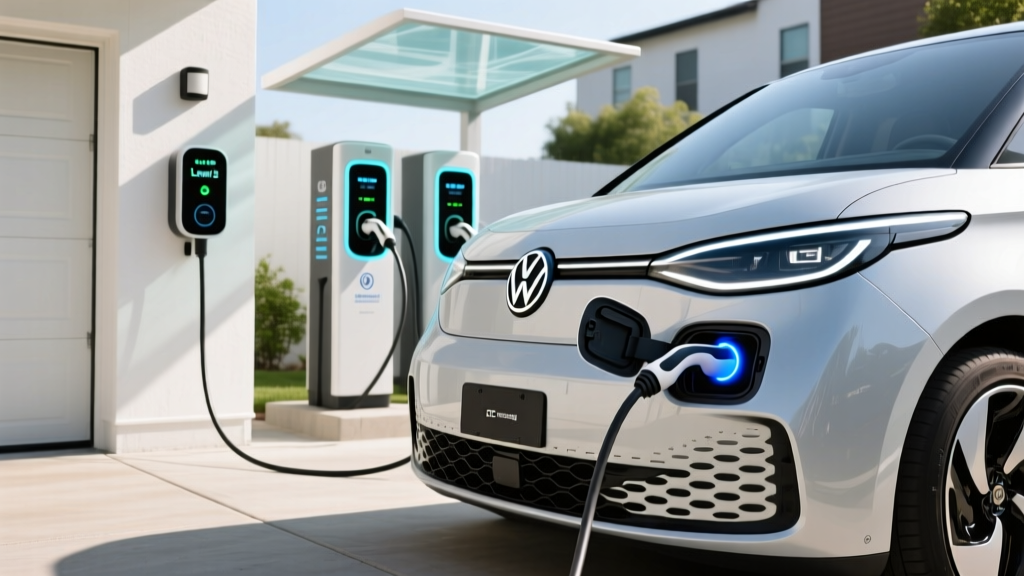
The 2025 Volkswagen ID. Buzz arrives in the U.S. as a three-row electric van with retro styling and a 91 kWh usable battery pack (NMC chemistry). But its CCS1 charge port and 170 kW peak DC fast-charging rate create a specific set of home-install and public-charging considerations that differ from Tesla or Hyundai/Kia EVs on the road. This guide walks through every charging scenario — from overnight Level 2 at home to 10-80% DC fast stops on a road trip — with exact numbers, equipment picks, and the real costs of keeping the ID. Buzz powered up.
Battery: 91 kWh usable (NMC) | EPA Range: 231–234 mi (RWD) / 231 mi (AWD 4MOTION)
Peak DC Fast Charge: 170 kW (CCS1) | 10–80%: ~26 min
Level 2 Max Acceptance: 11 kW (48A) | Level 1: ~1.4 kW (120V/12A)
Charge Port: CCS1 (J1772 + DC pins)
Charging Levels Explained: How Fast Each Adds Range to the ID. Buzz
EV charging comes in three tiers. The critical distinction is kW (kilowatts), which measures power — the rate at which energy flows into the battery — versus kWh (kilowatt-hours), which measures energy capacity (the size of the battery itself). Think of kW as the width of the hose and kWh as the size of the bucket.
| Level | Voltage / Amperage | Power (kW) | Miles of Range / Hour | 0–100% Time (91 kWh) |
|---|---|---|---|---|
| Level 1 (120V) | 120V / 12A | ~1.4 kW | ~4–5 mi/hr | ~65+ hours |
| Level 2 (240V) | 240V / 48A | 11 kW (max) | ~30–35 mi/hr | ~9 hours |
| DC Fast Charge | 350–800V DC | 170 kW peak | ~200+ mi/hr (peak) | 10–80% in ~26 min |
Real-world context: Level 1 is impractical as a primary strategy for the ID. Buzz's 91 kWh pack — it would take nearly three days to fill from empty. Level 2 at 11 kW is the sweet spot for daily ownership: plug in when you get home, wake up to a full battery. DC fast charging at 170 kW peak is respectable, though it trails the Hyundai Ioniq 5's 240 kW capability. Expect the ID. Buzz to sustain 150+ kW through roughly 40% SoC before tapering, with the 10–80% session averaging around 130–140 kW in moderate temperatures.
Home Level 2 Charger Installation: Electrical Requirements and Real Costs
The ID. Buzz's onboard charger accepts up to 11 kW at 48 amps on a 240V circuit. To deliver this, you need a dedicated 60-amp breaker (the National Electrical Code requires circuits rated at 125% of continuous load — 48A × 1.25 = 60A). If you opt for a 40-amp charger (the more common home setup), a 50-amp breaker suffices.
What Your Electrician Will Evaluate
- Panel capacity: Most modern 200-amp panels can accommodate a 50–60A EV circuit. Older 100-amp panels in homes built before 1990 often require an upgrade to 200A — a significant added cost.
- Wire run distance: Longer runs from panel to garage/driveway require thicker (and more expensive) copper wire. A 60-foot run of 6 AWG copper costs significantly more than a 15-foot run.
- Permit requirements: Most jurisdictions require an electrical permit for EV charger installs, typically $50–$200. Your electrician usually handles this.
- Outlet vs. hardwired: A NEMA 14-50 outlet offers portability (take the charger when you move), while hardwired units can deliver higher amperage and avoid the GFCI breaker requirement that some outlets trigger.
| Component | Simple Install (Near Panel) | Complex Install (Long Run / Upgrades) |
|---|---|---|
| Level 2 Charger (Equipment) | $400–$700 | $500–$750 |
| Electrician Labor | $300–$600 | $800–$2,000 |
| Permit & Inspection | $50–$150 | $100–$250 |
| Panel Upgrade (if needed) | $0 | $1,500–$3,500 |
| TOTAL RANGE | $750–$1,450 | $1,900–$6,500 |
Panel upgrade reality check: If your home has a 100-amp service panel and you're already running electric heat, an electric dryer, and an electric oven, adding a 50–60A EV circuit may exceed capacity. Budget $1,500–$3,500 for a panel upgrade to 200A. This is the single biggest variable in home charger installation cost and the one most online guides undercount.
Connector Compatibility: CCS1, NACS, and the Adapter Situation
The 2025 ID. Buzz ships with a CCS1 (Combined Charging System) port — the J1772 connector for AC charging with two additional DC pins below it. This is the same connector used by most non-Tesla EVs sold in the U.S. through 2024. However, the industry is rapidly migrating to Tesla's NACS (North American Charging Standard), which VW has confirmed future models will adopt.
| Connector Type | Native Support? | Adapter Needed? | Network Access |
|---|---|---|---|
| CCS1 (native) | ✅ Yes | None | Electrify America, EVgo, ChargePoint |
| J1772 (Level 2) | ✅ Yes (top portion of CCS) | None | All public Level 2 stations |
| NACS (Tesla) | ❌ No | CCS-to-NACS adapter (~$200–$250) | Tesla Superchargers (with adapter) |
| CHAdeMO | ❌ No | Not practical | Limited / legacy network |
The Supercharger adapter question: VW owners can access Tesla's Supercharger network using a CCS-to-NACS adapter. Tesla and third-party brands (Lectron, A2Z) sell these for $150–$250. However, not all Supercharger stalls support non-Tesla vehicles — check the Tesla app for "Magic Dock" or "NACS adapter-compatible" stations near you. As of 2025, Electrify America remains the ID. Buzz's most seamless DC fast-charging partner, with native CCS1 stalls at 150 kW and 350 kW.
How Much Does Charging the ID. Buzz Actually Cost?
The ID. Buzz's 91 kWh battery is one of the largest in its class, which means charging costs scale accordingly. Here's what you'll pay across common scenarios, compared to a gas-powered minivan averaging 22 MPG combined (like the Honda Odyssey).
| Scenario | Rate | Full Charge Cost (91 kWh) | Cost Per Mile |
|---|---|---|---|
| Home (off-peak utility rate) | $0.11/kWh | $10.01 | $0.043/mi |
| Home (avg. U.S. rate) | $0.17/kWh | $15.47 | $0.067/mi |
| Public Level 2 | $0.25/kWh | $22.75 | $0.098/mi |
| DC Fast (Electrify America) | $0.43/kWh | $39.13 | $0.169/mi |
| Gas Minivan (22 MPG) | $3.40/gal | $52.00 (19-gal tank) | $0.155/mi |
The takeaway: Home charging at off-peak rates costs roughly one-quarter of what a gas minivan costs per mile. Even at public DC fast-charging rates, the ID. Buzz is marginally more expensive per mile than gas — making home charging the economic linchpin of EV ownership. If you can charge at home 80%+ of the time, the ID. Buzz will save you $800–$1,200 annually versus a gas minivan at 12,000 miles/year. See the EPA's fueleconomy.gov listing for official efficiency figures (the ID. Buzz RWD is rated at 87 MPGe combined).
DC Fast Charging: Real-World Charge Times and Curve Behavior
Volkswagen rates the ID. Buzz at 170 kW peak DC fast charging. In practice, you will only see that peak rate in a narrow state-of-charge (SoC) window — typically between 15% and 35% SoC, when the battery is preconditioned and ambient temperatures are moderate (60–85°F).
Peak kW is not sustained kW. The ID. Buzz at 170 kW peak will taper to ~120 kW around 40% SoC, ~80 kW at 60% SoC, and ~40 kW above 80% SoC. This is why manufacturers quote 10–80% times rather than 0–100%: the last 20% can take as long as the first 70%. Always plan road-trip stops around 10–80% charges for optimal time efficiency.
Estimated DC Fast Charge Times (170 kW Peak)
- 10–80%: ~26 minutes (at a 175+ kW station, moderate temps)
- 10–50%: ~14 minutes (useful for quick top-ups on short breaks)
- 50 miles of range added: ~7–8 minutes at peak rate
- 80–100%: ~30+ additional minutes (heavy taper — avoid unless necessary)
Cold-weather impact: In temperatures below 32°F, expect 10–80% charge times to stretch by 15–25% unless the battery is preconditioned. The ID. Buzz's battery thermal management system will warm the pack during navigation to a charger, but preconditioning is less aggressive than in Tesla or Hyundai platforms. Plan for ~32–35 minutes in winter conditions.
Recommended Home Level 2 Chargers for the ID. Buzz
Since the ID. Buzz accepts up to 11 kW (48A), pairing it with a 48-amp charger extracts the maximum Level 2 speed. A 40-amp charger (9.6 kW) is the more common and slightly more affordable option — the difference is roughly 1.5 hours on a full charge.
ChargePoint Home Flex
- Power: Up to 12 kW / 50A (configurable)
- Connector: J1772 (plugs directly into ID. Buzz CCS port)
- Cable: 23 feet
- Smart features: Wi-Fi, app scheduling, Alexa, energy tracking
- Price: ~$550–$650
- Best for: Flexible amperage settings that adapt to your circuit
Emporia Level 2 EV Charger
- Power: Up to 11.5 kW / 48A
- Connector: J1772
- Cable: 24 feet
- Smart features: Wi-Fi, app control, solar integration, energy monitoring
- Price: ~$400–$500
- Best for: Budget-conscious buyers who want full smart features
Tesla Universal Wall Connector
- Power: Up to 11.5 kW / 48A
- Connector: NACS + built-in J1772 adapter (Magic Dock-style)
- Cable: 24 feet
- Smart features: Wi-Fi, OTA updates, power sharing with 2nd unit
- Price: ~$550–$600
- Best for: Multi-EV households with both Tesla and CCS vehicles
All three chargers are NEMA 4 rated for outdoor use and UL-listed for safety. Hardwire installation is recommended over NEMA 14-50 outlets for maximum reliability and to avoid nuisance GFCI trips that some jurisdictions require on 240V receptacles.
Safety, Code, and the Fine Print of Home Charging
A few non-negotiable safety and code considerations for your ID. Buzz charger install:
- Dedicated circuit: The EV charger must be on its own dedicated breaker — no sharing with other appliances.
- GFCI protection: NEC 2020 and later require GFCI protection on 240V receptacles. Hardwired installations bypass this requirement and avoid nuisance tripping.
- Outdoor rating: If your charger is mounted outside, ensure it carries a NEMA 4 (or higher) rating for weather resistance. All three recommended chargers above meet this standard.
- Load management: If your panel is near capacity, consider a smart charger with load-management features (e.g., Emporia's integration with your main panel monitor) that dynamically reduces charge rate when other high-draw appliances are running.
- Permit and inspection: Skipping the permit saves $50–$200 but voids homeowner's insurance coverage for electrical fires originating from the unpermitted work. Always permit.
Public Charging Networks: Where the ID. Buzz Fits Best
The ID. Buzz's CCS1 port gives it native access to the three largest U.S. DC fast-charging networks:
- Electrify America: VW's legacy charging partner. The ID. Buzz includes a complimentary charging plan (typically 2 years or a set kWh credit). EA's 150 kW and 350 kW stalls will both work, though the ID. Buzz caps at 170 kW.
- EVgo: Growing network with 350 kW stalls in metro areas. CCS1 native.
- ChargePoint: Primarily Level 2 destinations (hotels, malls, workplaces) with a growing DC fast network.
For Tesla Supercharger access, a CCS-to-NACS adapter is required. As of 2025, VW has not announced a native NACS port for the ID. Buzz, so the adapter route is your only path to Superchargers. Check Volkswagen's official ID. Buzz page for any firmware or compatibility updates.
Frequently Asked Questions
How much does it cost to install a home EV charger for the ID. Buzz?
A straightforward Level 2 install (panel nearby, 200A service, short wire run) typically costs $750–$1,450 including the charger, electrician labor, and permit. Complex installs with long wire runs or a panel upgrade can reach $1,900–$6,500. Get three quotes from licensed electricians before committing.
How fast will each charging level add range to the ID. Buzz?
Level 1 (120V) adds roughly 4–5 miles per hour — impractical for daily use. Level 2 (240V at 48A) adds 30–35 miles per hour, fully replenishing the 91 kWh battery in about 9 hours. DC fast charging at 170 kW peak can add 50+ miles in under 10 minutes, with a 10–80% session taking about 26 minutes.
Which connector and charger are compatible with the ID. Buzz?
The ID. Buzz uses a CCS1 port, which accepts J1772 connectors for Level 1/Level 2 AC charging and CCS1 connectors for DC fast charging. Any J1772 or CCS1 home charger or public station works natively. For Tesla Supercharger access, you need a CCS-to-NACS adapter ($150–$250).
How much does charging the ID. Buzz cost per mile versus a gas minivan?
At the U.S. average home electricity rate of ~$0.17/kWh, the ID. Buzz costs about $0.067 per mile. A comparable gas minivan at 22 MPG with $3.40/gallon fuel costs about $0.155 per mile. Home charging saves roughly $0.09/mile, or about $1,080 per year at 12,000 miles. Public DC fast charging at $0.43/kWh costs slightly more than gas per mile.
What electrical upgrades might I need for a home charger?
The most common upgrade is a panel replacement from 100A to 200A service ($1,500–$3,500) if your existing panel can't handle the additional 50–60A load. Other potential upgrades include: replacing aluminum wiring with copper, adding a sub-panel if the garage is far from the main panel, or installing a load-management device if your utility requires it. A licensed electrician will assess this during a site visit — most offer free estimates.
Sources: EPA fueleconomy.gov, Volkswagen USA, IRS §30D Clean Vehicle Credits.