Honda Prologue Charging Time at Every Level
The Honda Prologue uses an 85 kWh (usable) Ultium-platform battery pack with NMC chemistry, delivering an EPA-estimated 296 miles of range on the Elite AWD trim and up to 308 miles on the FWD Touring. But the sticker range is only half the equation — how quickly you can replenish that battery at home, on public Level 2 chargers, and at DC fast-charging stations determines whether the Prologue fits your daily routine or your road-trip plans.
Below is a full breakdown of Honda Prologue charging time across every charging level, the equipment you need, what installation actually costs, and how per-mile energy costs compare to gasoline.
Charging Levels: Speeds in kW and Miles Per Hour
Understanding EV charging starts with the difference between kW (kilowatts — the rate of power delivery, like water pressure) and kWh (kilowatt-hours — the total energy stored, like gallons in a tank). The Prologue's battery holds 85 kWh of energy. How fast you fill it depends on the kW rating of your charger.
| Level | Voltage / Amps | Power (kW) | Miles Added Per Hour | Prologue 0–100% Time |
|---|---|---|---|---|
| Level 1 (120V outlet) | 120V / 12A | ~1.4 kW | ~3–4 mi/hr | ~60+ hours |
| Level 2 (240V home/public) | 240V / 32A–48A | 7.7–11.5 kW | ~22–34 mi/hr | ~8–11 hours |
| DC Fast Charging | 400V architecture | Up to 150 kW peak | ~190 mi in 10 min | 10–80% in ~30 min |
Level 1: The Emergency Trickle
Plugging the Prologue into a standard 120V household outlet via the included mobile charging cord delivers roughly 1.4 kW. That translates to about 3–4 miles of range per hour of charging. For a depleted 85 kWh battery, a full charge takes over 60 hours. Level 1 works only for topping off after short commutes (under 30 miles round-trip) or as an emergency measure. It is not a viable daily charging strategy for most Prologue owners.
Level 2: The Daily Workhorse
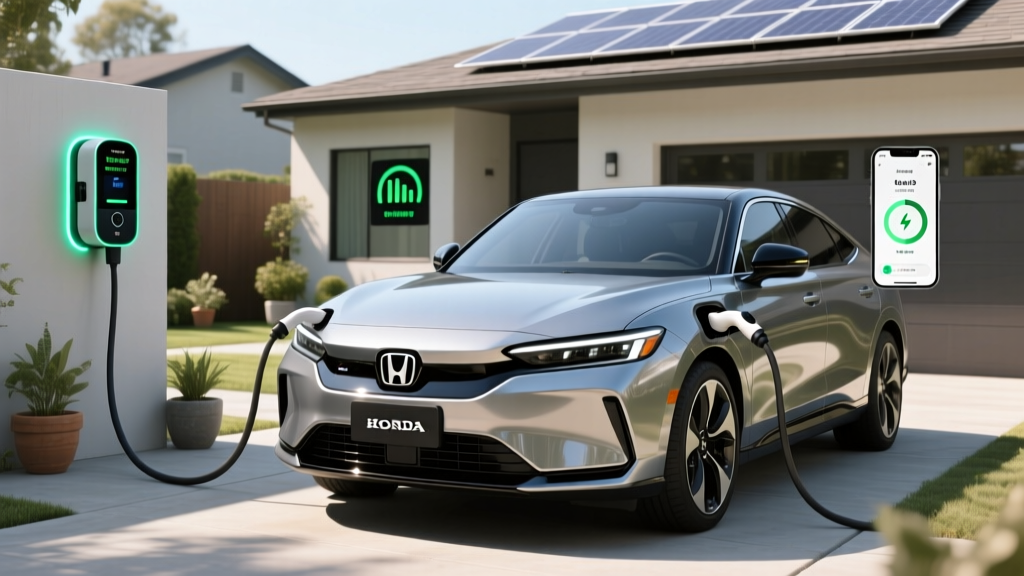
A 240V Level 2 home charger is where the Prologue spends most of its charging life. The Prologue's onboard charger accepts up to 11.5 kW (48 amps) on properly equipped trims, though some configurations accept 7.7 kW (32 amps). At 11.5 kW, you recover roughly 34 miles of range per hour — enough to fully replenish the battery overnight in about 8 hours. At 7.7 kW, plan on roughly 11 hours for a full charge.
DC Fast Charging: Road-Trip Speeds
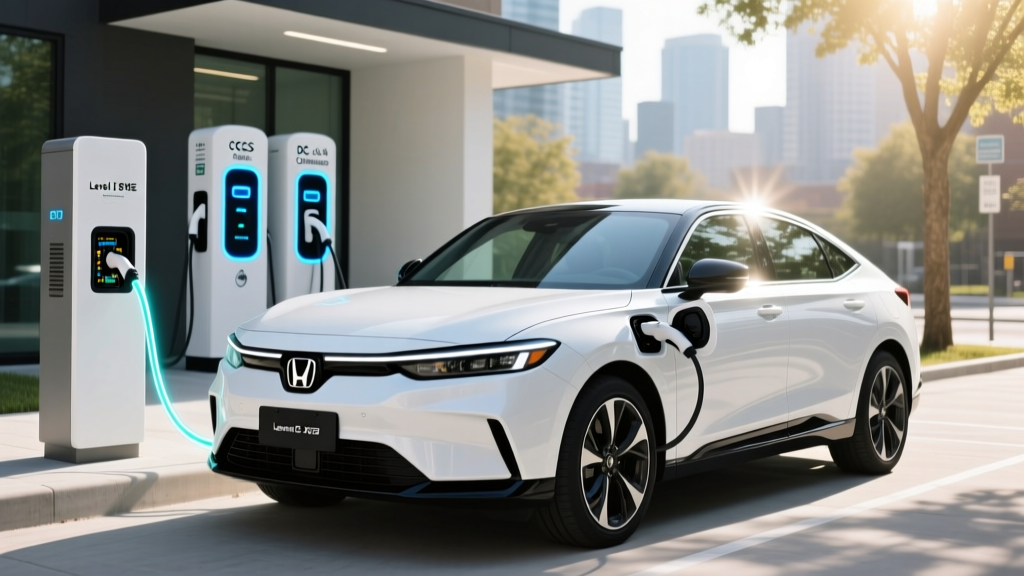
The Prologue supports DC fast charging at up to 150 kW peak on its CCS1 connector (with NACS compatibility arriving via adapter for Tesla Supercharger access). Honda states the Prologue can add approximately 65 miles of range in 10 minutes under optimal conditions. A 10–80% session takes roughly 30 minutes at a 150 kW or higher station.
Real-world caveat: peak 150 kW is not sustained across the entire session. The charge curve tapers significantly above 60–70% state of charge to protect the NMC battery. Expect the average rate across a 10–80% session to be closer to 90–110 kW, which is why the 30-minute estimate holds even though the peak rate is higher in the early portion of the session. Battery temperature also matters — preconditioning is not as aggressive on the Prologue as on some competitors, so cold-soaked batteries may see slower initial ramp-up.
Home Charger Installation: Requirements and Costs
Installing a Level 2 home charger for the Prologue requires a dedicated 240V circuit, typically 40A to 60A depending on the charger you select. Here is what that involves and what it costs.
Electrical Requirements
- Circuit: Dedicated 240V, 40A–60A breaker (a 48A charger requires a 60A circuit per NEC 80% continuous-load rule)
- Wire: 6 AWG copper for 40A; 4 AWG for 50–60A runs
- Outlet vs. hardwire: NEMA 14-50 outlet offers portability; hardwired units allow higher amperage and avoid GFCI nuisance-tripping issues common with 14-50 receptacles
- Panel capacity: Your electrical panel must have spare capacity — typically 200A service is adequate for most homes adding a 48A EV circuit. Older homes with 100A panels may require a panel upgrade or a smart load-management device.
Installation Cost Breakdown
| Component | Typical Cost Range | Notes |
|---|---|---|
| Level 2 Charger (Equipment) | $350–$700 | Varies by brand, power output, smart features |
| Electrician Labor | $500–$2,000 | Depends on run length, wall type, conduit needs |
| Permit & Inspection | $50–$250 | Required in most jurisdictions; varies by municipality |
| Panel Upgrade (if needed) | $1,500–$3,500 | 100A → 200A upgrade; ~15–20% of homes need this |
| Total (standard install) | $900–$2,950 | Without panel upgrade |
| Total (with panel upgrade) | $2,400–$6,450 | Including panel replacement |
Short runs from the panel to the garage (under 20 feet, same wall) keep costs near the low end. Detached garages, long conduit runs through finished walls, or trenching for underground runs push costs toward the high end. Always get 2–3 quotes from licensed electricians and confirm they pull a permit — unpermitted work can void homeowner's insurance claims and cause issues at sale time.
Panel Upgrade: The Hidden Cost
If your home has a 100A electrical panel — common in homes built before the 1990s — adding a 48A EV circuit may exceed available capacity. An electrician will perform a load calculation (NEC Article 220) to determine whether your panel can handle the additional draw. If it cannot, a panel upgrade to 200A typically costs $1,500–$3,500. An alternative is a smart load-management device like the Emporia Smart Load Center or a charger with built-in load sharing, which dynamically throttles charging when household demand is high — avoiding the panel upgrade entirely in some cases.
Connector Compatibility: CCS1, NACS, and Adapters
The Honda Prologue ships with a CCS1 (Combined Charging System) port, the standard used by most non-Tesla EVs in North America. However, Honda has confirmed NACS (Tesla-style) adapter compatibility, allowing Prologue owners to access the Tesla Supercharger network — which remains the largest and most reliable DC fast-charging network in the U.S.
| Connector | Prologue Compatible? | Network Access | Adapter Needed? |
|---|---|---|---|
| CCS1 | Yes (native) | Electrify America, EVgo, ChargePoint, Ionity | No |
| NACS (Tesla) | Yes (via adapter) | Tesla Supercharger network (15,000+ stalls) | Yes — CCS-to-NACS adapter (~$200–$250) |
| CHAdeMO | No | Largely deprecated in U.S. | N/A |
| J1772 (Level 2 public) | Yes (native) | Public Level 2 stations everywhere | No |
Practical advice: Purchase a CCS-to-NACS adapter (such as the official Honda-approved adapter or a reputable third-party unit like the Lectron or A2Z adapter) for road trips. Tesla Superchargers are more reliably operational than most CCS networks, and the NACS adapter unlocks thousands of additional fast-charging stalls. For daily home Level 2 charging, the Prologue uses a standard J1772 connector — every home charger on the market supports this natively.
Charging Cost Per Mile vs. Gasoline
One of the strongest ownership arguments for the Prologue is fuel-cost savings. Here is how per-mile energy costs compare across charging scenarios and versus a comparable gasoline SUV.
| Scenario | Rate | Cost per kWh | Cost per Mile (Prologue) |
|---|---|---|---|
| Home (off-peak utility rate) | $0.12–$0.16/kWh | $0.14 avg | $0.042 |
| Home (average U.S. rate) | $0.17/kWh | $0.17 | $0.051 |
| Public Level 2 | $0.25–$0.40/kWh | $0.32 avg | $0.096 |
| DC Fast Charging | $0.35–$0.55/kWh | $0.45 avg | $0.135 |
| Gasoline SUV (25 MPG, $3.40/gal) | — | — | $0.136 |
The Prologue consumes roughly 3.0–3.3 miles per kWh (approximately 97–105 MPGe combined, per fueleconomy.gov). At the U.S. average residential electricity rate of ~$0.17/kWh, home charging costs about $0.05 per mile — roughly one-third the cost of a 25 MPG gasoline SUV at $3.40/gallon.
However, if you rely exclusively on DC fast charging at $0.45/kWh, your per-mile cost rises to $0.135 — essentially equal to gasoline. The economic case for EV ownership depends heavily on home charging access. Prologue owners who can charge at home overnight will spend approximately $500–$600 per year on electricity for 12,000 miles of driving, compared to $1,600–$1,800 in gasoline for a comparable ICE SUV.
Recommended Home Chargers for the Honda Prologue
Because the Prologue accepts up to 11.5 kW (48A) on Level 2, pairing it with a charger that can deliver that full rate maximizes your overnight charging speed. Here are three proven options across price points.
Emporia Vue Link / Emporia Level 2 Charger
- Power Output: 48A (11.5 kW) on a 60A circuit
- Connector: J1772 (NACS version also available)
- Cable Length: 24 ft
- Smart Features: Wi-Fi, app scheduling, solar integration, load management
- Price: ~$399
- Best for: Budget-conscious buyers who want full 48A output and energy monitoring
ChargePoint Home Flex
- Power Output: Configurable 16A–50A (12 kW at 50A on a 60A circuit; Prologue will draw max 48A/11.5 kW)
- Connector: J1772 (NACS adapter included in newer units)
- Cable Length: 23 ft
- Smart Features: Wi-Fi, app scheduling, Alexa integration, amperage adjustment
- Price: ~$549–$649
- Best for: Flexibility — adjustable amperage works with any circuit size from 20A to 60A
Grizzl-E Smart
- Power Output: 40A (9.6 kW) on a 50A circuit
- Connector: J1772 (NACS version available)
- Cable Length: 24 ft
- Smart Features: Wi-Fi, OCPP support, outdoor-rated (IP67), extreme cold rated to -40°F
- Price: ~$499
- Best for: Outdoor installations and cold-climate durability — built in Canada
Editor's pick for the Prologue: The Emporia Level 2 charger offers the best value at 48A output and under $400. If your electrical panel is limited to a 50A circuit (40A continuous), the ChargePoint Home Flex lets you dial the amperage down to match — something fixed-output chargers cannot do without an electrician reconfiguring DIP switches.
Safety, Permits, and Code Considerations
EV charging installations must comply with the National Electrical Code (NEC Article 625) and local building codes. Key requirements:
- Dedicated circuit: Your Level 2 charger must be on its own dedicated breaker — it cannot share a circuit with other appliances.
- GFCI protection: NEC 2020 and later requires GFCI protection for 14-50 receptacles used for EV charging. However, many EV chargers have built-in ground-fault protection, and GFCI breakers paired with charger-internal GFCI can cause nuisance tripping. Hardwired installations often avoid this issue entirely.
- Outdoor rating: If your charger is installed outdoors or in an exposed carport, ensure the unit carries at least an IP55 rating (IP65+ preferred). All three chargers recommended above meet outdoor requirements.
- Permit: Most municipalities require an electrical permit for a new 240V circuit. The permit fee is typically $50–$250, and an inspector will verify the work after completion. Skipping the permit risks insurance denial in the event of an electrical fire and can complicate a future home sale.
- Utility notification: Some utilities require or recommend notifying them before installing an EV charger, especially if you want access to time-of-use (TOU) rate plans that offer cheaper off-peak charging.
Honda Prologue Charging Time: Frequently Asked Questions
How long does it take to charge the Honda Prologue from 10% to 80% on a DC fast charger?
Approximately 30 minutes at a 150 kW or higher CCS station. The Prologue peaks at 150 kW but tapers as state of charge climbs, so the average rate across the session is roughly 90–110 kW. Cold batteries or low-powered stations (50 kW CCS units) will extend this to 45–70 minutes.
Can I charge the Honda Prologue on a regular 120V outlet?
Yes, using the included Level 1 mobile charging cord. However, at roughly 1.4 kW, you will gain only 3–4 miles of range per hour — a full charge takes over 60 hours. Level 1 is practical only for overnight top-ups after short commutes.
How much does it cost to install a home Level 2 charger for the Prologue?
A standard installation (charger + electrician + permit) runs $900–$2,950 for homes with adequate 200A panel capacity. If your home needs a panel upgrade from 100A to 200A, add $1,500–$3,500, bringing the total to $2,400–$6,450. Always obtain multiple quotes from licensed electricians and confirm a permit is pulled.
Is the Honda Prologue compatible with Tesla Superchargers?
Yes, via a CCS-to-NACS adapter. Honda has confirmed adapter compatibility for Supercharger access. The adapter costs approximately $200–$250 and unlocks over 15,000 Tesla Supercharger stalls across North America. Native CCS1 charging remains available at Electrify America, EVgo, and other networks without an adapter.
What size breaker do I need for a 48A home charger?
Per the NEC 80% continuous-load rule, a 48A charger requires a 60A breaker with 4 AWG copper wire (or 3 AWG aluminum). Your electrician will confirm your panel has adequate spare capacity before installation.
How does the Prologue's charging speed compare to the Hyundai Ioniq 5 or Tesla Model Y?
The Prologue's 150 kW peak DC rate is slower than the Hyundai Ioniq 5 (which peaks at ~240 kW on its 800V architecture and achieves 10–80% in ~18 minutes) and the Tesla Model Y (~250 kW peak, 10–80% in ~20 minutes). The Prologue's 30-minute 10–80% time is adequate for road trips but adds roughly 10–12 minutes per stop compared to those competitors. For daily home Level 2 charging, the Prologue's 11.5 kW acceptance rate is competitive and refills the battery overnight.
Does the Honda Prologue qualify for the federal EV tax credit?
The Prologue may qualify for up to $7,500 under IRS §30D, but eligibility depends on current-year battery sourcing, critical-mineral requirements, buyer income caps ($150K single / $300K joint), and the vehicle's MSRP staying under the $80,000 SUV cap. Rules change frequently — verify current eligibility at IRS.gov or with a tax professional before purchasing. As of 2026, the credit can be transferred to the dealer at point of sale, reducing your purchase price directly.
How much does it cost to charge the Prologue at home per month?
At the U.S. average electricity rate of $0.17/kWh and the Prologue's efficiency of ~3.1 mi/kWh, driving 1,000 miles per month costs approximately $55 in electricity. Compare that to ~$136/month in gasoline for a 25 MPG SUV at $3.40/gallon — a monthly savings of roughly $80, or $960 per year.
Prologue Ownership Specs at a Glance
| Specification | 2025 Honda Prologue FWD Touring | 2025 Honda Prologue AWD Elite |
|---|---|---|
| EPA Range | 308 mi | 296 mi |
| Battery (Usable) | 85 kWh, NMC | 85 kWh, NMC |
| Level 2 Max Acceptance | 11.5 kW (48A) | 11.5 kW (48A) |
| DC Fast Charge Peak | 150 kW | 150 kW |
| 10–80% DC Fast Time | ~30 min | ~30 min |
| Connector | CCS1 (NACS via adapter) | CCS1 (NACS via adapter) |
| Horsepower | 212 hp | 288 hp |
| 0–60 mph | ~7.5 sec | ~6.0 sec |
| Base MSRP | ~$51,500 | ~$57,500 |
| Battery/Powertrain Warranty | 8 yr / 100,000 mi | 8 yr / 100,000 mi |
For the latest Honda Prologue specs and efficiency data, consult fueleconomy.gov. For tax credit eligibility, refer to the IRS Clean Vehicle Credits page.