Buying an electric vehicle is only half the equation. The other half—often more consequential for daily satisfaction—is how you keep it charged. For most EV owners, that means installing a Level 2 home charger, and the single most common question we hear is straightforward: what does it actually cost?
The answer depends on your home's electrical panel, the distance from that panel to your parking spot, local permitting fees, and the charger hardware you select. In 2026, a typical Level 2 home installation ranges from $800 on the low end to $3,500+ if your panel needs an upgrade. This guide breaks down every line item so you can budget accurately before calling an electrician.
Charging Levels Explained: Speed, Power, and What You Actually Need
Before estimating cost, you need to understand what each charging level delivers. The critical distinction in EV terminology is kW (kilowatts) = power, which determines how fast energy flows into your car, versus kWh (kilowatt-hours) = energy, which measures how much your battery holds. Think of kW as the width of a hose and kWh as the size of the bucket.
| Level | Voltage | Power (kW) | Miles of Range Added/Hour | Typical Use |
|---|---|---|---|---|
| Level 1 | 120V (standard outlet) | 1.0–1.4 kW | 3–5 miles | Overnight top-up for PHEVs or low-mileage BEV drivers |
| Level 2 | 240V (dryer-style outlet) | 3.3–19.2 kW | 12–75 miles | Primary home and workplace charging |
| DC Fast Charge | 400–900V DC | 50–350+ kW | 150–1,200+ miles (equivalent) | Road trips; 10–80% in 15–35 minutes |
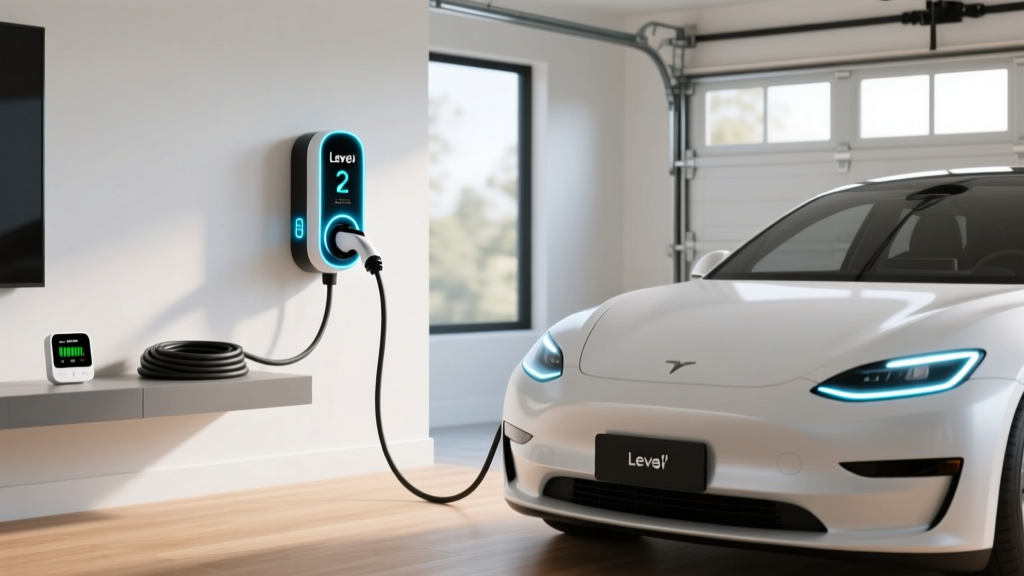
For home installation, Level 2 is the standard. A 48-amp (11.5 kW) Level 2 charger on a 240V circuit will fully recharge a 75 kWh battery (like a Tesla Model Y Long Range or Hyundai Ioniq 5) overnight in roughly 7–8 hours. That covers virtually every daily driving need.
Level 1 charging using a standard 120V outlet adds only 3–5 miles per hour. For a plug-in hybrid with 30–40 miles of electric range, Level 1 is often sufficient. For a full BEV with a 250+ mile battery, Level 1 is impractical as a primary charging method—it would take 50+ hours for a full charge.
How Much Does It Cost to Install a Home EV Charger?
The total cost of a home EV charger installation breaks into three components: the charger hardware, electrician labor, and permits. Here's what to expect in 2026:
| Component | Low End | Typical | High End | Notes |
|---|---|---|---|---|
| Level 2 Charger (hardware) | $300 | $450 | $700 | 32A–48A smart chargers; Wi-Fi enabled models cost more |
| Electrician Labor | $400 | $800 | $1,500 | Depends on run length, conduit, and whether drywall is opened |
| Electrical Permit | $50 | $125 | $300 | Varies by municipality; some jurisdictions waive for EV installs |
| Panel Upgrade (if needed) | $1,500 | $2,500 | $4,000+ | Required if existing panel lacks capacity for a new 40–60A circuit |
| Total (no panel upgrade) | $750 | $1,375 | $2,500 | Most homes built after 2000 with 200A service |
| Total (with panel upgrade) | $2,250 | $3,875 | $6,500 | Homes with 100A service or heavily loaded panels |
What Drives the Electrician Cost Up or Down
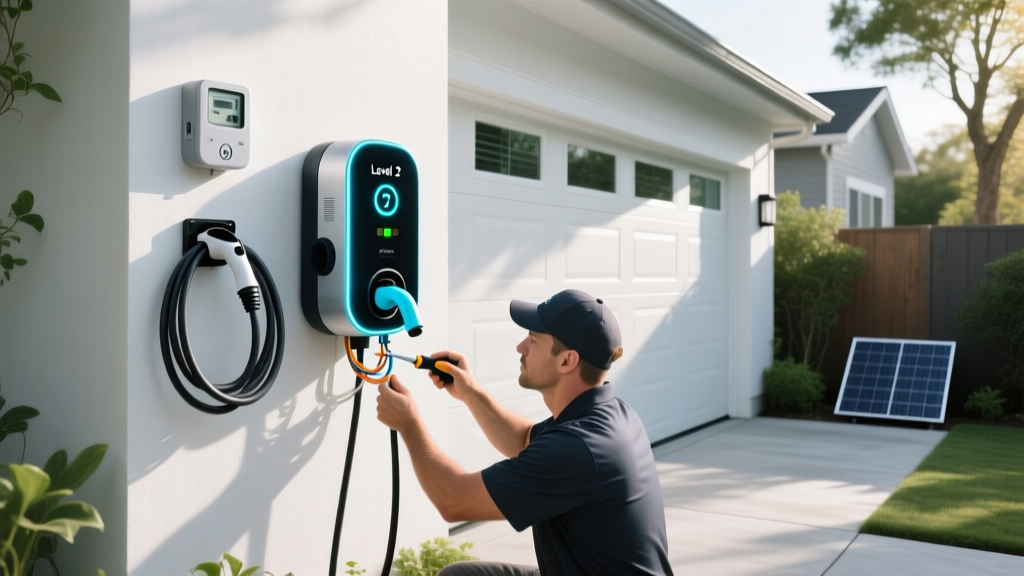
The single biggest variable in labor cost is distance from your electrical panel to the charger location. If your panel is in the garage next to where you park, expect a short conduit run and a bill closer to $400–$600. If the panel is in the basement and you need a 60-foot run through walls, attic crawls, and exterior conduit to reach a detached garage, labor can exceed $1,200.
Other cost factors include:
- Conduit type: PVC conduit is cheapest; metal EMT or rigid conduit costs more but may be required by local code for exterior runs.
- Hardwired vs. plug: A hardwired charger eliminates the need for a 240V receptacle (saving $50–$100 on a NEMA 14-50 outlet), but hardwired units can't be easily taken when you move.
- Drywall work: If the electrician needs to open and patch walls, add $200–$500 for finishing.
- Trenching: Running underground conduit to a detached structure adds $500–$1,500 depending on distance.
Electrical Requirements: Voltage, Amperage, and Panel Capacity
A Level 2 charger requires a 240-volt dedicated circuit, identical in principle to what powers your electric dryer or oven. The most common home charger configurations are:
- 32-amp charger → 40-amp circuit (7.7 kW) — sufficient for most daily needs; requires 6 AWG copper wire
- 40-amp charger → 50-amp circuit (9.6 kW) — popular middle ground; requires 6 AWG copper wire
- 48-amp charger → 60-amp circuit (11.5 kW) — maximum for most residential panels; requires 4 AWG copper wire
The National Electrical Code (NEC) requires circuits to be rated at 125% of the continuous load. A 48-amp charger draws continuously, so the circuit breaker must be rated for 60 amps. This isn't optional—it's a safety requirement.
Do You Need a Panel Upgrade?
Your home's electrical panel has a maximum amperage rating—typically 100A, 150A, or 200A. To determine if you can add a 40–60A EV circuit, an electrician will perform a load calculation per NEC Article 220, tallying your existing loads (HVAC, water heater, dryer, range, etc.).
If you have a 200-amp panel and your calculated existing load is under 140A, adding a 48A EV circuit usually fits without an upgrade. If you have a 100-amp panel—common in homes built before 1990—a panel upgrade to 200A is likely required, adding $1,500–$4,000 to the project.
An alternative to a panel upgrade is a smart load-management system (like the Emporia VUE with EV charger integration or a Span smart panel). These devices monitor real-time household load and throttle the charger if other major appliances kick on, keeping total draw within your panel's capacity. Cost: $200–$500 for the device, plus setup time. This can be a cost-effective workaround, but check with your local inspector—some jurisdictions don't accept all load-management solutions.
Which Connector and Charger Is Compatible with My EV?
The connector landscape in North America has consolidated significantly. As of 2026, the North American Charging Standard (NACS), originally developed by Tesla, is the dominant connector for new EVs. Most legacy CCS1 vehicles remain on the road, and CHAdeMO is effectively phased out for new vehicles.
| Connector | Brands Using It (New Vehicles) | Home Charger Availability | Adapter Needed? |
|---|---|---|---|
| NACS (Tesla-style) | Tesla, Ford, GM, Rivian, Volvo, Polestar, Hyundai, Kia (2025+) | Tesla Wall Connector, ChargePoint Home Flex (NACS), Lectron V-BOX Pro | No for new EVs; CCS-to-NACS adapter available for DCFC on legacy CCS cars |
| CCS1 | VW ID.4 (2024 and earlier), BMW i4/iX (through 2024), older Hyundai/Kia | ChargePoint Home Flex, Emporia Vue, Grizzl-E Smart | NACS-to-CCS adapter for Supercharger access ($200–$250) |
| CHAdeMO | Nissan Leaf (discontinued after 2025), Mitsubishi Outlander PHEV (older) | Limited; some older ChargePoint and ClipperCreek models | No adapter available to NACS; CHAdeMO infrastructure declining |
Key advice: If you're buying a new EV in 2026, it almost certainly uses NACS. Buy a NACS-equipped home charger. If you own a 2023–2024 CCS1 vehicle, you can install a CCS1 charger or use a J1772-to-NACS adapter (J1772 is the legacy Level 2 standard that most non-Tesla chargers shipped with before 2025).
Cost to Charge: Home vs. Public vs. Gas
The economic case for home charging is compelling. Let's compare real costs per mile using 2026 electricity and fuel prices.
| Scenario | Rate | Vehicle Efficiency | Cost Per Mile |
|---|---|---|---|
| Home (national avg. residential, off-peak) | $0.14/kWh | 3.5 mi/kWh (120 MPGe) | $0.040 |
| Home (California, off-peak TOU rate) | $0.18/kWh | 3.5 mi/kWh | $0.051 |
| Home (Texas, low rate) | $0.11/kWh | 3.5 mi/kWh | $0.031 |
| Public Level 2 (ChargePoint, EVgo) | $0.30–$0.45/kWh | 3.5 mi/kWh | $0.086–$0.129 |
| DC Fast Charging (Electrify America, Tesla Supercharger) | $0.35–$0.55/kWh | 3.5 mi/kWh | $0.100–$0.157 |
| Gasoline vehicle (28 MPG combined, $3.40/gal) | $3.40/gallon | 28 MPG | $0.121 |
Home charging on off-peak rates costs roughly one-third the per-mile cost of gasoline. Even public DC fast charging is often cheaper than gas on a per-mile basis, though the margin narrows considerably. The economics strongly favor home charging—over 15,000 miles per year, the difference between home charging at $0.14/kWh and gas at $3.40/gallon is approximately $1,215 in annual savings.
To access the lowest rates, check if your utility offers a time-of-use (TOU) plan. Most utilities provide off-peak rates between 10 PM and 6 AM that are 30–50% cheaper than peak afternoon rates. Smart chargers (detailed below) can schedule charging to automatically begin during off-peak windows.
Charging Time Examples: What to Expect with Common Battery Sizes
Charging time depends on two numbers: your battery's usable capacity (kWh) and your charger's power output (kW). Here are real-world Level 2 charging times for popular 2026 EVs:
- Tesla Model Y Long Range (75 kWh usable, NMC): On a 48A/11.5 kW charger, 0–100% takes approximately 7.5 hours. For the typical 10–80% daily charge window, expect about 5 hours.
- Hyundai Ioniq 5 (77.4 kWh usable, NMC): On a 48A/11.5 kW charger, 10–80% in roughly 5.5 hours. On a 32A/7.7 kW charger, the same range takes about 8 hours.
- Ford F-150 Lightning Extended Range (131 kWh usable, NMC): On a 48A/11.5 kW charger, 10–80% takes approximately 10 hours. This large battery benefits most from a 48A or higher circuit.
- Chevrolet Equinox EV (85 kWh usable, NMC): On a 48A/11.5 kW charger, 10–80% in roughly 6 hours.
- Toyota RAV4 Prime PHEV (18.1 kWh usable): On a 32A/7.7 kW Level 2 charger, 0–100% in about 2.5 hours. Level 1 (120V) takes roughly 9 hours.
Real-world note: Level 2 charging efficiency is typically 85–90%. A 75 kWh battery won't draw exactly 75 kWh from the wall to fill—expect to pay for about 83–88 kWh of grid electricity due to onboard charger losses and battery thermal management. This is already factored into the charging times above.
Equipment Recommendations: Top Home Chargers for 2026
After testing dozens of units across multiple homes and vehicles, these are the chargers we recommend based on reliability, power output, smart features, and value:
Tesla Wall Connector (Gen 4, NACS)
- Power Output: Up to 48A / 11.5 kW (on a 60A circuit)
- Connector: NACS (native Tesla; works with all NACS-equipped 2025+ EVs)
- Cable Length: 24 feet
- Smart Features: Wi-Fi, OTA updates, power-sharing between two units, access control
- Price: ~$475
- Best For: Tesla owners and anyone with a 2025+ NACS-equipped EV; the most reliable and cleanly integrated unit available
ChargePoint Home Flex (NACS or J1772)
- Power Output: Adjustable 16A–50A / up to 12 kW (on a 60A circuit; configurable via app to match your circuit)
- Connector: Available in NACS (2025+) or J1772; NACS-to-J1772 adapter included with some bundles
- Cable Length: 23 feet
- Smart Features: Wi-Fi, Alexa/Google Home integration, detailed energy tracking, scheduled charging, works with most utility TOU programs
- Price: ~$550–$650
- Best For: Multi-EV households with mixed connectors; the amperage flexibility means one unit works across different circuit sizes
Emporia VUE Smart EV Charger
- Power Output: Up to 48A / 11.5 kW (on a 60A circuit)
- Connector: J1772 (with NACS adapter available)
- Cable Length: 24 feet
- Smart Features: Wi-Fi, integrates with Emporia VUE energy monitor for whole-home load tracking, solar-aware charging, load management without panel upgrade
- Price: ~$400–$450
- Best For: Homes with solar panels or those wanting detailed energy analytics; the load-management capability can avoid a costly panel upgrade
Grizzl-E Smart (United Chargers)
- Power Output: Up to 40A / 9.6 kW (on a 50A circuit)
- Connector: J1772 (NACS adapter available)
- Cable Length: 24 feet
- Smart Features: Wi-Fi, OCPP-compatible (works with some utility demand-response programs), adjustable amperage via DIP switches
- Price: ~$450
- Best For: Cold-climate and outdoor installations; built in Canada with a -40°F operating rating and a rugged aluminum enclosure
Federal tax credit note: The IRS Alternative Fuel Vehicle Refueling Property Credit (IRC §30C) may cover 30% of charger hardware and installation costs, up to $1,000, if installed in a qualifying census tract. Eligibility depends on your address and the installer's certification. Consult a tax professional before claiming.
Safety, Code, and Installation Best Practices
EV chargers draw substantial current for many consecutive hours—this is classified as a continuous load under the NEC, which triggers specific safety requirements:
- Dedicated circuit: Your EV charger must have its own breaker—not shared with any other appliance. A 48A charger on a shared circuit is a code violation and a fire risk.
- GFCI protection: The 2023 NEC (and adopted by most jurisdictions by 2026) requires GFCI protection for all 240V EV charging outlets rated 60A or less. Hardwired chargers are typically exempt from this requirement, which is one reason some electricians prefer hardwiring. If using a receptacle, ensure your electrician installs a GFCI breaker (not a standard breaker)—budget an extra $80–$150 for the breaker itself.
- Outdoor rating: If your charger is mounted outdoors or in an unconditioned garage, verify it carries a NEMA 4 (weatherproof) rating. All units recommended above meet this standard, but verify the specific model variant.
- Cable management: A 24-foot charging cable left on the ground is a tripping hazard and will degrade from abrasion. Install a wall-mounted cable organizer ($15–$30) or select a charger with an integrated holster.
- Permit and inspection: Most jurisdictions require an electrical permit for new 240V circuits. The inspection ensures proper wire gauge, breaker sizing, grounding, and GFCI compliance. Skipping the permit risks insurance denial in the event of an electrical fire. Budget $50–$300 for the permit fee and 1–3 weeks for the inspection appointment.
Always hire a licensed electrician familiar with EV charger installations. Look for electricians listed on your charger manufacturer's certified installer network (Tesla, ChargePoint, and Emporia all maintain these) or verify licensing through your state's contractor board.
Frequently Asked Questions
Can I install a home EV charger myself?
Technically, a homeowner can pull their own electrical permit and do the work in many jurisdictions. Practically, this is not recommended unless you are experienced with 240V circuit installation, load calculations, and NEC code compliance. A mistake with a continuous 48A load can cause a fire that won't trip a standard breaker quickly. The $400–$1,500 in professional labor is worthwhile insurance.
Will a home charger increase my electric bill significantly?
Driving 15,000 miles per year in an EV averaging 3.5 mi/kWh requires about 4,286 kWh of electricity annually. At the national average residential rate of $0.14/kWh, that's approximately $600 per year, or $50/month. Compare this to a 28 MPG gas car at $3.40/gallon: $1,821 per year. Even after the electricity increase, you're saving over $1,200 annually.
What if I rent or live in a condo?
Renters have limited options. Some landlords will install a Level 2 charger if you cover the cost (it adds property value). Condo owners should check with the HOA—many states now have "right to charge" laws that prevent HOAs from unreasonably denying charger installations, though you'll typically pay for the installation and any common-area electrical upgrades. A portable Level 1 charger on a standard 120V outlet is always an option for PHEVs or low-mileage BEV drivers.
Do I need a smart charger, or is a basic unit fine?
A basic (non-smart) charger like the Grizzl-E Core (~$350) will charge your car just as fast as a smart charger. The "smart" features—Wi-Fi scheduling, energy tracking, utility demand-response integration—are conveniences, not necessities. However, if your utility offers TOU rates, a smart charger that automatically delays charging until off-peak hours can save $200–$400 per year. That ROI typically pays for the smart premium within 1–2 years.
How fast will each charging level add range?
Level 1 (120V): 3–5 miles per hour. Level 2 at 32A (7.7 kW): 25–30 miles per hour. Level 2 at 48A (11.5 kW): 37–44 miles per hour. DC fast charging at 150 kW: approximately 100+ miles in 15 minutes, though the charge curve tapers significantly above 80% state of charge, making the final 20% much slower.
What electrical upgrades might I need?
The most common upgrade is a panel service increase from 100A to 200A ($1,500–$4,000). Less common but possible: a meter-main replacement if the existing unit is outdated ($800–$2,000), or a sub-panel installation if your main panel is full and the EV circuit needs to branch from a sub-panel in the garage ($400–$800). A load-management device ($200–$500) can sometimes avoid a panel upgrade entirely.
For the most current data on EV efficiency and range, reference the EPA's fueleconomy.gov database, which provides kWh/100mi and MPGe figures for every certified EV sold in the United States. For federal tax credit eligibility on both vehicles and charging equipment, consult the IRS clean vehicle credit pages directly, as sourcing and income requirements are updated periodically.