If you're coming from a car like the 05 Cobalt SS Supercharged — a 2.0L supercharged Ecotec making 205 hp and roughly 24 mpg combined — the jump to an electric vehicle is as much about rewiring your garage as it is about rewiring your driving habits. That Cobalt SS could refuel in five minutes at any gas station. An EV "refuels" mostly at home, overnight, while you sleep. But getting a proper home charging setup requires understanding electrical panels, circuit breakers, connector standards, and a pile of acronyms that don't come up when you're shopping for a supercharger pulley upgrade.
This guide covers everything we wish someone had handed us before we called an electrician: charging speeds in real numbers, installation costs with line-item breakdowns, connector compatibility across every major brand, and a head-to-head cost-per-mile comparison against a 24 mpg supercharged compact. All figures reflect 2026 equipment pricing and utility rates.
Charging Levels Explained: How Much Range Does Each Add Per Hour?
EV charging falls into three tiers. The critical distinction to internalize is that kW (kilowatts) measures power — how fast energy flows — while kWh (kilowatt-hours) measures energy — the total amount stored in your battery. Think of kW as the diameter of the hose and kWh as the size of the bucket. A 10 kW charger fills a 75 kWh battery faster than a 1.4 kW charger. The battery size stays the same; the flow rate changes.
| Level | Voltage | Max Power (kW) | Miles of Range Added Per Hour | Best Use Case |
|---|---|---|---|---|
| Level 1 | 120V AC | 1.4–1.9 kW | 3–5 miles | Overnight top-ups, PHEVs, low-mileage drivers |
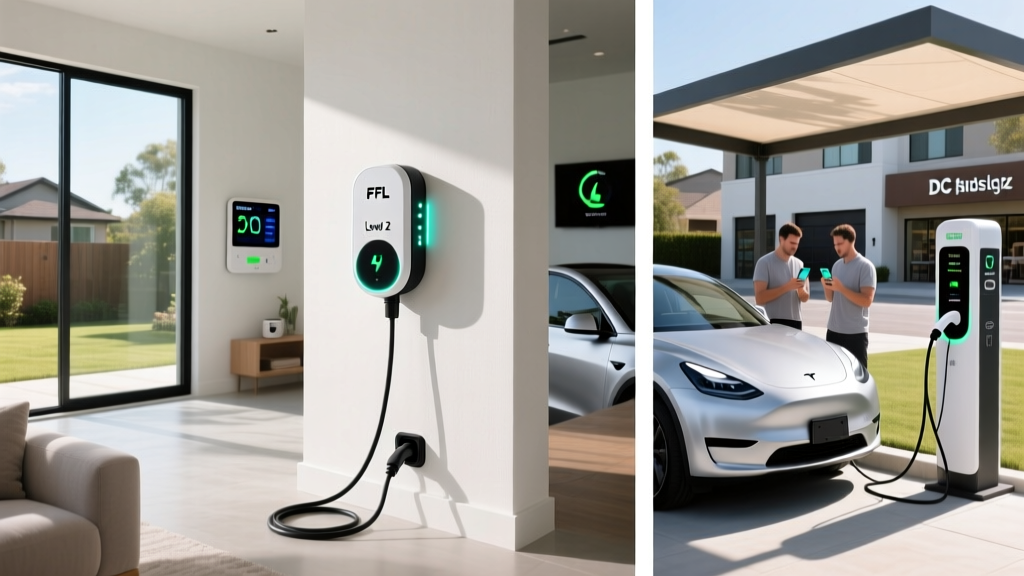
| Level 2 | 240V AC | 7.2–19.2 kW | 20–75 miles | Primary home charging, daily full recharges |
| DC Fast Charging | 400–800V DC | 50–350+ kW | 150–1,200+ miles/hr equivalent | Road trips, quick 10–80% top-ups |
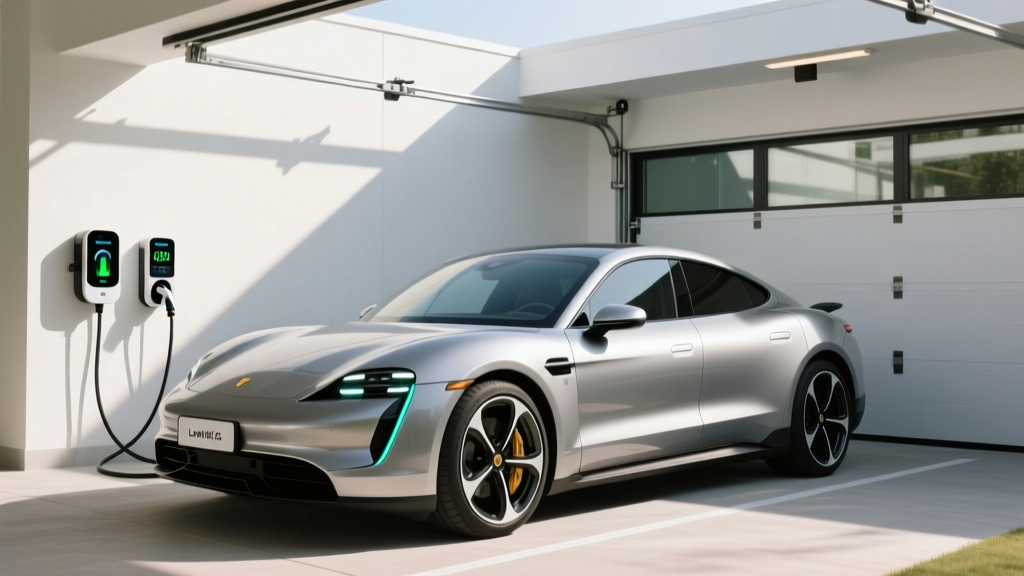
For a typical 75 kWh BEV (think Tesla Model Y, Hyundai Ioniq 5, or Ford Mustang Mach-E), Level 2 at 11.5 kW adds roughly 35–45 miles of range per hour, fully replenishing a depleted battery in 7–9 hours. That's the sweet spot for home charging. Level 1 at 1.4 kW would take 50+ hours for the same battery — fine for a PHEV with a 15 kWh pack, impractical for a full BEV.
DC fast charging speeds depend heavily on the vehicle's acceptance rate. A Hyundai Ioniq 5 with an 800V architecture can peak at 240 kW and charge 10–80% in approximately 18 minutes. A Chevrolet Equinox EV on a 400V architecture peaks around 150 kW, taking roughly 30 minutes for 10–80%. Charge curves taper significantly above 80% SoC to protect battery health — that last 20% can take as long as the first 60%.
How Much Does It Cost to Install a Home EV Charger?
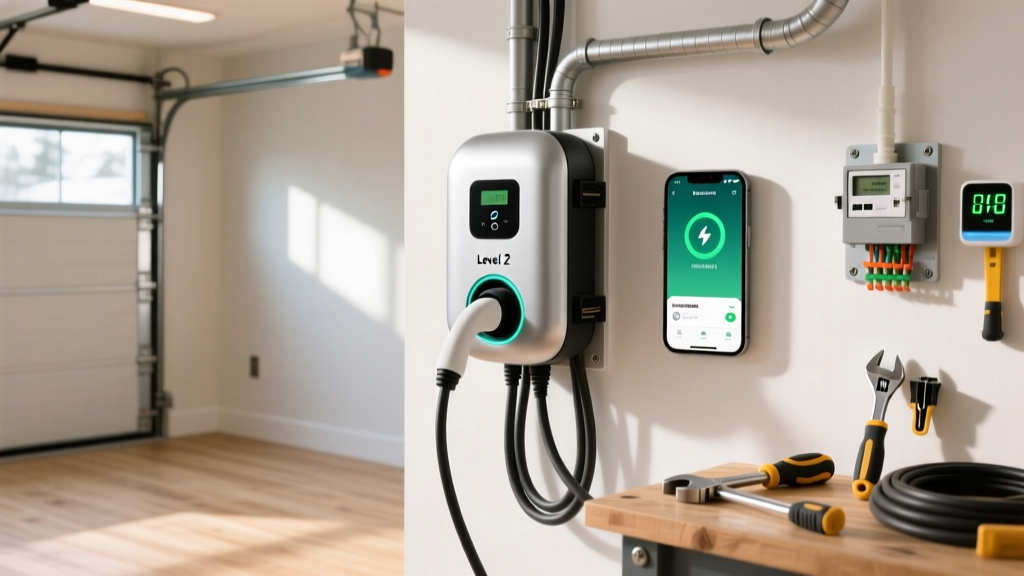
This is the question every new EV buyer asks, and the honest answer is: it depends on your electrical panel. Here's the full breakdown for a typical 240V / 48A Level 2 hardwired installation (the most common home setup) in 2026:
| Cost Component | Typical Range | Notes |
|---|---|---|
| Level 2 Charger (Equipment) | $400 – $750 | Smart Wi-Fi chargers, 40–48A, 25ft cable |
| Electrician Labor | $300 – $1,200 | Depends on panel-to-garage distance; longer runs cost more |
| Electrical Permit | $50 – $200 | Required in most jurisdictions; varies by municipality |
| 60A Breaker + Wiring (6 AWG) | $80 – $250 | Materials for a dedicated 60A circuit |
| Panel Upgrade (if needed) | $1,500 – $4,000 | Upgrading from 100A to 200A service; common in older homes |
| Total (No Panel Upgrade) | $830 – $2,400 | Average installs land around $1,200–$1,500 |
| Total (With Panel Upgrade) | $2,330 – $6,400 | Older homes with 100A service are the main cost driver |
The panel upgrade is the wildcard. Homes built before the 1990s often have 100-amp electrical service. Adding a 48A continuous-draw EV circuit (which the National Electrical Code requires sizing at 60A for continuous loads — 125% of the rated draw) may push a 100A panel past its capacity. If your panel is already near its limit with HVAC, an electric range, and a dryer, the electrician will recommend a service upgrade to 200A. This is a legitimate cost, not an upsell.
Money-saving tip: Some utilities and states offer rebates of $250–$1,000 for home charger installation. Check your utility's EV program page and your state energy office. The federal Alternative Fuel Vehicle Refueling Property Credit (30C) covers up to 30% of home charging equipment and installation costs, capped at $1,000 — but eligibility depends on census-tract income and location requirements per the IRS. Consult a tax professional for your specific situation.
Which Connector Is Compatible With My EV?
As of 2026, the North American connector landscape has consolidated significantly around NACS (North American Charging Standard), the connector Tesla developed and opened to the industry. Here's where each brand stands:
| Connector | Brands Using It Natively | Adapter Needed? |
|---|---|---|
| NACS (Tesla) | Tesla, Ford, GM, Rivian, Volvo, Polestar, Mercedes, Fisker, Lucid (newer) | No — native on 2025+ models from these brands |
| CCS1 (Combined Charging System) | Hyundai, Kia, BMW, VW, Stellantis, Honda, Subaru, Toyota (bZ series) | CCS-to-NACS adapter ($150–$250) needed for Tesla Supercharger access |
| CHAdeMO | Nissan Leaf (legacy only — discontinued for new sales) | Limited public network; plan for retirement of CHAdeMO stations |
For home Level 2 charging, nearly all chargers use a J1772 connector (or NACS for Tesla-specific units). If your EV has a NACS port (most 2025+ models from Ford, GM, Rivian, and Tesla), you'll want a NACS-equipped home charger or a J1772-to-NACS adapter. If your EV still has CCS1 (current Hyundai, Kia, BMW), a standard J1772 Level 2 charger works natively — J1772 is the AC charging portion of the CCS1 plug.
The real connector question matters more for public DC fast charging. Tesla's Supercharger network — the most reliable in North America — now accepts NACS-equipped non-Tesla vehicles directly. CCS1 vehicles need an adapter. When buying a home charger, match it to your car's native port to avoid daily adapter juggling.
Charging Cost Per Mile: EV vs. the 05 Cobalt SS Supercharged
Let's put real numbers behind what it costs to drive electric versus that 205 hp supercharged Ecotec. We'll use a 75 kWh BEV rated at 3.5 miles per kWh (roughly 115 MPGe combined, typical of an Ioniq 5 or Model Y) and compare it to the Cobalt SS at 24 mpg combined.
| Charging Scenario | Cost per kWh / Gallon | Cost Per Mile (EV) | Cost Per Mile (Cobalt SS Gas) |
|---|---|---|---|
| Home Level 2 — Off-Peak Utility Rate | $0.09/kWh | $0.026 | $0.146 (at $3.50/gal, 24 mpg) |
| Home Level 2 — Standard Rate | $0.16/kWh | $0.046 | |
| Public Level 2 (ChargePoint, EVgo L2) | $0.35/kWh | $0.100 | |
| DC Fast Charging (Electrify America, Tesla SC) | $0.48/kWh | $0.137 |
The takeaway: Charging at home on off-peak rates costs roughly $0.026 per mile — about one-fifth the fuel cost of the Cobalt SS at $3.50/gallon. Even standard-rate home charging at $0.046/mile saves you two-thirds on "fuel." Public DC fast charging at $0.48/kWh nearly matches gasoline costs, which is why home charging is the economic backbone of EV ownership. Road-trip DC charging is a convenience premium, not a savings strategy.
For a driver covering 12,000 miles annually, home off-peak charging costs roughly $312/year versus $1,750/year in gasoline for the Cobalt SS. That's over $1,400 in annual fuel savings — and it compounds over the ownership period.
Charging Time Examples: How Long to Fill Common Battery Sizes
Battery sizes in 2026 range from ~15 kWh (PHEVs) to ~130 kWh (large trucks). Here are real-world charging times for the most common scenarios, accounting for the charge-curve taper above 80% SoC:
10–80% DC Fast Charging Times
- Hyundai Ioniq 5 (77.4 kWh, 800V): ~18 minutes at a 250+ kW station (peaks at 240 kW, tapers to ~90 kW by 70%)
- Tesla Model Y Long Range (75 kWh, 400V): ~25 minutes at a V3 Supercharger (peaks at 250 kW, tapers to ~70 kW by 65%)
- Ford Mustang Mach-E Extended Range (91 kWh): ~30 minutes (peaks at 150 kW, tapers to ~60 kW by 70%)
- Chevrolet Silverado EV (200+ kWh): ~40 minutes (peaks at 350 kW on 800V architecture, but the massive pack absorbs time)
0–100% Level 2 Home Charging (11.5 kW / 48A)
- Toyota RAV4 Prime PHEV (18.1 kWh): ~2.5 hours
- Tesla Model Y (75 kWh usable): ~8 hours
- Ford F-150 Lightning Extended Range (131 kWh): ~13 hours
For most daily driving (30–50 miles), a Level 2 charger replenishes what you used in 1–2 hours. You rarely charge from 0–100% at home; the typical pattern is plugging in at 40–60% and waking up at 80–90%.
Recommended Home EV Chargers (2026 Picks)
After testing and tracking reliability data across dozens of units, these are the Level 2 chargers we recommend for different needs:
Emporia Level 2 Smart Charger
- Power Output: 48A / 11.5 kW (hardwired) or 40A / 9.6 kW (NEMA 14-50 plug)
- Connector: J1772 (NACS adapter available)
- Cable Length: 24 feet
- Smart Features: Wi-Fi, scheduled charging, energy monitoring, solar integration
- Price: ~$399
- Best For: Budget-conscious buyers who want full smart features and energy tracking
ChargePoint Home Flex (2nd Gen)
- Power Output: Up to 50A / 12 kW (adjustable down to 16A for lower-capacity panels)
- Connector: J1772 or NACS (configurable at purchase)
- Cable Length: 23 feet
- Smart Features: Wi-Fi, Alexa integration, charge scheduling, detailed session history
- Price: ~$599
- Best For: Flexibility — the adjustable amperage lets you install on a 20A to 60A circuit depending on your panel
Tesla Wall Connector
- Power Output: 48A / 11.5 kW
- Connector: NACS native (J1772 adapter included for non-Tesla EVs)
- Cable Length: 24 feet
- Smart Features: Wi-Fi, over-the-air updates, power sharing (link up to 6 units on one circuit), Tesla app integration
- Price: ~$475
- Best For: Tesla and NACS-native EV owners (Ford, GM, Rivian) who want a clean, reliable unit
Grizzl-E Smart (United Chargers)
- Power Output: 40A / 9.6 kW
- Connector: J1772 (NACS version available)
- Cable Length: 24 feet
- Smart Features: Wi-Fi, OCPP-compatible, adjustable amperage, extreme-cold rated (-40°C)
- Price: ~$549
- Best For: Cold-climate and outdoor installations — IP67-rated, built in Canada, designed for harsh weather
Electrical Requirements, Safety, and Code Considerations
Installing a Level 2 charger is electrical work that must comply with the National Electrical Code (NEC) and your local jurisdiction's amendments. Here are the non-negotiable requirements:
- Dedicated circuit: Your EV charger must be on its own dedicated breaker — no shared circuits with other appliances. A 48A charger requires a 60A breaker per NEC continuous-load rules (125% of rated amperage).
- Wire gauge: A 60A circuit typically requires 6 AWG copper wire (THHN in conduit or NM-B depending on local code). Longer runs may need 4 AWG to prevent voltage drop.
- GFCI protection: NEC 2020 and later require GFCI protection for receptacles in garages. Hardwired installations may be exempt in some jurisdictions, but a GFCI breaker is good safety practice regardless.
- Outdoor rating: If your charger is mounted outside, it must be rated for outdoor use (IP65 or higher) and installed on a GFCI-protected circuit. All recommended chargers above carry outdoor ratings.
- Permit and inspection: Most municipalities require an electrical permit for a new 240V circuit. Your electrician pulls the permit; a city inspector verifies the work. This typically costs $50–$200 and protects your home insurance coverage.
- NEMA 14-50 vs. hardwired: A NEMA 14-50 outlet gives you portability (take the charger when you move), but NEC 2023 now requires GFCI breakers for 14-50 receptacles in garages, which can cause nuisance tripping with some chargers. Hardwired installations avoid this issue and are generally more reliable.
Do not attempt a DIY install unless you are a licensed electrician. A 240V/60A circuit carries enough current to cause a fatal shock or an electrical fire if improperly wired. The permit-and-inspection process exists to protect you, and skipping it can void your homeowner's insurance in the event of a fire.
Frequently Asked Questions
Can I just plug my EV into a regular 120V outlet?
Yes — every EV ships with a Level 1 mobile cord that plugs into a standard 120V household outlet. At 1.4 kW, you'll add about 3–5 miles of range per hour, or roughly 35–50 miles overnight. For PHEVs with small batteries (12–18 kWh), this is often sufficient. For a full BEV with a 75+ kWh battery, Level 1 is a backup option, not a daily solution — a full charge would take over 50 hours.
Do I need a 200-amp electrical panel to install a Level 2 charger?
Not necessarily. Many homes with 100A or 150A service can accommodate a Level 2 charger if the existing load allows it. Your electrician will perform a load calculation per NEC Article 220 to determine if your panel has headroom. If your home is all-gas (gas range, gas dryer, gas heat), a 100A panel often has room. If you have electric heat, an electric range, and an electric dryer on a 100A panel, an upgrade to 200A is likely needed — budget $1,500–$4,000 for that work.
How much does it cost to charge an EV per mile compared to the 05 Cobalt SS Supercharged?
At a national average gas price of ~$3.50/gallon and the Cobalt SS's 24 mpg combined, you're paying about $0.146 per mile in fuel. Home EV charging at off-peak rates ($0.09/kWh) costs about $0.026 per mile — roughly 82% cheaper. Even at standard residential rates ($0.16/kWh), you're at $0.046/mile, a 68% savings. Only frequent DC fast charging at $0.48/kWh ($0.137/mile) approaches gasoline costs.
Is a smart (Wi-Fi) charger worth the extra cost?
For most EV owners, yes. Smart chargers let you schedule charging during off-peak utility hours (saving 30–60% on electricity), monitor energy usage, and receive firmware updates. The price premium over a "dumb" charger is typically $50–$150, and the utility savings pay it back within months. The only scenario where a basic non-smart charger makes sense is a dedicated off-peak rate plan managed by your utility at the meter level.
Will charging at home degrade my EV battery faster?
No — home Level 2 charging is actually gentler on your battery than frequent DC fast charging. Slow AC charging generates less heat, which is the primary driver of battery degradation. Best practice: set your charge limit to 80% for daily driving (your car's software allows this) and only charge to 100% before long road trips. Most 2026 EV batteries carry warranties of 8 years / 100,000 miles with a minimum 70% capacity retention guarantee, per fueleconomy.gov. Real-world data from Recurrent shows most modern NMC and LFP packs retain 90%+ capacity after 100,000 miles.
What happens if I buy a CCS1 EV now but NACS takes over?
You'll be fine. Every major automaker transitioning to NACS (Ford, GM, Rivian, Volvo, etc.) has committed to providing or selling CCS-to-NACS adapters for existing CCS1 vehicles. For home Level 2 charging, the J1772 connector used by Level 2 chargers works with both CCS1 and NACS vehicles (with a simple adapter for NACS). The connector shift primarily affects DC fast charging access to the Tesla Supercharger network, and adapters solve that gap. Your home charger investment is protected regardless of which standard your car uses.