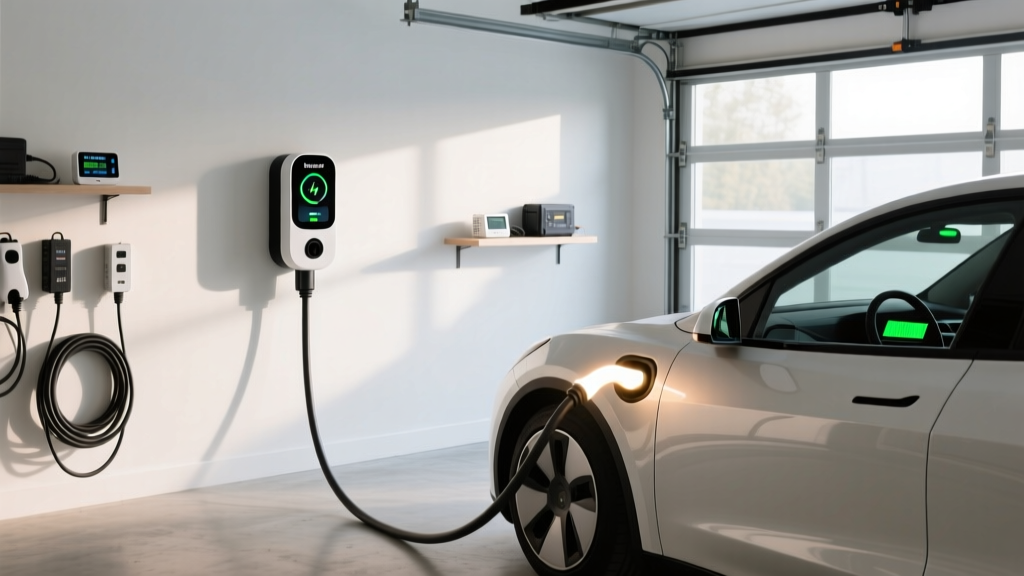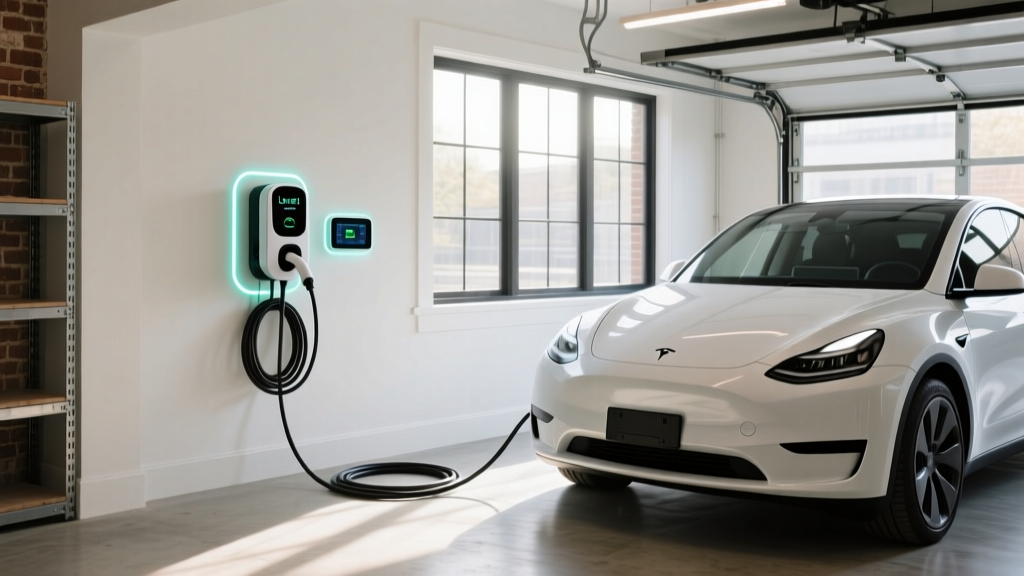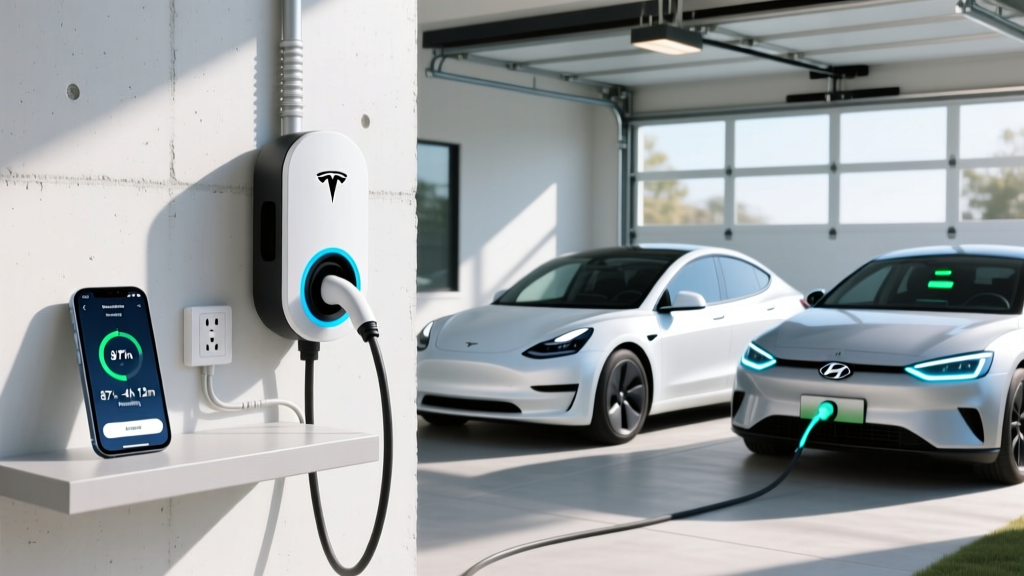
If you're shopping for a home EV charger, the sticker price on the wall unit is only part of the story. The total charger cost includes the hardware, electrical labor, permitting, and — in older homes — a possible panel upgrade that can double or triple your budget. This guide breaks down every line item so you can plan accurately, plus real-world charging speeds, per-mile costs, and equipment picks for 2026.
Charging Levels Explained: Speed, Power, and Range Added Per Hour
Before calculating cost, you need to understand what you're buying in terms of speed. EV charging is measured in kW (kilowatts), which is the rate of power delivery. Your battery capacity is measured in kWh (kilowatt-hours), which is the total energy stored. Think of kW as the width of a hose and kWh as the size of the bucket.
| Level | Voltage | Power (kW) | Miles of Range Per Hour | Typical Use |
|---|---|---|---|---|
| Level 1 | 120V AC | 1.0–1.4 kW | 3–5 mi/hr | Overnight trickle; PHEVs; low-mileage drivers |
| Level 2 | 240V AC | 3.3–19.2 kW | 12–75 mi/hr | Home daily charging; workplace; destination |
| DC Fast Charge | 200–900V DC | 50–350 kW | 150–1,200+ mi/hr | Road trips; commercial fleets; highway corridors |
For most EV owners, Level 2 at home is the baseline. A 48-amp (11.5 kW) Level 2 charger will add roughly 40–45 miles of range per hour on a typical EV with an efficiency of 3–4 mi/kWh. That's enough to replenish a 75 kWh battery (like the Ford Mustang Mach-E Extended Range or Hyundai Ioniq 5) from 10% to 80% in about 5–6 hours — easily overnight.
DC fast charging is for road trips, not daily use. Peak rates of 200–350 kW sound impressive, but charging curves taper significantly above 80% State of Charge (SoC). A Hyundai Ioniq 5 with its 800V architecture can hit a peak 240 kW and reach 10–80% in roughly 18 minutes at a compatible charger, but sustained average power over that session is closer to 150–170 kW.
How Much Does It Cost to Install a Home EV Charger?
The total installed cost for a Level 2 home charger in 2026 typically falls between $1,200 and $3,500, with the wide range driven by your home's existing electrical infrastructure. Here's a realistic line-item breakdown:
| Component | Low-End Estimate | High-End Estimate | Notes |
|---|---|---|---|
| Level 2 charger hardware (smart, 40–48A) | $300 | $700 | Hardwired or NEMA 14-50 plug; Wi-Fi-enabled models cost more |
| Electrician labor (run circuit, mount unit) | $400 | $1,500 | Depends on run length from panel to garage/driveway |
| Permit and inspection fees | $50 | $300 | Varies by municipality; some jurisdictions waive EV permits |
| Electrical panel upgrade (if needed) | $1,500 | $4,000+ | Required if your panel is 100A or has no spare breaker slots |
| Conduit, wiring, connectors (materials) | $100 | $400 | Longer runs and outdoor installations increase material cost |
| Total (no panel upgrade) | $850 | $2,900 | Most homes with 200A service fall in this range |
| Total (with panel upgrade) | $2,350 | $6,900+ | Older homes with 100A or 125A panels |
The Panel Upgrade Factor
This is the cost surprise that catches many buyers off guard. A 48-amp Level 2 charger draws 11.5 kW continuously, which requires a dedicated 60-amp breaker on a 240V circuit (the National Electrical Code requires continuous loads to be derated to 80% of breaker capacity). If your home has a 200-amp panel with spare slots, you're likely fine. If you have a 100-amp or 125-amp panel — common in homes built before 1990 — you may need a service upgrade to 200A.
One workaround for panel-constrained homes: install a lower-amperage charger. A 32-amp unit (7.7 kW, requiring a 40-amp breaker) still adds roughly 28–30 miles of range per hour — plenty for drivers covering under 60 miles daily. Another emerging option is a load-management device like the Emporia Smart Load Management System, which monitors your panel in real time and dynamically adjusts charger draw to avoid overloading the service.
Connector Compatibility: NACS, CCS, and CHAdeMO in 2026
The connector landscape has shifted dramatically. As of 2026, the North American Charging Standard (NACS), originally developed by Tesla, is the dominant connector for new EVs sold in North America. Most legacy CCS1 vehicles are still on the road, and adapters bridge the gap.
| Connector | Brands Using It (Native) | Adapter Needed For |
|---|---|---|
| NACS (Tesla plug) | Tesla, Ford, GM, Rivian, Volvo, Polestar, Mercedes-Benz (2025+), Honda (2025+) | Legacy CCS public chargers (adapter usually included or ~$200) |
| CCS1 | Hyundai, Kia, BMW, VW, Audi, Stellantis (2024 and earlier models) | Tesla Supercharger access (CCS-to-NACS adapter, ~$200–$250) |
| CHAdeMO | Nissan Leaf (legacy only — discontinued) | Limited public network; no practical adapter path |
For home Level 2 charging: All Level 2 chargers use a J1772 connector or a NACS connector. If your EV has a NACS port, buy a NACS-terminated charger or use the J1772-to-NACS adapter that most NACS vehicles ship with. If your EV has a CCS1/J1772 port, any standard J1772 Level 2 charger works natively. The J1772 standard remains fully compatible with both CCS and NACS vehicles (via adapter) for AC Level 2 charging.
Cost to Charge: Per-Mile Economics vs. Gasoline
The financial case for home charging is strong, but public DC fast charging can erode savings significantly. Here's a realistic cost comparison using a 2026 Hyundai Ioniq 5 (3.5 mi/kWh efficiency) as the baseline EV, and a 30 MPG combined gas vehicle at $3.40/gallon:
| Scenario | Rate ($/kWh) | Cost Per Mile | Annual Cost (12,000 mi) |
|---|---|---|---|
| Home Level 2 (national avg. residential rate) | $0.16/kWh | $0.046/mi | $552 |
| Home Level 2 (off-peak utility TOU rate) | $0.08/kWh | $0.023/mi | $276 |
| Home with rooftop solar (marginal cost near zero) | ~$0.03/kWh | $0.009/mi | $108 |
| Public Level 2 (networked: ChargePoint, EVgo) | $0.25–$0.49/kWh | $0.07–$0.14/mi | $840–$1,680 |
| DC Fast Charge (Electrify America, Tesla Supercharger) | $0.35–$0.55/kWh | $0.10–$0.16/mi | $1,200–$1,920 |
| Gas vehicle (30 MPG combined) | $3.40/gal | $0.113/mi | $1,356 |
The takeaway: home charging at residential or off-peak rates costs 60–80% less per mile than gasoline. But exclusive reliance on DC fast charging at $0.45+/kWh can actually cost more than gas. This is why home Level 2 access is the single biggest economic factor in EV ownership.
For reference, the U.S. Department of Energy's fueleconomy.gov provides MPGe ratings and kWh/100mi efficiency figures for every EV sold, which you can plug into your local electricity rate to calculate your personal cost per mile.
Charging Time Examples: What to Expect With Common Battery Sizes
Charging time depends on three variables: battery capacity (kWh), charger power output (kW), and the charge curve (batteries accept power faster at low SoC and taper as they fill). Here are realistic 10–80% times for popular EV battery sizes on a 48-amp (11.5 kW) home Level 2 charger:
- Chevrolet Equinox EV (85 kWh usable, NMC): ~7 hours from 10–80% on 11.5 kW Level 2. Overnight charging is ideal.
- Tesla Model Y Long Range (75 kWh usable, NMC): ~6 hours from 10–80% on 11.5 kW. The onboard charger accepts up to 11.5 kW AC.
- Hyundai Ioniq 5 (77.4 kWh usable, NMC): ~6.5 hours from 10–80% on 11.5 kW. On a 350 kW DC fast charger, 10–80% takes approximately 18 minutes.
- Ford F-150 Lightning Extended Range (131 kWh usable, NMC): ~11 hours from 10–80% on 11.5 kW. Ford recommends an 80-amp (19.2 kW) Level 2 charger for this truck, cutting the time to ~6.5 hours.
- Toyota Prius Prime PHEV (13.6 kWh usable, NMC): ~1.5 hours from empty to full on 11.5 kW. Even Level 1 (1.4 kW) fills it in about 4 hours, making a Level 2 install optional for PHEV owners.
Equipment Recommendations: Top Home Level 2 Chargers for 2026
These are the chargers we recommend based on reliability, features, and value. All units below support 240V and are available in either J1772 or NACS configurations.
Emporia Vue Level 2 EV Charger
- Power: 48A / 11.5 kW (hardwired) or 40A / 9.6 kW (plug-in)
- Connector: J1772 (NACS adapter available)
- Cable length: 24 ft
- Smart features: Wi-Fi, app scheduling, solar integration, load management
- Price: ~$350–$400
- Best for: Budget-conscious buyers who want smart scheduling and solar awareness
ChargePoint Home Flex
- Power: Configurable 16A–50A (3.8–12 kW); up to 50A on NEMA 14-50, 80A hardwired
- Connector: J1772 or NACS
- Cable length: 23 ft
- Smart features: Wi-Fi, Alexa, app scheduling, energy reports
- Price: ~$550–$650
- Best for: Flexible amperage to match your panel capacity
Tesla Wall Connector (Gen 4)
- Power: 48A / 11.5 kW (hardwired, 60A breaker)
- Connector: NACS native; J1772 adapter included
- Cable length: 24 ft
- Smart features: Wi-Fi, OTA updates, power sharing (link up to 6 units), Tesla app integration
- Price: ~$450
- Best for: Tesla and NACS-equipped vehicle owners
Grizzl-E Smart
- Power: 40A / 9.6 kW (NEMA 14-50 plug) or 48A hardwired
- Connector: J1772 or NACS
- Cable length: 24 ft
- Smart features: Wi-Fi, OCPP-compatible, adjustable amperage, outdoor-rated (NEMA 4)
- Price: ~$400–$500
- Best for: Outdoor installs and cold-climate durability (rated to -40°F)
Safety, Electrical Code, and Installation Requirements
A Level 2 charger is a major continuous electrical load. Here's what a proper, code-compliant installation requires:
- Dedicated circuit: Your charger must be on its own breaker — not shared with any other appliance. A 48A charger needs a 60A double-pole breaker; a 32A charger needs a 40A breaker.
- Wire gauge: 6 AWG copper for 48A/60A circuits; 8 AWG for 32A/40A circuits. Longer runs (over 50 ft) may require upsizing to 4 AWG to prevent voltage drop.
- GFCI protection: The 2023 NEC (National Electrical Code) requires GFCI protection for EV charging outlets in garages. Hardwired installations typically do not require a GFCI breaker, which is one reason many electricians prefer hardwiring — it eliminates nuisance tripping and saves ~$100 on the breaker cost.
- Outdoor rating: If your charger is installed outside (driveway or exterior wall), the unit must be rated at least NEMA 4 (weather-resistant). All recommended units above meet this standard.
- Permit and inspection: Most jurisdictions require an electrical permit for a new 240V circuit. The inspection ensures proper wire gauge, breaker sizing, grounding, and GFCI compliance. Skipping the permit risks insurance coverage issues if an electrical fire occurs.
Federal and State Incentives for Home Charger Installation
The federal Alternative Fuel Vehicle Refueling Property Credit (IRS Form 8911) offers a tax credit of up to 30% of the cost of home EV charging equipment and installation, capped at $1,000. However, as of 2026, this credit is only available for installations in census tracts classified as "low-income" or "non-urban" under the Inflation Reduction Act provisions. Check the IRS guidance on Form 8911 for eligibility details and consult a tax professional before claiming.
Many utilities also offer rebates of $200–$500 for purchasing a smart Level 2 charger, and some cover the full cost of installation in exchange for enrollment in a managed-charging program (where the utility can reduce your charger's draw during peak grid demand). Check with your local utility before purchasing equipment.
Frequently Asked Questions
How much does it cost to install a home EV charger?
Expect $1,200–$3,500 total for a Level 2 charger installation in a home with adequate 240V panel capacity. This includes $300–$700 for the charger unit, $400–$1,500 for electrician labor, $50–$300 for permits, and $100–$400 in materials. Homes needing a 200A panel upgrade should budget an additional $1,500–$4,000+.
How fast will each charging level add range?
Level 1 (120V) adds 3–5 miles per hour. Level 2 (240V, 48A) adds roughly 40–45 miles per hour for a typical EV. DC fast charging adds the equivalent of 150–1,200+ miles per hour at peak rates, but sessions are typically limited to 10–80% SoC (about 15–30 minutes for most EVs at a compatible station).
Which connector/charger is compatible with my EV?
If your EV has a NACS port (Tesla, Ford, GM, Rivian, Volvo, 2025+ Honda/Mercedes), buy a NACS-terminated Level 2 charger or use the included J1772-to-NACS adapter with a standard J1772 unit. If your EV has a CCS1/J1772 port (Hyundai, Kia, BMW, VW, older models), any J1772 Level 2 charger works natively. CHAdeMO (Nissan Leaf) is legacy and increasingly unsupported.
How much does charging cost per mile vs gas?
Home Level 2 charging at the national average residential rate ($0.16/kWh) costs approximately $0.046/mile for a typical EV — about 60% less than a 30 MPG gas car at $3.40/gallon ($0.113/mile). Off-peak utility rates can push home charging below $0.03/mile. However, DC fast charging at $0.45+/kWh can exceed gas costs per mile.
What electrical upgrades might I need?
The most common upgrade is a panel replacement from 100A to 200A service ($1,500–$4,000+), required when your existing panel lacks capacity or spare breaker slots for a new 60A circuit. You may also need a new conduit run from the panel to the charger location, wire upgrades for long runs, or a load-management device if a full panel upgrade isn't feasible. A licensed electrician's load calculation will determine your exact needs.