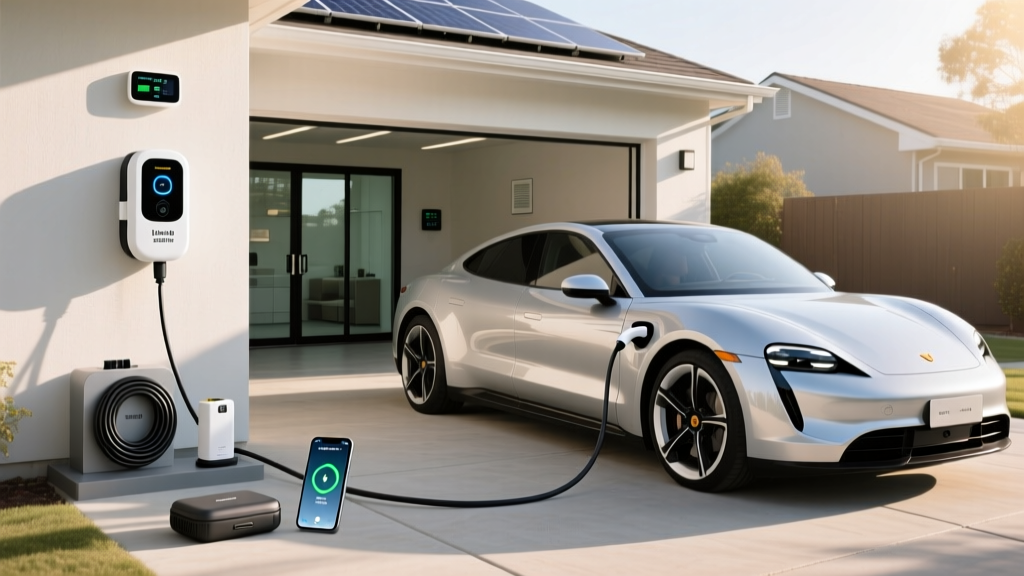
The Real Math Behind Charging at Home
Plug into a standard 120V outlet and you'll add roughly 3–5 miles of range per hour. For a 75 kWh battery starting at 10%, that's nearly 30 hours to reach 80%. Most EV owners quickly outgrow Level 1 and move to a dedicated home electric charger running on 240V — the same voltage as your electric dryer. The payoff is dramatic: 25–45 miles of range per hour, meaning a typical overnight session fully replenishes even the largest batteries.
This guide breaks down every number you need — charging speeds in kW (power) and kWh (energy), real installation costs with electrician labor, connector compatibility across 2026 models, and the per-mile cost compared to gasoline. We'll also flag the panel-upgrade scenario that can double your budget if you're not expecting it.
Charging Levels Explained: kW, Miles per Hour, and 10–80% Times
A common mistake is confusing kW (kilowatts — the rate of energy flow, like water pressure) with kWh (kilowatt-hours — the total energy stored, like gallons in a tank). Your charger's kW rating determines how fast energy enters your battery; your battery's kWh capacity determines how far you can drive.
| Level | Voltage | Max Power (kW) | Miles of Range Added/Hour | Typical Use Case |
|---|---|---|---|---|
| Level 1 | 120V AC | 1.0–1.9 kW | 3–5 mi/hr | Emergency / PHEV overnight top-up |
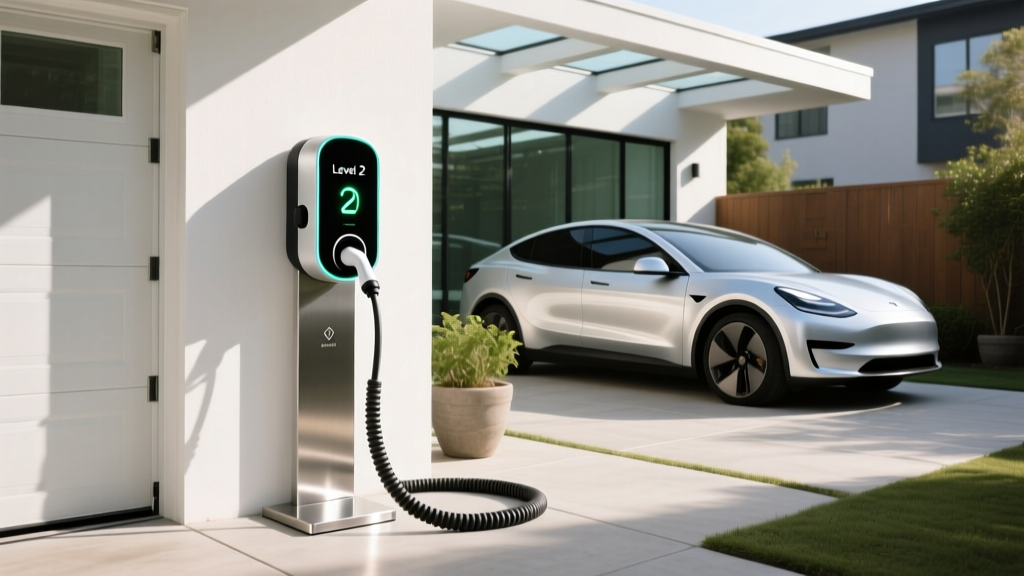
| Level 2 (Home) | 240V AC | 3.3–19.2 kW | 12–75 mi/hr | Daily home charging — the standard |
| DC Fast (Level 3) | 200–920V DC | 50–350+ kW | 150–1,200+ mi/hr | Road trips, public stations |
Real-world charging times vary by battery size. Here's what 10–80% looks like across common scenarios:
- 60 kWh battery (e.g., Nissan Ariya, base Tesla Model 3 RWD): ~8 hours on a 7.2 kW Level 2 home electric charger; ~25 minutes on a 150 kW DC fast charger (with taper above 80%).
- 82 kWh battery (e.g., Ford Mustang Mach-E Extended Range): ~11 hours on 7.2 kW; ~28 minutes on a 150 kW DCFC.
- 100 kWh battery (e.g., Rivian R1T Dual-Motor Large): ~13 hours on 7.2 kW; ~32 minutes on a 200 kW DCFC.
DC fast charging isn't linear. Peak kW applies only in a narrow state-of-charge window (often 10–40%). Above 80%, the charge curve tapers sharply to protect battery chemistry — which is why manufacturers quote 10–80% times rather than 0–100%.
How Much Does It Cost to Install a Home EV Charger?
The total cost to install a Level 2 home electric charger spans a wide range, driven by your home's existing electrical panel, the distance from panel to charger location, and local permit fees. Here's a realistic breakdown based on 2025–2026 electrician quotes across major U.S. metro areas:
| Component | Simple Install (panel nearby, no upgrade) | Complex Install (long run or panel upgrade) |
|---|---|---|
| Level 2 Charger (hardware) | $350–$700 | $350–$700 |
| Electrician labor (240V circuit, 40–60A) | $500–$1,200 | $1,500–$3,000 |
| Permit & inspection | $50–$200 | $50–$300 |
| Electrical panel upgrade (if needed) | $0 | $1,500–$4,000 |
| Total | $900–$2,100 | $3,400–$8,000 |
The panel-upgrade gotcha: Homes built before 2000 often have 100-amp service panels. Adding a 40-amp dedicated EV circuit to an already-loaded 100A panel may require upgrading to 200A service — a $1,500–$4,000 job on its own. Before committing to a charger, have a licensed electrician perform a load calculation per NEC Article 220. Some utilities offer rebates of $300–$1,000 for panel upgrades tied to EV adoption.
The federal IRS §30D clean vehicle credit covers the car, not the charger itself. However, the separate §25E Energy Efficient Home Improvement Credit can cover 30% of home charging equipment and installation costs up to $1,000 — check current-year eligibility with a tax professional. Some states and utilities layer on additional rebates; check your local utility's EV program page for specifics.
What Electrical Upgrades Might I Need?
A Level 2 home electric charger on a 48-amp circuit (the most common high-power residential setup) draws 40 amps continuously. Per the National Electrical Code (NEC), continuous loads must not exceed 80% of a circuit's rated capacity. That means:
- 40A charger → requires a 50A dedicated circuit (6 AWG copper wire typical)
- 48A charger → requires a 60A dedicated circuit (4 AWG copper wire typical)
- 32A charger → requires a 40A dedicated circuit (8 AWG copper wire typical)
Your electrician will also verify:
- GFCI protection: NEC 2020 and later requires GFCI breakers for EV charging circuits in garages and all outdoor locations. A 50A GFCI breaker costs $50–$120 more than a standard breaker.
- Outdoor rating: If your charger mounts outside, the unit must carry a NEMA 4 (weatherproof) rating, and the receptacle needs an in-use weatherproof cover.
- Hardwired vs. plug-in (NEMA 14-50): Hardwired installations avoid the receptacle entirely, reducing points of failure and often satisfying inspectors more easily. A NEMA 14-50 outlet gives you portability but requires a GFCI breaker and proper torque on the receptacle terminals — a known failure point if installed incorrectly.
Which Connector Is Compatible With My EV?
The connector landscape shifted dramatically in 2024–2025 when nearly every major automaker adopted the North American Charging Standard (NACS), originally developed by Tesla. Here's where things stand for 2026 models:
| Connector | Brands Using It (2026 MY) | Adapter Needed? |
|---|---|---|
| NACS (Tesla-style) | Tesla (all), Ford, GM, Rivian, Volvo, Polestar, Nissan (Ariya), Hyundai/Kia (new platforms), Mercedes-Benz | None for NACS vehicles; CCS-to-NACS adapters available for legacy CCS cars |
| CCS1 | VW ID.4 (carryover), BMW iX/i4 (some trims), older Hyundai/Kia models (pre-2025) | NACS-to-CCS adapter needed for Tesla Supercharger access |
| CHAdeMO | Nissan Leaf (legacy, discontinued after 2025 MY) | Increasingly limited public infrastructure |
Key buying advice: If you're purchasing a new EV in 2026, it almost certainly uses NACS. Match your home electric charger to your car's native connector to avoid relying on adapters daily. For households with two EVs using different connectors, dual-cable chargers (one NACS, one CCS) are available from manufacturers like Autel and Lectron.
How Much Does Charging Cost Per Mile vs. Gas?
Electricity prices vary enormously by region and time of day. The national average residential rate in early 2026 sits around $0.17/kWh, but time-of-use (TOU) plans can drop off-peak rates to $0.08–$0.12/kWh. Public DC fast charging typically runs $0.30–$0.55/kWh.
| Scenario | Energy Cost | Vehicle Efficiency | Cost Per Mile |
|---|---|---|---|
| Home off-peak (TOU plan) | $0.10/kWh | 3.5 mi/kWh (typical sedan) | $0.029 |
| Home standard rate | $0.17/kWh | 3.5 mi/kWh | $0.049 |
| Public Level 2 (ChargePoint, etc.) | $0.25/kWh | 3.5 mi/kWh | $0.071 |
| DC fast charging (Electrify America) | $0.43/kWh | 3.5 mi/kWh | $0.123 |
| Gasoline car (30 MPG combined) | $3.40/gal | 30 mi/gal | $0.113 |
| Gasoline car (22 MPG combined, truck/SUV) | $3.40/gal | 22 mi/gal | $0.155 |
Home off-peak charging delivers fuel costs roughly 75–80% lower than a comparable gasoline car. Even at standard residential rates, you're saving 55–65%. The economics flip only when you rely exclusively on DC fast charging at premium networks — at $0.43+/kWh, you're paying roughly the same per mile as a 30 MPG gas car. This is why a home electric charger isn't just convenient; it's the economic foundation of EV ownership.
Best Home Electric Chargers for 2026: Equipment Picks
We evaluate chargers on power output, cable length, connector type, smart features (Wi-Fi, scheduling, energy monitoring), build quality, and price. All units below are UL-listed or ETL-listed — never buy an uncertified charger.
Tesla Wall Connector (Gen 4)
- Power: Up to 11.5 kW (48A on 60A circuit)
- Connector: NACS native
- Cable: 24 ft
- Smart features: Wi-Fi, OTA updates, power sharing between units, access control
- Price: ~$475
- Best for: Tesla owners and NACS-equipped Ford/GM/Rivian vehicles
ChargePoint Home Flex
- Power: Up to 12 kW (50A on 60A circuit), adjustable down to 16A
- Connector: NACS or CCS1 (configurable)
- Cable: 23 ft
- Smart features: Wi-Fi, app scheduling, Alexa integration, energy dashboard
- Price: ~$650–$700
- Best for: Multi-EV households, flexible amperage for older panels
Emporia Vue Level 2 Charger
- Power: Up to 11.5 kW (48A)
- Connector: NACS or J1772 (with adapter)
- Cable: 24 ft
- Smart features: Wi-Fi, real-time energy monitoring, solar integration, TOU scheduling
- Price: ~$400–$450
- Best for: Budget-conscious buyers who want smart scheduling and solar pairing
Grizzl-E Smart
- Power: Up to 10 kW (40A)
- Connector: NACS or J1772
- Cable: 24 ft
- Smart features: Wi-Fi, OCPP support, adjustable amperage
- Price: ~$450–$500
- Best for: Extreme cold climates (rated to -40°F), outdoor installs, Canadian-built durability
Our pick for most buyers: The ChargePoint Home Flex offers the widest amperage range (16A–50A), letting you match the charger to your panel's available capacity without swapping hardware. If you're a single-Tesla household, the Tesla Wall Connector at $475 is hard to beat on value.
Frequently Asked Questions
Can I install a home electric charger myself?
Level 1 (120V) requires no installation — just plug in. Level 2 (240V) involves running a new dedicated circuit from your panel, which requires a permit and inspection in virtually all U.S. jurisdictions. DIY electrical work on 240V circuits carries fire and electrocution risk and may void your homeowner's insurance if unpermitted. Hire a licensed electrician.
How fast will a Level 2 home charger add range overnight?
A 48A (11.5 kW) charger adds roughly 40–45 miles of range per hour to a typical EV sedan. Over an 8-hour overnight session, that's 320+ miles — more than enough to fully replenish even a 100 kWh battery. A 32A (7.7 kW) charger adds ~28 miles per hour, yielding ~220 miles overnight.
Do I need a smart charger, or is a dumb charger fine?
Smart chargers with Wi-Fi and app scheduling let you charge during off-peak TOU windows automatically, potentially cutting your per-kWh cost in half. They also provide energy monitoring and remote start/stop. A non-smart ("dumb") charger works perfectly for charging but forfeits these savings and controls. For the $50–$100 price premium, a smart charger pays for itself within months on a TOU plan.
Will charging at home degrade my battery faster?
No — Level 2 home charging is gentler on battery chemistry than DC fast charging. Heat and high C-rates (rapid energy intake) accelerate degradation in both NMC and LFP cells. Overnight Level 2 charging at moderate power generates minimal heat. For long-term battery health, most manufacturers recommend keeping state of charge between 20–80% for daily use and charging to 100% only before long trips. Check your vehicle's battery warranty — most cover 8 years/100,000 miles with a 70% capacity retention guarantee.
My garage is far from the electrical panel. What are my options?
Long wire runs increase material cost (larger-gauge copper to limit voltage drop) and labor time. Runs over 100 feet from panel to charger may require 4 AWG or even 2 AWG wire instead of 6 AWG, adding $200–$500 in materials alone. If the run exceeds 150 feet, your electrician may recommend a sub-panel closer to the garage — a practical solution that also gives you spare circuit capacity for future additions.
Can I use a portable Level 2 charger instead of a wall-mounted unit?
Yes. Many EVs now ship with a portable Level 2 cord (e.g., Tesla's Mobile Connector with NACS plug, Ford's mobile charger) that plugs into a NEMA 14-50 outlet. This works well if you already have a 14-50 receptacle (common for RV owners and electric ranges). However, portable cords are limited to 32A (7.7 kW) on most mobile units, versus 48A on hardwired wall units. You'll also need to ensure the 14-50 outlet was installed to current code with a GFCI breaker — a common deficiency in older installations.