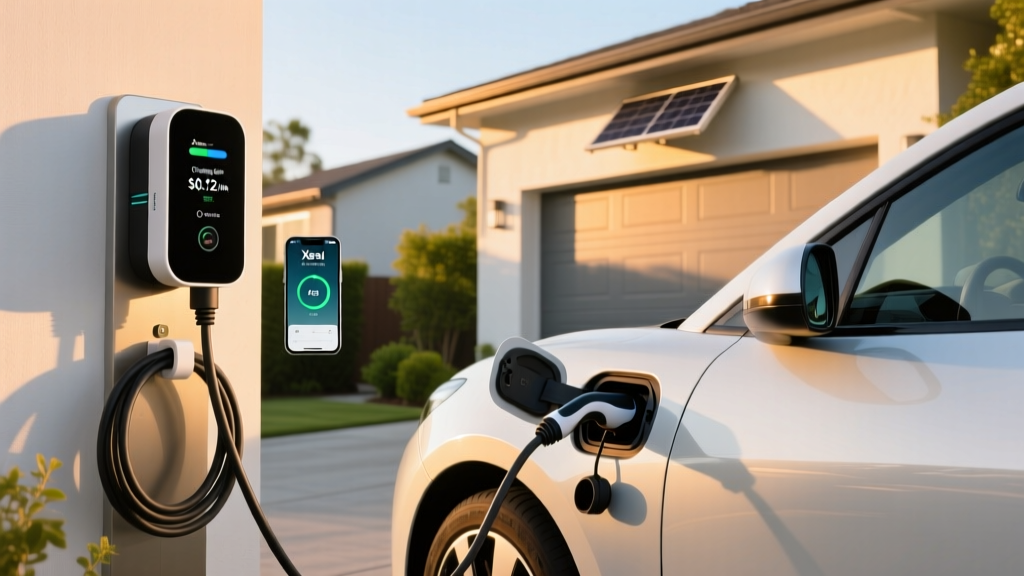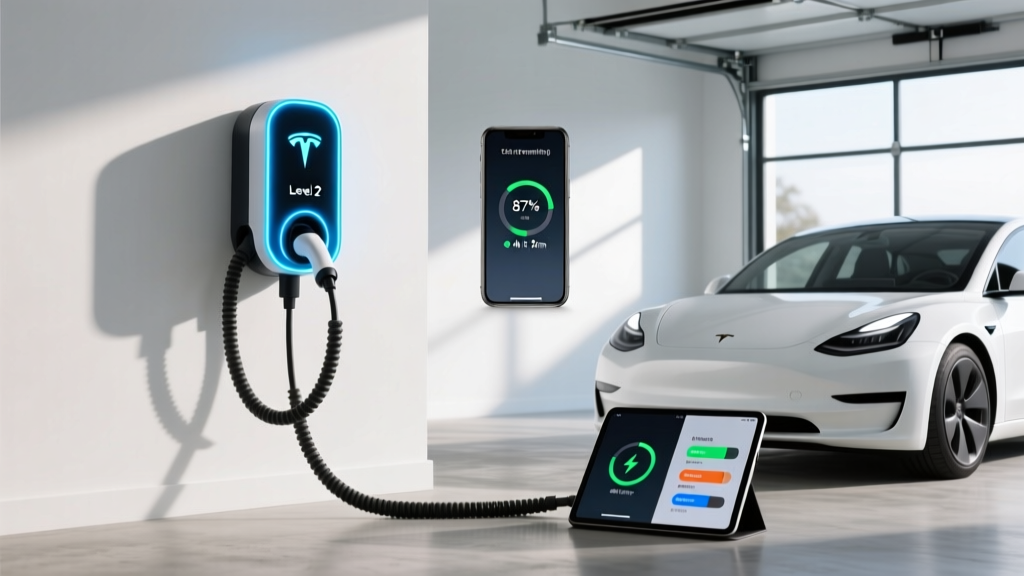
If you own or are shopping for an electric vehicle, a home charger for EV daily use is the single most impactful upgrade you can make. Roughly 80% of EV charging happens at home, and the right setup means waking up to a full battery every morning — no detours to gas stations or public chargers required. But choosing the right equipment, understanding your electrical panel's capacity, and budgeting for installation can feel overwhelming. This guide breaks down exactly what you need, what it costs, and which chargers earn our recommendation for 2026.
Understanding EV Charging Levels: Speeds That Actually Matter
Before picking hardware, you need to know the three charging levels and what they deliver in practical terms. The critical distinction: kW (kilowatts) measures power — how fast energy flows into your car. kWh (kilowatt-hours) measures energy — the total capacity of your battery. Think of kW as the width of a hose and kWh as the size of the bucket.
| Level | Voltage | Max Power (kW) | Miles of Range Added Per Hour | Best For |
|---|---|---|---|---|
| Level 1 | 120V AC | 1.2–1.9 kW | 3–5 miles | Overnight top-ups, PHEVs, low daily mileage |
| Level 2 | 240V AC | 3.3–19.2 kW | 12–75 miles | Daily home charging, all BEVs and PHEVs |
| DC Fast Charging | 400–800V DC | 50–350+ kW | 150–1,000+ miles (equivalent) | Road trips, rapid top-ups away from home |
Level 1 charging uses a standard household outlet and the cord that ships with most EVs. It's adequate for plug-in hybrids with small batteries (say, 10–18 kWh) or BEV owners who drive under 30 miles daily. But for a 75 kWh battery like the one in a Tesla Model Y, Level 1 would take over 50 hours for a full charge — impractical for most.
Level 2 is the home-charging sweet spot. A 48-amp (11.5 kW) Level 2 station can fully recharge a 75 kWh battery in roughly 7–8 hours — perfect for overnight replenishment. Most EVs accept between 7.2 kW and 19.2 kW on Level 2, though the vehicle's onboard charger caps the actual intake regardless of how much the station can supply.
DC Fast Charging bypasses the onboard charger and feeds DC current directly to the battery. You won't install DC fast charging at home (equipment alone costs $25,000–$150,000+), but understanding it matters for road-trip planning. A 350 kW station can take a Hyundai Ioniq 5 from 10–80% in about 18 minutes under ideal conditions — though real-world charge curves taper significantly above 80% State of Charge (SoC).
How Much Does It Cost to Install a Home EV Charger?
The honest answer: anywhere from $500 to $4,000+, depending entirely on your home's electrical infrastructure. Here's the realistic breakdown based on 2026 electrician rates and equipment pricing.
| Component | Simple Install (Panel Nearby) | Moderate Install (Longer Run) | Complex Install (Panel Upgrade Needed) |
|---|---|---|---|
| Level 2 Charger (Equipment) | $350–$700 | $350–$700 | $350–$700 |
| Electrician Labor | $300–$600 | $600–$1,200 | $800–$1,500 |
| Electrical Permit | $50–$150 | $50–$200 | $100–$300 |
| Wiring/Conduit Materials | $50–$150 | $150–$400 | $200–$500 |
| Electrical Panel Upgrade (if needed) | $0 | $0 | $1,500–$3,500 |
| Total Estimated Cost | $750–$1,600 | $1,150–$2,500 | $2,950–$6,500 |
The biggest cost variable is whether your electrical panel can handle the added load. Most homes built after 2000 have a 200-amp service panel, which typically supports a dedicated 40–60 amp circuit for EV charging without issue. Older homes with 100-amp service may need a panel upgrade — a $1,500–$3,500 job that involves replacing the panel and potentially the service entrance wires from your utility.
A licensed electrician will perform a load calculation before recommending a circuit size. This isn't optional — the National Electrical Code (NEC) requires that continuous loads (including EV chargers) not exceed 80% of a circuit's rated capacity. So a 48-amp charger requires a 60-amp circuit; a 40-amp charger needs a 50-amp circuit.
Some utilities and states offer rebates that offset installation costs. Check with your local utility — many offer $250–$500 rebates for Level 2 installations, and some even cover panel upgrades in full when paired with time-of-use rate enrollment.
Which Connector and Charger Is Compatible With My EV?
The connector landscape shifted dramatically in 2024–2025 when nearly every major automaker adopted the North American Charging Standard (NACS), originally developed by Tesla. Here's where things stand for 2026 model-year vehicles:
| Connector | Brands Using It (Native) | Notes |
|---|---|---|
| NACS (Tesla connector) | Tesla, Ford, GM, Rivian, Volvo, Polestar, Mercedes-Benz, Nissan, Fisker, Honda, Jaguar, BMW, Hyundai/Kia (select models) | Now the dominant standard; smaller, lighter connector |
| CCS1 (Combined Charging System) | Hyundai/Kia (most models), Stellantis (Jeep, Chrysler), Volkswagen, legacy models from Ford/GM pre-2025 | Still widely deployed at public stations; adapters available |
| CHAdeMO | Nissan Leaf (legacy only — discontinued for new sales) | Being phased out; no new vehicles use it |
If you're buying a new EV in 2026, it almost certainly has a NACS port or will ship with a CCS-to-NACS adapter. For home charging, this means:
- NACS-native vehicles: Buy a NACS-connector home charger. Most new Level 2 stations now ship with NACS by default.
- CCS1 vehicles: Buy a CCS1 (J1772-compatible) charger, or buy a NACS charger with a NACS-to-CCS adapter (~$100–$200).
- CHAdeMO (older Nissan Leaf): Use a J1772 charger with a J1772-to-CHAdeMO adapter, or keep the OEM Level 1 cord for home and rely on remaining CHAdeMO public stations for DC fast charging.
The good news: for Level 2 home charging, nearly every charger sold today supports the standard you need either natively or through an inexpensive adapter. The connector wars largely affected public DC fast charging access — at home, you control the hardware.
Charging Time: How Long Does It Take to Charge at Home?
Charge time depends on three factors: your battery's usable capacity (kWh), the charger's power output (kW), and the vehicle's onboard charger limit. Here are real-world estimates for common scenarios, calculated from 10% to 80% State of Charge (the range where charging is fastest and healthiest for the battery):
Charging Time Examples (10–80% SoC)
- Tesla Model Y (75 kWh usable, 11.5 kW onboard max): ~4.5 hours on a 48A/11.5 kW Level 2 charger
- Ford F-150 Lightning (131 kWh extended range, 19.2 kW onboard max): ~5 hours on an 80A/19.2 kW Level 2 charger; ~9.5 hours on a 48A/11.5 kW charger
- Hyundai Ioniq 5 (77.4 kWh usable, 10.9 kW onboard max): ~5 hours on a 48A/11.5 kW charger
- Chevrolet Equinox EV (85 kWh usable, 11.5 kW onboard max): ~5.2 hours on a 48A/11.5 kW charger
- Toyota RAV4 Prime PHEV (18.1 kWh usable, 6.6 kW onboard max): ~2 hours on a 32A/7.7 kW Level 2 charger
Note: Actual times vary based on battery temperature, preconditioning, and charge-curve taper above 80%. Charging to 100% adds significant time as current slows to protect battery health.
For most EV owners, overnight charging from 10% to 80% is more than sufficient. A 48-amp Level 2 charger replenishes roughly 30–45 miles of range per hour for most EVs, meaning an 8-hour overnight session adds 240–360 miles — more than enough for a full daily recharge.
Cost to Charge: Home Electricity vs. Gas vs. Public Charging
This is where home charging delivers its biggest financial advantage. Let's compare real costs per mile using 2026 average rates.
| Scenario | Rate | Vehicle Efficiency | Cost Per Mile |
|---|---|---|---|
| Home charging (national avg. electricity) | $0.17/kWh | 3.5 mi/kWh (115 MPGe) | $0.049 |
| Home charging (off-peak TOU rate) | $0.09/kWh | 3.5 mi/kWh (115 MPGe) | $0.026 |
| Public Level 2 (network pricing) | $0.35/kWh | 3.5 mi/kWh (115 MPGe) | $0.100 |
| Public DC Fast Charging | $0.48/kWh | 3.5 mi/kWh (115 MPGe) | $0.137 |
| Gas vehicle (25 MPG combined) | $3.40/gallon | 25 MPG | $0.136 |
| Gas vehicle (30 MPG combined) | $3.40/gallon | 30 MPG | $0.113 |
The math is stark: home charging at off-peak rates costs roughly $0.026 per mile — about 75–80% cheaper than gasoline. Even at the national average electricity rate, home charging at ~$0.05/mile undercuts gas by more than half. Public DC fast charging, however, can cost as much as or more than gasoline per mile — which is exactly why a home charger for EV ownership is so economically important.
Enrolling in your utility's time-of-use (TOU) rate plan is the key to maximizing savings. Most utilities offer off-peak rates between 10 PM and 6 AM that are 40–60% cheaper than peak pricing. Set your EV or charger to schedule charging during those windows, and your cost per mile drops to pennies.
Top Home EV Chargers for 2026: Equipment Recommendations
We evaluated chargers on power output, build quality, smart features, cable length, connector options, and real-world reliability. Here are our top picks across categories:
Best Overall: ChargePoint Home Flex
- Power: Up to 12 kW (50A) on a 60A circuit
- Connector: NACS or J1772 (configurable)
- Cable Length: 23 feet
- Smart Features: Wi-Fi, app scheduling, energy tracking, Alexa integration
- Indoor/Outdoor: NEMA 4 rated (outdoor safe)
- Price: ~$599
- Why we recommend it: Adjustable amperage (16A–50A) lets you match your circuit capacity without buying different hardware. Excellent app, reliable connectivity.
Best Value: Emporia Level 2 EV Charger
- Power: Up to 11.5 kW (48A) on a 60A circuit
- Connector: J1772 (NACS adapter included)
- Cable Length: 24 feet
- Smart Features: Wi-Fi, app control, solar integration, TOU scheduling
- Indoor/Outdoor: NEMA 4 rated
- Price: ~$399
- Why we recommend it: Best price-to-feature ratio available. Solar-aware charging is a standout for homes with PV panels.
Best for Tesla/NACS Owners: Tesla Wall Connector
- Power: Up to 11.5 kW (48A) on a 60A circuit
- Connector: NACS native
- Cable Length: 24 feet
- Smart Features: Wi-Fi, OTA updates, power sharing (link multiple units), Tesla app integration
- Indoor/Outdoor: NEMA 4 rated
- Price: ~$475
- Why we recommend it: Seamless integration with Tesla vehicles. Power-sharing feature lets two Wall Connectors share a single circuit — ideal for two-EV garages.
Best High-Power: Grizzl-E Smart
- Power: Up to 10 kW (40A) on a 50A circuit
- Connector: J1772 or NACS
- Cable Length: 24 feet
- Smart Features: Wi-Fi, app scheduling, OCPP compatibility
- Indoor/Outdoor: NEMA 4X rated (extreme weather)
- Price: ~$449
- Why we recommend it: Built in Canada, rated to -40°F. One of the most rugged chargers available — ideal for unheated garages and outdoor installs in cold climates.
Safety, Electrical Code, and Installation Requirements
A home EV charger is a significant continuous electrical load. Cutting corners on installation isn't just risky — it can void your homeowner's insurance if a fire traces back to unpermitted work. Here's what proper installation requires:
- Dedicated circuit: Your Level 2 charger must have its own dedicated circuit — it cannot share with other appliances or outlets. This is non-negotiable per NEC Article 625.
- GFCI protection: The 2020 NEC and later require GFCI (Ground Fault Circuit Interrupter) protection for all EV charging outlets. Most hardwired chargers have built-in GFCI; plug-in units require a GFCI breaker.
- Hardwired vs. plug-in: Hardwired installations (no plug — wires connect directly to the charger) are preferred for circuits 48A and above. Plug-in units using a NEMA 14-50 outlet are convenient and portable but limited to 40A continuous (50A breaker) per code. Some jurisdictions now require GFCI breakers for NEMA 14-50 outlets, which can cause nuisance tripping with certain chargers.
- Outdoor rating: If your charger mounts outside, it must carry at minimum a NEMA 4 rating (weatherproof). NEMA 4X adds corrosion resistance for coastal or road-salt environments.
- Permit and inspection: Virtually every jurisdiction requires an electrical permit for a new 240V circuit. The inspection ensures code compliance and protects your insurance coverage. Permit fees typically run $50–$200.
- Wire gauge: A 60A circuit requires 6 AWG copper wire (or 4 AWG aluminum). A 50A circuit needs 6 AWG copper. Your electrician will size wire based on run length and local code amendments.
Always hire a licensed electrician — ideally one with EV charger installation experience. Get at least two quotes, and ask specifically about load calculations, permit pulling, and whether they've installed EVSE (Electric Vehicle Supply Equipment) before. A proper installation should come with documentation you can provide to your insurance company.
Frequently Asked Questions
Can I use a regular outlet to charge my EV at home?
Yes, but slowly. A standard 120V outlet provides Level 1 charging at about 1.2–1.9 kW, adding 3–5 miles of range per hour. For a PHEV with a 15 kWh battery, that's fine — an overnight charge gets you to full. For a BEV with a 75+ kWh battery, Level 1 is only practical as emergency backup or for very low daily mileage (under 25 miles). Most EV owners find a Level 2 home charger essential.
Do I need a 200-amp electrical panel to install a home charger?
Not necessarily, but it helps. A 200-amp panel can typically support a 40–60 amp dedicated EV circuit without upgrades. A 100-amp panel may require an upgrade if your home already has significant electric loads (electric range, dryer, HVAC). Your electrician's load calculation determines this. If a panel upgrade is needed, budget $1,500–$3,500 for the work.
Is it better to hardwire or use a plug for my home charger?
Hardwiring is generally preferred for circuits above 40A. It eliminates the NEMA 14-50 receptacle (a potential failure point), avoids GFCI breaker nuisance-tripping issues, and is required by code in some jurisdictions for 60A+ circuits. Plug-in installations offer portability — you can take the charger when you move — but are practically limited to 40A continuous draw. If you plan to stay in your home, hardwire.
Will a home charger for EV increase my electric bill significantly?
Your electric bill will increase, but your total fuel cost will decrease. A typical EV driver covering 12,000 miles per year at 3.5 mi/kWh uses about 3,430 kWh annually for driving. At $0.17/kWh (national average), that's roughly $583/year in electricity — compared to $1,632/year in gasoline for a 25 MPG vehicle at $3.40/gallon. Net savings: approximately $1,049 per year. Your exact numbers depend on local electricity rates, your vehicle's efficiency, and whether you use off-peak TOU pricing.
Does the federal tax credit apply to home charger installation?
The IRS §30C Alternative Fuel Vehicle Refueling Property Credit covers up to 30% of home charger equipment and installation costs, capped at $1,000. However, eligibility depends on your census tract meeting specific low-income or non-urban criteria. Check the IRS guidelines or consult a tax professional — rules are subject to change and have geographic restrictions. This is separate from the §30D vehicle purchase credit.
How do I know if my EV can accept the full power of a Level 2 charger?
Check your vehicle's onboard charger specification. For example, the Tesla Model Y accepts up to 11.5 kW on Level 2, so a 48A/11.5 kW charger maxes it out. The Ford F-150 Lightning with the extended-range battery accepts up to 19.2 kW, meaning an 80A charger delivers faster fills. If your vehicle's onboard charger is rated at 7.2 kW (common in older EVs and many PHEVs), even a 48A charger will only deliver 7.2 kW — the car limits the draw. Buy for your current vehicle but consider future-proofing with a higher-amp unit if you plan to upgrade.