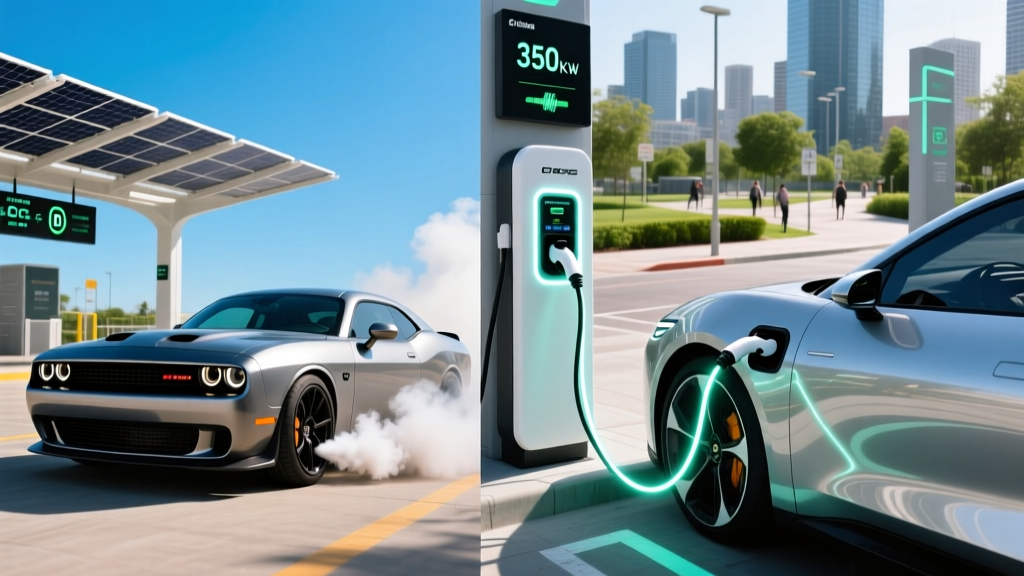
Quick verdict: The Dodge Challenger SRT Hellcat's 707-horsepower supercharged 6.2L V8 represents peak internal combustion performance, but EV charging infrastructure has matured to deliver comparable acceleration with fundamentally different ownership economics. This guide breaks down what it actually takes to charge a high-performance EV at home versus fueling a Hellcat, with exact numbers on installation costs, charging speeds, and per-mile expenses.
The Supercharged Hellcat Baseline: What We're Comparing Against
The 2023 Dodge Challenger SRT Hellcat (final model year before discontinuation) delivered 717 horsepower and 656 lb-ft of torque from its supercharged HEMI V8, achieving 0-60 mph in 3.6 seconds with an EPA-estimated 13 mpg city / 21 mpg highway. At $65,000 MSRP and requiring premium fuel, the Hellcat set a performance benchmark that EVs like the Tesla Model S Plaid, Lucid Air Sapphire, and Porsche Taycan Turbo S now challenge—but with entirely different infrastructure requirements.
Where the Hellcat needs a gas station and 5 minutes to refill its 18.5-gallon tank (roughly $75-$90 per fill-up at 2026 premium prices), high-performance EVs require understanding charging levels, electrical panel capacity, connector standards, and rate structures. The question isn't whether EVs can match Hellcat performance—they can—but whether buyers have the charging infrastructure to support daily use and road trips.
Charging Levels Explained: Speed, Power, and Real-World Range Addition
EV charging operates across three distinct levels, each with specific power requirements and charging speeds. Understanding the difference between kilowatts (kW—power, the rate of energy transfer) and kilowatt-hours (kWh—energy, the battery capacity) is critical. Think of kW as water flow rate and kWh as the total volume in your tank.
| Level | Power (kW) | Voltage/Amps | Miles Added/Hour | Typical Use Case |
|---|---|---|---|---|
| Level 1 | 1.2-1.9 kW | 120V / 12-16A | 3-5 miles | Overnight top-up, PHEVs |
| Level 2 (Home/Public) | 7.2-19.2 kW | 240V / 30-80A | 25-60 miles | Daily home charging, workplace |
| DC Fast Charging | 50-350 kW | 400-800V DC | 180-1,200 miles | Road trips, rapid top-up |
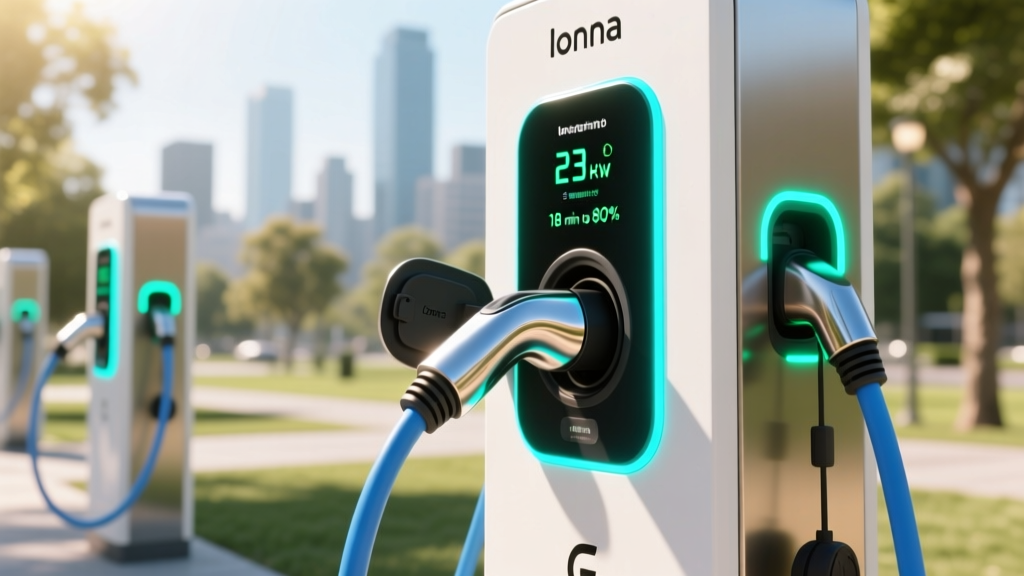
For a high-performance EV like the Tesla Model S Plaid (100 kWh battery, 396-mile EPA range), Level 2 charging at 11.5 kW adds roughly 35 miles of range per hour—meaning a full charge from 10% to 90% takes about 7 hours. DC fast charging at Tesla's V3 Superchargers (250 kW peak) can add 200 miles in 15 minutes, though charging speed tapers significantly above 80% state of charge to protect battery health.
Real-world range caveat: EPA range estimates assume moderate temperatures and mixed driving. Expect 15-30% range reduction in cold weather (below 32°F) due to battery chemistry limitations and cabin heating demands. Highway driving at 75+ mph reduces efficiency by 10-20% versus combined city/highway cycles. A 396-mile EPA-rated Model S Plaid realistically delivers 280-320 miles on a cold-weather highway trip.
Home Charging Installation: Electrical Requirements and True Costs
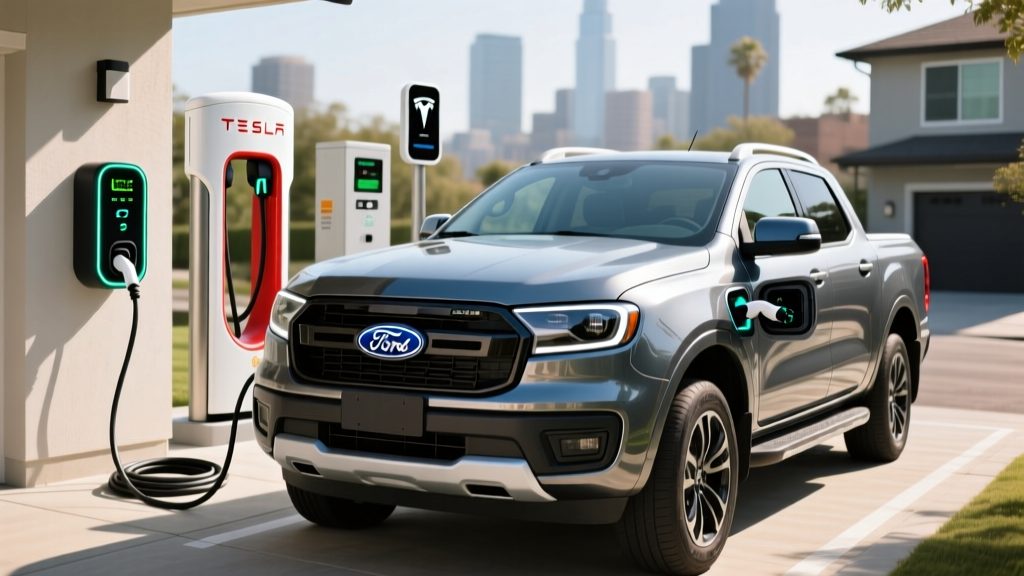
Installing a Level 2 home charger requires a dedicated 240-volt circuit, similar to what powers an electric dryer or oven. The most common setup is a 50-amp circuit with a 40-amp continuous load charger (the National Electrical Code requires circuits be rated for 125% of continuous load), delivering 9.6 kW of charging power.
Here's where the Hellcat comparison becomes concrete: while the Hellcat needs no home infrastructure beyond a standard gas can for emergency fuel, a high-performance EV requires upfront electrical work that varies dramatically based on your home's existing panel capacity and the distance from panel to charging location.
| Component | Basic Install | Complex Install | Notes |
|---|---|---|---|
| EV Charger (Level 2, 40A) | $500-$700 | $600-$1,200 | Smart chargers with WiFi/app control cost more |
| Electrical Permit | $50-$150 | $150-$300 | Varies by municipality; required for code compliance |
| Electrician Labor (2-4 hours) | $400-$800 | $800-$1,500 | Licensed electrician rates: $100-$200/hour |
| Conduit, Wiring, Breaker | $200-$400 | $400-$1,000 | Longer runs from panel increase material costs |
| Panel Upgrade (if needed) | $0 | $1,500-$3,500 | Required if existing panel lacks capacity or space |
| Total | $1,150-$2,050 | $3,450-$7,500 | Most homes fall in $1,500-$3,000 range |
The panel upgrade scenario deserves emphasis. Homes built before 1990 often have 100-amp electrical service, which may already be near capacity with existing appliances. Adding a 50-amp EV circuit could require upgrading to 200-amp service—a $1,500-$3,500 expense that catches many buyers off guard. Newer homes (post-2000) typically have 200-amp panels with spare capacity, making installation straightforward.
A licensed electrician will perform a load calculation to determine if your panel can support EV charging. This isn't optional—it's a safety requirement and insurance consideration. Never install a high-amperage circuit without proper permitting; unpermitted work can void homeowner insurance claims and create fire hazards.
Connector Compatibility: NACS, CCS1, and Adapter Requirements
The EV charging landscape in 2026 has consolidated around two primary connector standards, with Tesla's North American Charging Standard (NACS) winning the format war after Ford, GM, Rivian, and most major automakers committed to adopting it starting in 2025.
| Connector | Brands Using (2026) | DC Fast Charge Availability | Adapter Needed? |
|---|---|---|---|
| NACS (Tesla) | Tesla, Ford, GM, Rivian, Volvo, Polestar, Mercedes, BMW | Tesla Supercharger network (17,000+ stalls), growing third-party | None for Tesla; CCS-to-NACS adapters ($200-$400) for older non-Tesla EVs |
| CCS1 | VW, Hyundai, Kia, legacy non-Tesla EVs (pre-2025) | Electrify America, EVgo, ChargePoint DC stations | NACS-to-CCS adapter for Tesla Supercharger access |
| CHAdeMO | Nissan Leaf (legacy only) | Limited; being phased out | Not recommended for new purchases |
For buyers comparing a used Hellcat to a modern EV, connector choice matters for road trip flexibility. Tesla's Supercharger network remains the most reliable and extensive DC fast-charging infrastructure, with 98% uptime versus 70-80% for some third-party networks. If you're considering a non-Tesla EV, verify it has NACS compatibility or that the manufacturer provides a CCS-to-NACS adapter for Supercharger access.
Cost Per Mile: EV Charging vs Hellcat Fuel Economy
The economic argument for EVs hinges on per-mile energy costs, but those costs vary dramatically based on where and when you charge. Here's the real math comparing a Tesla Model S Plaid to the final-generation Dodge Challenger Hellcat:
| Scenario | EV (Model S Plaid) | Hellcat (13/21 mpg) | Difference |
|---|---|---|---|
| Home Charging (Off-Peak Rate: $0.12/kWh) | $0.036/mile | — | — |
| Home Charging (Peak Rate: $0.25/kWh) | $0.075/mile | — | — |
| Public Level 2 ($0.35/kWh) | $0.105/mile | — | — |
| DC Fast Charging ($0.48/kWh) | $0.144/mile | — | — |
| Gasoline (Premium $4.50/gal, 16 mpg avg) | — | $0.281/mile | — |
| Annual Cost (12,000 miles) | $432-$1,728 | $3,372 | $1,644-$2,940 savings |
The Model S Plaid achieves roughly 3.0 miles per kWh (EPA-rated 120 MPGe combined). At the national average residential electricity rate of $0.16/kWh (U.S. Energy Information Administration), home charging costs $0.053 per mile—81% cheaper than fueling a Hellcat at $4.50/gallon premium.
However, DC fast charging on road trips narrows the gap significantly. At Electrify America's $0.48/kWh rate, the EV costs $0.144/mile—still half the Hellcat's cost, but no longer dramatically cheaper. Time-of-use rates matter enormously: charging during off-peak hours (typically 10 PM - 6 AM) can cut costs by 50-70% versus peak afternoon rates.
Equipment Recommendations: Home Chargers for High-Performance EVs
High-performance EVs with large batteries (80-100+ kWh) benefit from higher-power Level 2 chargers that reduce overnight charging time. Here are three proven options across price ranges:
ChargePoint Home Flex (50A)
- Power Output: 12 kW (50A circuit, 40A continuous)
- Connector: NACS or CCS1 (configurable)
- Cable Length: 23 feet
- Smart Features: WiFi, app scheduling, energy tracking, Alexa integration
- Price: $699
- Best For: Most homes with 200A panels; balances speed and cost
Tesla Wall Connector (60A)
- Power Output: 14.4 kW (60A circuit, 48A continuous)
- Connector: NACS (native Tesla)
- Cable Length: 24 feet
- Smart Features: WiFi, over-the-air updates, power sharing (multiple units), load management
- Price: $475
- Best For: Tesla owners wanting maximum home charging speed
Grizzl-E Smart (40A)
- Power Output: 9.6 kW (40A circuit, 32A continuous)
- Connector: NACS or CCS1 (configurable)
- Cable Length: 24 feet
- Smart Features: WiFi, app control, adjustable amperage (16A-40A), outdoor-rated
- Price: $549
- Best For: Older homes with limited panel capacity; adjustable amperage prevents overload
For buyers comparing a used Hellcat ($40,000-$55,000 in 2026 used market) to a new Tesla Model 3 Performance ($52,990 MSRP, eligible for $7,500 federal tax credit with proper income and sourcing compliance per IRS §30D guidelines), the charger cost is a one-time $500-$700 expense versus ongoing premium fuel costs.
Charging Time Examples: 10-80% State of Charge
DC fast charging speeds are rarely linear. Batteries accept charge fastest between 10-50% state of charge, then taper significantly to prevent overheating and degradation. Here's what to expect with common high-performance EV batteries:
| Vehicle | Battery (kWh) | Peak DC kW | 10-80% Time | Notes |
|---|---|---|---|---|
| Tesla Model S Plaid | 100 | 250 kW | 27 minutes | Tapers to 100 kW above 60% SoC |
| Lucid Air Grand Touring | 112 | 300 kW | 22 minutes | 900V architecture enables sustained high power |
| Porsche Taycan Turbo S | 83.7 | 270 kW | 23 minutes | 800V system; preconditioning required for peak speed |
| Hyundai Ioniq 5 N | 84 | 240 kW | 18 minutes | Best-in-class charging speed for price point |
Preconditioning—warming the battery to optimal temperature before DC charging—is critical for achieving advertised charge rates. Tesla navigation automatically precondition when routing to a Supercharger; other brands require manual activation or app-based preconditioning. Skip this step in cold weather and you'll see 40-60% slower charging speeds.
Safety, Code Compliance, and Outdoor Installation
EV charger installation must comply with National Electrical Code (NEC) Article 625 and local building codes. Key safety requirements include:
- Dedicated Circuit: EV chargers require their own circuit—no sharing with other appliances
- GFCI Protection: Ground Fault Circuit Interrupter breakers are mandatory for outdoor installations and recommended indoors
- Outdoor Rating: Chargers installed outside must be NEMA 4-rated (weatherproof); indoor chargers are typically NEMA 1
- Cable Management: NEC requires cables not create trip hazards; wall-mounted cord reels or retractors are common solutions
- Ventilation: While EVs don't emit gases, chargers generate heat; garage installations should maintain 3-foot clearance from combustibles
For homes in flood zones or areas with extreme temperature swings (-20°F to 120°F), specify chargers with appropriate environmental ratings. Most quality chargers operate from -22°F to 122°F, but LCD screens may become sluggish below 0°F.
FAQ: Supercharged Hellcat vs EV Charging Infrastructure
How much does it cost to install a home EV charger?
Most homes pay $1,500-$3,000 for a complete Level 2 installation (charger + electrician + permit + materials). Homes requiring panel upgrades can pay $3,500-$7,500. Get 2-3 quotes from licensed electricians and verify they pull permits—unpermitted work creates insurance and resale issues.
How fast will each charging level add range?
Level 1 (120V): 3-5 miles per hour. Level 2 (240V, 40A): 25-35 miles per hour. DC Fast Charging (150-250 kW): 180-400 miles in 20-30 minutes, though speed tapers above 80% state of charge.
Which connector/charger is compatible with my EV?
2026 models from Tesla, Ford, GM, Rivian, and most major brands use NACS. Older non-Tesla EVs (pre-2025) typically use CCS1 and need an adapter for Tesla Superchargers. Check your vehicle's charge port or owner's manual—never force a connector.
How much does charging cost per mile vs gas?
Home charging averages $0.04-$0.08 per mile (depending on local electricity rates), while a Hellcat costs $0.28 per mile at $4.50/gallon premium. DC fast charging costs $0.12-$0.16 per mile—still cheaper than gas but less dramatically so.
What electrical upgrades might I need?
Homes with 100-amp service or full electrical panels may need a 200-amp upgrade ($1,500-$3,500). An electrician will perform a load calculation considering existing appliances (HVAC, electric range, dryer) to determine if your panel can support a 50-amp EV circuit.
Can I charge faster than Level 2 at home?
Technically yes—some homes can support 80-amp circuits delivering 19.2 kW—but the electrical service upgrade costs ($5,000-$15,000) rarely justify the benefit. Most EVs charge overnight on 40-50A circuits; the time savings from faster home charging don't offset the expense.
Does the federal tax credit cover home charger installation?
The Alternative Fuel Vehicle Refueling Property Credit covers 30% of charger and installation costs up to $1,000, but only if you live in an eligible census tract (typically low-income or non-urban areas). Check IRS guidelines and consult a tax professional—eligibility is location-specific.
Choose EV charging infrastructure if:
- You have home charging access (garage or dedicated parking spot)
- Your electrical panel has capacity for a 50-amp circuit (or you're willing to upgrade)
- You drive 30-200 miles daily and want $1,500-$3,000 annual fuel savings
- You value instant torque and 0-60 times matching or exceeding a Hellcat
Stick with a supercharged Hellcat if:
- You lack reliable home charging access (apartment, street parking)
- You regularly drive 400+ miles in remote areas with sparse charging infrastructure
- You prioritize exhaust sound, mechanical engagement, and V8 character over efficiency
- You view the vehicle as a collectible (Hellcats are appreciating post-discontinuation)