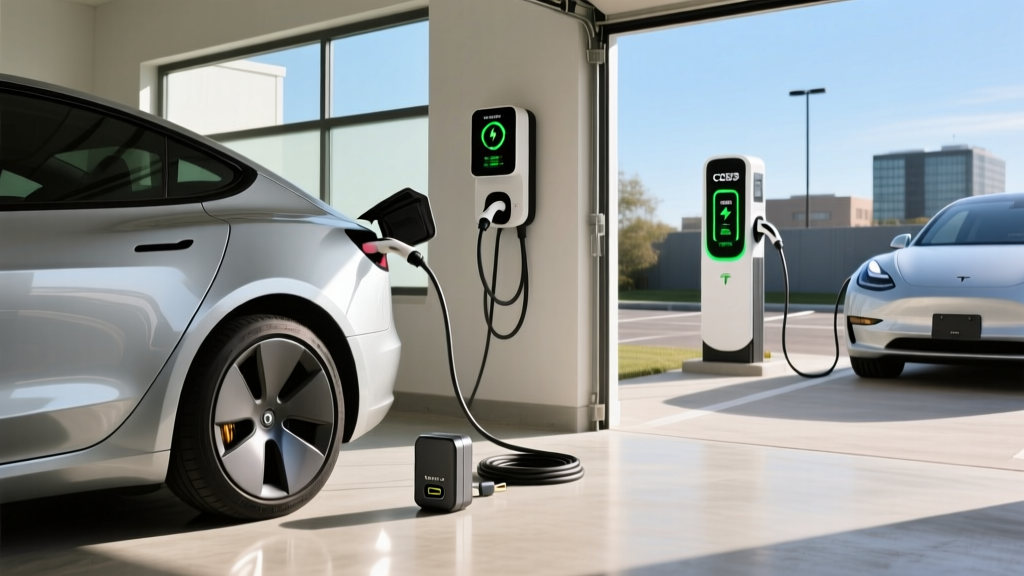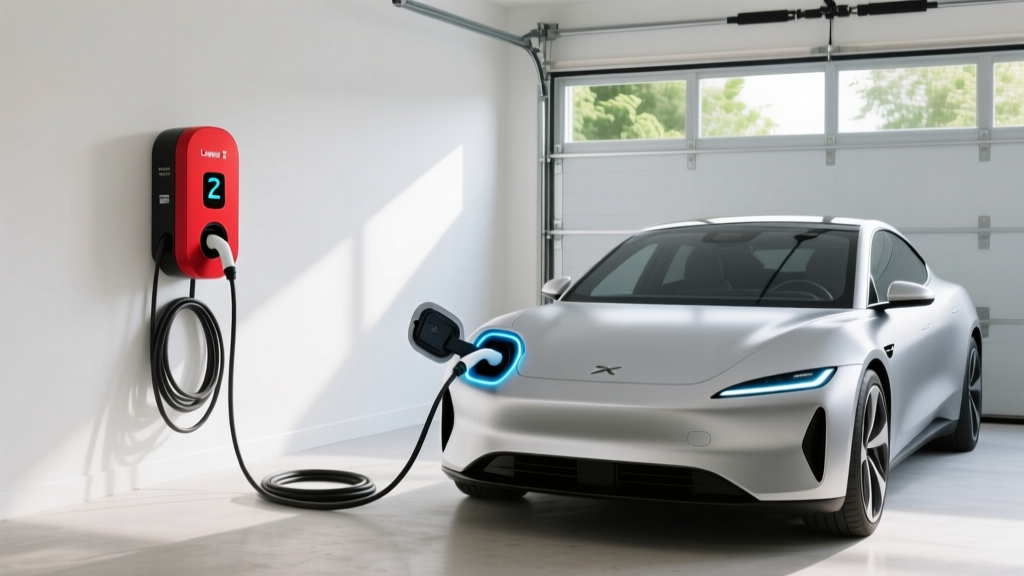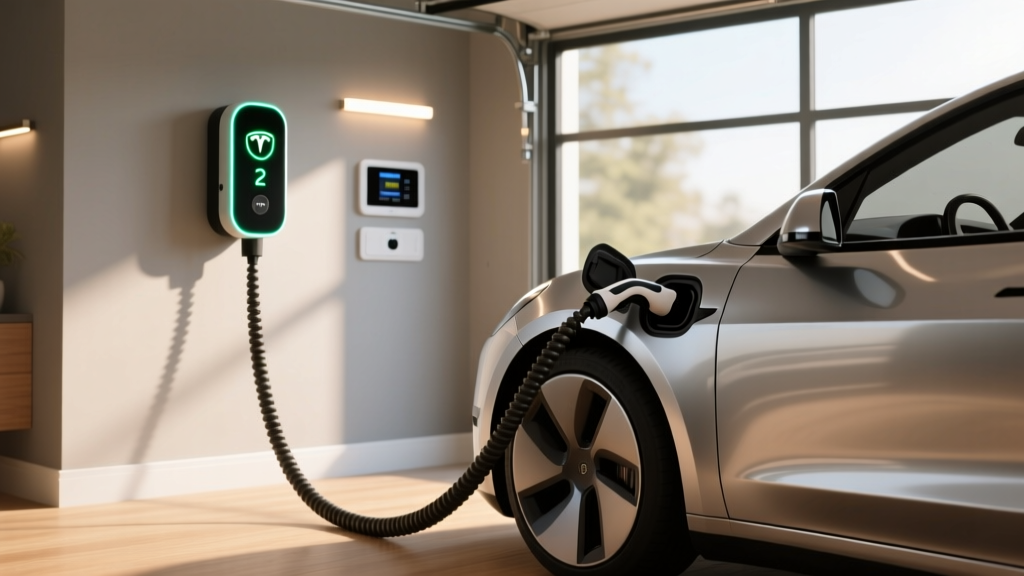
If you've searched for a gray charger for your garage or driveway, you're likely looking at the most popular color option for Level 2 home EV charging stations. Manufacturers like ChargePoint, Wallbox, Emporia, and Grizzl-E offer their wall-mounted units in neutral gray finishes that blend with modern garage aesthetics. But aesthetics aside, choosing the right home charger means matching electrical capacity, connector type, and power output to your specific EV and daily driving needs.
This guide breaks down everything you need to know: charging speeds by level, what your electrical panel can support, real installation costs, connector compatibility, and the best gray-finish Level 2 chargers available in 2026.
Understanding EV Charging Levels and Speeds
Before picking any charger, you need to understand the three charging levels and what each delivers in practical range per hour. The critical distinction: kW (kilowatts) measures power — the rate electricity flows into your battery. kWh (kilowatt-hours) measures energy — the total capacity stored. A 48-amp Level 2 charger delivering 11.5 kW is the power rate; an 82 kWh battery is how much energy it holds.
| Level | Voltage | Max Power (kW) | Miles of Range Added Per Hour | Typical Use Case |
|---|---|---|---|---|
| Level 1 | 120V AC | 1.4–1.9 kW | 3–5 miles | Overnight top-up, PHEVs, low-mileage drivers |
| Level 2 | 240V AC | 3.3–19.2 kW | 12–75 miles | Home daily charging, workplace, public destinations |
| DC Fast | 400–800V DC | 50–350+ kW | 150–1,200+ miles (equivalent) | Road trips, highway corridors, commercial fleets |
For most EV owners, a Level 2 home charger is the daily workhorse. A typical 60 kWh battery (like the Chevrolet Equinox EV or base Tesla Model 3) charges from 10% to 80% in roughly 5–6 hours on an 11.5 kW (48-amp) home charger. Larger batteries, such as the 131 kWh pack in the Ford F-150 Lightning Extended Range, need 10+ hours at that same rate — making a higher-amperage unit or scheduled off-peak charging essential.
How Much Does It Cost to Install a Home EV Charger?
The total installed cost of a gray Level 2 wall charger depends on four variables: the charger unit itself, electrician labor, permit fees, and whether your electrical panel needs an upgrade. Here's a realistic breakdown based on 2026 national averages:
| Component | Typical Range | Notes |
|---|---|---|
| Level 2 charger unit (hardwired or plug-in) | $300–$750 | 40A–80A smart chargers; gray finish widely available |
| Electrician labor (240V circuit run) | $400–$1,500 | Depends on distance from panel, wall material, conduit run |
| Electrical permit | $50–$200 | Required in most jurisdictions; varies by municipality |
| Panel upgrade (if needed) | $1,500–$4,000+ | 100A → 200A service upgrade for older homes; not always required |
| Total (no panel upgrade) | $750–$2,450 | Most homes with 200A service and nearby panel |
| Total (with panel upgrade) | $2,250–$6,450+ | Older homes with 100A service or maxed-out panels |
Panel upgrade reality check: Homes built before the 1990s often have 100-amp electrical service. Adding a 40-amp or 50-amp dedicated EV circuit may exceed the panel's capacity, requiring a service upgrade to 200 amps. A licensed electrician will perform a load calculation per NEC Article 220 to determine whether your existing panel can handle the additional draw. Don't skip this step — an overloaded panel is a fire hazard.
The IRS §30C Alternative Fuel Vehicle Refueling Property Credit offers up to $1,000 (30% of equipment and installation costs) for home charger installations, subject to income limits and census-tract eligibility. Consult a tax professional for your specific situation.
Electrical Requirements: What Your Home Needs
A Level 2 charger requires a 240-volt dedicated circuit, the same voltage as your electric dryer or oven. The amperage of that circuit determines your maximum charging speed:
- 40-amp circuit: Delivers up to 32 amps continuous (9.6 kW) — NEC requires chargers to draw no more than 80% of a circuit's rated capacity for continuous loads
- 50-amp circuit: Delivers up to 40 amps continuous (9.6–11.5 kW) — the sweet spot for most EVs
- 60-amp circuit: Delivers up to 48 amps continuous (11.5 kW) — ideal for larger batteries like the F-150 Lightning or Rivian R1T
- 100-amp circuit: Delivers up to 80 amps continuous (19.2 kW) — requires substantial panel capacity; supported by select EVs like the Tesla Model S/X and Cybertruck with the optional high-amperage onboard charger
Safety and code considerations: The National Electrical Code (NEC) requires a dedicated circuit for EV charging — you cannot share the circuit with other appliances. Hardwired installations must be on a GFCI-protected breaker (NEC 2020 and later). Outdoor-rated chargers need a NEMA 4 or NEMA 4X enclosure rating to withstand rain, dust, and temperature swings. If you're installing a plug-in unit (NEMA 14-50 outlet), ensure the receptacle is properly grounded and rated for continuous use — cheap or worn outlets can overheat under sustained EV charging loads.
Connector Compatibility: NACS, CCS1, and CHAdeMO
Your EV's charge port determines which connector your home charger needs. As of 2026, the North American Charging Standard (NACS, originally Tesla's proprietary connector) has become the dominant standard, with most legacy CCS1 vehicles now shipping with or offering adapters.
| Connector | Brands Using It (Native) | Home Charger Availability | Adapter Needed? |
|---|---|---|---|
| NACS (Tesla) | Tesla, Ford, GM, Rivian, Volvo, Polestar, BMW, Hyundai/Kia (2025+), Toyota (2026+) | Widely available — Tesla Wall Connector, ChargePoint Home Flex (NACS), Wallbox Pulsar Max (NACS) | No for NACS-native EVs |
| CCS1 | Legacy models: 2020–2024 VW ID.4, Hyundai Ioniq 5 (pre-2025), Kia EV6 (pre-2025), BMW i4 (pre-2025) | Available — ChargePoint Home Flex (CCS), Emporia Vue (CCS) | NACS-to-CCS adapter for newer NACS chargers |
| CHAdeMO | Nissan Leaf (all years), Mitsubishi Outlander PHEV (legacy) | Limited — mostly legacy Level 2 units | J1772-to-CHAdeMO for Level 2 (CHAdeMO is DC-specific) |
| J1772 | All non-Tesla EVs for Level 2 AC charging (universal AC standard) | Universal — every Level 2 charger supports J1772 or includes adapter | Tesla vehicles use included J1772 adapter |
Practical recommendation: If you own a NACS-native EV (2025+ models from most brands), buy a NACS-connector charger. If your EV has CCS1, buy a CCS1 charger or a NACS charger with a certified NACS-to-CCS adapter (roughly $150–$250). The J1772 standard still governs all Level 2 AC charging in North America at the protocol level, so even NACS connectors deliver AC power using the J1772 communication protocol.
Best Gray Level 2 Home Chargers in 2026
Here are four highly rated gray-finish Level 2 chargers spanning different amperage tiers and price points. All are UL-listed or ETL-certified for safety.
ChargePoint Home Flex (NACS or CCS1)
- Power output: Up to 11.5 kW (48 amps) on a 60A circuit; adjustable down to 16A
- Connector: Available in NACS or CCS1 configurations
- Cable length: 23 feet
- Smart features: Wi-Fi, app scheduling, Alexa/Google integration, energy tracking, utility demand-response programs
- Price: ~$599 (NACS), ~$549 (CCS1)
- Best for: Flexibility across amperage settings; utility integration
Tesla Wall Connector (Gen 3.5)
- Power output: Up to 11.5 kW (48 amps) on a 60A circuit
- Connector: NACS native; includes J1772 adapter in box
- Cable length: 24 feet
- Smart features: Wi-Fi, Tesla app integration, over-the-air updates, Power-Share (load balancing between two units)
- Price: ~$475
- Best for: Tesla owners seeking the cleanest integration and lowest cost per kW
Emporia Level 2 EV Charger
- Power output: Up to 11.5 kW (48 amps) on a 60A circuit; configurable 16A–48A
- Connector: J1772 (NACS adapter available separately)
- Cable length: 24 feet
- Smart features: Wi-Fi, Emporia app, real-time energy monitoring, solar integration with Emporia Vue energy monitor, time-of-use scheduling
- Price: ~$399
- Best for: Budget-conscious buyers wanting detailed energy data and solar pairing
Wallbox Pulsar Max
- Power output: Up to 11.5 kW (48 amps) on a 60A circuit
- Connector: Available in NACS or J1772
- Cable length: 25 feet
- Smart features: Wi-Fi + Bluetooth, myWallbox app, Eco-Smart mode (solar matching), Power Sharing, compact form factor
- Price: ~$549
- Best for: Compact garages; solar-home integration
Charging Cost: Home vs. Public vs. Gas
The economics of EV charging depend on your electricity rate, whether you charge at home or on public networks, and how your vehicle's efficiency compares to a gasoline equivalent. Here's a realistic cost-per-mile comparison using 2026 national averages:
| Scenario | Rate / Price | Vehicle Efficiency | Cost Per Mile |
|---|---|---|---|
| Home charging (off-peak, national avg.) | $0.13/kWh | 3.5 miles/kWh (typical midsize EV, ~115 MPGe) | $0.037 |
| Home charging (California avg.) | $0.27/kWh | 3.5 miles/kWh | $0.077 |
| Public Level 2 (ChargePoint, EVgo L2) | $0.30–$0.45/kWh | 3.5 miles/kWh | $0.086–$0.129 |
| DC Fast Charging (Electrify America, Tesla Supercharger) | $0.35–$0.55/kWh | 3.5 miles/kWh | $0.100–$0.157 |
| Gasoline vehicle (national avg.) | $3.35/gallon | 28 MPG combined | $0.120 |
Even at California's higher residential rates, home EV charging costs roughly 35–65% less per mile than fueling an average gasoline car. The savings widen dramatically with off-peak utility rates or solar-generated electricity. However, exclusive reliance on DC fast charging can push your per-mile cost above gasoline — a key reason home Level 2 charging is the economic backbone of EV ownership.
According to fueleconomy.gov, the average 2026 EV achieves 100–130 MPGe combined, translating to 2.8–4.0 miles per kWh. Efficiency varies significantly: the Hyundai Ioniq 6 SE Long Range delivers around 4.0 mi/kWh (140 MPGe), while the GMC Hummer EV manages roughly 2.0 mi/kWh (47 MPGe). Check your specific model's EPA efficiency rating before calculating personal costs.
Charging Time Examples: 10–80% by Battery Size
Most EV owners charge between 10% and 80% State of Charge (SoC) for daily use — the 80% ceiling preserves battery longevity and avoids the steep charge-curve taper that occurs above 80%. Here's how long common battery sizes take on different home charger outputs:
- 60 kWh battery (Chevrolet Equinox EV, base Tesla Model 3 RWD): 10–80% = ~42 kWh needed
- At 9.6 kW (40A circuit): ~4.4 hours
- At 11.5 kW (60A circuit): ~3.7 hours
- 82 kWh battery (Tesla Model Y Long Range, Ford Mustang Mach-E Extended Range): 10–80% = ~57 kWh needed
- At 9.6 kW: ~5.9 hours
- At 11.5 kW: ~5.0 hours
- 100 kWh battery (Rivian R1T Dual-Motor Large, BMW iX xDrive50): 10–80% = ~70 kWh needed
- At 9.6 kW: ~7.3 hours
- At 11.5 kW: ~6.1 hours
- 131 kWh battery (Ford F-150 Lightning Extended Range): 10–80% = ~92 kWh needed
- At 9.6 kW: ~9.6 hours
- At 11.5 kW: ~8.0 hours
- At 19.2 kW (100A circuit, if supported): ~4.8 hours
Real-world note: These times assume consistent peak power delivery. In practice, charging speed can taper slightly in extreme heat or cold due to battery thermal management. If you charge overnight during off-peak hours (typically 10 PM – 6 AM), even the largest batteries recharge fully by morning on a standard 48-amp circuit.
What Electrical Upgrades Might I Need?
Before purchasing a gray charger or scheduling an electrician, assess these four factors:
- Panel capacity: Check your main breaker rating (100A, 150A, or 200A). A 200A panel with existing loads under ~140A can typically accommodate a 40–60A EV circuit. A licensed electrician will perform a NEC Article 220 load calculation.
- Panel location vs. charger location: Longer conduit runs increase labor cost. A charger mounted 10 feet from the panel might cost $400 in labor; one requiring 80 feet of conduit through finished walls could exceed $1,500.
- Available breaker spaces: Your panel needs two adjacent open slots for a 240V double-pole breaker. If your panel is full, a sub-panel or tandem breakers (where code permits) may be needed — adding $200–$600.
- Utility service capacity: In rare cases, the utility's service drop to your home may need upgrading. This is the most expensive scenario ($3,000–$10,000+) and requires coordination with your utility company.
For homes that cannot support a full panel upgrade, smart load-management chargers (like the Wallbox Pulsar Max with Eco-Smart or the Emporia charger paired with a Vue energy monitor) can dynamically throttle charging amperage based on real-time household load — avoiding panel upgrades entirely while still delivering overnight charging.
Frequently Asked Questions
Can I install a gray Level 2 charger outdoors?
Yes, provided the unit carries a NEMA 4 or NEMA 4X weather-resistance rating. All four chargers recommended above are rated for outdoor installation. Ensure the electrical connection point (hardwired junction box or NEMA 14-50 outlet) is also weather-protected, and use a GFCI breaker as required by NEC 2020+ for outdoor receptacles.
Do I need a smart charger, or will a basic unit work?
A basic (non-connected) charger will charge your EV just fine. Smart features — app scheduling, energy monitoring, utility demand-response participation, and over-the-air firmware updates — add convenience and can reduce charging costs by automating off-peak scheduling. If your utility offers time-of-use rates, a smart charger pays for its price premium within months.
Is a plug-in (NEMA 14-50) or hardwired charger better?
Hardwired installations are generally preferred for 48-amp and higher chargers: they eliminate the outlet as a potential failure point, allow higher continuous amperage (some 14-50 outlets are rated for only 40A continuous), and are required by code in many jurisdictions for circuits above 50 amps. Plug-in units offer portability — useful if you plan to move or take the charger to a new home. For a 60-amp circuit (48A continuous), hardwire is the safer, code-compliant choice.
Will a gray charger work with my Tesla?
Yes. All Tesla vehicles (Model 3, Model Y, Model S, Model X, Cybertruck) use the NACS connector natively. The Tesla Wall Connector, ChargePoint Home Flex (NACS version), and Wallbox Pulsar Max (NACS version) all connect directly. If you buy a J1772 charger, Tesla includes a J1772-to-NACS adapter with every vehicle.
How do I claim the home charger tax credit?
The IRS §30C credit covers 30% of equipment and installation costs, up to $1,000, for home EV charger installations placed in service at your primary residence. Eligibility depends on your census tract (must be a non-urban or low-income community per IRS guidance) and income limits. File IRS Form 8911 with your federal tax return. Consult a tax professional to confirm eligibility for your specific address and tax situation.