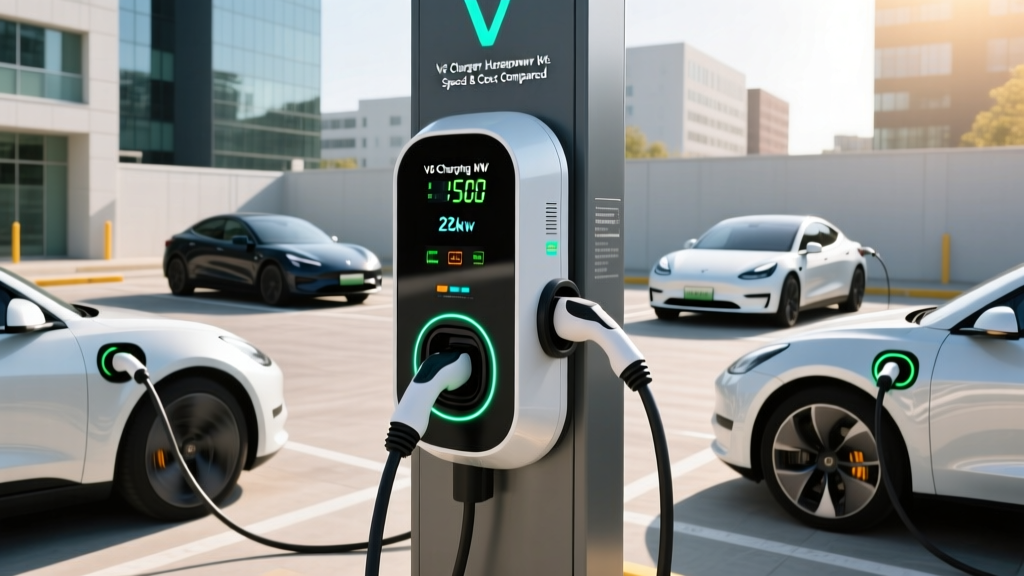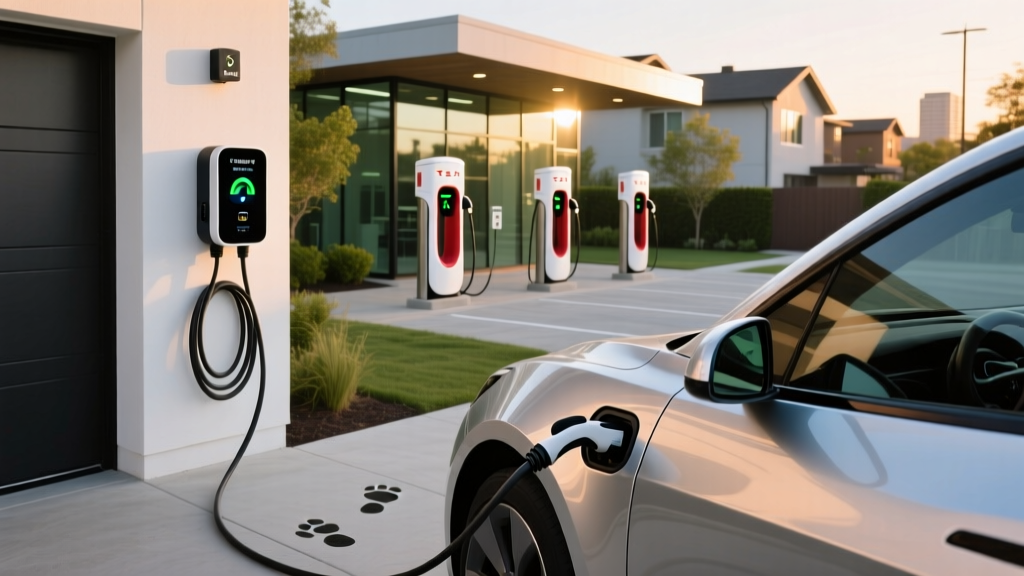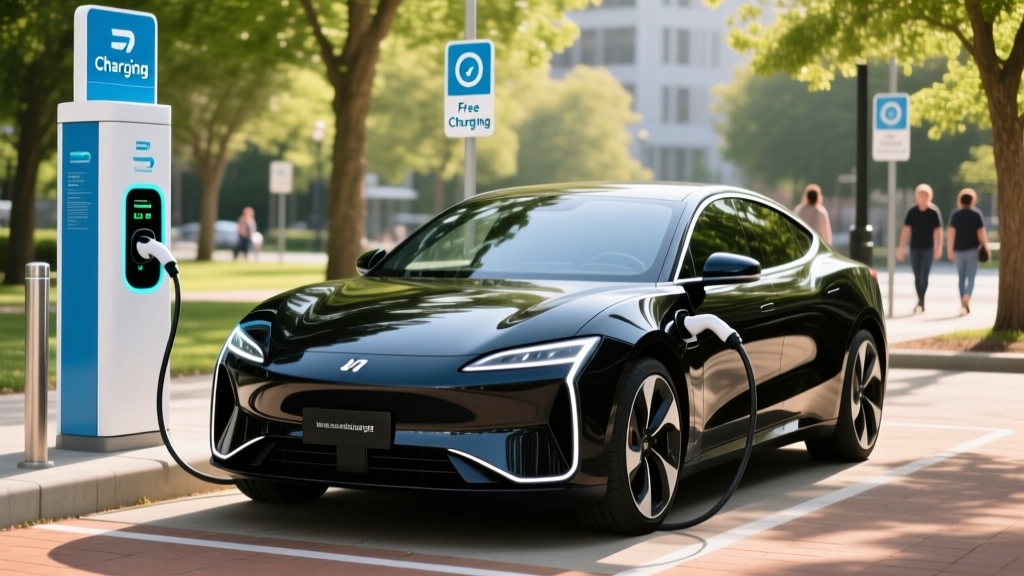
Search any EV forum or subreddit and you'll find owners sharing pins on maps of free EV chargers — hotel parking garages, shopping centers, car dealerships, and municipal lots that offer complimentary electricity. For a new EV owner trying to offset a higher monthly payment, or an apartment dweller without home charging access, these free stations look like a lifeline. But free electricity comes with trade-offs that most aggregator apps bury in fine print: slow charging speeds, time limits, unreliable hardware, and the hidden cost of driving out of your way to use them.
This guide breaks down where free EV chargers actually exist in 2026, what they cost you in time and convenience, and how they compare to paid public charging and a home Level 2 installation on a per-mile basis.
Where Free EV Chargers Actually Exist (and Where They Don't)
Free EV charging isn't a myth, but it isn't a nationwide network either. Most free chargers fall into a few predictable categories:
- Hospitality venues: Hotels, resorts, and some Airbnb hosts install Level 2 chargers (typically 6.6–11.5 kW) as guest amenities. Access is often restricted to paying guests or requires a valet key.
- Retail and grocery: Shopping centers, especially in EV-dense markets like California, Oregon, Washington, and the Northeast corridor, sometimes offer free Level 2 charging for 1–2 hours to encourage foot traffic. Expect J1772 or NACS connectors.
- Workplace charging: Some employers subsidize Level 2 charging as an employee benefit. Availability is shrinking as companies shift to paid models to manage demand and recoup electricity costs.
- Municipal and library lots: City governments occasionally install free chargers in public parking structures. These are often older 6.6 kW units and can be occupied by non-EVs (ICEing) or broken.
- Dealership lots: Some EV dealerships let you charge for free while you wait, but this is informal and varies by location.
What you will almost never find for free is DC fast charging (50–350 kW). DCFC equipment costs $50,000–$150,000 to install, carries demand charges from the utility, and is operated by networks like Electrify America, EVgo, and Tesla Supercharger as a for-profit business. If an app shows a "free" DC fast charger, verify it — it's almost certainly a data error or a temporary promotional period that has ended.
Apps like PlugShare, ChargePoint, and A Better Routeplanner let you filter for free stations. But treat user-reported "free" status skeptically: pricing changes frequently, and a station marked free six months ago may have switched to a paid model without the listing updating.
Charging Levels Explained: Speed, Power, and What "Free" Gets You
Before evaluating whether a free charger is worth your time, you need to understand the three charging levels and what each delivers. The critical distinction: kW (kilowatts) measures power — how fast energy flows into your car. kWh (kilowatt-hours) measures energy — how much total capacity your battery holds. A 10 kW charger delivers 10 kWh of energy in one hour (before losses).
| Level | Voltage | Typical Power (kW) | Miles of Range Added per Hour | Best For |
|---|---|---|---|---|
| Level 1 | 120V AC | 1.2–1.9 kW | 3–5 miles | Overnight top-up, PHEVs, low-mileage drivers |
| Level 2 | 240V AC | 3.3–19.2 kW | 12–75 miles | Home charging, workplace, retail/hotel free stations |
| DC Fast (DCFC) | 200–900V DC | 50–350 kW | 150–1,000+ miles (theoretical peak) | Road trips, quick top-ups; rarely free |
Most free chargers you'll encounter are Level 2 units in the 6.6–11.5 kW range. At 7.2 kW (a very common public Level 2 output), a vehicle averaging 3.5 miles per kWh gains roughly 25 miles of range per hour. That's useful if you're parked for a two-hour dinner or a full workday — but it's not a quick pit stop. A 75 kWh battery going from 10% to 80% (52.5 kWh delivered, or ~60 kWh accounting for charging losses) takes roughly 8+ hours at 7.2 kW.
For context, here are approximate 10–80% charging times at various power levels for a mid-size EV with a ~75 kWh usable battery:
- Level 1 (1.4 kW): ~50+ hours — not viable for full charges
- Level 2 (7.2 kW): ~8–9 hours
- Level 2 (11.5 kW): ~5.5–6 hours
- Level 2 (19.2 kW): ~3.5 hours
- DCFC (150 kW peak, tapered curve): ~25–35 minutes (10–80%)
The DCFC time reflects real-world charge-curve taper: a vehicle may peak at 150–250 kW up to ~50% state of charge, then throttle significantly above 80% to protect battery health. This is why we quote 10–80% times rather than 0–100%.
The Real Cost of "Free" Charging: Time, Detours, and Unreliability
Free electricity sounds like a pure win, but the economics shift when you factor in the full cost of using free public chargers:
- Detour distance: If the nearest free Level 2 is 8 miles out of your way (round trip: 16 miles), and your EV averages 3.5 mi/kWh, you've spent ~4.6 kWh just getting there — roughly $0.60–$1.40 worth of electricity at residential rates, or $1.50–$2.30 at public DCFC rates. That partially offsets the savings.
- Wait time: Free chargers are popular. At a shopping center with two free Level 2 spots, you'll often find them occupied — by other EVs, or by gas cars (ICEing). A 15–20 minute wait is common.
- Time limits: Many free stations enforce 1–2 hour limits, which may not deliver enough range for your needs at 6.6–7.2 kW.
- Reliability: Free chargers tend to be older, less maintained hardware. According to J.D. Power's 2025 EV Public Charging Study, public Level 2 chargers have a roughly 20% failure rate — and free, unmonitored units skew worse.
- No preconditioning optimization: When you charge at home, your EV can precondition the battery on a schedule for optimal charging speed and battery health. Public Level 2 charging is opportunistic and often done at suboptimal battery temperatures.
For most EV owners, free public Level 2 charging works best as a supplementary perk — a nice bonus when you're already shopping or dining — not as a primary charging strategy.
Home Level 2 Charging: Installation Costs, Electrical Requirements, and Panel Upgrades
The most reliable and cost-effective charging setup for the majority of EV owners is a home Level 2 charger. But installation costs vary dramatically depending on your home's electrical panel, the distance from the panel to your parking spot, and local permit requirements.
Electrical Requirements
A standard home Level 2 installation requires a 240V dedicated circuit. Common configurations:
- 240V / 30A circuit → 24A continuous draw → ~5.8 kW — adequate for PHEVs and low-mileage BEV drivers
- 240V / 40A circuit → 32A continuous → ~7.7 kW — the most common residential setup, handles overnight charging for most BEVs
- 240V / 50A circuit → 40A continuous → ~9.6 kW — ideal for larger batteries (100+ kWh) or high-mileage drivers
- 240V / 60A circuit → 48A continuous → ~11.5 kW — maximum for most residential chargers; requires robust panel capacity
Electrical code (NEC Article 625) requires that EV chargers be on a dedicated circuit and that continuous loads not exceed 80% of the circuit breaker rating — hence a 40A breaker yields 32A of usable charging current.
Panel Upgrade Considerations
Many homes built before 2000 have 100-amp electrical panels. Adding a 40A EV circuit may push total load past the panel's capacity, especially if you already run electric range, dryer, HVAC, and water heater. A licensed electrician will perform a load calculation to determine if your panel can handle the new circuit.
If an upgrade is needed, expect to move from a 100A to a 200A panel. This is a significant expense but also future-proofs your home for additional electrification (heat pumps, solar, second EV).
| Component | Typical Cost Range | Notes |
|---|---|---|
| Level 2 charger hardware | $300–$700 | Varies by power output, cable length, smart features |
| Electrician labor (standard install) | $500–$1,500 | Depends on distance from panel, conduit run, wall type |
| Permit and inspection | $50–$300 | Required in most jurisdictions; varies by municipality |
| Electrical panel upgrade (if needed) | $1,500–$4,000 | 100A → 200A service upgrade; not always required |
| Total (no panel upgrade) | $850–$2,500 | Most common scenario for newer homes |
| Total (with panel upgrade) | $2,350–$6,500 | Older homes or high-load households |
Some utilities offer rebates of $200–$500 for Level 2 charger installation, and a few states provide additional incentives. Check your utility's EV programs page and your state energy office. Always hire a licensed electrician — DIY 240V work is dangerous and will fail inspection, potentially voiding your home insurance coverage.
Connector Compatibility: NACS, CCS, CHAdeMO, and Adapter Needs
The connector landscape in North America has consolidated significantly since Tesla opened its Supercharger network and the North American Charging Standard (NACS) was adopted by nearly every major automaker starting in 2024–2025. Here's where things stand in 2026:
| Connector | Vehicle Brands (Native) | Public Charger Availability | Adapter Needed? |
|---|---|---|---|
| NACS (Tesla) | Tesla, Ford, GM, Rivian, Volvo, Polestar, Mercedes-Benz, BMW, Hyundai/Kia (2025+), Nissan (2025+) | Tesla Superchargers (17,000+ stalls), growing third-party NACS stations | CCS→NACS adapter for older non-Tesla EVs at Superchargers |
| CCS1 | Legacy models pre-NACS transition; some 2024 and earlier vehicles still on road | Electrify America, EVgo, ChargePoint DCFC stations | NACS→CCS adapter for CCS vehicles at NACS stations |
| CHAdeMO | Nissan Leaf (pre-2025), Mitsubishi Outlander PHEV (older) | Declining rapidly; very few new installations | No widely available adapter; CHAdeMO infrastructure shrinking |
| J1772 (Level 2 AC) | All non-Tesla EVs (native); Tesla vehicles use included adapter | Universal for Level 2 public charging | Tesla includes J1772→NACS adapter with vehicle |
For home Level 2 charging, most hardwired chargers come with a J1772 connector (the North American AC standard). Tesla owners use the J1772 adapter included with their vehicle. If you buy a third-party NACS wall connector (such as the Tesla Wall Connector, which now supports both NACS and J1772 via an integrated switch or included adapter), you can charge any EV without swapping adapters.
Cost Per Mile: Home Charging vs. Public Charging vs. Gasoline
The strongest argument for home charging — free or paid — is the per-mile fuel cost. Let's compare realistic scenarios using a mid-size EV averaging 3.5 miles per kWh (286 Wh/mile, similar to a Tesla Model Y or Hyundai Ioniq 5) and a comparable gas vehicle at 28 MPG combined.
| Charging/Fuel Scenario | Rate | Cost Per Mile | Annual Cost (12,000 mi) |
|---|---|---|---|
| Home Level 2 (national avg. residential electricity, off-peak) | $0.13/kWh | $0.037 | $444 |
| Home Level 2 (California avg. residential) | $0.27/kWh | $0.077 | $924 |
| Home Level 2 (time-of-use off-peak rate) | $0.08/kWh | $0.023 | $276 |
| Public Level 2 (paid, typical) | $0.25–$0.40/kWh | $0.071–$0.114 | $852–$1,368 |
| DC Fast Charging (paid, typical network) | $0.35–$0.55/kWh | $0.100–$0.157 | $1,200–$1,884 |
| Free Level 2 (hotel, retail, workplace) | $0.00/kWh | $0.000 | $0 (electricity only) |
| Gasoline vehicle (28 MPG, $3.30/gal national avg.) | $3.30/gal | $0.118 | $1,416 |
Even at California's high residential electricity rates, home Level 2 charging costs roughly half what gasoline costs per mile. At off-peak time-of-use rates available from many utilities, the savings are dramatic — under $300 per year for 12,000 miles of driving. Free public charging saves more on paper, but only if it's reliably available, close to your routine, and fast enough to deliver meaningful range.
According to fueleconomy.gov, the average EV owner who charges primarily at home saves $800–$1,200 annually on fuel compared to a gasoline vehicle. Those savings erode significantly if you rely on paid DC fast charging as your primary fuel source.
Equipment Recommendations: Home Level 2 Chargers Worth Buying
If you're investing in a home Level 2 charger, here are well-regarded units available in 2026, organized by use case. All prices are approximate MSRP and exclude installation.
Best Overall: Tesla Wall Connector (Gen 4)
- Power: Up to 11.5 kW (48A on 60A circuit)
- Connector: NACS native; J1772 adapter included
- Cable length: 24 ft
- Smart features: Wi-Fi, OTA updates, power sharing between two units, load management
- Price: ~$450–$475
- Best for: Tesla owners and mixed-EV households (with adapter)
Best for Non-Tesla EVs: ChargePoint Home Flex
- Power: Up to 12 kW (50A on a 60A circuit; configurable down to 16A)
- Connector: J1772 (NACS adapter available separately)
- Cable length: 23 ft
- Smart features: Wi-Fi, app scheduling, utility TOU integration, Alexa/Google Home
- Price: ~$550–$700
- Best for: Non-Tesla EV owners who want smart scheduling and utility integration
Best Budget Option: Emporia Level 2 EV Charger
- Power: Up to 11.5 kW (48A)
- Connector: J1772
- Cable length: 24 ft
- Smart features: Wi-Fi, app control, energy monitoring, solar integration
- Price: ~$350–$400
- Best for: Budget-conscious buyers who still want smart features and energy tracking
Best Portable / No-Install Option: Lectron V-Box Pro
- Power: Up to 9.6 kW (40A on NEMA 14-50 outlet)
- Connector: J1772 or NACS (model dependent)
- Cable length: 20 ft
- Smart features: Basic app, no Wi-Fi scheduling on base model
- Price: ~$300–$370
- Best for: Renters or those with an existing 240V NEMA 14-50 outlet (e.g., dryer outlet); can be unplugged and taken when moving
Safety, Code, and Installation Best Practices
Level 2 charging involves sustained high-current draw over many hours — this is not the same as plugging in a power tool. Proper installation is critical for safety and insurance compliance:
- Dedicated circuit: NEC Article 625 requires EV supply equipment to be on a dedicated branch circuit. Do not share the circuit with other appliances.
- GFCI protection: Outdoor installations require GFCI (Ground Fault Circuit Interrupter) protection. Many modern chargers include built-in GFCI; confirm with your electrician whether a GFCI breaker is also required at the panel.
- Outdoor rating: If your charger is installed outdoors (carport, driveway), the unit must be NEMA 4 rated for weather resistance. All major chargers listed above meet this standard.
- Hardwired vs. plug-in: Hardwired installations (directly connected to junction box) are preferred for circuits above 40A and avoid the potential for plug overheating. NEMA 14-50 plug-in setups are convenient for portability but should use an industrial-grade receptacle (Hubbell, Bryant) — cheap 14-50 outlets have been linked to overheating incidents.
- Permit and inspection: Most jurisdictions require an electrical permit for a new 240V circuit. The inspection ensures code compliance and protects your home insurance coverage. Skipping the permit is not worth the risk.
- Cable management: A 24-foot charging cable is heavy and can be a tripping hazard. Install a cable holster or retractor to keep the connector off the ground and protected from weather and vehicle damage.
Is Relying on Free Chargers a Viable Long-Term Strategy?
For a small subset of EV owners, free public charging can work as a primary strategy:
- You work at a location with reliable, free workplace Level 2 charging and your daily commute is within the range added during your workday.
- You live in an apartment without charging access, and a free charger is within a short walk or reliably available on your route.
- You drive a PHEV with a short electric-only range (20–40 miles) and can top up for free during routine stops.
For most other EV owners, relying on free chargers introduces friction, unpredictability, and time cost that outweigh the electricity savings. The math is straightforward: if home charging at off-peak rates costs $0.023 per mile, a full year of 12,000 miles costs $276 in electricity. The value of your time spent driving to free chargers, waiting for availability, and dealing with broken stations almost certainly exceeds that amount.
A home Level 2 installation — even at the higher end of the cost range ($2,000–$2,500 without a panel upgrade) — pays for itself within 2–4 years through fuel savings versus gasoline, while providing the convenience of starting every day with a full battery. According to the IRS, some home charging equipment may also qualify for the Alternative Fuel Vehicle Refueling Property Credit (Form 8911), which can cover up to 30% of installation costs (capped at $1,000) for eligible taxpayers in qualifying census tracts. Consult a tax professional to determine eligibility.
Frequently Asked Questions
How much does it cost to install a home EV charger?
A typical home Level 2 installation costs $850–$2,500 including the charger unit ($300–$700), electrician labor ($500–$1,500), and permit ($50–$300). If your home needs an electrical panel upgrade from 100A to 200A, add $1,500–$4,000. Most newer homes with 200A panels don't need an upgrade. Get at least two quotes from licensed electricians and confirm they include permit and inspection in the estimate.
How fast will each charging level add range?
Level 1 (120V) adds 3–5 miles per hour. Level 2 (240V) adds 12–75 miles per hour depending on power output (3.3–19.2 kW). DC fast charging can add 150+ miles in 15–20 minutes at peak power, but charge speed tapers significantly above 80% state of charge. For a typical 75 kWh battery, expect 10–80% in roughly 8 hours at 7.2 kW (Level 2) or 25–35 minutes at a 150 kW DC fast charger.
Which connector is compatible with my EV?
For 2025–2026 model-year vehicles, most new EVs use the NACS connector natively (Tesla, Ford, GM, Rivian, Hyundai/Kia, BMW, Mercedes-Benz, Volvo/Polestar, Nissan). Older EVs may still have CCS1. The Nissan Leaf (pre-2025) uses CHAdeMO for DC fast charging. All non-Tesla EVs use J1772 for Level 2 AC charging; Tesla includes a J1772 adapter. Check your vehicle's owner manual or the fueleconomy.gov vehicle listing for your specific model's connector type.
How much does charging cost per mile compared to gas?
At the national average residential electricity rate (~$0.13/kWh), home charging costs roughly $0.037 per mile for an EV averaging 3.5 mi/kWh. A gasoline vehicle at 28 MPG and $3.30/gallon costs $0.118 per mile — about 3× more. Public DC fast charging at $0.35–$0.55/kWh narrows the gap to $0.10–$0.16 per mile, approaching gasoline costs. Free public charging is $0.00 per mile for electricity, but the time and detour costs reduce the effective savings.
What electrical upgrades might I need?
If your home has a 100-amp electrical panel and you already use electric appliances (range, dryer, HVAC), adding a 40A EV circuit may require a panel upgrade to 200A ($1,500–$4,000). Homes with 200A panels usually have sufficient capacity. A licensed electrician will perform a load calculation per NEC Article 220 to determine your available headroom. Some utilities offer smart load-management devices (like the Emporia VUE or Span panel) that can avoid a panel upgrade by dynamically adjusting charger power based on real-time household load.