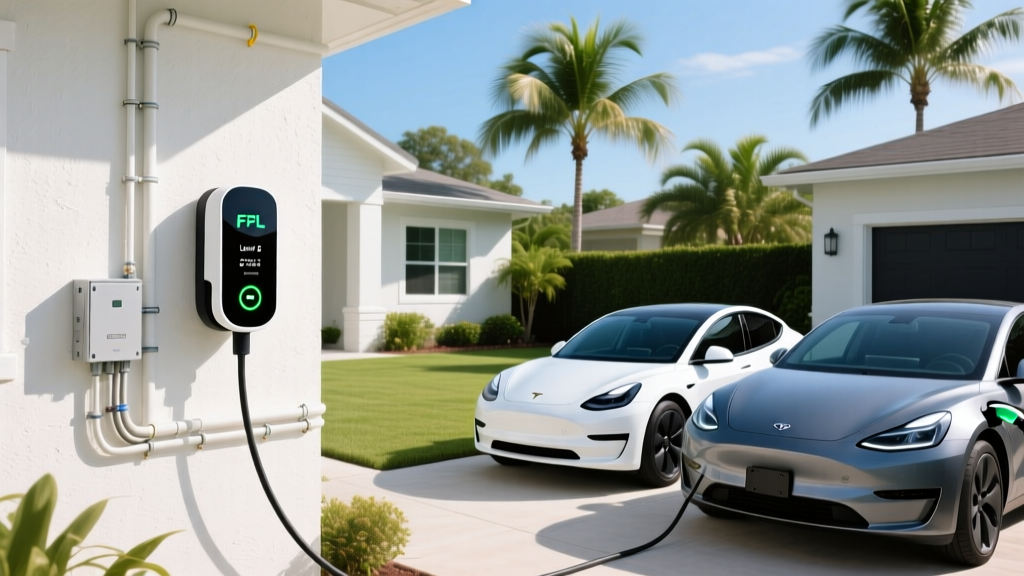
If you're a Florida Power & Light (FPL) customer considering an electric vehicle—or you've already taken delivery of one—the single most impactful ownership decision you'll make is setting up a dedicated home charging station. FPL's service territory covers much of Florida's Atlantic coast, from Miami through Jacksonville, and the utility's time-of-use (TOU) rate plans and SolarTogether program make home charging economics particularly favorable. But the path from unboxing a charger to plugging in your EV involves electrical panels, permits, connector compatibility, and real costs that most utility brochures gloss over.
This guide breaks down everything a Florida EV owner needs to know about pairing an FPL electricity plan with the right home car charger: charging speeds, installation costs with full breakdowns, connector compatibility for 2026-model EVs, equipment picks, and how FPL's rate structures affect your cost per mile.
Understanding EV Charging Levels: Speeds, Power, and What Your FPL Panel Can Deliver
Before evaluating equipment or calling an electrician, you need clarity on the three charging levels available to EV owners. The critical distinction: kW (kilowatts) measures power—the rate at which electricity flows, like water pressure from a hose. kWh (kilowatt-hours) measures energy—the total amount stored in your battery, like gallons in a tank. A 10 kW charger delivers energy faster than a 2 kW charger, filling your battery's kWh capacity in less time.
| Level | Voltage / Amps | Power Output (kW) | Miles of Range Added Per Hour | Typical Use Case |
|---|---|---|---|---|
| Level 1 | 120V / 12–16A | 1.4–1.9 kW | 3–5 miles | Overnight top-ups; PHEVs with small batteries |
| Level 2 (Home) | 240V / 32–48A | 7.7–11.5 kW | 25–44 miles | Primary home charging; full overnight BEV refill |
| DC Fast Charging | 400–800V DC | 50–350 kW | 150–1,000+ miles (equivalent rate) | Road trips; public stations (not residential) |
For most FPL customers with a battery electric vehicle (BEV), a Level 2 home charger operating at 240V and 48 amps (11.5 kW) is the practical target. At that rate, a vehicle with a 75 kWh usable battery—like a Tesla Model Y Long Range or Ford Mustang Mach-E Extended Range—can recover from 10% to 80% state of charge in roughly 5 to 6 hours. That's a full overnight session while you sleep on FPL's off-peak rates.
Level 1 charging (a standard 120V household outlet) is best understood as a backup or supplement. If your daily commute is under 30 miles and your EV is a plug-in hybrid (PHEV) with a 15–40 mile electric-only range, Level 1 may suffice. For BEV owners, Level 1 is too slow for daily needs—you'd need over 20 hours to fully recharge a large battery.
DC fast charging is exclusively a public infrastructure option. You cannot install a DC fast charger at home—the electrical service requirements (480V three-phase power, dedicated transformers) are commercial-grade. Florida's I-95 and I-4 corridors are well-served by Electrify America, Tesla Supercharger, and EVgo stations, typically delivering 150–350 kW. A modern EV with 800V architecture (Hyundai Ioniq 5, Kia EV6, Porsche Taycan) can charge from 10–80% in approximately 18 minutes at a 350 kW station, though sustained rates taper significantly above 80% to protect battery health.
Home Charger Installation: Electrical Requirements, Panel Upgrades, and Real Costs
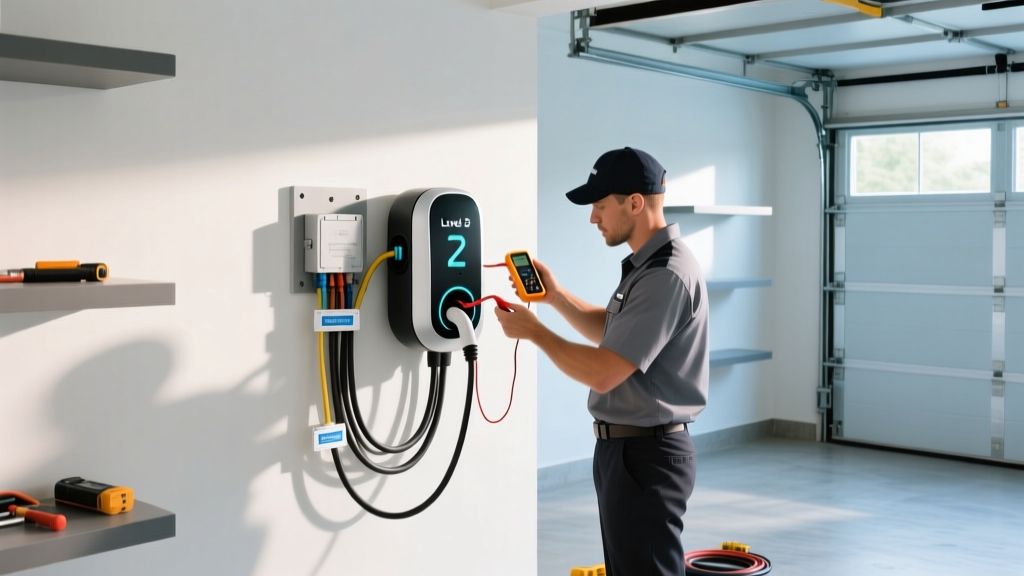
The question every Florida EV buyer eventually asks: how much does it cost to install a home EV charger? The honest answer depends heavily on your home's existing electrical panel, the distance from panel to your garage or parking spot, and whether your utility service can handle the added load.
Electrical Requirements for a Level 2 FPL Car Charger
A typical Level 2 home charger requires a dedicated 240V circuit at 40 to 60 amps, wired with appropriately gauged copper conductors (usually 6 AWG for 48A continuous load, per the NEC 80% rule for continuous loads). The National Electrical Code requires that continuous loads—defined as operating for three hours or more, which EV charging routinely does—not exceed 80% of a circuit breaker's rated capacity. So a 48A charger needs a 60A breaker.
Key installation considerations for Florida homes:
- Dedicated circuit: Your charger cannot share a circuit with other high-draw appliances (dryers, HVAC, water heaters).
- GFCI protection: The 2023 NEC (adopted in Florida) requires GFCI protection for EV charging outlets in garages and outdoor locations.
- Outdoor rating: If your charger is mounted outside (carport, driveway pedestal), it must carry a NEMA 4 or NEMA 4X weatherproof enclosure rating. Florida's humidity and afternoon thunderstorms make this non-negotiable.
- Permit: Florida requires an electrical permit for new 240V circuit installations. Your electrician pulls this; expect it included in quotes.
Will Your Electrical Panel Need an Upgrade?
This is where costs can escalate. Many Florida homes built before 2000 have 100A or 150A main service panels. Adding a 60A dedicated EV circuit may push total calculated load beyond your panel's capacity, especially if you already run central A/C, an electric range, electric water heater, and a dryer—all common in Florida homes.
A licensed electrician will perform a load calculation (NEC Article 220) to determine whether your panel has headroom. If it doesn't, you face a panel upgrade—typically from 100A or 150A to 200A service. In South Florida, this upgrade can also trigger a utility service upgrade from FPL if the transformer or service drop is undersized.
| Component | Best Case (Simple Install) | Typical Install | Complex Install (Panel Upgrade) |
|---|---|---|---|
| Level 2 Charger Equipment | $350–$500 | $400–$650 | $400–$650 |
| Electrician Labor (run 240V circuit) | $500–$800 | $800–$1,500 | $1,000–$2,000 |
| Electrical Permit (Florida) | $50–$100 | $75–$150 | $100–$200 |
| Panel Upgrade (100A → 200A) | Not needed | Not needed | $1,500–$3,500 |
| Conduit, Wire, Misc. Materials | $100–$200 | $150–$400 | $200–$500 |
| Total Estimated Cost | $1,000–$1,600 | $1,425–$2,700 | $3,200–$6,850 |
Best case assumes your panel has ample spare capacity, the charger mounts on a garage wall directly adjacent to the panel (under 10 feet of wire run), and no conduit or trenching is needed. Complex installs involve long wire runs (50+ feet through attic or crawlspace), panel upgrades, or outdoor pedestal mounts requiring trenching.
FPL occasionally offers rebates or incentives for EV charger installations—check FPL's EV program page for current offerings, as these change annually. Additionally, the federal Residential Clean Energy Credit (IRC §25C) may cover up to 30% of charger equipment and installation costs (capped at $1,000 for EV charging equipment placed in service through 2032), though eligibility depends on whether your census tract qualifies as a non-urban area. Consult a tax professional for your specific situation.
Connector Compatibility: NACS, CCS, and What Plugs Into Your EV
The connector landscape shifted dramatically between 2023 and 2026. Tesla's North American Charging Standard (NACS) has been adopted by Ford, GM, Rivian, Volvo, Polestar, Hyundai, Kia, and most major automakers for their 2025–2026 model-year vehicles. CCS1 (Combined Charging System) remains on many 2022–2024 models still on the road. CHAdeMO is effectively legacy, surviving only on the Nissan Leaf and a handful of older vehicles.
| Connector | Compatible Brands (2026 Models) | Adapter Needed? |
|---|---|---|
| NACS (Tesla standard) | Tesla (all), Ford (2025+), GM (2025+), Rivian (2025+), Hyundai (2026+), Kia (2026+), Volvo/Polestar (2025+) | CCS→NACS adapter for older CCS vehicles |
| CCS1 | VW ID.4 (through 2025), BMW i4/iX (through 2025), older Ford/GM/Hyundai EVs, Nissan Ariya | NACS→CCS adapter for Tesla Supercharger access |
| CHAdeMO | Nissan Leaf (legacy only); discontinued on all other brands | Limited adapter options; infrastructure declining |
For home Level 2 charging, all non-Tesla EVs (including new NACS-equipped vehicles) use a J1772 connector for AC charging—or a NACS connector that also carries J1772 signaling. Tesla vehicles use a proprietary connector that doubles as both AC and DC. If you own a Tesla and want to use a third-party Level 2 charger with a J1772 plug, Tesla sells a J1772-to-Tesla adapter (~$150) that ships with every new Tesla. If you own a CCS1 vehicle and buy a NACS-equipped home charger, adapters are available from Lectron, A2Z, and others for $100–$200.
When choosing a home charger, match the charger's connector to your vehicle's inlet—or plan to use an adapter every session. Most FPL customers buying a new 2025–2026 EV will want a NACS-connector home charger for future-proofing.
Charging Time Examples: How Long Does It Take to Charge Common EVs at Home?
Charging time depends on your battery's usable capacity (kWh), your charger's power output (kW), and the vehicle's onboard charger acceptance rate. Here are realistic estimates for common 2026 EVs charging on a 48A / 11.5 kW Level 2 home charger, from 10% to 80% state of charge:
- Tesla Model Y Long Range (75 kWh usable): ~5.5 hours (10–80%)
- Ford Mustang Mach-E Extended Range (91 kWh usable): ~6.5 hours (10–80%)
- Hyundai Ioniq 5 Long Range (77.4 kWh usable): ~5.5 hours (10–80%)
- Chevrolet Equinox EV (85 kWh usable): ~6 hours (10–80%)
- Toyota bZ4X (71.4 kWh usable): ~5 hours (10–80%)
- BMW i4 eDrive40 (81.5 kWh usable): ~5.8 hours (10–80%)
These times assume the vehicle's onboard AC charger can accept the full 11.5 kW. Some EVs have lower onboard charger limits—for example, certain base trims cap at 7.2 kW or 9.6 kW, which would extend charge times proportionally. Check your vehicle's spec sheet for its maximum AC charge acceptance rate.
For context, a typical Florida driver covering 35–40 miles per day consumes roughly 10–13 kWh. On an 11.5 kW Level 2 charger, that daily replenishment takes just 50 to 70 minutes—well within an overnight window on FPL's off-peak rate.
FPL Rate Plans and the True Cost to Charge Your EV Per Mile
Florida Power & Light offers several rate structures that directly affect your EV charging economics. The most relevant for EV owners is FPL's Time-of-Use (TOU) rate plan, which offers significantly lower per-kWh prices during off-peak hours—typically overnight from 10 PM to 6 AM.
| Scenario | Rate ($/kWh) | Cost for 35-Mile Daily Drive* | Cost Per Mile |
|---|---|---|---|
| Home charging — FPL off-peak (overnight) | $0.07–$0.09 | $0.84–$1.08 | $0.024–$0.031 |
| Home charging — FPL standard rate | $0.13–$0.15 | $1.56–$1.80 | $0.045–$0.051 |
| Public Level 2 (ChargePoint, EVgo L2) | $0.25–$0.40 | $3.00–$4.80 | $0.086–$0.137 |
| DC Fast Charging (Electrify America, EA Pass+) | $0.35–$0.55 | $4.20–$6.60 | $0.120–$0.189 |
| Gasoline car (30 MPG combined, $3.40/gal FL avg) | N/A | $3.97 | $0.113 |
| *Based on 3.5 kWh/mile efficiency (286 Wh/mi), a typical midsize BEV. Source: fueleconomy.gov | |||
The takeaway is clear: home charging on FPL's off-peak rate delivers fuel costs at roughly one-quarter to one-third the per-mile cost of gasoline. Even on FPL's standard residential rate without TOU optimization, home charging undercuts gas by about 55–60%. Public DC fast charging, however, can equal or exceed gasoline costs on a per-mile basis—which is why road-trip charging budgets should be factored separately from daily driving.
To maximize savings, program your EV or your smart charger to begin charging at 10 PM. Most modern EVs (Tesla, Ford, Hyundai, GM) allow scheduled charging via the vehicle's infotainment system or companion app. Smart Level 2 chargers (see recommendations below) can also be configured to charge only during off-peak windows.
Best Level 2 Chargers for FPL Customers: Equipment Picks for 2026
After testing dozens of Level 2 chargers across Florida's climate—where heat, humidity, and salt air are hard on electronics—these are the top picks for FPL customers setting up home charging.
Emporia Level 2 EV Charger
- Power Output: 48A / 11.5 kW (hardwired) or 40A / 9.6 kW (NEMA 14-50 plug)
- Connector: J1772 (NACS adapter included with newer kits)
- Cable Length: 24 feet
- Smart Features: Wi-Fi connected, energy monitoring via Emporia app, scheduled charging, solar integration, TOU rate optimization
- Outdoor Rating: NEMA 4 (suitable for Florida carports and exterior walls)
- Price: $399–$449
- Why for FPL: The built-in energy monitoring pairs perfectly with FPL TOU plans—you can track exactly how many kWh your EV consumes and when, helping you verify off-peak charging behavior.
ChargePoint Home Flex
- Power Output: Up to 50A / 12 kW (adjustable via dip switches to match your circuit: 16A–50A)
- Connector: J1772 (NACS adapter available separately) or NACS (newer SKU)
- Cable Length: 23 feet
- Smart Features: Wi-Fi, ChargePoint app scheduling, Alexa integration, flexible amperage for panel-constrained homes
- Outdoor Rating: NEMA 4
- Price: $549–$649
- Why for FPL: The adjustable amperage is ideal if your electrician determines your panel can only support a 32A or 40A circuit—you can set the charger to match without buying a different unit.
Tesla Wall Connector (Gen 4)
- Power Output: 48A / 11.5 kW (hardwired, 60A circuit required)
- Connector: NACS native (J1772 adapter included for non-Tesla vehicles)
- Cable Length: 24 feet
- Smart Features: Wi-Fi, over-the-air updates, Tesla app integration, power sharing between two Wall Connectors on one circuit
- Outdoor Rating: NEMA 3R (adequate for covered Florida carports; less robust than NEMA 4 for fully exposed installs)
- Price: $420–$475
- Why for FPL: If you own a Tesla or any 2025+ NACS-equipped EV, the native NACS connector eliminates adapter hassle. Power sharing is valuable for two-EV households on a single 60A circuit.
Grizzl-E Smart
- Power Output: 40A / 9.6 kW (NEMA 14-50) or 48A / 11.5 kW (hardwired)
- Connector: J1772 or NACS (selectable at purchase)
- Cable Length: 24 feet
- Smart Features: Wi-Fi, OCPP-compatible (open protocol), app scheduling, load balancing
- Outdoor Rating: IP67 (submersible—overkill for Florida, but excellent for hurricane-prone areas)
- Price: $449–$549
- Why for FPL: Canadian-built, extremely durable, and the IP67 rating means you never worry about Florida storms. OCPP compatibility means future utility demand-response programs can interface with it.
Safety, Code Compliance, and Florida-Specific Installation Considerations
Florida's building environment presents specific challenges for EV charger installations that out-of-state electricians sometimes overlook:
- Hurricane and wind-load mounting: Outdoor charger mounts must be secured to structural framing, not just drywall or siding. In Miami-Dade and Broward counties (High-Velocity Hurricane Zone), mounting hardware must meet local wind-load requirements.
- Corrosion resistance: Coastal Florida properties (within ~1 mile of the ocean) experience salt spray that corrodes standard steel electrical enclosures within a few years. Specify stainless steel or powder-coated aluminum enclosures and corrosion-resistant connectors.
- Flood zone awareness: If your garage or parking area is in a FEMA-designated flood zone, the charger should be mounted at least 12 inches above the Base Flood Elevation (BFE). Your electrician or local building department can verify your BFE.
- Whole-home surge protection: Florida leads the nation in lightning strikes. A whole-home surge protective device (SPD) at your main panel—typically $200–$400 installed—protects your EV charger, vehicle, and all home electronics from transient voltage spikes. This is strongly recommended for any Florida EV owner.
- Load management devices: If your panel is near capacity but you want to avoid a full upgrade, consider a smart load-management device like the Emporia Smart Load Center or a Tesla Wall Connector with power sharing. These devices monitor real-time panel load and throttle the charger if other appliances spike—keeping total draw within your panel's rating without a costly upgrade.
Always hire a licensed Florida electrical contractor (verify their license at myfloridalicense.com) and ensure they pull the required local permit. Unpermitted electrical work can void your homeowner's insurance and create fire risk.
Frequently Asked Questions
How much does it cost to install a home EV charger with FPL service?
For a straightforward installation with adequate panel capacity and a short wire run, expect $1,000–$1,600 total (equipment + electrician + permit). Typical installations average $1,400–$2,700. If your home needs a panel upgrade from 100A to 200A service, total costs can reach $3,200–$6,850. Always get three quotes from licensed Florida electricians and confirm they perform an NEC Article 220 load calculation.
How fast will a Level 2 charger add range to my EV?
A 48A / 11.5 kW Level 2 charger adds approximately 35–44 miles of range per hour of charging, depending on your EV's efficiency. A Tesla Model Y (about 3.5 miles/kWh) gains roughly 40 miles per hour. A less efficient vehicle like the Ford F-150 Lightning (about 2.2 miles/kWh) gains roughly 25 miles per hour at the same charger power.
Which connector do I need for my 2025 or 2026 EV?
If your EV is a 2025+ Ford, GM, Rivian, Hyundai, Kia, or Volvo/Polestar—or any Tesla—you need a NACS connector. If your EV is a 2022–2024 model from VW, BMW, or an earlier Hyundai/Kia/GM EV, you likely have CCS1. Check your vehicle's charge port or owner's manual. When in doubt, buy a charger with the connector that matches your car natively and keep an adapter for future vehicles.
How does FPL's off-peak rate compare to gas for daily driving?
On FPL's TOU off-peak rate (~$0.07–$0.09/kWh), charging a typical midsize EV costs about $0.024–$0.031 per mile. A gasoline car averaging 30 MPG at Florida's ~$3.40/gallon costs about $0.113 per mile. That's roughly a 70–75% fuel cost reduction when charging at home overnight.
What electrical upgrades might my home need for an EV charger?
The most common upgrade is a panel capacity increase (100A or 150A to 200A), which costs $1,500–$3,500 in Florida. Other potential needs include replacing a Federal Pacific or Zinsco panel (common in 1960s–1980s Florida homes and considered fire hazards—replacement runs $2,000–$4,000), adding a whole-home surge protector, or upgrading FPL's service drop if the utility transformer is undersized. Your electrician's load calculation will identify these before work begins.
Can FPL's solar program help offset EV charging costs?
FPL's SolarTogether program and net metering can effectively reduce your marginal electricity cost for EV charging, especially if you charge during peak solar production hours (midday). However, most EV owners charge overnight when solar isn't producing—so the benefit comes as a credit offset on your overall bill rather than direct "free" charging. Home solar with battery storage (like a Tesla Powerwall) can enable true midday-to-evening solar-powered charging, but the economics depend on your system size and usage patterns.
Setting up a home FPL car charger is one of the highest-return investments an EV owner can make. With off-peak rates as low as $0.07/kWh, a properly installed Level 2 station pays for itself in fuel savings within 18–30 months for most Florida drivers. Get three electrician quotes, verify your panel capacity, choose a NACS or J1772 charger matched to your vehicle, and schedule your charging for overnight—you'll rarely visit a public charger again except on road trips.