If you drive a four-door electric sedan — whether it's a Tesla Model 3, Hyundai Ioniq 6, BMW i4, or Polestar 2 — understanding your charging ecosystem is the single biggest factor in daily EV satisfaction. A "4 door electric charger" search usually means one thing: you own or are buying a four-door EV and need to know exactly how to charge it at home, what it costs, and which equipment to buy. This guide gives you the precise numbers.
Charging Levels Explained: Speeds in kW and Miles Per Hour
Before buying any equipment, you need to understand the three charging levels. The critical distinction: kW (kilowatts) measures power — how fast energy flows into your car. kWh (kilowatt-hours) measures energy — how much your battery holds. Think of kW as the width of a pipe and kWh as the size of the tank.
| Level | Voltage | Power (kW) | Miles Added/Hour | Typical Use |
|---|---|---|---|---|
| Level 1 | 120V AC | 1.0–1.4 kW | 3–5 mi/hr | Emergency / overnight trickle |
| Level 2 | 240V AC | 3.3–19.2 kW | 12–75 mi/hr | Home daily charging |
| DC Fast | 400–800V DC | 50–350 kW | 150–1,000+ mi/hr | Road trips, highway corridors |
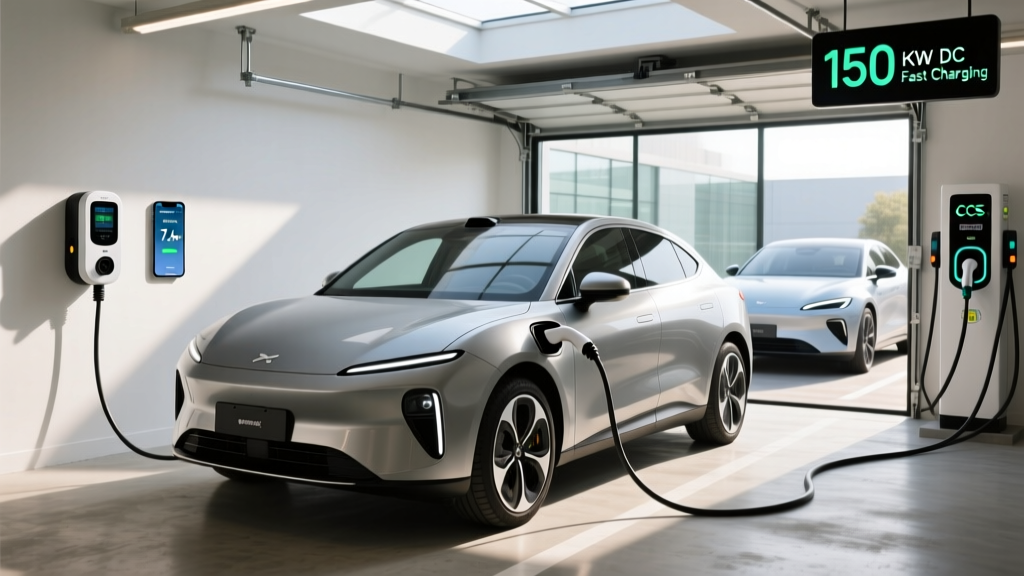
For most four-door EV owners, Level 2 at home handles 90%+ of charging needs. A typical 75 kWh battery (like the BMW i4 eDrive40) charged at 11.5 kW adds roughly 40–45 miles of range per hour, meaning a 10–80% session takes about 5–6 hours overnight. DC fast charging is reserved for road trips, where a 250 kW-capable car like the Hyundai Ioniq 6 can hit 10–80% in roughly 18 minutes under ideal conditions.
Home Charger Installation: Electrical Requirements and Costs
Installing a Level 2 home charger isn't plug-and-play — it's an electrical project that requires proper planning. Here's what you're dealing with:
Electrical requirements: A standard Level 2 home charger runs on a 240V circuit, typically requiring 40A to 60A service. The National Electrical Code (NEC) requires that continuous loads (like EV charging) not exceed 80% of a circuit's rated capacity. So a 40A circuit delivers a maximum 32A (7.7 kW), while a 60A circuit delivers 48A (11.5 kW). Higher amperage means faster charging, but also demands heavier-gauge wiring and potentially a panel upgrade.
Panel upgrade reality: Homes built before 2000 often have 100A electrical panels. Adding a 40–60A EV circuit to an already-loaded 100A panel can trip the main breaker or violate code. Upgrading to a 200A panel typically costs $1,500–$3,000, and this is a cost many buyers overlook until the electrician's assessment. Some utilities offer rebates for panel upgrades tied to EV adoption — check your local provider.
| Component | Cost Range | Notes |
|---|---|---|
| Level 2 Charger (Equipment) | $250–$700 | Smart WiFi chargers cost more |
| Electrician Labor | $500–$2,000 | Depends on run length from panel to garage |
| Permit & Inspection | $50–$250 | Required in most jurisdictions |
| Panel Upgrade (if needed) | $1,500–$3,000 | Common in older homes with 100A service |
| Total (no panel upgrade) | $800–$2,950 | Most homes with 200A panels |
| Total (with panel upgrade) | $2,300–$5,950 | Older homes needing 200A service |
Safety and code considerations: Your charger must be on a dedicated circuit — never shared with other appliances. Outdoor installations require a NEMA 4-rated (weatherproof) enclosure or a hardwired unit rated for outdoor use. Many jurisdictions now require GFCI protection on EV circuits per NEC 2023 and later. Permits are required in most municipalities, and skipping them can void home insurance claims or cause issues at resale. Always hire a licensed electrician familiar with EV charging installations.
Connector Compatibility: NACS, CCS1, and CHAdeMO
Your four-door EV's charge port determines which connectors work. As of 2026, the North American market has largely consolidated around two standards, with CHAdeMO fading:
| Connector | Brands Using It | Notes |
|---|---|---|
| NACS (Tesla / J3400) | Tesla, Ford, GM, Rivian, Volvo, Polestar, Mercedes, Hyundai/Kia (2025+), BMW (2025+), Toyota | Industry standard going forward; access to Tesla Supercharger network |
| CCS1 | VW (ID.7), older Hyundai/Kia models (pre-2025), some Stellantis models | Legacy standard; Electrify America, EVgo networks |
| CHAdeMO | Nissan Leaf (discontinued 2025), Mitsubishi Outlander PHEV | Effectively discontinued for new vehicles |
Adapter needs: If you own a CCS1-equipped four-door EV (like a 2024 Ioniq 6) and want access to the Tesla Supercharger network, Tesla sells a CCS-to-NACS adapter for approximately $199. Conversely, newer NACS-equipped vehicles can access CCS networks using a NACS-to-CCS adapter. Always verify adapter compatibility with your specific model year before purchasing. For DC fast charging, adapter quality matters — cheap third-party adapters can throttle charge speeds or cause connector overheating.
Cost to Charge: Per Mile vs. Gas
One of the strongest arguments for electrifying a four-door sedan is the fuel-cost advantage, but the math depends heavily on where and when you charge.
| Scenario | Rate ($/kWh) | Cost per 100 mi* | Equivalent MPG Gas Price |
|---|---|---|---|
| Home off-peak (utility TOU rate) | $0.08–$0.12 | $2.40–$3.60 | $0.72–$1.08/gal |
| Home standard rate | $0.13–$0.18 | $3.90–$5.40 | $1.17–$1.62/gal |
| Public Level 2 (ChargePoint, etc.) | $0.20–$0.35 | $6.00–$10.50 | $1.80–$3.15/gal |
| DC Fast (Electrify America, Tesla) | $0.30–$0.55 | $9.00–$16.50 | $2.70–$4.95/gal |
| Gas sedan (30 MPG, $3.50/gal) | — | $11.67 | $3.50/gal |
*Based on an average four-door EV efficiency of 3.0 mi/kWh (roughly 100 MPGe combined, per EPA fueleconomy.gov data for vehicles like the BMW i4 and Tesla Model 3).
The takeaway: home charging on an off-peak rate delivers fuel costs equivalent to gasoline under $1/gallon — a savings of 70–90% over a comparable gas sedan. However, exclusive reliance on DC fast charging can narrow that gap significantly, especially on networks charging $0.48+/kWh. The economics strongly favor home charging as your primary strategy.
Charging Times for Common Four-Door EV Battery Sizes
Real-world charging time depends on battery capacity (kWh), the charger's power output (kW), and your vehicle's onboard charger limit. Here's how typical four-door EVs perform across charging levels:
| Vehicle | Battery (kWh usable) | Level 2 @ 11.5 kW | DC Fast (peak kW) | DC 10–80% Time |
|---|---|---|---|---|
| Tesla Model 3 LR (2026) | 75 kWh | ~4.5 hrs | 250 kW | ~25 min |
| Hyundai Ioniq 6 SE LR (2026) | 74 kWh | ~4.5 hrs | 240 kW (800V) | ~18 min |
| BMW i4 eDrive40 (2026) | 81 kWh | ~5 hrs | 205 kW | ~31 min |
| Polestar 2 LR DM (2026) | 79 kWh | ~4.5 hrs | 205 kW | ~28 min |
Charge curve reality check: Peak kW is never sustained across the entire session. A car rated for 250 kW may only hold that rate between 10–30% SoC before tapering to 150 kW, then dropping further above 60%. This is why 10–80% time is the standard metric — charging above 80% slows dramatically to protect battery health, often taking as long as the 10–80% session itself. Always plan road-trip stops around the 10–80% window.
Best Home Chargers for Four-Door EVs (2026 Equipment Picks)
After testing across multiple four-door EVs, here are the Level 2 home chargers that deliver the best combination of power, reliability, and smart features:
ChargePoint Home Flex
- Power: Up to 12 kW (50A) — adjustable down to 16A for panel-limited homes
- Connector: NACS (J3400) or CCS1 (select at purchase)
- Cable length: 23 feet
- Smart features: WiFi scheduling, utility TOU integration, Alexa/Google Home, energy tracking
- Price: ~$549
- Best for: Flexible amperage for homes with limited panel capacity
Wall Connector (Tesla, 3rd Gen)
- Power: Up to 11.5 kW (48A)
- Connector: NACS native; includes J1772 adapter for non-Tesla EVs
- Cable length: 24 feet
- Smart features: WiFi updates, load sharing (pair two units on one circuit), power sharing
- Price: ~$475
- Best for: Tesla owners and NACS-adopting households
Emporia Vue Level 2 Charger
- Power: Up to 11.5 kW (48A)
- Connector: J1772 (works with CCS1 EVs natively; NACS EVs via adapter)
- Cable length: 24 feet
- Smart features: Integrated energy monitoring, solar-aware scheduling, app control
- Price: ~$399
- Best for: Budget-conscious buyers who want energy monitoring without a separate panel monitor
Public Charging Networks: What Four-Door EV Owners Need to Know
While home charging covers daily needs, public charging infrastructure matters for road trips and apartment dwellers. Here's the current landscape:
- Tesla Supercharger network: Now open to NACS-equipped non-Tesla EVs via the Tesla app. Over 30,000 stalls in North America, with speeds from 150 kW (V2) to 250 kW (V3) and emerging 350 kW (V4) stations. Reliability consistently rated highest among networks.
- Electrify America: Largest non-Tesla DC network with 150–350 kW chargers. CCS1 native, with NACS adapters being deployed. Pricing averages $0.37–$0.48/kWh. Reliability has improved but still lags Tesla.
- EVgo: Urban-focused network, 50–350 kW. Strong presence in metro areas and shopping centers. Pricing varies by market.
- ChargePoint: Dominates Level 2 public charging (workplaces, retail, parking garages). DC fast stations are less common.
For four-door EV owners living in apartments or without home-charging access, networks like EVgo and ChargePoint offer subscription plans ($4.99–$7.99/month) that reduce per-kWh pricing by 10–25%. Check whether your employer or utility offers subsidized public charging — many do.
Frequently Asked Questions
How much does it cost to install a home EV charger?
Expect $800–$2,950 total if your home has a 200A electrical panel, covering the charger ($250–$700), electrician labor ($500–$2,000), and permits ($50–$250). If you need a panel upgrade from 100A to 200A, add $1,500–$3,000. Get three quotes — labor varies significantly by region and run length from panel to garage.
How fast will each charging level add range?
Level 1 (120V) adds 3–5 miles per hour — useful only for overnight top-ups on small batteries. Level 2 (240V) adds 12–75 miles per hour depending on amperage — the standard for daily home charging. DC fast charging adds 150–1,000+ miles per hour at peak power, though real sessions average 10–80% in 18–31 minutes for typical four-door EVs.
Which connector and charger is compatible with my EV?
Check your vehicle's charge port. Most 2025–2026 four-door EVs from Ford, GM, Hyundai, Kia, BMW, Mercedes, Volvo, and Polestar now use NACS (J3400). Older or carryover models may still have CCS1. CHAdeMO is effectively discontinued. Match your home charger's connector to your car, or plan for an adapter. The IRS §30D credit does not cover charger equipment — that falls under the separate §30C alternative fuel infrastructure credit (up to $1,000 for residential).
How much does charging cost per mile compared to gas?
At home on off-peak rates ($0.08–$0.12/kWh), a typical four-door EV costs $0.024–$0.036 per mile — equivalent to a gas car running on $0.72–$1.08/gallon fuel. On public DC fast chargers ($0.35–$0.55/kWh), that rises to $0.09–$0.165 per mile, which is comparable to a 30 MPG gas car at $2.70–$4.95/gallon. Home charging is where the real savings live.
What electrical upgrades might I need?
The most common upgrade is a panel replacement from 100A to 200A service ($1,500–$3,000). You may also need a new dedicated 240V circuit run from the panel to your garage or parking spot — longer runs require heavier-gauge wire and increase labor costs. Some homes with newer 200A panels can accommodate a 40–60A EV circuit without any upgrade. An electrician's load calculation will determine your situation. Utility companies sometimes offer free or discounted load assessments.