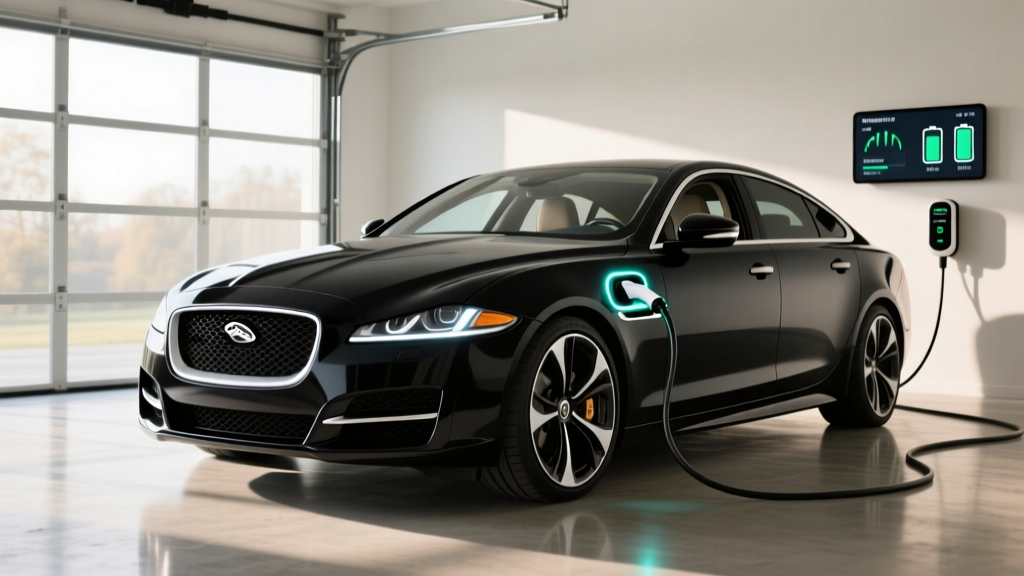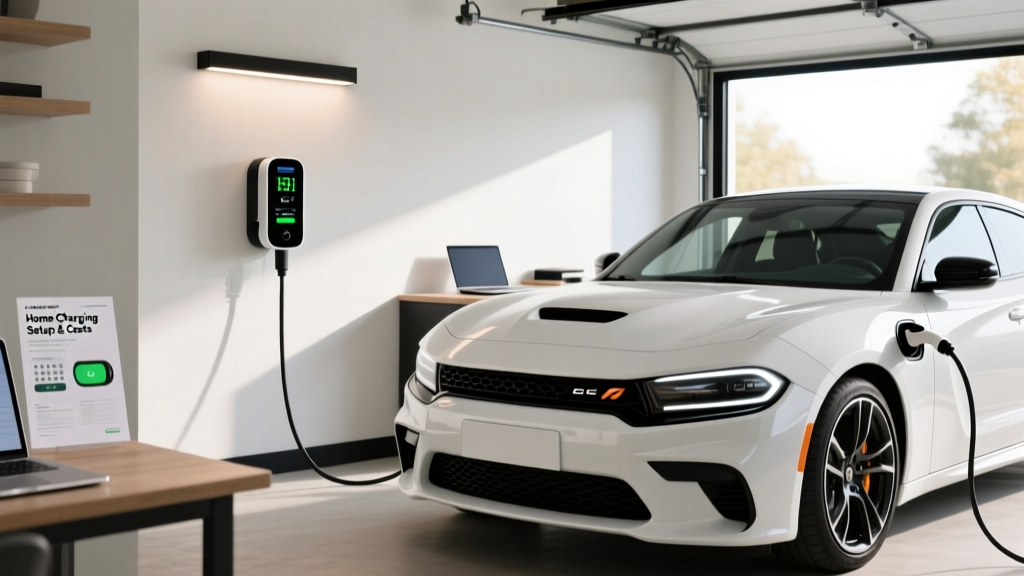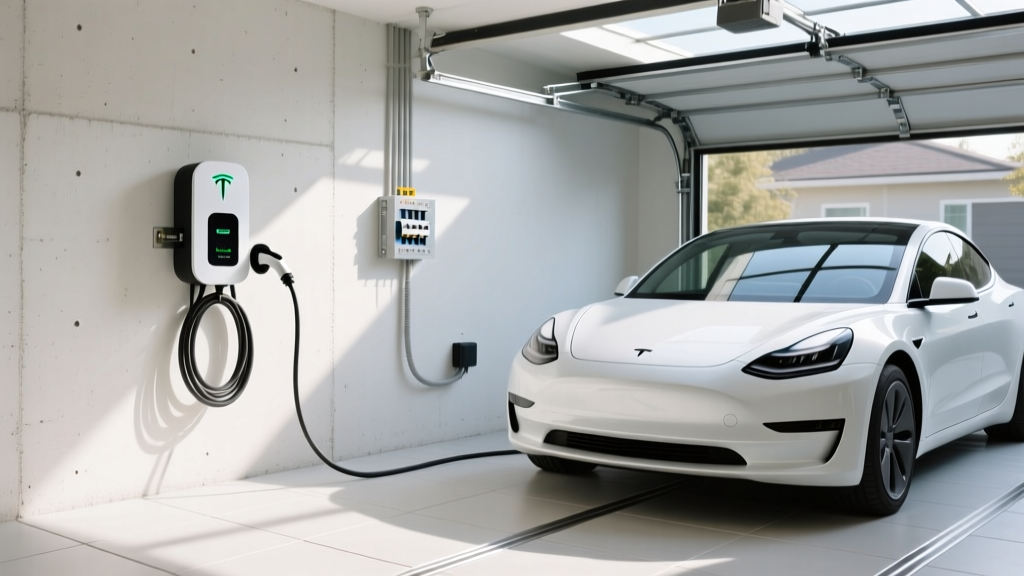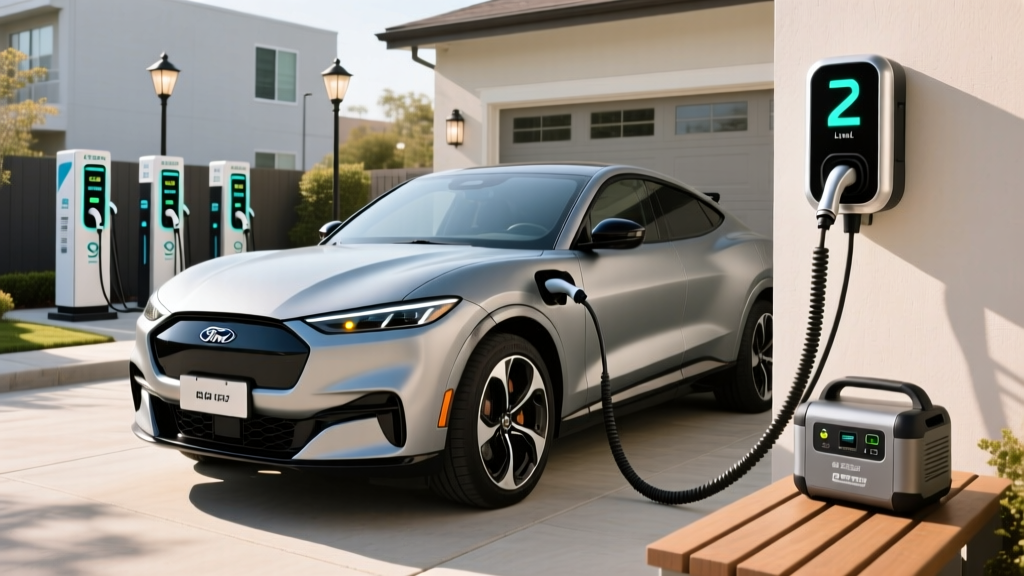
The 2025 Ford Mustang Mach-E is one of the most compelling electric SUVs on the market, but owning one means understanding exactly how to keep its battery charged efficiently and affordably. Whether you're plugging into a standard wall outlet, installing a dedicated Level 2 home charger, or relying on DC fast-charging road trips, the Mach-E's charging behavior depends heavily on which battery pack you have and what equipment you're using.
This guide breaks down every charging scenario for the 2025 Mach-E — including the real-world speeds, costs, electrical requirements, and equipment you'll need. We'll also clarify one critical distinction up front: kW (kilowatts) measures the rate of charging (power), while kWh (kilowatt-hours) measures the total energy stored in the battery. You'll see both throughout this guide, and mixing them up is the single most common mistake new EV owners make.
2025 Mustang Mach-E Battery Packs and Charging Specs at a Glance
Before we get into charging infrastructure, you need to know what's under the floor. The 2025 Mach-E is available with two battery sizes, both using NMC (nickel manganese cobalt) lithium-ion chemistry with liquid thermal management:
| Spec | Standard Range | Extended Range |
|---|---|---|
| Usable Battery Capacity | 72 kWh | 91 kWh |
| EPA Range (RWD) | 250 mi | 320 mi |
| Real-World Highway (~70 mph) | ~210-225 mi | ~265-285 mi |
| Max DC Fast Charge Rate | 115 kW peak | 150 kW peak |
| 10-80% DC Fast Charge Time | ~38 min | ~45 min |
| Onboard AC Charger (Level 2) | 10.5 kW (48A) | 10.5 kW (48A) |
| Level 2 Time (0-100%) | ~7.5 hours | ~9.5 hours |
A few real-world notes: highway driving at 75+ mph and cold weather (below 30°F) can reduce range by 15-30%. On DC fast charging, the Mach-E's charge curve tapers significantly above 80% State of Charge — so that 10-80% time is the practical metric, not 0-100%. Pushing from 80% to 100% on a fast charger can add another 25-35 minutes and is rarely worth the wait unless you absolutely need a full battery.
Charging Levels Explained: How Fast Will Each Level Add Range?
EV charging is categorized into three levels. Here's what each delivers on a 2025 Mach-E, measured in both kW and estimated miles of range added per hour of charging:
| Level | Voltage / Power | Mach-E Range Added/Hour | Best Use Case |
|---|---|---|---|
| Level 1 (Standard Outlet) | 120V / ~1.3 kW | ~3-4 miles/hr | Overnight trickle; emergency top-offs |
| Level 2 (Home / Workplace) | 240V / 7.7-10.5 kW | ~22-32 miles/hr | Daily home charging; overnight full charge |
| DC Fast Charging (Public) | 400V+ / 50-150 kW | ~120-180 miles in 20 min | Road trips; rapid top-ups away from home |
Level 1 is what you get from a standard 120V household outlet using the Ford Mobile Charger included with the vehicle. At roughly 1.3 kW, you'll add about 3-4 miles of range per hour. That's enough if you drive 20-30 miles daily and can plug in for 10+ hours overnight, but it won't keep up with heavier driving schedules or the Extended Range battery.
Level 2 is the sweet spot for home charging. The Mach-E's onboard charger accepts up to 10.5 kW (48 amps at 240V). With a properly sized home charger, the Standard Range pack fills from empty to full in about 7.5 hours, while the Extended Range takes roughly 9.5 hours — both easily achievable overnight.
DC Fast Charging bypasses the onboard charger entirely, sending direct current straight to the battery at much higher power levels. The Extended Range Mach-E peaks at 150 kW, meaning under ideal conditions (low SoC, warm battery, capable charger) it can add roughly 50-60 miles of range in 10 minutes. However, that peak rate isn't sustained — the charge curve tapers as the battery fills, which is why the 10-80% metric (~45 minutes for Extended Range) is more honest than peak kW figures alone.
Home Charger Installation: Electrical Requirements, Costs, and Upgrades
Installing a Level 2 home charger is the single biggest ownership upgrade you can make for daily EV convenience. Here's what's involved electrically and financially for a 2025 Mach-E setup.
Electrical Requirements for the Mach-E
To take full advantage of the Mach-E's 10.5 kW onboard charger, you need a 240V circuit rated for at least 60 amps (which supports a continuous 48A draw — EV chargers are considered continuous loads, so the circuit must be rated 125% above the charger's max amperage per the National Electrical Code). If you're willing to accept slightly slower charging, a 50A circuit (40A continuous) delivering ~9.6 kW still charges the Standard Range battery overnight with room to spare.
Most homes built after the 1990s have a 200-amp electrical panel, which typically has enough spare capacity for a 60A EV circuit. Older homes with 100A or 150A panels may need a panel upgrade — and this is where costs can spike. A panel upgrade to 200A can add $1,500-$3,500 to your project.
Installation Cost Breakdown
| Component | Simple Install (Panel Nearby) | Complex Install (Long Run / Panel Upgrade) |
|---|---|---|
| Level 2 Charger (Hardware) | $400-$700 | $400-$700 |
| Electrical Permit | $50-$150 | $50-$200 |
| Electrician Labor + Materials | $300-$800 | $1,200-$3,000 |
| Panel Upgrade (if needed) | $0 | $1,500-$3,500 |
| Total Estimated Cost | $750-$1,650 | $3,150-$7,400 |
The wide range reflects real-world variability: how far your panel is from the garage, whether conduit runs through walls or an attic, local labor rates, and whether your panel has capacity. Always get at least two quotes from licensed electricians, and confirm they pull a permit — unpermitted EV charger installs can void home insurance claims and cause issues at resale.
Safety and Code Considerations
Your installation must meet NEC Article 625 requirements for EV charging systems. Key points:
- Dedicated circuit: Your Level 2 charger must be on its own breaker — not shared with other appliances.
- GFCI protection: Required for all 240V receptacles used for EV charging (NEC 2020 and later). Hardwired chargers may have GFCI built into the unit.
- Outdoor rating: If your charger is mounted outside or in an exposed carport, it must carry a NEMA 4 or NEMA 4X weatherproof rating.
- NEMA 14-50 vs. hardwired: A NEMA 14-50 outlet gives you flexibility to unplug and take the charger with you, but hardwired installations avoid the GFCI breaker nuisance-tripping issue that some owners experience with 14-50 receptacles on 60A circuits.
Connector Compatibility: NACS, CCS1, and What the 2025 Mach-E Uses
The connector landscape shifted dramatically in 2024-2025. Here's where the 2025 Mach-E stands:
| Connector | 2025 Mach-E Native? | Adapter Needed? | Networks Accessible |
|---|---|---|---|
| CCS1 (Combined Charging System) | Yes — standard on all trims | No | Electrify America, EVgo, ChargePoint, most non-Tesla networks |
| NACS (Tesla / North American Charging Standard) | No — adapter required | Yes — Ford-approved NACS adapter (~$200) | Tesla Supercharger network (15,000+ stalls in the US) |
| CHAdeMO | No | No viable adapter | Largely discontinued in the US |
| J1772 (Level 2 AC) | Yes (CCS1 includes J1772 upper portion) | No | All public Level 2 stations |
The 2025 Mach-E ships with a CCS1 port. Ford began offering a NACS adapter for Mach-E owners in 2024, and by the 2025 model year, the adapter is available for purchase through Ford dealers and the FordPass app. This adapter unlocks access to Tesla's Supercharger network — a significant advantage for road trips, as Superchargers are generally the most reliable and widespread DC fast-charging network in the US.
One important caveat: when using the NACS adapter on Tesla Superchargers, the Mach-E Extended Range will typically charge at up to 150 kW (matching its native CCS capability), but older V2 Supercharger stalls are limited to 150 kW shared between two vehicles. Seek out V3 or V4 Supercharger stalls for the best experience. Per Ford's official specs, the adapter supports DC fast charging up to the vehicle's maximum acceptance rate.
How Much Does Charging the Mach-E Cost Per Mile vs. Gasoline?
One of the strongest arguments for the Mach-E is lower fueling costs — but the savings depend heavily on how and where you charge. Let's break down real cost-per-mile scenarios using the Mach-E's EPA-rated efficiency of approximately 3.0-3.3 kWh per mile (varies by trim and drivetrain; we'll use 3.2 kWh/mi for these calculations).
| Charging Scenario | Rate ($/kWh) | Cost Per Mile | Full Charge Cost (91 kWh ER) |
|---|---|---|---|
| Home (Off-Peak Utility Rate) | $0.09 | $0.029 | $8.19 |
| Home (Average US Residential) | $0.17 | $0.054 | $15.47 |
| Public Level 2 (Workplace / Mall) | $0.25-$0.35 | $0.08-$0.11 | $22.75-$31.85 |
| DC Fast Charging (Electrify America) | $0.43-$0.56 | $0.14-$0.18 | $39.13-$50.96 |
| DC Fast Charging (Tesla Supercharger) | $0.28-$0.36 | $0.09-$0.12 | $25.48-$32.76 |
| Gasoline Equivalent (25 MPG, $3.40/gal) | $3.40/gal | $0.136 | N/A |
At home on off-peak utility rates, the Mach-E costs roughly 3 cents per mile — about one-quarter the cost of a 25 MPG gas car at $3.40/gallon. Even at average residential rates, you're still saving roughly 60% per mile. The gap narrows on DC fast chargers: at the highest public DC rates, charging can actually cost more per mile than gasoline. This is why home charging is the economic foundation of EV ownership.
Check with your utility about time-of-use (TOU) plans — many offer significantly cheaper rates between 10 PM and 6 AM, which pairs perfectly with overnight home charging. Some utilities also offer dedicated EV rate plans with even lower off-peak pricing.
Best Level 2 Home Chargers for the 2025 Mustang Mach-E
Since the Mach-E can accept up to 10.5 kW (48A), you'll want a charger that can deliver at least that much to maximize your overnight charging speed. Here are top picks, all compatible with the Mach-E's CCS1/J1772 inlet:
Ford Charge Station Pro (48A)
Power: 11.5 kW (48A @ 240V) | Cable Length: 25 ft | Connector: J1772/CCS1 | Smart Features: FordPass integration, scheduled charging, OTA updates | Price: ~$600-$700
The OEM option. Pairs seamlessly with the FordPass app for scheduling and monitoring. Hardwired installation recommended. Supports the full 48A the Mach-E can accept. Best choice if you want a unified Ford ecosystem experience.
Emporia Level 2 EV Charger (48A)
Power: 11.5 kW (48A @ 240V) | Cable Length: 24 ft | Connector: J1772 | Smart Features: Real-time energy monitoring, solar integration, load management, app control | Price: ~$400-$450
Best value in the 48A category. Excellent energy monitoring and the ability to integrate with home solar or manage load to avoid panel overload. Works great with the Mach-E, though it lacks native FordPass integration.
ChargePoint Home Flex (up to 50A)
Power: Up to 12 kW (50A @ 240V, adjustable) | Cable Length: 23 ft | Connector: J1772 | Smart Features: App scheduling, Alexa integration, amperage adjustment for panel limits | Price: ~$550-$650
A proven, well-reviewed charger with the unique ability to dial amperage up or down in the app — useful if your electrical panel has limited headroom. NEMA 14-50 or hardwired install. The Mach-E will draw its max 48A from this unit.
Grizzl-E Smart (40A)
Power: 9.6 kW (40A @ 240V) | Cable Length: 24 ft | Connector: J1772 | Smart Features: App control, OCPP support, firmware updates | Price: ~$400-$500
Built in Canada and designed for extreme cold (-40°F rated). If you live in a northern climate where outdoor charging in winter is the norm, the Grizzl-E's rugged build is a standout. Limited to 40A, so the Mach-E won't charge at its full 10.5 kW rate, but still fills the Standard Range pack overnight.
Public DC Fast Charging: Networks, Reliability, and Trip Planning
For road trips and occasional fast top-ups, the 2025 Mach-E owner has access to three primary DC fast-charging networks:
- Tesla Supercharger (with NACS adapter): The most reliable and widespread network. Download the Tesla app, add your Mach-E's VIN, and you can charge at any Supercharger. Expect peak rates of 120-150 kW depending on stall generation. Pricing typically $0.28-$0.36/kWh.
- Electrify America: The largest non-Tesla DC network. Native CCS1 — no adapter needed. Stations can deliver up to 350 kW, but the Mach-E caps at 150 kW. Reliability has improved but still lags Superchargers in uptime. Pricing ~$0.43-$0.56/kWh for guests, less with a Pass+ subscription ($4/month for 800 kWh at reduced rates).
- EVgo / ChargePoint: Smaller DC networks often found in urban areas and retail locations. Useful for quick top-ups but less ideal for long-distance travel planning.
Use the FordPass app's built-in trip planner or third-party tools like A Better Routeplanner (ABRP) to plan charging stops. The Mach-E's navigation system will precondition the battery when you route to a DC fast charger — warming or cooling the battery to its optimal charging temperature before you arrive, which can shave 5-10 minutes off your charge time, especially in cold weather.
Frequently Asked Questions
How much does it cost to install a home EV charger for the Mach-E?
For a straightforward installation where your electrical panel has capacity and is close to the garage, expect $750-$1,650 total (charger + electrician + permit). If your panel needs an upgrade or the wiring run is long, costs can reach $3,000-$7,000+. Always get a site assessment from a licensed electrician before budgeting.
How fast will each charging level add range to the Mach-E?
Level 1 (120V outlet): about 3-4 miles per hour. Level 2 (240V, 48A): about 28-32 miles per hour. DC fast charging: roughly 50-60 miles in 10 minutes at peak rate (150 kW for Extended Range), tapering as the battery fills.
Which connector is compatible with the 2025 Mach-E?
The 2025 Mach-E has a native CCS1 port for DC fast charging and J1772 for Level 2 AC. To use Tesla Superchargers, you need Ford's NACS adapter (~$200). CHAdeMO is not supported and no viable adapter exists.
How much does charging the Mach-E cost per mile compared to gas?
At home on average residential rates ($0.17/kWh), the Mach-E costs about 5.4 cents per mile. A comparable 25 MPG gas car at $3.40/gallon costs about 13.6 cents per mile. Home charging saves roughly 60%, but DC fast charging at the highest public rates can exceed gas costs.
What electrical upgrades might I need for a Level 2 charger?
You'll need a dedicated 240V circuit — ideally 60A for full-speed Mach-E charging. Homes with 200A panels usually have sufficient capacity. Homes with 100A or 150A panels may need a panel upgrade ($1,500-$3,500). Your electrician will perform a load calculation to determine if your panel can handle the additional draw. Per the US Department of Energy, a professional assessment is the best first step.
Can I charge the Mach-E with solar panels?
Yes. If you have a home solar system, you can charge your Mach-E effectively for the marginal cost of solar generation (often near zero after system payback). Chargers like the Emporia Level 2 offer built-in solar integration that prioritizes charging when solar production is high, maximizing self-consumption.
Does the Mach-E support vehicle-to-home (V2H) or vehicle-to-load (V2L)?
The 2025 Mach-E with the Extended Range battery and Ford's Intelligent Backup Power system supports vehicle-to-home (V2H) when paired with the Ford Charge Station Pro and a compatible home transfer switch. This can power essential home circuits during an outage. V2L (powering individual devices via an outlet) is not natively supported on the Mach-E as of the 2025 model year.