If you own or are shopping for a Ford F-150 Lightning, the single biggest factor in your daily satisfaction isn't horsepower or towing capacity — it's how efficiently you replenish the battery. The Lightning's available 98 kWh (Standard Range) and 131 kWh (Extended Range) lithium-ion NMC packs deliver EPA-estimated 240 and 320 miles respectively, but real-world range and charging convenience depend almost entirely on your setup at home and your strategy on the road.
This guide breaks down exactly how to charge a Ford F-150 Lightning at every level, what home installation actually costs in 2026, which connectors you need as Ford transitions to NACS, and how charging costs compare to filling a gas truck. Every figure below reflects current model-year specs and real-world ownership data.
Ford Lightning Battery Specs and Real-World Range Expectations
Before plugging in, know what you're working with. The 2025-2026 F-150 Lightning offers two battery options, both using nickel-manganese-cobalt (NMC) chemistry for high energy density:
| Spec | Standard Range | Extended Range |
|---|---|---|
| Usable Battery Capacity | 98 kWh | 131 kWh |
| EPA Range | 240 mi | 320 mi |
| Real-World Highway (70 mph) | ~200–215 mi | ~265–285 mi |
| Cold Weather (20°F, highway) | ~165–185 mi | ~220–245 mi |
| MPGe (Combined) | 76 MPGe | 70 MPGe |
| Efficiency | ~44 kWh/100mi | ~48 kWh/100mi |
Charging Levels Explained: Speeds, kW, and Miles Per Hour
Understanding charging requires distinguishing two units that get confused constantly: kW (kilowatts) measures power — how fast energy flows into the battery right now. kWh (kilowatt-hours) measures energy — the total capacity of the battery, like gallons in a tank. A 131 kWh battery charged at 11.5 kW takes roughly 11.4 hours from empty; at 150 kW DC fast charging, it takes about 50 minutes to 80%.
| Charging Level | Voltage / Amps | Power (kW) | Miles Added per Hour | Best For |
|---|---|---|---|---|
| Level 1 (120V) | 120V / 12A | ~1.4 kW | ~2–3 mi/hr | Emergency / overnight trickle |
| Level 2 (240V Home) | 240V / 32–48A | 7.7–11.5 kW | ~17–28 mi/hr | Daily home charging |
| Level 2 (48A Pro) | 240V / 48A | 11.5 kW | ~25–28 mi/hr | Fully replenish Extended Range overnight |
| DC Fast Charge | 400V+ DC | Up to 150 kW (Std) / 150 kW (Ext) | ~185–230 mi in 30 min | Road trips |
The Ford F-150 Lightning's onboard charger accepts up to 11.5 kW on Level 2 (Extended Range models; Standard Range is capped at 10.5 kW on some trims). On DC fast charging, both packs peak around 150 kW, though the larger 131 kWh pack sustains higher rates longer due to its greater cell count distributing thermal load.
Home Charger Installation: Electrical Requirements and Total Cost
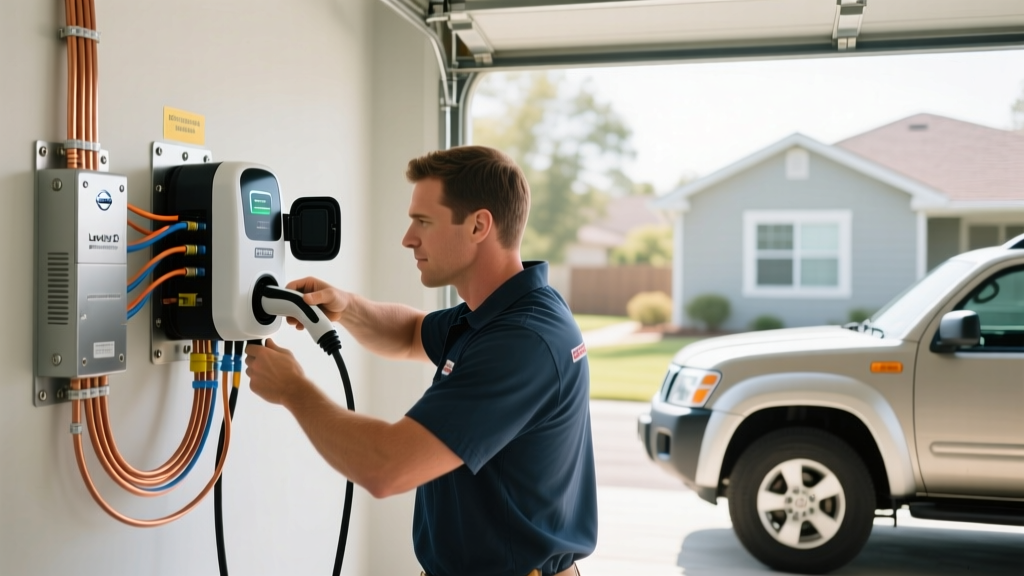
Level 2 home charging is where Lightning ownership makes the most sense financially and practically. But installation costs vary widely based on your home's electrical panel, distance from the panel to the charger location, and local permit fees.
Electrical Requirements
- Circuit: A dedicated 60-amp breaker is standard for a 48-amp continuous-draw charger (NEC requires circuits rated 125% above continuous load).
- Wire: 6 AWG copper (or 4 AWG aluminum) for runs up to ~50 feet; thicker gauge for longer runs.
- Outlet vs. Hardwired: A NEMA 14-50 outlet offers portability; hardwired units avoid GFCI nuisance trips common with 240V receptacles in some jurisdictions.
- Panel Capacity: Your main panel needs at least 60 amps of spare capacity. A 200-amp panel in an all-gas home usually has room. A 100-amp panel or a home with multiple high-draw appliances may require a panel upgrade.
Installation Cost Breakdown
| Cost Component | Simple Install (panel nearby, 200A) | Complex Install (long run, panel upgrade) |
|---|---|---|
| Level 2 Charger (Equipment) | $400–$700 | $400–$700 |
| Electrician Labor | $400–$800 | $1,200–$2,500 |
| Materials (wire, conduit, breaker) | $100–$300 | $300–$800 |
| Permit & Inspection | $50–$150 | $50–$200 |
| Panel Upgrade (if needed) | $0 | $1,500–$3,500 |
| Total Estimated Cost | $950–$1,950 | $3,450–$7,700 |
Connector Compatibility: CCS1, NACS, and What You Need in 2026
Ford began transitioning the F-150 Lightning to the North American Charging Standard (NACS, the Tesla connector) starting with the 2025 model year. This creates a split landscape for current owners:
| Model Year | Built-in Connector | Tesla Supercharger Access | CCS Network Access |
|---|---|---|---|
| 2022–2024 Lightning | CCS1 | Via Ford-provided NACS adapter | Native (no adapter) |
| 2025–2026 Lightning | NACS | Native (no adapter) | Via NACS-to-CCS adapter |
What this means practically: If you own a 2022–2024 Lightning, Ford issued a NACS adapter (free for early owners, ~$230 replacement) that unlocks Tesla Supercharger V3 and V4 stalls — dramatically expanding your road-trip network. If you have a 2025+ model with native NACS, you'll need a NACS-to-CCS adapter (available from Ford and third parties like Lectron, ~$180–$250) to use Electrify America, EVgo, and other CCS-equipped public stations. Most home Level 2 chargers now ship with NACS connectors or include adapters.
DC Fast Charging: 10–80% Times and the Charge Curve Reality
The Lightning's DC fast-charging peak is approximately 150 kW for both battery sizes. But peak rate isn't sustained rate — the charge curve tapers significantly above 80% state of charge (SoC) to protect battery longevity.
| Metric | 98 kWh (Standard Range) | 131 kWh (Extended Range) |
|---|---|---|
| Peak DC Charge Rate | ~150 kW | ~150 kW |
| 10–80% Time (ideal conditions) | ~36 minutes | ~41 minutes |
| 15–80% Time (real-world avg) | ~32 minutes | ~38 minutes |
| 80–100% Time (taper zone) | ~25+ minutes | ~35+ minutes |
| Miles Added in 10 min (at peak) | ~54 mi | ~54 mi |
Preconditioning matters. The Lightning's navigation system will precondition the battery (warm it to optimal temperature) when you route to a DC fast charger. Arriving without preconditioning — especially in cold weather — can reduce peak charge rates by 30–50%, adding 10–15 minutes to your stop. Always navigate to the charger using the truck's built-in nav or FordPass app for best results.
Road-trip strategy: Because charging slows dramatically past 80%, the most time-efficient approach on long trips is to charge to 80% and drive on. Charging from 80–100% takes nearly as long as 10–80%. Only charge to 100% when you're at your destination or at home overnight.
Cost to Charge: Home vs. Public vs. Gas Comparison
Charging economics depend heavily on where and when you plug in. Here's a realistic breakdown using national average electricity rates and current gas prices:
| Scenario | Rate ($/kWh) | Cost for 131 kWh Full Charge | Cost per Mile (Extended Range) |
|---|---|---|---|
| Home Off-Peak (Time-of-Use) | $0.08–$0.12 | $10.50–$15.70 | $0.033–$0.049 |
| Home Standard Rate | $0.14–$0.18 | $18.35–$23.60 | $0.057–$0.074 |
| Public Level 2 (ChargePoint, etc.) | $0.25–$0.40 | $32.75–$52.40 | $0.102–$0.164 |
| DC Fast Charge (Electrify America) | $0.35–$0.55 | $45.85–$72.05 | $0.143–$0.225 |
| Tesla Supercharger (avg) | $0.28–$0.40 | $36.70–$52.40 | $0.115–$0.164 |
Gas comparison: A comparable 2026 Ford F-150 with the 3.5L EcoBoost V6 averages about 20 MPG combined. At $3.40/gallon (2026 national average), that's $0.17 per mile. Even at standard home electricity rates, the Lightning Extended Range costs $0.057–$0.074 per mile — roughly one-third the fuel cost of the gas truck. Over 15,000 miles per year, that's an annual fuel savings of approximately $1,440–$1,695. Source: fueleconomy.gov F-150 4WD comparison.
Recommended Level 2 Home Chargers for the Ford Lightning
The Lightning's 11.5 kW onboard charger (Extended Range) means you benefit from a 48-amp Level 2 station. A 32-amp unit will work but adds ~3 hours to a full charge of the 131 kWh pack.
Ford Charge Station Pro
- Power: 11.5 kW (48A) at 240V
- Connector: NACS (2025+ models); CCS1 for 2022–2024
- Cable Length: 25 feet
- Smart Features: FordPass integration, scheduled charging, OTA updates
- Installation: Hardwired, requires 60A circuit
- Price: ~$750–$850 (often included with Lightning purchase)
Best for: Lightning owners who want seamless Ford ecosystem integration and maximum Level 2 speed.
ChargePoint Home Flex
- Power: Up to 12 kW (50A) at 240V, configurable 16–50A
- Connector: NACS or J1772 (with adapter)
- Cable Length: 23 feet
- Smart Features: Wi-Fi, app scheduling, Alexa, energy tracking
- Installation: NEMA 14-50 plug or hardwired
- Price: ~$550–$650
Best for: Multi-EV households or renters who want a plug-in unit they can take when moving.
Emporia Level 2 Smart Charger
- Power: Up to 11.5 kW (48A) at 240V
- Connector: NACS or J1772
- Cable Length: 24 feet
- Smart Features: Wi-Fi, solar integration, energy dashboard, load management
- Installation: Hardwired or NEMA 14-50
- Price: ~$350–$400
Best for: Budget-conscious buyers and homes with solar panels who want energy monitoring.
Safety, Code, and Installation Best Practices
EV charging draws sustained high current for hours — unlike a dryer or oven that cycles on and off. This makes proper installation non-negotiable:
- Dedicated Circuit: Your Level 2 charger must be on its own dedicated breaker. Sharing a circuit with other appliances risks overheating and nuisance trips.
- GFCI Considerations: The 2020 NEC requires GFCI protection for 240V receptacles in garages. However, some EV chargers experience nuisance GFCI trips. Hardwired installations are exempt from this GFCI requirement and are often preferred by electricians for EVSE.
- Outdoor Rating: If mounting outside, ensure the charger is rated NEMA 4 (weatherproof). All recommended units above carry outdoor ratings.
- Permit & Inspection: Most jurisdictions require an electrical permit for a new 240V circuit. The inspection verifies wire gauge, breaker sizing, grounding, and proper torque on connections. Skipping the permit risks insurance denial in the event of an electrical fire.
- Load Management: If your panel is near capacity but you don't want to upgrade, devices like the Emporia Smart Charger or a dedicated load-management relay can dynamically reduce charge rate when other appliances are running.
Frequently Asked Questions
How much does it cost to install a home EV charger for the Ford Lightning?
A straightforward installation (200-amp panel, short wire run, no panel upgrade) typically costs $950–$1,950 including equipment, electrician labor, materials, and permit. If your home needs a panel upgrade from 100A to 200A, total costs can reach $3,450–$7,700. Always get 2–3 quotes from licensed electricians who have specific EVSE installation experience.
How fast will each charging level add range to my Lightning?
Level 1 (120V) adds roughly 2–3 miles per hour — enough only for emergency trickle charging. Level 2 at 48 amps (11.5 kW) adds 25–28 miles per hour, fully replenishing the 131 kWh Extended Range pack in about 11–12 hours. DC fast charging at 150 kW adds approximately 54 miles in 10 minutes at peak rate, with 10–80% taking 36–41 minutes depending on pack size.
Which connector is compatible with my Ford Lightning?
Model years 2022–2024 use the CCS1 connector natively and require a Ford-supplied NACS adapter for Tesla Supercharger access. Model years 2025–2026 use NACS natively and need a NACS-to-CCS adapter for Electrify America and other CCS networks. For home Level 2 charging, match the charger connector to your truck's port or use the appropriate adapter.
How much does charging the Lightning cost per mile vs. a gas F-150?
At home off-peak rates (~$0.10/kWh), the Extended Range Lightning costs approximately $0.04 per mile. A comparable gas F-150 EcoBoost at 20 MPG and $3.40/gallon costs $0.17 per mile. That's a $0.13/mile savings, or roughly $1,950 saved over 15,000 annual miles. Even at public DC fast-charge rates ($0.40/kWh), the Lightning costs about $0.16/mile — still cheaper than gas.
What electrical upgrades might I need for home charging?
The most common upgrade is a panel replacement from 100-amp to 200-amp service ($1,500–$3,500), needed in older homes with limited spare capacity. You may also need a service lateral upgrade if your utility drop is undersized (rare, but possible in homes built before 1970). Your electrician will perform an NEC Article 220 load calculation to determine if your existing panel can handle the additional 60-amp circuit.
Does the Ford Lightning qualify for the federal EV tax credit?
The F-150 Lightning's eligibility under IRS §30D depends on current-year battery sourcing, critical mineral requirements, MSRP caps ($80,000 for trucks/vans/SUVs), and buyer income limits ($150K single / $300K joint). The credit can be up to $7,500 and may be applied as a point-of-sale rebate. Eligibility changes as supply chains shift — verify current status at IRS.gov or with your tax professional before purchasing.
Can I charge my Lightning with solar panels?
Yes. A typical 10 kW residential solar system produces roughly 35–45 kWh per day in good conditions — enough to fully recharge the Standard Range pack or add ~100 miles to the Extended Range daily. Smart chargers like the Emporia can prioritize solar production, charging only when excess solar is available. This effectively reduces your per-mile fuel cost to near zero after the solar system payback period.