If you are transitioning from a legacy internal-combustion vehicle like the 2004 Nissan Xterra Supercharged — a 3.3L V6 SUV that averaged roughly 15 MPG combined — to a modern battery-electric vehicle, the single biggest ownership shift is fueling at home. Understanding EV charging infrastructure before you buy your first EV eliminates the most common pain points new owners face: insufficient circuit capacity, mismatched connectors, and surprise electrical panel upgrades. This guide covers every technical and financial detail you need to plan a home charging setup in 2026.
Understanding EV Charging Levels: Speeds, Power, and Range Added
EV charging is categorized into three levels, each defined by voltage, power output in kilowatts (kW), and practical charging speed. Note that kW measures power (the rate of energy delivery), while kWh measures energy (the total capacity of your battery). Confusing these is the most common EV literacy mistake — a 10 kW charger does not deliver 10 kWh in one minute; it delivers 10 kWh in one hour.
| Level | Voltage | Power (kW) | Miles of Range Added Per Hour | Typical Use Case |
|---|---|---|---|---|
| Level 1 | 120V AC | 1.0–1.4 kW | 3–5 miles | Overnight trickle; PHEV top-ups |
| Level 2 | 240V AC | 3.3–19.2 kW | 12–75 miles | Primary home and workplace charging |
| DC Fast Charging | 400–900V DC | 50–350+ kW | 150–1,200+ miles/hr equivalent | Road trips and rapid public top-ups |
For context, a typical 2026 EV with a 75 kWh battery (such as a Hyundai Ioniq 5 or Tesla Model Y) charging on a 48-amp Level 2 circuit (11.5 kW) will add roughly 40–45 miles of range per hour, or fully replenish from 10% to 80% in about 4.5 hours. On a 350 kW DC fast charger, that same 10–80% session can complete in 18–25 minutes, though sustained peak rates taper significantly above 80% state of charge to protect battery health.
How Much Does It Cost to Install a Home EV Charger?
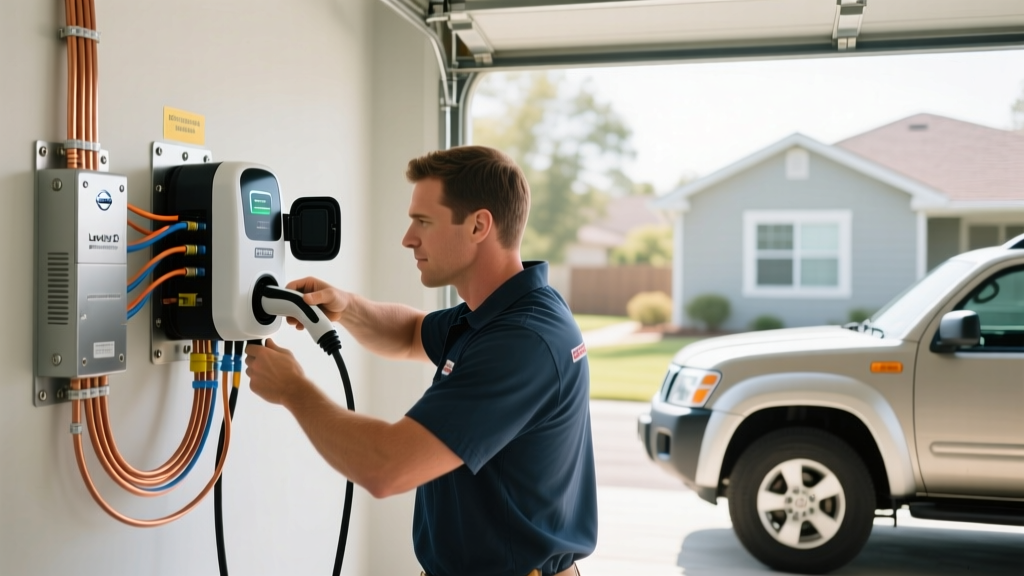
Home Level 2 charger installation costs vary dramatically based on your electrical panel's existing capacity, the distance from the panel to the charging location, and local permit requirements. Below is a realistic breakdown for a typical 240V/48A hardwired installation in 2026.
| Component | Low-End Estimate | High-End Estimate | Notes |
|---|---|---|---|
| Level 2 EVSE Equipment (40–48A) | $350 | $750 | Smart chargers with Wi-Fi and scheduling cost more |
| Electrician Labor (2–6 hours) | $300 | $1,200 | Varies by region; $75–$200/hr typical |
| Electrical Permit | $50 | $300 | Required in most jurisdictions; varies by municipality |
| Conduit, Wiring (6 AWG copper), Misc. | $100 | $500 | Longer runs from panel to garage increase cost |
| Panel Upgrade (if needed: 100A → 200A) | $1,500 | $4,000 | Older homes with 100A service often require this |
| Total (No Panel Upgrade) | $800 | $2,750 | Most homes with 200A service fall in this range |
| Total (With Panel Upgrade) | $2,300 | $6,750 | Common in homes built before 1990 |
Homes built in the 1970s–1990s era — the same vintage as a well-maintained 2004 Nissan Xterra Supercharged might have been garaged in — frequently have 100-amp or 150-amp electrical panels. A 48-amp EV charger requires a dedicated 60-amp circuit (NEC code mandates continuous loads use only 80% of a circuit's rated capacity). If your panel lacks sufficient spare capacity, an upgrade to 200A service is mandatory before installation. Always have a licensed electrician perform a load calculation before committing to equipment.
Connector Compatibility: NACS, CCS1, and CHAdeMO Explained
As of 2026, the North American EV charging connector landscape has consolidated significantly around the North American Charging Standard (NACS), originally developed by Tesla. However, many EVs sold between 2020 and 2024 still use the CCS1 (Combined Charging System) connector, and older Japanese-market EVs use CHAdeMO.
| Connector Type | Compatible Brands (2026) | Adapter Needed? |
|---|---|---|
| NACS (Tesla/J3400) | Tesla (all), Ford, GM, Rivian, Hyundai/Kia (2025+), Volvo/Polestar, BMW, Mercedes-Benz, Lucid, Subaru | No for native NACS; CCS-to-NACS adapters available (~$200) |
| CCS1 | VW ID.4 (pre-2025), older Ford/GM EVs, Stellantis, some Hyundai/Kia (pre-2025) | NACS-to-CCS adapter required for Tesla Superchargers |
| CHAdeMO | Nissan Leaf (legacy), Mitsubishi Outlander PHEV (older) | Limited public infrastructure; being phased out |
For home Level 2 charging, all non-Tesla EVs use a J1772 connector, and Tesla provides a J1772 adapter with every vehicle. If you purchase a NACS-equipped home charger (increasingly common in 2026), you will need a J1772-to-NACS adapter for non-Tesla vehicles, or simply choose a charger with a J1772 plug for universal compatibility. According to the U.S. Department of Energy, over 90% of home charging occurs at Level 2, making connector choice at home less critical than for public DC fast charging.
Cost to Charge Per Mile: EV Electricity vs. Gasoline
One of the most compelling reasons EV owners cite for switching from vehicles like the supercharged Xterra is per-mile fuel cost. Here is how typical 2026 charging scenarios compare to gasoline at $3.50 per gallon.
| Scenario | Rate | Cost per kWh | Cost per Mile (250 Wh/mi EV) | Annual Cost (12,000 mi) |
|---|---|---|---|---|
| Home Level 2 (off-peak utility rate) | Time-of-use | $0.08–$0.14 | $0.02–$0.035 | $240–$420 |
| Home Level 2 (standard rate) | Flat | $0.12–$0.20 | $0.03–$0.05 | $360–$600 |
| Public Level 2 (network pricing) | Per kWh or session | $0.20–$0.40 | $0.05–$0.10 | $600–$1,200 |
| DC Fast Charging (public) | Per kWh | $0.30–$0.60 | $0.075–$0.15 | $900–$1,800 |
| Gasoline SUV (15 MPG combined) | $3.50/gallon | N/A | $0.233 | $2,800 |
Even using exclusively DC fast charging at public rates, an EV costs roughly half per mile compared to a 15 MPG gasoline SUV. Home charging on off-peak rates delivers the most dramatic savings — approximately 85–90% less per mile than gasoline. The U.S. EPA's fueleconomy.gov provides vehicle-specific MPGe and kWh/100mi ratings to calculate precise costs for any EV model you are considering.
Charging Time Examples: How Long Does It Really Take?
Charging times depend on battery capacity (measured in kWh), the charger's power output (kW), and the vehicle's onboard charge acceptance rate. Below are real-world estimates for common 2026 EV battery sizes.
| Battery Size | Level 1 (1.4 kW) | Level 2 (11.5 kW / 48A) | DC Fast (150 kW peak) | DC Fast (350 kW peak) |
|---|---|---|---|---|
| 60 kWh (e.g., base EV sedan) | 43 hours (0–100%) | 5.2 hours (0–100%) | ~25 min (10–80%) | ~18 min (10–80%) |
| 75 kWh (e.g., mid-size SUV) | 54 hours (0–100%) | 6.5 hours (0–100%) | ~30 min (10–80%) | ~22 min (10–80%) |
| 100 kWh (e.g., large truck/SUV) | 71 hours (0–100%) | 8.7 hours (0–100%) | ~40 min (10–80%) | ~28 min (10–80%) |
For daily driving of 30–40 miles, a Level 2 home charger replenishes overnight use in 1–2 hours — meaning most owners never need to think about charging during the work week. DC fast charging is primarily relevant for road trips exceeding your vehicle's EPA range.
Recommended Home EV Chargers for 2026
The home EVSE (Electric Vehicle Supply Equipment) market has matured considerably. Below are top-tier recommendations based on reliability, smart features, and value.
ChargePoint Home Flex
- Power: Up to 12 kW (50A), adjustable down to 16A
- Connector: J1772 (NACS adapter available)
- Cable Length: 23 feet
- Smart Features: Wi-Fi, scheduling, Alexa integration, energy tracking
- Price: ~$550–$650
- Best For: Flexible amperage for older panels
Tesla Wall Connector
- Power: Up to 11.5 kW (48A)
- Connector: NACS native (J1772 adapter included for non-Tesla)
- Cable Length: 24 feet
- Smart Features: Wi-Fi, OTA updates, power sharing (multiple units)
- Price: ~$475
- Best For: Tesla owners and NACS-native vehicles
Grizzl-E Smart
- Power: Up to 10 kW (40A)
- Connector: J1772
- Cable Length: 24 feet
- Smart Features: OCPP-compatible, works with multiple networks
- Price: ~$450–$550
- Best For: Durability; rated -40°F to +122°F outdoor use
Emporia Level 2 Charger
- Power: Up to 11.5 kW (48A)
- Connector: J1772
- Cable Length: 24 feet
- Smart Features: Real-time energy monitoring, solar integration, load management
- Price: ~$400–$500
- Best For: Budget-conscious buyers wanting smart features
Safety, Electrical Code, and Permit Considerations
EV charger installation is governed by the National Electrical Code (NEC) and local amendments. Key requirements include:
- Dedicated Circuit: Your Level 2 charger must be on its own dedicated circuit — it cannot share a breaker with other appliances. A 48A charger requires a 60A breaker.
- GFCI Protection: NEC 2020 and later require GFCI (Ground Fault Circuit Interrupter) protection for all EVSE outlets. Hardwired units typically have built-in GFCI, but plug-in units on NEMA 14-50 receptacles require a GFCI breaker, which adds $50–$100 to costs.
- Outdoor Rating: If your charger is installed outdoors (carport, driveway), the EVSE must carry a NEMA 4 or NEMA 4X weather-resistance rating. All units listed above meet this standard.
- Permit and Inspection: Nearly all U.S. jurisdictions require an electrical permit for EVSE installation. The inspection verifies proper wire gauge, breaker sizing, grounding, and GFCI compliance. Never skip this step — it protects your home insurance coverage and resale value.
- Utility Notification: Some utilities require notification before installing a Level 2 charger, especially if your area has distribution transformer capacity limits. Many utilities offer rebates of $200–$1,000 for smart charger installation and time-of-use enrollment.
For detailed electrical specifications, always consult a licensed electrician who can perform a load calculation on your specific panel. The National Fire Protection Association publishes the NEC standards that govern all residential EVSE installations.
Frequently Asked Questions
How much does it cost to install a home EV charger?
A standard Level 2 home charger installation costs between $800 and $2,750 when your electrical panel has sufficient capacity (200A service with spare breaker slots). If a panel upgrade from 100A to 200A is needed, total costs range from $2,300 to $6,750. The EVSE unit itself costs $350–$750, with labor, wiring, and permits making up the remainder.
How fast will each charging level add range?
Level 1 (120V) adds 3–5 miles of range per hour. Level 2 (240V, 48A) adds approximately 35–45 miles per hour for a typical EV. DC fast charging adds 150–1,200+ miles per hour equivalent, with 10–80% sessions completing in 18–40 minutes depending on the vehicle and charger power rating.
Which connector/charger is compatible with my EV?
For 2026 models, most manufacturers have adopted NACS (Tesla's connector standard). Vehicles from 2020–2024 may use CCS1. For home Level 2 charging, all EVs accept J1772 (Tesla includes an adapter). Check your vehicle's charge port or the manufacturer's specifications to confirm. Adapters are available for cross-compatibility.
How much does charging cost per mile vs gas?
Home EV charging on off-peak utility rates costs approximately $0.02–$0.035 per mile. A 15 MPG gasoline SUV at $3.50/gallon costs $0.233 per mile — roughly 7–10x more expensive. Even public DC fast charging at $0.30–$0.60/kWh costs $0.075–$0.15 per mile, still significantly less than gasoline.
What electrical upgrades might I need?
If your home has a 100A electrical panel (common in homes built before 1990), you will likely need a panel upgrade to 200A service, costing $1,500–$4,000. Even with a 200A panel, a licensed electrician must perform a load calculation to confirm spare capacity for a dedicated 60A circuit. Homes with newer 200A+ panels typically need no upgrade.