Understanding the Ford E-Transit Range and Charging Realities
The Ford E-Transit is the electric workhorse of the commercial van segment, but its 68 kWh usable battery (NMC chemistry) delivers an EPA-estimated 126 miles of range in the low-roof cargo van configuration. That number drops in real-world use: expect 90–110 miles on the highway with a full payload, and as little as 75–85 miles in cold weather (below 30°F) due to cabin heating demands and battery chemistry limitations.
Real-World Highway (loaded): ~90–110 miles
Cold Weather (below 30°F): ~75–85 miles
Source: fueleconomy.gov
For fleet operators and owner-operators running predictable routes under 100 miles per day, the E-Transit's range is workable — but only with disciplined charging infrastructure. This guide breaks down exactly how to charge the E-Transit at home, at the depot, or on the road, what it costs, and what equipment you need.
Charging Levels Explained: Speeds, Power, and Miles Added Per Hour
EV charging is measured in kilowatts (kW), which is the rate of power delivery. The energy stored in the battery is measured in kilowatt-hours (kWh) — a fundamentally different unit. Confusing kW with kWh is the single most common mistake in EV literacy. Think of kW as the speed of water flowing into a tank, and kWh as the total volume of the tank.
| Level | Voltage | Max Power (kW) | Miles Added Per Hour | E-Transit 10–80% Time |
|---|---|---|---|---|
| Level 1 (120V outlet) | 120V | 1.4–1.9 kW | ~3–5 miles/hr | ~30+ hours (impractical) |
| Level 2 (240V home/depot) | 240V | 7.2–19.2 kW | ~15–40 miles/hr | ~4–8 hours (varies by kW) |
| DC Fast Charging | 400V+ | 115 kW (peak) | ~150+ miles/hr (peak) | ~45 minutes (10–80%) |
The E-Transit's onboard charger accepts up to 11.3 kW on AC Level 2, meaning a 48-amp Level 2 station will fully utilize its capacity. On DC fast charging, it peaks at 115 kW but tapers significantly above 60% state of charge (SoC), so the 10–80% time averages around 45 minutes rather than the theoretical minimum.
How Much Does It Cost to Install a Home or Depot EV Charger?
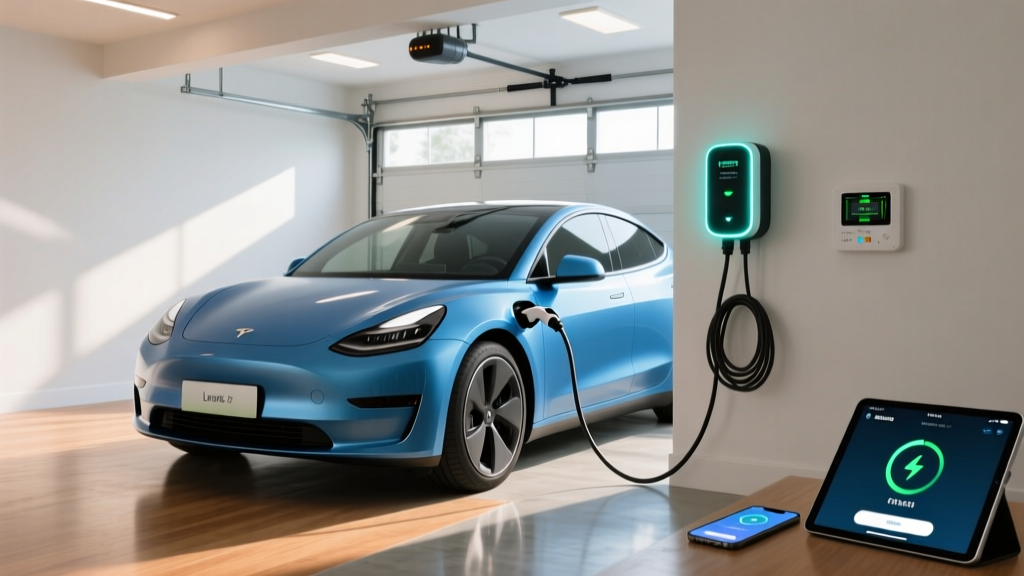
Installing a dedicated Level 2 charger for the E-Transit at a home garage or small fleet depot requires a 240V circuit — typically 60 amps to support a 48-amp continuous charger. Costs vary enormously based on your electrical panel's condition and the distance from the panel to the charger location.
| Component | Low Estimate | High Estimate | Notes |
|---|---|---|---|
| Level 2 Charger (Equipment) | $400 | $800 | 48-amp, 240V, hardwired or NEMA 14-50 |
| Electrician Labor | $600 | $2,500 | Depends on run length, conduit, wall type |
| Permit & Inspection | $100 | $400 | Varies by municipality |
| Panel Upgrade (if needed) | $1,500 | $4,000 | Required if panel is 100A or at capacity |
| Total (no panel upgrade) | $1,100 | $3,700 | Most common scenario for modern homes |
| Total (with panel upgrade) | $2,600 | $7,700 | Older homes, 100A service |
For small fleet depots installing multiple chargers, commercial electrical work and potential transformer upgrades from the utility can push costs higher. Always get a load calculation from a licensed electrician before committing to equipment. The IRS §30D tax credit does not cover charger installation for commercial vehicles — that falls under the separate §30C Alternative Fuel Infrastructure credit, which has its own eligibility rules and census-tract requirements.
Connector Compatibility: What Plugs Into the E-Transit?
The Ford E-Transit uses the CCS1 (Combined Charging System) connector for both AC Level 2 and DC fast charging. As of 2025–2026, Ford has begun equipping new vehicles with the NACS (Tesla-style) port, and the E-Transit lineup is expected to follow. For existing CCS1-equipped E-Transits, a Ford-provided or third-party NACS-to-CCS adapter enables access to Tesla Supercharger stations.
| Connector | Use Case | E-Transit Compatibility | Adapter Needed? |
|---|---|---|---|
| CCS1 | Level 2 & DC Fast (public networks) | Native (2022–2024 models) | No |
| NACS (Tesla) | DC Fast (Superchargers) & Level 2 | Via adapter or native (2025+ models) | Yes (for CCS1 models) |
| CHAdeMO | DC Fast (legacy Nissan/Mitsubishi) | Not compatible | N/A |
| J1772 | AC Level 1 & Level 2 | Native (AC charging portion of CCS1) | No |
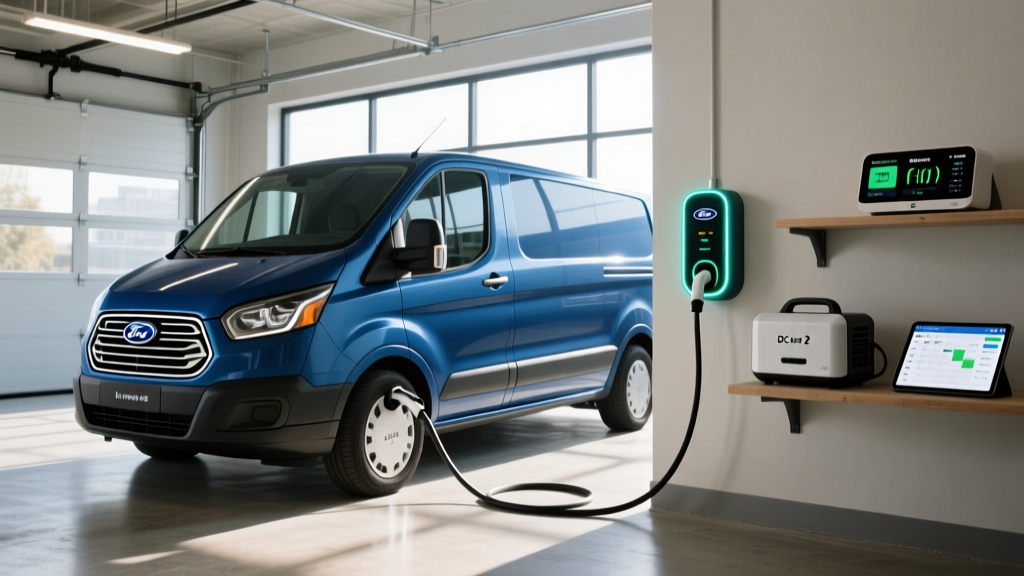
For depot charging, most commercial Level 2 stations use a J1772 plug, which connects directly to the upper portion of the E-Transit's CCS1 port. No adapter is needed for AC charging.
Charging Cost Per Mile: E-Transit vs. Gas Transit
The E-Transit consumes approximately 2.0–2.5 kWh per mile under mixed driving conditions (loaded). At residential electricity rates, this translates to significant savings over the gasoline Transit, which averages 14–16 MPG combined.
| Scenario | Rate | Cost Per Mile (E-Transit) | Cost Per Mile (Gas Transit @ 15 MPG) |
|---|---|---|---|
| Home charging (off-peak) | $0.12/kWh | $0.24–$0.30 | $0.23 (at $3.50/gal) |
| Home charging (peak/average) | $0.18/kWh | $0.36–$0.45 | $0.23 (at $3.50/gal) |
| Public Level 2 | $0.30/kWh | $0.60–$0.75 | $0.23 (at $3.50/gal) |
| DC Fast Charging | $0.48/kWh | $0.96–$1.20 | $0.23 (at $3.50/gal) |
The economics strongly favor home or depot charging. Public DC fast charging erases the fuel-cost advantage entirely — a critical consideration for fleet operators who may lack overnight charging access. At gas prices above $4.00/gallon, the E-Transit breaks even even on peak residential rates. Factor in reduced maintenance (no oil changes, fewer brake replacements due to regenerative braking) and the total cost of ownership tilts further in the E-Transit's favor for predictable, short-route operations.
Recommended Level 2 Chargers for the E-Transit
ChargePoint Home Flex
- Power Output: Up to 12 kW (50 amps), configurable down to 16 amps
- Connector: J1772 (25-foot cable)
- Smart Features: Wi-Fi, app scheduling, energy tracking, Alexa integration
- Price: ~$550 (equipment only)
- Best For: Single-vehicle home or small-office charging with flexible amperage
Wallbox Pulsar Plus
- Power Output: Up to 11.5 kW (48 amps)
- Connector: J1772 (25-foot cable)
- Smart Features: Wi-Fi/Bluetooth, load balancing, Power Sharing (daisy-chain multiple units)
- Price: ~$650 (equipment only)
- Best For: Small fleet depots needing multiple chargers on one circuit
Ford Connected Charge Station
- Power Output: Up to 11.3 kW (48 amps)
- Connector: J1772 (25-foot cable)
- Smart Features: FordPass app integration, scheduled charging, departure-time preconditioning
- Price: ~$700 (equipment only, sometimes bundled with vehicle purchase)
- Best For: E-Transit owners wanting seamless Ford telematics integration
All three chargers deliver sufficient power to replenish the E-Transit's 68 kWh battery overnight (approximately 6–7 hours from 10% to full at 11.3 kW). For fleet operations running multiple vans, the Wallbox Pulsar Plus's Power Sharing feature allows up to three units to share a single 60-amp circuit, reducing per-station electrical costs.
Safety, Electrical Code, and Installation Requirements
EV charger installation is governed by the National Electrical Code (NEC Article 625) and local amendments. Key requirements include:
- Dedicated Circuit: The charger must be on its own dedicated breaker — no sharing with other appliances. A 48-amp continuous-load charger requires a 60-amp breaker (NEC requires 125% overhead for continuous loads).
- GFCI Protection: NEC 2020 and later requires Ground Fault Circuit Interrupter protection for all EV supply equipment, whether hardwired or plug-in. Most modern chargers have built-in GFCI; if yours does not, the breaker must provide it.
- Outdoor Rating: If the charger is installed outdoors or in an unenclosed carport, it must carry a NEMA 4 (weatherproof) rating. All three chargers recommended above are rated for outdoor use.
- Cable Management: Avoid running charging cables across walkways or driveways where they create trip hazards or can be driven over. Use wall-mounted cable organizers or retractable cord reels for commercial installations.
- Permit and Inspection: Nearly all jurisdictions require an electrical permit and post-installation inspection. Skipping this step can void insurance coverage in the event of an electrical fire.
For fleet depot installations, consult with your utility about demand charges — commercial electricity billing often includes peak-demand fees that can make DC fast charging economically punishing without careful load management software.
Frequently Asked Questions
How much does it cost to install a home EV charger for the E-Transit?
Expect $1,100–$3,700 for a standard installation without a panel upgrade, including equipment ($400–$800), electrician labor ($600–$2,500), and permits ($100–$400). If your home has a 100-amp panel or insufficient spare capacity, a panel upgrade to 200 amps adds $1,500–$4,000.
How fast will each charging level add range to the E-Transit?
Level 1 (120V) adds roughly 3–5 miles per hour — essentially useless for daily fleet operations. Level 2 (240V, 48 amps) adds approximately 20–25 miles per hour, fully recharging overnight. DC fast charging at 115 kW peak adds 150+ miles per hour at peak, tapering above 60% SoC, with a 10–80% session taking about 45 minutes.
Which connector does the Ford E-Transit use?
Model years 2022–2024 use CCS1 natively. The J1772 connector (the AC portion of CCS1) plugs in directly for Level 2 charging. For Tesla Supercharger access, a Ford-approved NACS-to-CCS adapter is required. 2025+ models may ship with native NACS — confirm with your dealer.
How much does charging the E-Transit cost per mile vs. gas?
At home off-peak rates ($0.12/kWh), the E-Transit costs $0.24–$0.30 per mile — comparable to the gas Transit at $3.50/gallon. At peak residential rates or public chargers, the E-Transit costs more per mile. The real savings come from reduced maintenance and the ability to charge at fleet depots at negotiated commercial rates.
What electrical upgrades might I need for a Level 2 charger?
A 48-amp Level 2 charger requires a 60-amp dedicated 240V circuit. If your electrical panel is 100 amps or already near capacity, you'll need a panel upgrade to 200 amps ($1,500–$4,000). A licensed electrician will perform a load calculation to determine if your existing panel can support the additional draw. Older homes (pre-1990) are most likely to need upgrades.
Does the E-Transit qualify for the federal EV tax credit?
The E-Transit is a commercial vehicle, so it falls under different rules than passenger cars. The IRS §30D credit applies to personal-use vehicles; commercial fleet buyers may qualify under the Commercial Clean Vehicle Credit (§45W), which offers up to $7,500 for vehicles under 14,000 lbs GVWR. Eligibility depends on battery sourcing, MSRP, and buyer tax liability. Consult a tax professional for your specific situation.