Understanding EV Charging Levels: Speed, Power, and Real-World Range
The single most important distinction in EV charging is between kW (kilowatts — the rate of power delivery) and kWh (kilowatt-hours — the total energy stored in your battery). Think of kW as the width of the pipe and kWh as the size of the tank. A wider pipe (higher kW) fills the tank faster, but the tank size (kWh) determines how far you can drive.
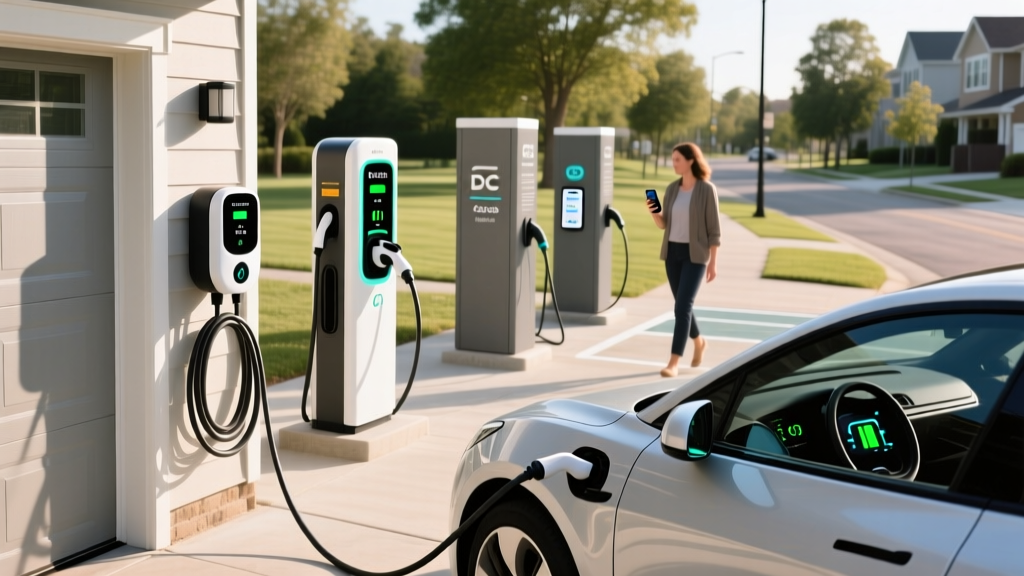
Every EV owner uses a mix of three charging levels depending on context: overnight at home, during errands at a destination, or on road trips via DC fast charging.
| Level | Voltage | Power (kW) | Miles of Range/Hour | Typical Use Case |
|---|---|---|---|---|
| Level 1 | 120V AC | 1.0–1.9 kW | 3–5 miles | Overnight top-ups, PHEVs, low-mileage drivers |
| Level 2 | 240V AC | 3.3–19.2 kW | 12–75 miles | Home daily charging, workplace, hotels, shopping |
| DC Fast Charge | 400–900V DC | 50–350 kW | 150–1,200+ miles/hr (peak) | Road trips, highway corridors, quick top-ups |
A critical reality check on DC fast charging: the advertised peak kW (say, 250 kW) is only sustained for a portion of the session. As your battery's State of Charge (SoC) climbs past 50–60%, the charge rate tapers to protect the cells. A vehicle rated for 250 kW peak might average 130–150 kW across a full 10–80% session. That's why manufacturers quote 10–80% charge times rather than 0–100%.
- 75 kWh battery (e.g., Tesla Model Y) at 250 kW peak: ~25–30 minutes, averaging ~150 kW
- 84 kWh battery (e.g., Hyundai Ioniq 5) at 350 kW peak (800V): ~18–22 minutes, averaging ~200 kW
- 100 kWh battery (e.g., Ford F-150 Lightning Extended) at 150 kW peak: ~45–55 minutes
- 18 kWh PHEV battery (e.g., Toyota RAV4 Prime) at Level 2 (6.6 kW): ~2.5 hours
How to Find Electric Car Charging Stations Near You
Finding reliable charging has gotten substantially easier in recent years, but the ecosystem remains fragmented across multiple networks and apps. Here's a practical breakdown of the tools and strategies that actually work.
Best Apps and Networks for Locating Chargers
The most effective approach is to use a combination of aggregator apps and network-specific tools:
- PlugShare — The most comprehensive aggregator. Shows all networks, user reviews, real-time status, photos, and connector types. Essential for road trip planning.
- A Better Routeplanner (ABRP) — Inputs your specific EV model, battery SoC, and destination, then generates an optimized charging plan with realistic time estimates accounting for terrain, temperature, and charge-curve taper.
- Network-specific apps — Tesla Supercharger (built into the car's nav), Electrify America, EVgo, and ChargePoint all have their own apps with real-time availability and payment.
- Apple Maps / Google Maps — Both now integrate EV routing with charger availability, though data freshness varies by region.
Public Charging Network Landscape in 2026
The U.S. public charging infrastructure has expanded significantly. The major networks you'll encounter:
- Tesla Supercharger — Now open to non-Tesla EVs via built-in NACS connectors or adapters. Over 30,000 stalls in North America. Consistently the most reliable network.
- Electrify America — Largest non-Tesla DC fast network. 350 kW CCS and NACS stalls along major highways. Variable reliability.
- EVgo — Urban and suburban fast charging, often co-located with retail. 350 kW-capable stations expanding.
- ChargePoint — Dominant in Level 2 destination charging (workplaces, retail, hotels) plus growing DC fast footprint.
Home EV Charger Installation: Requirements, Costs, and Electrical Upgrades
Home Level 2 charging is where 80–90% of all EV charging happens for owners with access. It's faster, cheaper per kWh, and more convenient than any public option. But installation costs vary dramatically based on your home's electrical infrastructure.
Electrical Requirements for a Level 2 Home Charger
A Level 2 charger requires a dedicated 240-volt circuit — the same type of circuit your electric dryer or oven uses. The most common configurations:
- 40-amp circuit / 32-amp continuous draw (7.7 kW) — The most popular residential setup. Sufficient for overnight charging of virtually any EV. Requires a NEMA 14-50 outlet or hardwired connection.
- 50-amp circuit / 40-amp continuous (9.6 kW) — Faster charging, useful for larger batteries (100+ kWh trucks/SUVs) or two-EV households sharing charge time.
- 60-amp circuit / 48-amp continuous (11.5 kW) — Maximum common residential speed. Requires robust panel capacity and heavier-gauge wiring.
Your EV's onboard charger also limits Level 2 speed. Most EVs accept 11.5 kW maximum (48A), while some (like the Ford F-150 Lightning with the optional 80A onboard charger) can accept up to 19.2 kW. Installing a 19.2 kW charger is pointless if your car can only accept 11.5 kW.
Installation Cost Breakdown
Installation cost is the biggest variable in home charging setup. Here's what to budget based on your home's situation:
| Component | Simple Install (panel nearby, no upgrade) | Moderate Install (long wire run, permit) | Complex Install (panel upgrade needed) |
|---|---|---|---|
| Level 2 Charger Equipment | $400–$700 | $400–$700 | $400–$700 |
| Electrician Labor | $400–$800 | $800–$2,000 | $1,500–$3,500 |
| Electrical Permit | $50–$150 | $50–$200 | $100–$300 |
| Panel Upgrade (200A service) | Not needed | Not needed | $1,500–$4,000 |
| Conduit/Wiring Materials | $50–$150 | $200–$600 | $200–$500 |
| Total Estimated Cost | $900–$1,800 | $1,450–$3,500 | $3,700–$9,000 |
Safety and Electrical Code Considerations
EV charging places a sustained high-current load on your electrical system — unlike an oven that cycles on and off, an EV charger may run at full draw for 6–10 hours straight. Key safety requirements:
- Dedicated circuit: Your EV charger must have its own dedicated breaker — never share a circuit with other appliances.
- GFCI protection: NEC 2020 and later require GFCI protection for all EV charging outlets. Hardwired chargers may have GFCI built in.
- Outdoor rating: If your charger is installed outdoors (garage-less homes, driveways), the unit must carry a NEMA 4 or IP65 weatherproof rating.
- Wire gauge: 40A circuits require minimum 8 AWG copper wire; 50A requires 6 AWG; 60A requires 4 AWG. Undersized wire is a fire risk.
- NEMA 14-50 vs hardwired: A NEMA 14-50 outlet offers portability (take the charger when you move) but requires GFCI breaker. Hardwired connections eliminate the GFCI breaker requirement and are often more reliable for permanent installations.
Connector Compatibility: NACS, CCS, and CHAdeMO Explained
The connector landscape has consolidated dramatically since 2023, when Ford, GM, Rivian, and most major automakers committed to the North American Charging Standard (NACS), originally developed by Tesla. By 2026, NACS is the dominant standard for new vehicles sold in North America.
| Connector | Brands Using It (New Vehicles) | Adapter Needed? |
|---|---|---|
| NACS (Tesla standard) | Tesla, Ford, GM, Rivian, Volvo, Polestar, Mercedes-Benz, BMW, Hyundai/Kia (select 2026+ models) | No — native NACS. CCS vehicles need a CCS-to-NACS adapter (~$200–$300) for Tesla Supercharger access. |
| CCS1 (Combo) | Hyundai, Kia (older models), Stellantis, VW (ID.4 pre-2026), legacy EVs | No for Electrify America/EVgo. Needs NACS-to-CCS adapter for Tesla Supercharger access. |
| CHAdeMO | Nissan Leaf (legacy only — discontinued in U.S.) | Increasingly rare. CHAdeMO adapters to CCS/NACS are limited and expensive. |
Adapter reality check: If you own a CCS-equipped EV (common for 2021–2025 models), most automakers now sell or include a CCS-to-NACS adapter that unlocks Tesla Supercharger access. Ford provides one free to eligible owners. These adapters typically support up to 150–250 kW DC fast charging — slightly below the stall's maximum, but sufficient for most sessions.
Cost to Charge: Home vs. Public vs. Gas Comparison
Electricity pricing varies enormously by location, time of day, and charging method. Here's how real-world costs break down.
| Scenario | Price per kWh | Cost for 60 kWh (≈200 mi) | Cost per Mile | Gas Equivalent (30 MPG @ $3.50/gal) |
|---|---|---|---|---|
| Home Off-Peak (TOU rate) | $0.08–$0.12 | $4.80–$7.20 | $0.024–$0.036 | $0.117/mile |
| Home Standard Rate | $0.13–$0.18 | $7.80–$10.80 | $0.039–$0.054 | $0.117/mile |
| Public Level 2 (ChargePoint, etc.) | $0.20–$0.35 | $12.00–$21.00 | $0.060–$0.105 | $0.117/mile |
| DC Fast Charge (Electrify America, EVgo) | $0.30–$0.55 | $18.00–$33.00 | $0.090–$0.165 | $0.117/mile |
| Tesla Supercharger | $0.25–$0.40 | $15.00–$24.00 | $0.075–$0.120 | $0.117/mile |
The economics are clear: home charging on an off-peak time-of-use (TOU) plan is 3–5x cheaper per mile than gasoline. Even expensive DC fast charging is often comparable to or slightly cheaper than gas. The catch is that exclusive reliance on public DC fast charging erodes the cost advantage and accelerates battery degradation due to sustained high-current sessions.
Most utilities offer TOU plans that discount electricity during overnight hours (typically 9 PM–6 AM). If you charge exclusively at home overnight, a vehicle averaging 3–4 miles per kWh (the typical EV efficiency range) will cost $0.025–$0.04 per mile to fuel. According to fueleconomy.gov, the average 2026 EV achieves 100–130 MPGe combined, translating to roughly $500–$700 annually in electricity for 12,000 miles of driving at home rates.
Recommended Home EV Chargers: Power, Features, and Pricing
Not all Level 2 chargers are created equal. Here are proven units across common power levels, with the specs that matter.
ChargePoint Home Flex
- Power Output: Up to 12 kW (50A circuit) — adjustable down to 16A
- Connector: NACS or J1772 (configurable)
- Cable Length: 23 feet
- Smart Features: Wi-Fi, app scheduling, energy tracking, Alexa integration
- Installation: Hardwired or NEMA 14-50 plug
- Price: ~$550–$650
- Best For: Flexible amperage for homes with limited panel capacity
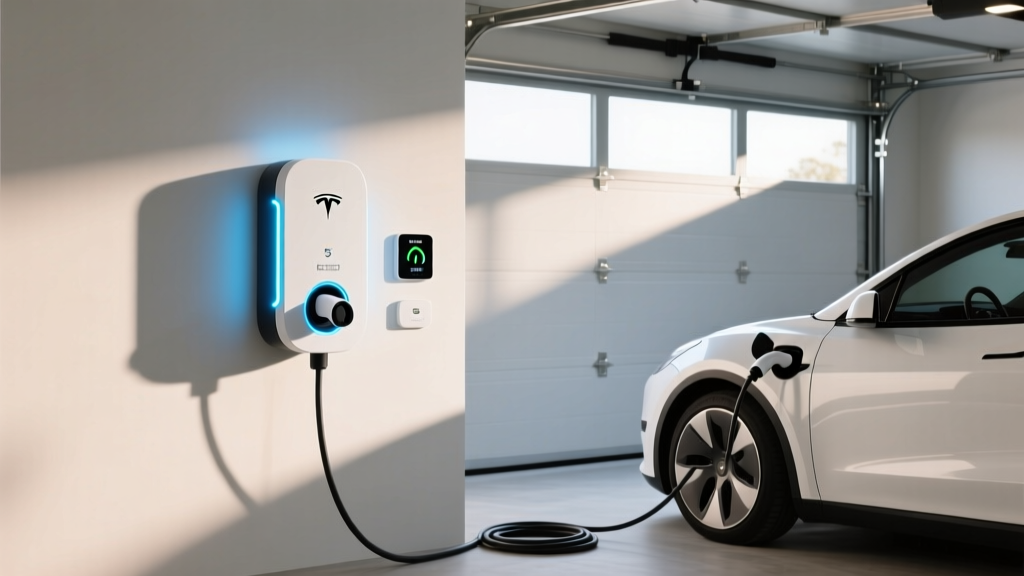
Tesla Wall Connector
- Power Output: Up to 11.5 kW (48A / 60A circuit)
- Connector: Native NACS
- Cable Length: 24 feet
- Smart Features: Wi-Fi, OTA updates, power sharing (link two units on one circuit), load management
- Installation: Hardwired only
- Price: ~$425–$475
- Best For: Tesla and NACS-equipped Ford/GM/Rivian owners. Power-sharing is ideal for two-EV garages.
Emporia Level 2 EV Charger
- Power Output: Up to 11.5 kW (48A / 60A circuit)
- Connector: J1772 (NACS adapter available)
- Cable Length: 24 feet
- Smart Features: Wi-Fi, detailed energy monitoring, solar integration, scheduling
- Installation: Hardwired or NEMA 14-50
- Price: ~$350–$450
- Best For: Budget-conscious buyers who want smart energy monitoring and solar pairing
For homes with 200A panels and a dedicated 60A circuit available, a 48A/11.5 kW charger delivers roughly 40–45 miles of range per hour of charging — enough to fully replenish most EVs in 6–8 hours overnight. If your panel is constrained, the ChargePoint Home Flex's adjustable amperage lets you dial down to 32A or 24A to stay within your electrical capacity.
Frequently Asked Questions
How much does it cost to install a home EV charger?
A straightforward Level 2 installation with a nearby electrical panel and no upgrade needed typically costs $900–$1,800 (charger + electrician + permit). If your panel requires an upgrade to 200A service, total costs can reach $3,700–$9,000. Get at least three quotes from licensed electricians and always require a permit — it protects your home insurance coverage and ensures code compliance.
How fast will each charging level add range?
Level 1 (120V standard outlet) adds 3–5 miles of range per hour — adequate for PHEVs with 20–40 mile electric ranges but impractical for full BEVs. Level 2 (240V) at a typical 40A/9.6 kW setup adds 30–40 miles per hour. DC fast charging at 150+ kW adds 150–300+ miles in 20–30 minutes, though the charge rate tapers significantly above 80% SoC.
Which connector and charger is compatible with my EV?
Check your vehicle's charge port: 2025–2026 Tesla, Ford, GM, Rivian, Volvo, and Polestar models use NACS. Most 2021–2025 Hyundai, Kia, VW, and Stellantis EVs use CCS1. If you have a CCS vehicle, you can access Tesla Superchargers with a CCS-to-NACS adapter from your automaker. For home charging, buy a Level 2 unit that matches your car's native connector to avoid daily adapter use.
How much does charging cost per mile compared to gas?
Home charging on off-peak rates costs $0.025–$0.04 per mile — roughly one-third the cost of gasoline at $3.50/gallon and 30 MPG ($0.117/mile). Public DC fast charging ranges from $0.08–$0.17 per mile, which is comparable to or slightly cheaper than gas. The savings are maximized when 80%+ of your charging happens at home.
What electrical upgrades might I need for a home charger?
Homes with 100-amp electrical service (common in pre-1990 construction) often need a panel upgrade to 200 amps before adding a 40–60A EV circuit. Homes with 200A service usually have sufficient capacity, but a long wire run from the panel to the garage (50+ feet) increases material costs. Your electrician will perform a load calculation per NEC Article 220 to determine whether your existing panel can handle the additional draw. Some utilities offer smart-panel solutions or managed charging programs that let you avoid a panel upgrade by coordinating EV charging with other household loads.
Sources: U.S. Department of Energy / fueleconomy.gov, energy.gov Home EV Charging Guide, IRS §30D Clean Vehicle Credits