If you have a Costco membership and are shopping for home EV charging equipment, you have probably searched for a "Costco EVSE" and found the selection confusing — or surprisingly limited. Unlike tires or batteries, electric vehicle supply equipment (EVSE) is not a core Costco category, and availability rotates through warehouse floors and Costco.com as seasonal or online-only items. In 2026, the landscape includes periodic Kirkland Signature-branded chargers (often rebranded units from established manufacturers), occasional listings from brands like Emporia and ChargePoint, and a growing ecosystem of adapters for the NACS connector standard.
This guide tells you exactly what to expect when buying a Level 2 home charger through Costco, how to evaluate the specs against dedicated EVSE brands, what your installation will actually cost, and how to avoid the most common mistakes first-time home-charger buyers make.
What Costco Actually Sells for EV Charging
Costco's EVSE inventory is not consistent. Unlike the permanent charger aisles at Home Depot or the dedicated storefronts of EV charger manufacturers, Costco rotates stock. Here is what shoppers typically encounter:
- Kirkland Signature Level 2 EV Charger — Periodically available online. Historically a rebranded unit (often manufactured by a company like Emporia or a white-label supplier) offering 32A to 48A output on a 240V circuit, with a 20- to 25-foot cable and a NEMA 14-50 plug or hardwired option.
- Name-brand chargers — Costco.com has periodically listed the Emporia Vue with charger bundle, ChargePoint Home Flex, and occasionally Webasto or Lectron units. Stock appears and disappears within weeks.
- Portable EVSE and adapters — NACS-to-J1772 adapters, Tesla Mobile Connectors, and CCS1 adapters occasionally appear, especially as the North American Charging Standard (NACS) has become the dominant connector for 2025-2026 model-year vehicles.
- Accessories — EVSE wall mounts, cable organizers, and J-hooks appear seasonally.
The appeal is clear: Costco's return policy (typically 90 days for electronics, sometimes longer for members), competitive pricing, and the ability to bundle with a Costco Shop Card or use a Costco Cash Card make these purchases attractive. But you need to evaluate the specs, not just the price tag.
Charging Levels Explained: kW, Speed, and What You Need at Home
Before buying any EVSE from Costco or elsewhere, you need clarity on the three charging levels. The single most important distinction in EV charging is between kW (kilowatts), which measures power — how fast energy flows — and kWh (kilowatt-hours), which measures energy — how much your battery holds. A charger's kW rating tells you its speed; your battery's kWh tells you its capacity.
| Level | Voltage | Max Power (kW) | Miles of Range Added per Hour | Typical Use |
|---|---|---|---|---|
| Level 1 | 120V (standard outlet) | 1.4–1.9 kW | 3–5 miles | Overnight trickle for PHEVs or low-mileage drivers |
| Level 2 | 240V (dryer-style outlet or hardwired) | 3.3–19.2 kW | 12–75 miles | Daily home charging; the standard for BEV owners |
| DC Fast Charging | 400V–800V+ (commercial stations) | 50–350+ kW | 150–1,000+ miles (peak) | Road trips; 10–80% in 15–40 minutes |
For home use, Level 2 is the target. Level 1 is too slow for any battery-electric vehicle (BEV) driven more than 30 miles daily, and DC fast charging is not a home option (residential electrical service cannot support it, and the equipment costs $20,000+).
A typical Level 2 Costco EVSE rated at 48 amps on a 240V circuit delivers up to 11.5 kW. That translates to roughly 35–45 miles of range per hour of charging for an efficient sedan like the Tesla Model 3 or Hyundai Ioniq 6, and roughly 25–35 miles per hour for a larger SUV like the Ford F-150 Lightning or Rivian R1S. Most EV owners charge overnight (8–10 hours), which is more than enough to replenish a daily commute and then some.
Home Installation: Electrical Requirements, Panel Upgrades, and Real Costs
The charger itself is only part of the expense. Installation is where costs vary wildly based on your home's electrical infrastructure. Here is what determines your total spend:
Circuit and Amperage Requirements
A Level 2 EVSE drawing 48 amps requires a dedicated 60-amp circuit (the National Electrical Code requires circuits to be rated at 125% of continuous load, so 48A × 1.25 = 60A). If you opt for a 32A charger, you need a 40A dedicated circuit. The most common outlet for plug-in Level 2 chargers is the NEMA 14-50, a 240V/50A receptacle commonly used for electric ranges and RV hookups.
Panel Capacity and Upgrade Needs
Most modern homes have a 200-amp electrical panel, which can usually accommodate a 60A EV circuit if there is sufficient spare capacity. However, older homes with 100A or 150A service, or homes already running heavy loads (electric heat, electric water heater, electric dryer, pool equipment), may need a panel upgrade to 200A or even 400A. This is the single biggest variable in installation cost.
An electrician will perform a load calculation per NEC Article 220 to determine whether your panel can handle the additional circuit. Do not skip this step — an overloaded panel is a fire hazard.
Permit Requirements
Virtually every jurisdiction in the U.S. requires an electrical permit for a new 240V circuit. Permit fees typically range from $50 to $300 depending on your municipality. The work must pass inspection. A licensed electrician will pull the permit as part of their service.
Installation Cost Breakdown
| Component | Low Estimate | High Estimate | Notes |
|---|---|---|---|
| EVSE equipment (Level 2, 32A–48A) | $300 | $700 | Costco pricing tends toward the lower end |
| Electrician labor (simple install, panel nearby) | $400 | $800 | Short conduit run, same wall as panel |
| Electrician labor (complex install, long run) | $800 | $2,000+ | Trenching, attic crawls, long conduit runs |
| Electrical permit | $50 | $300 | Varies by municipality |
| Panel upgrade (if needed) | $1,500 | $4,500+ | 200A upgrade; 400A service can exceed $5,000 |
| NEMA 14-50 outlet (if plug-in) | $50 | $150 | Parts and labor for receptacle |
| Total (no panel upgrade) | $800 | $3,500 | Most homes fall in $1,000–$2,000 range |
| Total (with panel upgrade) | $2,500 | $7,000+ | Older homes, high-load homes |
The federal government does not currently offer a direct tax credit for home charger equipment for most taxpayers. The Residential Clean Energy Credit (IRS §25D) covers solar, battery storage, and related equipment but does not generally cover EVSE for most filers. Some states and utilities offer rebates of $250–$1,000 for home charger installation — check your local utility's website and your state energy office for current programs.
Connector Compatibility: NACS, CCS1, and CHAdeMO
The connector landscape shifted dramatically between 2023 and 2026. Here is where things stand for 2026 model-year vehicles:
| Connector | Brands Using It (Native) | Status in 2026 |
|---|---|---|
| NACS (North American Charging Standard / Tesla) | Tesla, Ford, GM, Rivian, Volvo, Polestar, Mercedes-Benz, Nissan, Honda, Fisker, Lucid (adapter) | Dominant standard; most new EVs ship with NACS or include a CCS-to-NACS adapter |
| CCS1 (Combined Charging System) | Hyundai, Kia (some models), BMW, VW (legacy), Stellantis | Declining; many automakers transitioning to NACS for 2025+ models |
| CHAdeMO | Nissan Leaf (legacy) | Effectively discontinued for new vehicles |
What this means for your Costco EVSE purchase: Most Level 2 home chargers sold in 2026 ship with a J1772 connector (the legacy Level 2 standard) and include or support a NACS adapter. Tesla vehicles can use J1772 with the adapter that ships with every Tesla. Non-Tesla vehicles with native NACS ports (2025+ Ford, GM, Rivian, etc.) need a J1772-to-NACS adapter for a J1772-equipped charger, or you should buy a charger with a native NACS plug.
Before purchasing any EVSE from Costco, confirm:
- What connector does the charger ship with (J1772, NACS, or both)?
- Does your vehicle have a native J1772 port, a native NACS port, or do you have the appropriate adapter?
- Is the adapter included, or will you need to purchase one separately ($100–$250)?
Cost to Charge: Home vs. Public vs. Gas
One of the strongest arguments for home Level 2 charging is cost. Here is how the economics break down per mile for a typical EV getting 3–4 miles per kWh (the efficiency range for most 2026 BEVs from a Tesla Model 3 to a Ford F-150 Lightning):
| Scenario | Cost per kWh | Vehicle Efficiency | Cost per Mile |
|---|---|---|---|
| Home (off-peak utility rate) | $0.08–$0.14 | 3.5 mi/kWh | $0.02–$0.04 |
| Home (standard residential rate) | $0.14–$0.20 | 3.5 mi/kWh | $0.04–$0.06 |
| Home (high-cost state like CA, HI) | $0.25–$0.40 | 3.5 mi/kWh | $0.07–$0.11 |
| Public Level 2 (ChargePoint, EVgo L2) | $0.25–$0.49 | 3.5 mi/kWh | $0.07–$0.14 |
| DC Fast Charging (Electrify America, Tesla Supercharger) | $0.30–$0.55 | 3.5 mi/kWh | $0.09–$0.16 |
| Gasoline (30 MPG combined, $3.40/gal) | — | 30 MPG | $0.11 |
| Gasoline (20 MPG truck, $3.40/gal) | — | 20 MPG | $0.17 |
The takeaway: Home charging on off-peak rates is roughly one-third to one-fifth the cost per mile of gasoline, and significantly cheaper than public DC fast charging. Even in high-cost electricity states, home charging is competitive with gas. Public DC fast charging, while convenient for road trips, can approach or exceed the per-mile cost of gasoline — which is why home Level 2 charging is the economic foundation of EV ownership.
For a driver covering 12,000 miles per year in a vehicle averaging 3.5 mi/kWh:
- Home charging at $0.12/kWh: ~$411/year
- Gas at 25 MPG and $3.40/gal: ~$1,632/year
- Annual savings: ~$1,200+
Charging Time: What to Expect from Common Battery Sizes
Charging time depends on three variables: your battery's usable capacity (kWh), your charger's output (kW), and your vehicle's onboard charger limit (the maximum AC power the car can accept). Here are real-world estimates for Level 2 charging from 10% to 80% state of charge:
- Tesla Model 3 Long Range (75 kWh usable, 11.5 kW onboard charger): ~4.5 hours at 11.5 kW; ~6 hours at 7.7 kW (32A charger)
- Ford F-150 Lightning Extended Range (131 kWh usable, 19.2 kW onboard): ~5 hours at 19.2 kW (80A circuit); ~8 hours at 11.5 kW (48A); ~11 hours at 7.7 kW (32A)
- Hyundai Ioniq 5 (77.4 kWh usable, 10.9 kW onboard): ~5 hours at 10.9 kW; ~7 hours at 7.7 kW
- Chevrolet Equinox EV (85 kWh usable, 11.5 kW onboard): ~5.5 hours at 11.5 kW; ~7.5 hours at 7.7 kW
Key insight: Buying a 48A charger when your vehicle's onboard charger maxes out at 32A (7.7 kW) does not make your car charge faster. The vehicle is the bottleneck. Check your owner's manual or fueleconomy.gov for your specific model's AC charging limit before overspending on amperage you cannot use.
For DC fast charging (road trips), 10–80% times are dramatically shorter: typically 18–35 minutes on a 150–350 kW charger, though the charge curve tapers significantly above 80% to protect battery health. That last 20% can take as long as the first 80%.
Equipment Recommendations: Chargers to Consider (Costco and Beyond)
If you find a Level 2 EVSE at Costco, evaluate it against these benchmarks. If the Costco unit meets these specs at a competitive price, it is worth buying. If it falls short, consider one of these proven alternatives:
Emporia Vue + Level 2 Charger Bundle
- Power: Up to 48A (11.5 kW) on 240V
- Connector: J1772 (NACS adapter available)
- Cable length: 24 feet
- Smart features: Energy monitoring, solar integration, scheduled charging, load management
- Price: ~$350–$500 (frequently at Costco as a bundle with the Emporia Vue energy monitor)
- Verdict: Excellent value, especially if you have or plan to add solar. Load management lets you share a circuit with other appliances.
ChargePoint Home Flex
- Power: Adjustable 16A–50A (up to 12 kW) on 240V
- Connector: J1772 or NACS (select at purchase)
- Cable length: 23 feet
- Smart features: Wi-Fi, app scheduling, Alexa integration, charge history
- Price: ~$550–$700
- Verdict: Proven reliability, flexible amperage (set it to match your circuit), and strong app. A safe default if Costco does not have what you need.
Grizzl-E Smart
- Power: Up to 40A (9.6 kW) on 240V
- Connector: J1772 or NACS
- Cable length: 24 feet
- Smart features: Wi-Fi, OCPP-compatible, over-the-air updates
- Price: ~$400–$550
- Verdict: Built in Canada, rugged, outdoor-rated (NEMA 4), and one of the most durable units available. Great for garage or exterior wall installs in harsh climates.
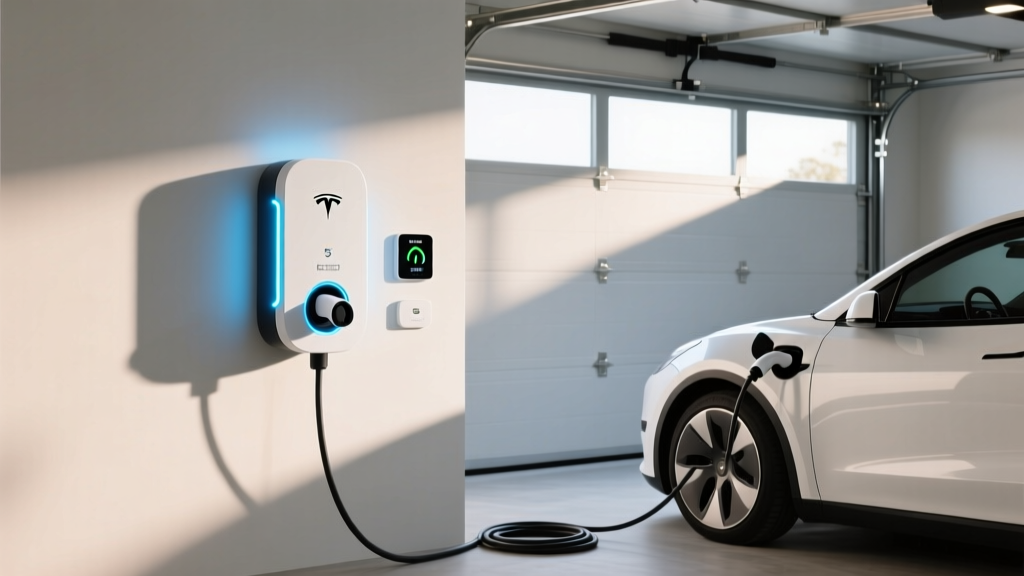
Wall Connector (Tesla, Gen 3)
- Power: Up to 48A (11.5 kW) on 240V
- Connector: Native NACS
- Cable length: 24 feet
- Smart features: Wi-Fi, OTA updates, power sharing between multiple units
- Price: ~$475
- Verdict: Best-in-class for Tesla owners and any 2025+ vehicle with a native NACS port. Non-Tesla NACS vehicles (Ford, GM, Rivian) can use it directly. J1772 vehicles need an adapter.
What to check on any Costco EVSE before buying:
- Amperage and kW output (32A/7.7 kW minimum for BEVs; 48A/11.5 kW preferred)
- Cable length (20+ feet recommended for garage flexibility)
- Plug type (NEMA 14-50 for plug-in, or hardwire — hardwire allows higher amperage on some units and avoids the GFCI breaker requirement for receptacles)
- Smart features (Wi-Fi scheduling lets you charge during off-peak hours for lower rates)
- Indoor/outdoor rating (NEMA 4 or IP65 for outdoor installations)
- UL or ETL listing (mandatory for safety and code compliance — never buy an uncertified charger)
Safety, Code, and Installation Best Practices
EV charging involves continuous high-amperage draw for hours at a time. This is more demanding on your wiring than almost any other household appliance. Follow these non-negotiable safety requirements:
- Dedicated circuit: Your EVSE must be on its own dedicated breaker — never shared with other outlets or appliances.
- GFCI protection: The 2023 NEC (and subsequent editions adopted by most states by 2026) requires GFCI protection for all 240V receptacles in garages. If you install a NEMA 14-50 outlet, your electrician will use a GFCI breaker. Hardwired installations are exempt from this GFCI requirement, which is one reason many electricians recommend hardwiring.
- Wire gauge: A 60A circuit requires 6 AWG copper wire (or 4 AWG aluminum). Do not let anyone undersize the wire — this is a fire risk.
- Outdoor rating: If your charger will be mounted outside, it must be rated for outdoor use (NEMA 4 or IP65 minimum). The connector holster should protect the plug from rain and debris.
- No extension cords: Never use an extension cord with a Level 2 EVSE. If the cable does not reach your vehicle, buy a charger with a longer cable or relocate the unit.
- Load management: If your panel is near capacity but you want to avoid a panel upgrade, consider a smart charger with load management (like the Emporia) that dynamically reduces charging power when other appliances are drawing heavily.
Frequently Asked Questions
How much does it cost to install a home EV charger?
For a straightforward installation with no panel upgrade, expect to spend $800–$2,500 total (equipment + electrician + permit). The EVSE itself costs $300–$700, electrician labor runs $400–$1,500 depending on the complexity of the wire run, and permits cost $50–$300. If your home needs a panel upgrade (common in pre-1990 homes or homes with 100A service), add $1,500–$4,500+ to that total.
How fast will each charging level add range?
Level 1 (120V) adds roughly 3–5 miles of range per hour — adequate only for plug-in hybrids or very low-mileage drivers. Level 2 (240V) adds 12–75 miles per hour depending on amperage and vehicle efficiency. A 48A/11.5 kW charger adds roughly 35–45 miles per hour for an efficient sedan. DC fast charging adds 150–1,000+ miles per hour at peak power, but sessions are measured in minutes (15–40 min for 10–80%), not hours.
Which connector/charger is compatible with my EV?
For 2026 model-year vehicles, check your vehicle's charge port. Most new vehicles from Tesla, Ford, GM, Rivian, Volvo, and others now use the NACS connector. Hyundai, Kia, and some legacy models still use CCS1. Most Level 2 home chargers ship with a J1772 connector — Tesla includes a J1772 adapter with every vehicle, and NACS-equipped non-Tesla vehicles may need a J1772-to-NACS adapter. Always confirm what is included with both the charger and the vehicle.
How much does charging cost per mile vs. gas?
Home charging on off-peak electricity ($0.08–$0.14/kWh) costs $0.02–$0.04 per mile for a typical EV. Gasoline at $3.40/gallon in a 25 MPG vehicle costs $0.14 per mile. Even in expensive electricity markets, home EV charging is typically 40–70% cheaper per mile than gasoline. Public DC fast charging ($0.30–$0.55/kWh) narrows the gap to roughly $0.09–$0.16 per mile — still competitive with gas, but not the bargain that home charging is.
What electrical upgrades might I need?
The most common upgrade is a panel capacity increase from 100A or 150A to 200A, which costs $1,500–$4,500. You may also need a new conduit run from the panel to the garage or exterior wall ($200–$800 depending on distance and access), a new NEMA 14-50 receptacle ($50–$150), or a GFCI breaker ($50–$100). Homes with very limited panel space may benefit from a smart panel or load-management device instead of a full upgrade. Always get a licensed electrician's load calculation before purchasing equipment.
Does Costco offer any warranty or return advantage on EVSE?
Costco's return policy is generally stronger than most retailers. Electronics typically have a 90-day return window, and Costco's concierge service can assist with technical issues. However, the manufacturer's warranty (typically 2–3 years for quality EVSE units) still applies and is your primary protection for long-term reliability. Keep your receipt and register the product with the manufacturer upon installation.
Can I claim a tax credit for buying a home EV charger?
For most residential taxpayers in 2026, there is no federal tax credit specifically for home EVSE. The Alternative Fuel Vehicle Refueling Property Credit (§30C) was modified and now applies primarily to businesses and certain low-income or rural census tracts. Check with a tax professional and the IRS website for current eligibility. Some state utilities and municipalities offer rebates of $250–$1,000 — these are often stackable and worth pursuing.
Buying a Level 2 charger from Costco can be a smart move — the pricing is competitive, the return policy is generous, and the occasional Kirkland Signature or name-brand bundle delivers genuine value. But the charger is only one part of the equation. Your installation cost, your home's electrical capacity, your vehicle's connector type, and your local electricity rates determine whether the total package saves you money and delivers reliable daily charging. Evaluate the specs, hire a licensed electrician for a load calculation, and charge with confidence.