If the Dodge Charger Daytona EV — the muscle car Dom Toretto would drive in the next Fast and Furious chapter — has you rethinking electric performance, you're not alone. The Charger Daytona Scat Pack puts out 670 horsepower, hits 0–60 in the mid-3-second range, and carries a 100.6 kWh battery with up to 317 miles of EPA-estimated range. But owning a high-performance EV like this (or any modern BEV) hinges on one practical question: how fast can you actually charge it, and what does it cost?
This guide breaks down every charging tier from a standard wall outlet to a 350 kW DC fast charger, the real cost to install a Level 2 station at home, connector compatibility across brands, and what you'll actually spend per mile compared to gasoline. Whether you're eyeing the Charger Daytona, a Tesla Model 3, or a Hyundai Ioniq 5, the physics and economics below apply.
Charging Levels Explained: Level 1, Level 2, and DC Fast Charging
EV charging is categorized into three tiers. The critical distinction to understand: kW (kilowatts) measures power — how fast energy flows into the battery. kWh (kilowatt-hours) measures energy — how much the battery holds. A 100 kWh battery charged at 10 kW takes roughly 10 hours from empty to full (minus taper losses). Here's how each level performs:
| Level | Voltage / Phase | Power (kW) | Miles of Range Added per Hour | Typical Use Case |
|---|---|---|---|---|
| Level 1 | 120V / Single-phase | 1.2–1.9 kW | 3–5 mi/hr | Overnight trickle; PHEVs or low daily mileage |
| Level 2 | 240V / Single-phase | 3.3–19.2 kW | 12–75 mi/hr | Home daily charging; workplace; destination |
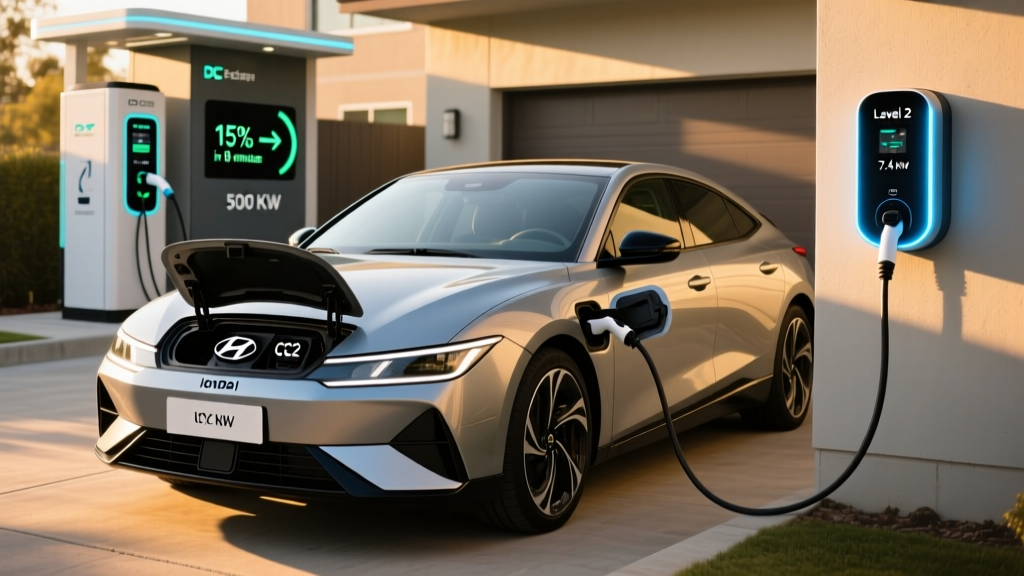
| DC Fast (Level 3) | 400–800V DC | 50–350 kW | 150–1,200+ mi/hr (peak) | Road trips; rapid top-ups on highways |
A few real-world caveats: DC fast charging speeds are peak rates, not sustained. Most EVs hit their maximum kW between 10–40% State of Charge (SoC), then taper significantly above 80% to protect battery health. A vehicle rated for 270 kW peak might average 150 kW across a 10–80% session. Cold batteries also charge slower — preconditioning (warming the pack before arrival via navigation) is essential for achieving advertised speeds.
Real Charging Times: 10–80% for Common Battery Sizes
Most EV owners charge between 10% and 80% SoC on road trips, since charging above 80% slows dramatically. Here's what to expect across popular 2025–2026 models on a DC fast charger:
| Vehicle | Battery (kWh usable) | Peak DC Rate (kW) | 10–80% Time (est.) |
|---|---|---|---|
| Dodge Charger Daytona Scat Pack | 100.6 | ~220 | ~32 min |
| Tesla Model 3 Long Range (2026) | 75 | 250 | ~22 min |
| Hyundai Ioniq 5 (84 kWh pack) | 77.4 | 240 (800V arch) | ~18 min |
| Ford F-150 Lightning (Extended) | 131 | 150 | ~41 min |
| Chevrolet Equinox EV (2026) | 85 | 150 | ~30 min |
Home EV Charger Installation: Costs, Electrical Requirements, and Upgrades
Installing a Level 2 home charger is the single biggest ownership enabler for an EV. Here's what the electrical work actually involves.
Electrical Requirements
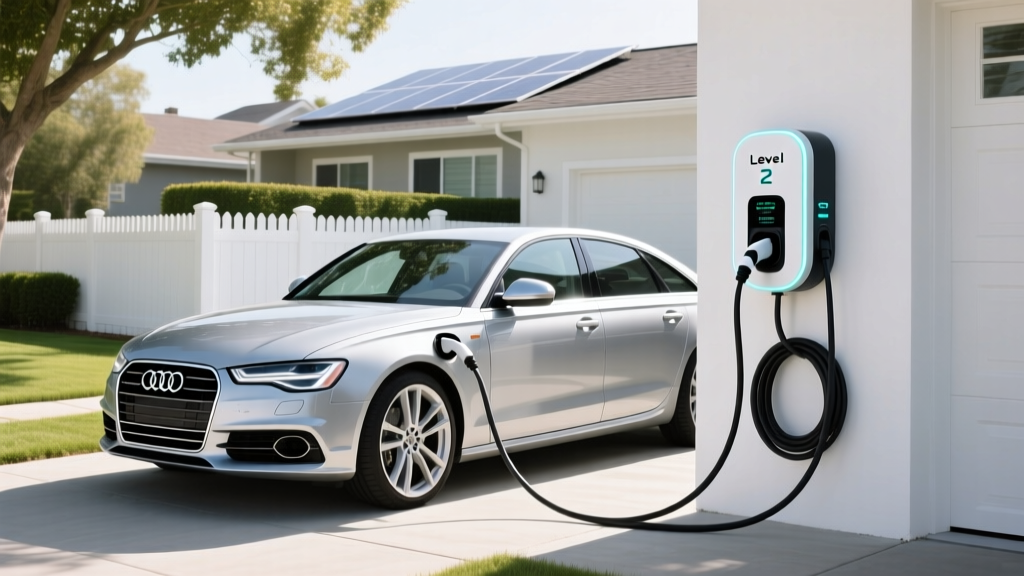
A typical Level 2 home charger requires a dedicated 240V circuit, similar to a dryer or oven outlet. Common configurations:
- 40-amp circuit → delivers up to 9.6 kW (32 amps continuous, per the 80% NEC rule for continuous loads)
- 50-amp circuit → delivers up to 12 kW (40 amps continuous)
- 60-amp circuit → delivers up to 14.4 kW (48 amps continuous)
Most modern EVs accept between 11.5 kW and 19.2 kW on Level 2 AC, but the charge rate is limited by whichever is lower: the charger's output or the vehicle's onboard charger capacity. The Charger Daytona's onboard charger accepts up to 11 kW on Level 2.
Panel Upgrade Reality
Homes built before 2000 often have 100-amp or 150-amp main electrical panels. Adding a 40–60 amp dedicated circuit may push total load beyond 80% of panel capacity, requiring a panel upgrade to 200 amps. This is one of the most expensive variables in home charging — and one that listing descriptions often omit.
| Item | Low-End Estimate | High-End Estimate | Notes |
|---|---|---|---|
| Level 2 Charger Equipment | $350 | $750 | Hardwired or NEMA 14-50 plug; smart vs. basic |
| Electrician Labor (install + wiring) | $500 | $2,000 | Depends on run length from panel to garage/carport |
| Permit & Inspection | $50 | $300 | Required in most jurisdictions; varies by municipality |
| Panel Upgrade (if needed) | $1,500 | $4,000 | 100A → 200A service upgrade; not always required |
| Total (no panel upgrade) | $900 | $3,050 | Typical for homes with 200A service |
| Total (with panel upgrade) | $2,400 | $7,050 | Older homes or high-load panels |
Always hire a licensed electrician and pull a permit. EV chargers draw continuous high current for hours — improper wiring is a fire risk. The NEC (National Electrical Code) requires GFCI protection for outdoor receptacles, and many jurisdictions now require it for all EVSE (Electric Vehicle Supply Equipment) installations.
Connector Compatibility: NACS, CCS1, and CHAdeMO in 2026
The connector landscape has consolidated significantly since Tesla opened its Supercharger network. Here's where things stand for the 2025–2026 model year:
| Connector | Brands Using It (native) | Adapter Needed For |
|---|---|---|
| NACS (J3400) | Tesla, Ford, GM, Rivian, Volvo, Polestar, Dodge (Charger Daytona) | Legacy CCS stations (adapter included or ~$200) |
| CCS1 | Hyundai, Kia, BMW, VW, Mercedes-Benz, Stellantis (non-Daytona) | Tesla Superchargers (Magic Dock or CCS-to-NACS adapter) |
| CHAdeMO | Nissan Leaf (legacy); largely discontinued on new models | Limited network; no viable adapter to NACS/CCS for DC |
The Dodge Charger Daytona uses the NACS connector, giving it native access to Tesla's Supercharger network — over 25,000 stalls in North America as of early 2026 (Tesla Supercharger). If you plan to charge at Electrify America or other CCS1-only public stations, you'll need a CCS-to-NACS adapter. Stellantis includes one with some trims; aftermarket options from brands like Lectron run $150–$230.
Level 2 Home Charger Recommendations for 2026
Below are four proven Level 2 chargers suited for high-capacity EVs like the Charger Daytona. All are UL-listed and support the NACS connector (or CCS with appropriate configuration).
ChargePoint Home Flex (NACS)
- Power: Up to 12 kW (50A circuit) / configurable 16–50A
- Cable: 23 ft
- Smart Features: Wi-Fi, app scheduling, Alexa, energy tracking
- Price: ~$599
- Best For: Flexible amperage to match your panel capacity
Wallbox Pulsar Plus (NACS)
- Power: Up to 11.5 kW (48A / 60A circuit)
- Cable: 25 ft
- Smart Features: Wi-Fi + Bluetooth, load balancing, solar integration
- Price: ~$549
- Best For: Compact size, solar-panel homes
Tesla Wall Connector (NACS native)
- Power: Up to 11.5 kW (48A / 60A circuit)
- Cable: 24 ft
- Smart Features: Wi-Fi, OTA updates, power sharing between units
- Price: ~$450
- Best For: Tesla + NACS-adopting vehicles; best value
Emporia Vue Level 2 (NACS)
- Power: Up to 11.5 kW (48A / 60A circuit)
- Cable: 24 ft
- Smart Features: Whole-home energy monitoring, solar-aware scheduling
- Price: ~$399
- Best For: Budget-conscious buyers wanting energy analytics
For a vehicle with an 11 kW onboard charger like the Charger Daytona, any of these at 48A will fully replenish the 100.6 kWh battery in roughly 9.5–10 hours — ideal for overnight charging.
Charging Cost Per Mile: EV vs. Gasoline
How much does it actually cost to drive an electric muscle car versus a gas V8? Let's run the numbers using the Charger Daytona Scat Pack (rated at approximately 3.0 mi/kWh or ~33 kWh/100mi) against a comparable gas Dodge Charger Scat Pack (6.4L V8, EPA combined 19 MPG).
| Scenario | EV: Charger Daytona | Gas: Charger 6.4L V8 |
|---|---|---|
| Energy Source | Electricity | Gasoline (premium 91 octane) |
| Home Off-Peak Rate | $0.12/kWh → $0.040/mi | — |
| Home Peak Rate | $0.22/kWh → $0.073/mi | — |
| Public Level 2 (avg) | $0.30/kWh → $0.100/mi | — |
| DC Fast Charging (avg) | $0.42/kWh → $0.140/mi | — |
| Gasoline ($3.80/gal) | — | $0.200/mi |
| Annual Fuel Cost (12,000 mi) | $480 (home off-peak) to $1,680 (DC fast) | $2,400 |
Even at public DC fast-charging rates, the EV costs roughly 30% less per mile than the gas V8. Charge at home on off-peak utility rates and you're spending one-fifth of what the gas car costs. According to fueleconomy.gov, electricity costs vary by state — check your local utility for time-of-use (TOU) plans that offer rates as low as $0.06–$0.10/kWh overnight.
Safety, Code Compliance, and Smart Charging Practices
EV charging involves sustained high-current draw — often 8+ hours at 32–48 amps. This is fundamentally different from intermittent appliance use. Key safety requirements:
- Dedicated circuit: Your EV charger must have its own breaker — never share a circuit with other high-draw appliances.
- GFCI protection: Required for outdoor installations per NEC 2023 (Article 625). Many modern chargers include built-in GFCI.
- Outdoor rating: If your charger is mounted outside or in an unenclosed carport, it must carry a NEMA 4 (weatherproof) rating. All chargers listed above qualify.
- Cable management: Use a holster or retractable reel. A charging cable on a garage floor is a trip hazard and degrades from abrasion.
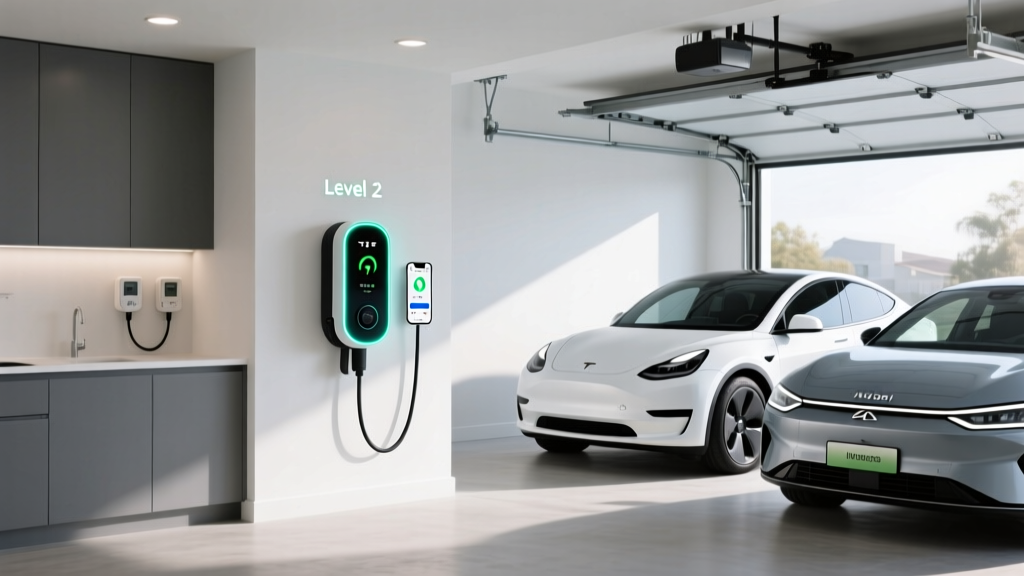
- Load management: If your panel is near capacity, consider a smart charger with load-balancing (like the Wallbox Pulsar Plus) that dynamically reduces charge rate when other circuits are active, avoiding panel upgrades entirely.
For the Charger Daytona's 100+ kWh battery, charging to 100% occasionally is fine, but daily charging to 80–90% prolongs long-term battery health. Stellantis provides an 8-year / 100,000-mile battery warranty covering capacity below 70% of original — consistent with industry norms (Dodge Charger Daytona).
Frequently Asked Questions
How much does it cost to install a home EV charger?
Expect $900–$3,050 for a standard Level 2 installation in a home with an adequate 200-amp electrical panel. If your home needs a panel upgrade from 100A to 200A, total costs range from $2,400 to $7,050. Equipment runs $350–$750, electrician labor $500–$2,000, and permits $50–$300 depending on your municipality.
How fast will each charging level add range?
Level 1 (120V) adds 3–5 miles per hour. Level 2 (240V, 40–50A) adds 25–40 miles per hour for most EVs. DC fast charging at 150–350 kW can add 150–300+ miles in a 20–30 minute session, though speed tapers significantly above 80% SoC.
Which connector/charger is compatible with my EV?
For 2025–2026 models: Tesla, Ford, GM, Rivian, Volvo, and the Dodge Charger Daytona use NACS (J3400). Hyundai, Kia, BMW, VW, and Mercedes use CCS1. CHAdeMO is limited to older Nissan Leafs. Check your vehicle's charge port or the manufacturer's spec page to confirm.
How much does charging cost per mile vs gas?
Charging at home on off-peak electricity ($0.12/kWh) costs roughly $0.04 per mile for a vehicle like the Charger Daytona. Gasoline at $3.80/gallon in a 19 MPG V8 costs about $0.20 per mile. Home charging is approximately 5x cheaper per mile.
What electrical upgrades might I need?
If your home has a 200-amp panel with available capacity, you likely only need a dedicated 50–60 amp circuit and wiring run. Homes with 100A or 150A panels, or panels already near 80% load, may require a full service upgrade to 200A — a $1,500–$4,000 job. A licensed electrician can perform a load calculation to determine your exact needs.
Does the Dodge Charger Daytona qualify for the federal EV tax credit?
The §30D federal tax credit offers up to $7,500, but eligibility depends on MSRP caps ($55,000 for sedans; the Daytona Scat Pack exceeds this), buyer income limits ($150K single / $300K joint AGI), and battery component/critical mineral sourcing requirements. As of 2026, check the latest rules on IRS.gov before assuming eligibility. The credit can be transferred to the dealer at point of sale as an instant discount if you qualify.