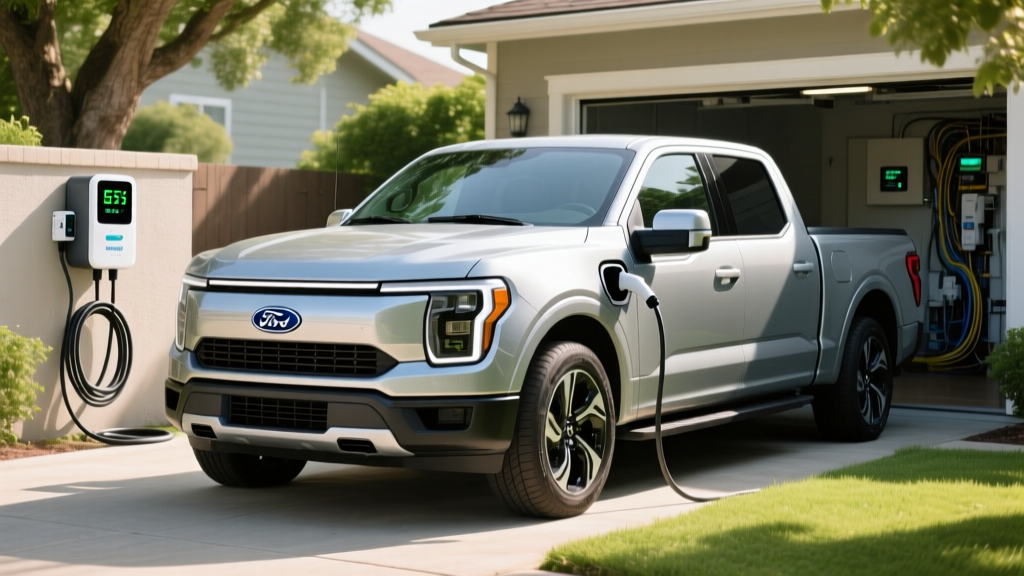
The Ford F-150 Lightning pairs full-size truck utility with an all-electric powertrain — but maximizing its EPA-estimated 230 to 320 miles of range depends heavily on how you charge it at home and on the road. This guide breaks down the Lightning's real-world range expectations and walks through every charging decision you'll face as an owner, from Level 2 home installations to DC fast-charging costs.
F-150 Lightning Range: EPA vs. Real World
The 2025–2026 F-150 Lightning comes in two battery configurations. The Standard Range pack delivers an EPA-estimated 230 miles, while the Extended Range pack pushes that to 320 miles (on XLT and Lariat trims with 18-inch wheels). Here's how those numbers translate to real driving:
| Configuration | EPA Range | Highway (70 mph) | Cold Weather (20°F) | Towing (5,000 lb trailer) |
|---|---|---|---|---|
| Standard Range (98 kWh usable) | 230 mi | ~195–210 mi | ~160–185 mi | ~110–140 mi |
| Extended Range (131 kWh usable) | 320 mi | ~270–290 mi | ~220–255 mi | ~155–195 mi |
Sources: fueleconomy.gov, Ford Motor Company. Real-world figures are estimates based on independent testing and owner reports.
The Extended Range pack uses NMC (nickel manganese cobalt) lithium-ion chemistry in both configurations. NMC offers higher energy density — essential for fitting 131 kWh into a truck platform — but is more sensitive to sustained high-state-of-charge storage than LFP chemistry. Ford recommends daily charging to 90% and 100% only before long trips to preserve long-term battery health.
Charging Levels Explained: kW Speeds and Miles Per Hour
Understanding the difference between kW (power — how fast energy flows) and kWh (energy — how much the battery stores) is essential. Think of kW as the width of the hose and kWh as the size of the bucket.
| Level | Voltage / Amperage | Power (kW) | Miles Added Per Hour | Best Use Case |
|---|---|---|---|---|
| Level 1 (120V outlet) | 120V / 12A | ~1.4 kW | ~2–3 mi/hr | Emergency / overnight trickle |
| Level 2 (240V home) | 240V / 48A | 11.5 kW | ~19–23 mi/hr | Daily home charging |
| Level 2 (80A Charge Station Pro) | 240V / 80A | 19.2 kW | ~30–38 mi/hr | Fastest home / fleet charging |
| DC Fast Charging | 400V+ architecture | Up to 150 kW (Std) / 155 kW (Ext) | ~150–230 mi in 30 min | Road trips, highway travel |
At 19.2 kW with Ford's Charge Station Pro, the Extended Range pack charges from 15% to 100% in approximately 8 hours — ideal for overnight replenishment. The Standard Range pack achieves the same in roughly 6 hours at that rate. Using a 48-amp (11.5 kW) Level 2 charger extends those times to about 13 hours and 10 hours, respectively.
On DC fast charging, the Lightning's charge curve peaks early and tapers significantly above 80%. Ford quotes 15% to 80% in approximately 41 minutes (Standard Range) and 44 minutes (Extended Range) at peak power. Expect the final 20% to take nearly as long as the first 65%.
Home Charger Installation: Costs, Electrical Requirements, and Upgrades
Installing a Level 2 home charger for the F-150 Lightning is the single biggest ownership decision you'll make. The truck's large battery makes Level 1 (120V) impractical for daily use — you'd need nearly four full days to recharge the Extended Range pack from empty.
Electrical Requirements
Ford's Charge Station Pro requires a 240V / 100-amp dedicated circuit to deliver its full 19.2 kW (80A continuous). Most third-party Level 2 chargers running at 48 amps need a 240V / 60-amp dedicated circuit. The National Electrical Code (NEC) requires circuits to be rated at 125% of the continuous load, so a 48A charger demands a 60A breaker.
If your home's electrical panel is already near capacity — common in homes built before 2000 with 100A or 150A main service — you may need a panel upgrade to 200A to safely accommodate EV charging alongside existing loads like HVAC, electric ranges, and dryers.
Installation Cost Breakdown
| Component | Basic Install (48A, short run) | Complex Install (80A, long run) | With Panel Upgrade |
|---|---|---|---|
| Level 2 Charger Equipment | $400–$700 | $900–$1,300 (Charge Station Pro) | $400–$1,300 |
| Electrician Labor | $500–$1,200 | $1,000–$2,500 | $1,500–$3,000 |
| Permit & Inspection | $50–$200 | $100–$300 | $100–$300 |
| Panel Upgrade (if needed) | — | — | $1,500–$3,500 |
| Conduit/Wiring (long runs >50 ft) | $0–$200 | $300–$800 | $200–$600 |
| Total Estimated Cost | $950–$2,300 | $2,300–$4,900 | $3,700–$8,700 |
Federal tax incentives may offset some of this cost. The Residential Clean Energy Credit (IRS §25D) covers up to 30% of qualified home EV charging equipment costs, capped at $1,000. Eligibility depends on your property and local requirements — consult a tax professional.
Safety and Code Considerations
- Dedicated circuit: EV chargers must have their own breaker — never share a circuit with other major appliances.
- GFCI protection: NEC 2020 and later requires GFCI breakers for outdoor receptacles; hardwired installations may have different requirements depending on local code.
- Outdoor rating: If mounting outside, ensure the charger carries a NEMA 4 (weatherproof) rating. The Charge Station Pro is rated for indoor and outdoor use.
- Permit required: Most jurisdictions require an electrical permit and post-installation inspection. Skipping this can void homeowner's insurance coverage for electrical fires.
Connector Compatibility: NACS, CCS, and Adapters
The F-150 Lightning's charging port has evolved. The 2023–2024 models shipped with a CCS1 (Combined Charging System) port. Starting with the 2025 model year, Ford transitioned to the NACS (North American Charging Standard) connector — the same plug used by Tesla vehicles — giving Lightning owners native access to the Tesla Supercharger network.
| Model Year | Native Port | Supercharger Access | CCS Network Access | Adapter Needed? |
|---|---|---|---|---|
| 2022–2024 | CCS1 | Via Ford-provided NACS adapter | Native (no adapter) | NACS-to-CCS adapter for Superchargers |
| 2025–2026 | NACS | Native (no adapter) | Via CCS-to-NACS adapter | CCS adapter for Electrify America, EVgo (legacy stalls) |
If you own a 2022–2024 Lightning, Ford distributed complimentary NACS adapters enabling Supercharger access. For 2025–2026 trucks with native NACS, a CCS adapter (approximately $200–$250 aftermarket) ensures access to Electrify America and other legacy CCS networks still being transitioned.
CHAdeMO — the older DC fast-charging standard used by the Nissan LEAF — is effectively obsolete for the Lightning. No adapter exists, and new CHAdeMO installations have largely ceased in the U.S.
Charging Cost Per Mile: Lightning vs. Gas F-150
One of the strongest arguments for the Lightning is fuel-cost savings, particularly if you charge at home on off-peak electricity rates. Here's how the math works out:
| Scenario | Rate / Cost | Cost Per Mile (Lightning Ext. Range) | Cost Per Mile (Gas F-150 4x4, 19 MPG combined) |
|---|---|---|---|
| Home off-peak (national avg.) | $0.13/kWh | $0.037 | $0.184 (at $3.50/gal) |
| Home peak rate | $0.25/kWh | $0.071 | $0.184 |
| Public Level 2 (avg.) | $0.35/kWh | $0.100 | $0.184 |
| DC Fast Charging (avg.) | $0.48/kWh | $0.137 | $0.184 |
| DC Fast Charging (peak pricing) | $0.65/kWh | $0.186 | $0.184 |
The Extended Range Lightning consumes approximately 2.0–2.2 kWh per mile in mixed driving (roughly 48–50 MPGe combined per fueleconomy.gov). At the national average residential electricity rate of $0.13/kWh, that works out to under 4 cents per mile — about one-fifth the cost of fueling a comparable gas F-150.
However, frequent DC fast charging at peak rates ($0.55–$0.65/kWh at highway Electrify America or EVgo stations) can push per-mile costs to parity with gasoline. Home charging is where the Lightning's economics shine. If your utility offers time-of-use (TOU) rates, scheduling charges between 10 PM and 6 AM can drop your cost below $0.10/kWh in many regions.
Recommended Home Chargers for the F-150 Lightning
Given the Lightning's massive battery, we recommend chargers that deliver at least 48 amps (11.5 kW) — and ideally 80 amps if your electrical panel supports it.
Ford Charge Station Pro (Best for Maximum Speed)
- Power Output: 19.2 kW (80A / 240V)
- Connector: NACS (2025+ trucks) / CCS (2022–2024)
- Cable Length: 25 ft
- Smart Features: FordPass app integration, scheduled charging, bi-directional power (V2H with Home Integration System)
- Price: ~$900–$1,300 (equipment only)
- Note: Requires 100A dedicated circuit; panel upgrade likely in older homes
ChargePoint Home Flex (Best Universal Option)
- Power Output: Up to 12 kW (50A, adjustable down to 16A)
- Connector: NACS or J1772 (configurable at purchase)
- Cable Length: 23 ft
- Smart Features: Wi-Fi, app scheduling, Alexa integration, energy tracking
- Price: ~$550–$700
- Note: Requires 60A circuit at 50A setting; NEMA 14-50 plug or hardwired
Emporia Vue Level 2 Charger (Best Budget Smart Charger)
- Power Output: Up to 11.5 kW (48A)
- Connector: J1772 (NACS adapter available)
- Cable Length: 24 ft
- Smart Features: Wi-Fi, app control, solar integration, load management with Emporia energy monitor
- Price: ~$399–$450
- Note: Excellent value; 60A circuit required at full 48A output
Tesla Wall Connector (Best for NACS-Equipped Trucks)
- Power Output: Up to 11.5 kW (48A / 240V)
- Connector: NACS native
- Cable Length: 24 ft
- Smart Features: Wi-Fi, OTA updates, power sharing between multiple units
- Price: ~$450–$500
- Note: Ideal for 2025+ Lightning with NACS; no adapter needed
DC Fast Charging the Lightning: What to Expect on Road Trips
The F-150 Lightning's 400-volt architecture supports DC fast charging at up to 150 kW (Standard Range) and 155 kW (Extended Range). While these aren't the fastest peak rates in the EV market — Hyundai's E-GMP platform peaks at 240+ kW on 800V — they're sufficient for highway travel with proper planning.
Here's what real DC fast charging looks like for the Lightning Extended Range:
- 15% to 80%: ~44 minutes at a 150+ kW station
- 10% to 80%: ~50 minutes
- Peak charge rate: ~155 kW sustained from roughly 15–45% SoC, then tapering
- Above 80%: Rate drops to 50 kW and below — avoid charging past 80% on road trips unless necessary
Preconditioning matters. The Lightning will warm its battery when you navigate to a DC fast charger via the built-in navigation system. Arriving with a cold battery (especially below 50°F) can reduce peak charge rates by 30–50%. Always route through the truck's nav to enable thermal preconditioning before a fast-charge stop.
As of 2026, the Lightning with NACS can access over 17,000 Tesla Supercharger stalls nationwide. Ford's BlueOval Charge Network aggregates access to Electrify America, EVgo, and ChargePoint stations through the FordPass app, though reliability varies by network and region.
F-150 Lightning Charging FAQ
How much does it cost to install a home EV charger for the F-150 Lightning?
A basic 48-amp Level 2 installation with a short wiring run typically costs $950–$2,300 (equipment + electrician + permit). An 80-amp Ford Charge Station Pro install with a longer run costs $2,300–$4,900. If your home needs a 200A panel upgrade, add $1,500–$3,500. Always get at least two quotes from licensed electricians.
How fast will each charging level add range to the Lightning?
Level 1 (120V) adds roughly 2–3 miles per hour — essentially useless for the Lightning's large battery. Level 2 at 48 amps (11.5 kW) adds about 19–23 miles per hour. At 80 amps (19.2 kW), you'll see 30–38 miles per hour. DC fast charging can add 54–90 miles in 10 minutes at peak power.
Which connector does the F-150 Lightning use?
2022–2024 Lightnings have a CCS1 port; 2025–2026 models use NACS. All model years can access both Supercharger and CCS networks with the appropriate adapter. CHAdeMO is not compatible.
How much does charging cost per mile vs. a gas F-150?
At the national average residential rate of $0.13/kWh, the Extended Range Lightning costs about $0.037 per mile — roughly 80% less than a gas F-150 at $3.50/gallon ($0.184/mile). Public DC fast charging at $0.48–$0.65/kWh narrows the gap to near parity or slightly above gas costs.
What electrical upgrades might I need for a home charger?
The most common upgrade is a panel replacement from 100A or 150A service to 200A — needed when your existing panel lacks capacity for a 60A or 100A dedicated EV circuit. Other potential upgrades include new conduit runs (for chargers mounted far from the panel), a sub-panel in the garage, and utility service upgrades for homes with very old infrastructure.
Can I use a standard 120V outlet to charge my Lightning?
Yes, but only as a last resort. At ~1.4 kW (Level 1), fully recharging the Extended Range pack from empty would take approximately 90+ hours. Level 1 is suitable for maintaining charge or adding 20–30 miles overnight, not for regular use.
Does the F-150 Lightning support vehicle-to-home (V2H) power?
Yes — but only with the Ford Charge Station Pro paired with the Ford Home Integration System (~$3,890 installed). This setup allows the Lightning's battery to power your home during outages for up to three days (Extended Range) at average household consumption. This is separate from basic Level 2 charging and requires additional equipment and installation.