Quick Verdict: Who the Eviqo Level 2 EV Charger Is For
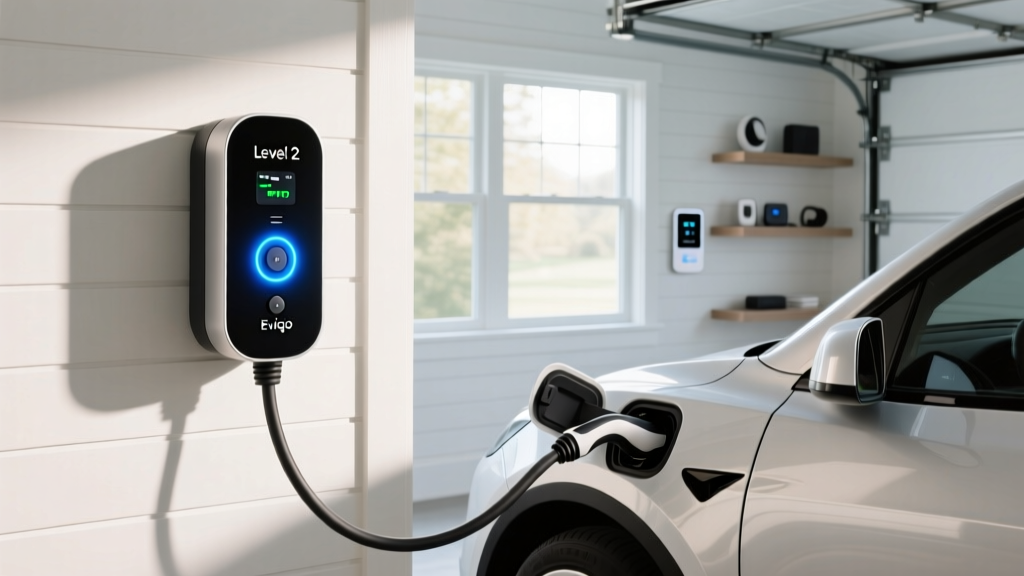
The Eviqo Level 2 EV charger is a 48-amp, 240-volt home charging station designed for EV owners who want near-maximum Level 2 speeds without paying Tesla Wall Connector or ChargePoint Home Flex premiums. At roughly $399 for the hardwired model, it delivers up to 11.5 kW of continuous power — enough to add approximately 35-44 miles of range per hour depending on your vehicle's onboard charger acceptance rate.
For most EV owners with a 75-100 kWh battery, the Eviqo will recover a full day's driving (30-40 miles) in under an hour of charging. It's a strong pick for households with a 60-amp dedicated circuit available in their electrical panel. But before you buy, the real question isn't just the charger's price — it's whether your home's electrical system can support it without a costly panel upgrade.
Charging Levels Explained: Where the Eviqo Fits
Understanding the three EV charging levels is essential before sizing your home setup. Here's what each delivers in real-world terms:
| Level | Voltage | Max Power (kW) | Miles of Range Added/Hour | Best Use Case |
|---|---|---|---|---|
| Level 1 | 120V (standard outlet) | 1.4 kW | 3-5 mi/hr | Overnight top-ups, PHEVs, low-mileage drivers |
| Level 2 (Eviqo class) | 240V (dryer-style) | 11.5 kW (48A) | 35-44 mi/hr | Daily home charging for all BEVs |
| Level 2 (lower-amp) | 240V | 7.2-9.6 kW (30-40A) | 22-35 mi/hr | Homes with limited panel capacity |
| DC Fast Charging | 400-800V DC | 50-350 kW | 150-1,200+ mi/hr (peak) | Road trips, 10-80% in 15-45 min |
Key distinction: kW (kilowatts) measures power — the rate at which energy flows into your battery. kWh (kilowatt-hours) measures energy capacity — how much your battery holds. A 48A Level 2 charger delivering 11.5 kW will add roughly 11.5 kWh of energy to your battery per hour of charging (minus minor efficiency losses of 5-10%).
Home Installation Requirements and Real Costs
The Eviqo Level 2 EV charger requires a dedicated 60-amp circuit breaker with 240-volt service to deliver its rated 48 amps (the National Electrical Code requires circuits to be rated at 125% of continuous load, so 48A × 1.25 = 60A breaker). Here's what that actually costs:
| Component | Cost Range | Notes |
|---|---|---|
| Eviqo charger (hardwired, 48A) | $379-$429 | NACS or J1772 connector options |
| Electrical permit | $50-$200 | Varies by municipality; some jurisdictions waive for EV installs |
| Electrician labor (standard install) | $300-$800 | Panel to garage run under 30 ft, conduit in finished walls adds cost |
| Wire, conduit, breaker | $100-$300 | 6 AWG copper for 60A circuit; longer runs need thicker wire |
| Standard install total | $830-$1,730 | Assumes adequate panel capacity |
| Panel upgrade (if needed) | $1,500-$3,500+ | 100A → 200A service upgrade for older homes |
| With panel upgrade total | $2,330-$5,230 | Common in pre-1990 homes with 100A service |
Panel capacity check: Before purchasing any 48A charger, have an electrician perform a load calculation on your panel. If you have a 200-amp service panel with significant existing loads (electric range, dryer, HVAC, water heater), adding a 60A circuit may push you over the 80% continuous-load threshold. In that case, you have three options: upgrade your panel, choose a lower-amperage charger (32A/40A on a 40A/50A breaker), or install a smart panel-level load manager like the Emporia Smart Load Manager that throttles charging when household demand spikes.
Connector Compatibility: NACS, CCS, and Adapter Realities
The Eviqo is available in two native connector configurations, and adapter compatibility depends on your vehicle's charge port:
| Connector Type | Brands Using It (2026) | Eviqo Compatibility |
|---|---|---|
| NACS (Tesla-style) | Tesla (all models), Ford (2025+), GM (2025+), Rivian (2025+), Hyundai/Kia (2026+), most new EVs | Eviqo NACS model — direct plug |
| J1772 (Level 2 standard) | Older non-Tesla EVs (pre-2025 Nissan Leaf, some PHEVs), remaining CCS vehicles via adapter | Eviqo J1772 model — direct plug |
| CCS1 (combined) | Legacy non-Tesla EVs (2024 and older VW, BMW, etc.) — DC fast charge port only | Use J1772 Eviqo + J1772-to-CCS adapter for Level 2; CCS1 is being phased out for new models |
| CHAdeMO | Nissan Leaf (all years), Mitsubishi Outlander PHEV (older) | No direct Eviqo option; requires CHAdeMO-to-J1772 adapter (limited availability, ~$200-400) |
2026 landscape note: With the industry's near-complete shift to NACS for new vehicles, ordering the Eviqo with a NACS connector is the forward-looking choice for most buyers. If you currently drive a CCS1 vehicle but plan to upgrade to a NACS-equipped EV within 2-3 years, buy the NACS Eviqo now and use a Tesla CCS adapter (or equivalent) in the interim. According to fueleconomy.gov, nearly all 2026 model-year EVs now ship with NACS charge ports.
Cost to Charge: Home vs. Public vs. Gas Per Mile
The economic case for home Level 2 charging rests on electricity rates that are a fraction of gasoline costs per mile. Here's a realistic breakdown:
| Scenario | Rate | Cost Per Mile (at 3 mi/kWh or 28 MPG) |
|---|---|---|
| Home Level 2 — off-peak utility rate | $0.08-$0.12/kWh | $0.027-$0.040/mile |
| Home Level 2 — standard residential rate | $0.14-$0.18/kWh | $0.047-$0.060/mile |
| Home with rooftop solar (net metered) | ~$0.03-$0.05/kWh effective | $0.010-$0.017/mile |
| Public Level 2 (ChargePoint, EVgo L2) | $0.25-$0.49/kWh | $0.083-$0.163/mile |
| DC Fast Charging (EA, EVgo, Tesla Supercharger) | $0.32-$0.58/kWh | $0.107-$0.193/mile |
| Gasoline (regular, $3.40/gal at 28 MPG combined) | $3.40/gallon | $0.121/mile |
| Gasoline (premium, $4.00/gal at 24 MPG combined) | $4.00/gallon | $0.167/mile |
The takeaway: Charging at home on off-peak rates costs roughly 70-80% less per mile than gasoline. Even standard-rate home charging undercuts gas by 50-60%. Public DC fast charging, however, can approach or exceed gas costs — which is why home Level 2 installation pays for itself. At 12,000 miles/year and a $0.10/kWh off-peak rate, you'd spend roughly $480/year on electricity vs. $1,452 on gas (at 28 MPG, $3.40/gal). That's $972 in annual fuel savings, meaning the Eviqo plus a standard installation ($830-$1,730) pays back in under two years.
Many utilities offer time-of-use (TOU) plans or dedicated EV charging rates that make overnight Level 2 charging even cheaper. Check your utility's EV programs before installing — some offer rebates of $250-$500 on smart Level 2 chargers.
Charging Time Examples: What to Expect With the Eviqo
Charge times depend on two factors: your EV's battery size (kWh) and its onboard charger's maximum Level 2 acceptance rate (kW). The Eviqo can deliver up to 11.5 kW, but your vehicle may not accept that full rate.
| Vehicle (2026 Examples) | Usable Battery | Onboard Charger Max | 10-80% Time (Eviqo) |
|---|---|---|---|
| Tesla Model Y Long Range | 75 kWh | 11.5 kW | ~4 hr 30 min |
| Ford Mustang Mach-E Extended Range | 91 kWh | 10.5 kW | ~6 hr 5 min |
| Hyundai Ioniq 5 (Long Range) | 77.4 kWh | 10.9 kW | ~5 hr |
| Chevrolet Equinox EV | 85 kWh | 11.5 kW | ~5 hr 10 min |
| BMW i4 eDrive40 | 81.5 kWh | 11 kW | ~5 hr 10 min |
| Toyota bZ4X | 64 kWh | 7.2 kW | ~6 hr 15 min (bottlenecked by 7.2 kW onboard charger) |
Charge-curve reality check: Level 2 charging maintains a relatively linear rate through most of the charge session — unlike DC fast charging, which tapers significantly above 80% SoC. With the Eviqo, you can expect fairly consistent 11.5 kW delivery from 10% through roughly 90%, then a gentle taper. This makes overnight charging straightforward: plug in at 10 PM, and most EVs will be at 80-90% by 6 AM.
Equipment Comparison: Eviqo vs. Competing 48A Home Chargers
The Eviqo competes directly with several established 48A Level 2 chargers. Here's how it stacks up on the specs that matter:
Eviqo Level 2 (Hardwired, 48A)
- Power output: 11.5 kW (48A, 240V)
- Connector: NACS or J1772
- Cable length: 25 ft
- Smart features: Wi-Fi scheduling, energy monitoring via app
- Indoor/Outdoor: NEMA 4 rated (indoor/outdoor)
- Price: ~$379-$429
- Energy Star certified: Yes
ChargePoint Home Flex (NACS, 48A)
- Power output: 11.5 kW (48A, 240V)
- Connector: NACS or J1772
- Cable length: 23 ft
- Smart features: Wi-Fi, Alexa, detailed app analytics, utility demand-response programs
- Indoor/Outdoor: NEMA 4
- Price: ~$599-$649
- Energy Star certified: Yes
Tesla Wall Connector (48A)
- Power output: 11.5 kW (48A, 240V)
- Connector: NACS only (J1772 adapter sold separately)
- Cable length: 24 ft
- Smart features: Wi-Fi, OTA updates, power sharing between two units, Tesla app integration
- Indoor/Outdoor: NEMA 3R (outdoor rated, less robust than NEMA 4)
- Price: ~$450
- Energy Star certified: Yes
Our take: The Eviqo offers essentially the same 11.5 kW output and 25-ft cable as the ChargePoint Home Flex at $200+ less. The trade-off is a less mature app ecosystem and fewer utility demand-response integrations. If your utility offers a smart-charger rebate that specifically lists ChargePoint or Tesla, that rebate may close the price gap. The Tesla Wall Connector is the best choice if you exclusively drive Tesla vehicles and value power-sharing (running two chargers on one 60A circuit, splitting amperage dynamically).
Safety, Electrical Code, and Installation Best Practices
Every Level 2 charger installation must comply with the National Electrical Code (NEC Article 625) and your local jurisdiction's amendments. Key requirements for the Eviqo:
- Dedicated circuit: The 60A breaker must serve only the EV charger — no shared outlets or appliances on the same circuit.
- GFCI protection: NEC 2020 and later require GFCI protection for all EV charging circuits. The Eviqo hardwired model includes integrated ground-fault protection; if using a plug-in variant on a NEMA 14-60 receptacle, the breaker itself must be GFCI-type (adds $50-$80 to material cost).
- Outdoor rating: If mounting outdoors or in an unenclosed carport, confirm the unit is NEMA 4 rated (the Eviqo is). NEMA 3R protects against rain but not hose-directed water or ice formation.
- Wire gauge: 6 AWG copper THHN in conduit for runs up to 50 ft. For longer runs, an electrician may specify 4 AWG to limit voltage drop below 3%.
- Permit and inspection: Most jurisdictions require an electrical permit ($50-$200) and a post-install inspection. Skipping this risks insurance claim denial if a fire originates from an unpermitted circuit. Per NFPA NEC guidelines, all EV charging installations must be permitted.
- Cable management: Install a holster or cable retractor to keep the 25-ft cord off the garage floor — prevents trip hazards and cord damage from being run over.
Frequently Asked Questions
How much does it cost to install a home EV charger?
A standard Eviqo Level 2 installation (no panel upgrade, conduit run under 30 ft) typically costs $830-$1,730 total, including the charger ($379-$429), electrician labor ($300-$800), wire/conduit/breaker ($100-$300), and permit ($50-$200). Homes needing a 100A-to-200A panel upgrade should budget an additional $1,500-$3,500. Some states and utilities offer rebates of $250-$750 for Level 2 installations — check the Alternative Fuels Data Center for your state's incentives.
How fast will each charging level add range?
Level 1 (120V) adds 3-5 miles per hour. Level 2 at 48A (like the Eviqo) adds 35-44 miles per hour. DC fast charging adds 150-1,200+ miles per hour at peak rates but is designed for 10-80% top-ups in 15-45 minutes, not daily use. The exact rate depends on your EV's efficiency (miles per kWh) and its onboard charger's maximum acceptance rate.
Which connector/charger is compatible with my EV?
For 2026 model-year EVs, the vast majority now use the NACS connector for both Level 2 and DC fast charging. This includes Tesla, Ford, GM, Rivian, Hyundai, Kia, and most new entrants. Older non-Tesla EVs (pre-2025) may still have CCS1 or CHAdeMO ports — check your vehicle's charge port or owner's manual. If buying an Eviqo, choose the NACS model unless you drive a legacy CHAdeMO vehicle (Nissan Leaf). Adapters exist for most combinations but add $100-$400 and some charging-speed limitations.
How much does charging cost per mile vs gas?
Home Level 2 charging at off-peak utility rates ($0.10/kWh) costs approximately $0.03-$0.04 per mile for an efficient EV (3 mi/kWh). Gasoline at $3.40/gallon in a 28 MPG vehicle costs $0.12 per mile. That's roughly a 70% per-mile savings for home EV charging. Annual savings for a 12,000-mile driver: approximately $960. Public DC fast charging ($0.35-$0.58/kWh) narrows the gap to 20-50% savings, which is why maximizing home charging is the key to EV economics.
What electrical upgrades might I need?
The most common upgrade is a panel capacity increase from 100A to 200A service ($1,500-$3,500), required when your existing panel lacks headroom for a 60A dedicated circuit. Other potential upgrades include: adding a sub-panel in the garage ($400-$800) if the main panel is far away, replacing a Federal Pacific or Zinsco panel (known fire hazards, $2,000-$4,000 replacement), or upgrading the service drop from the utility if your home's total capacity is insufficient. Always get a professional load calculation before purchasing a 48A charger.
Does the Eviqo qualify for any tax credits or rebates?
The federal §30D tax credit applies to EV purchases, not charging equipment for most homeowners. However, the Residential Clean Energy Credit (IRC §25D) does not cover EV chargers either as of 2026. Your best incentive path is state/utility rebates — many utilities offer $250-$500 rebates for smart Level 2 chargers, and some states (California, Colorado, Massachusetts, New York) offer additional installation rebates. Check with your utility and state energy office before purchasing.