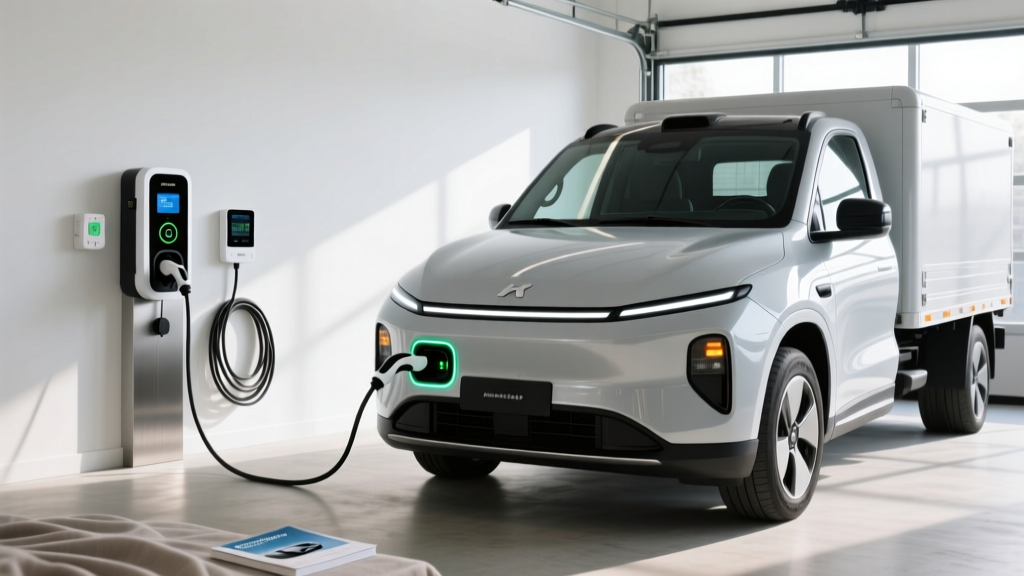
Why EV Truck Charging Demands More Planning Than a Sedan
Electric trucks carry massive batteries. The Ford F-150 Lightning Extended Range packs 131 kWh of usable capacity; the Chevrolet Silverado EV 4WT uses a 200+ kWh pack; the Rivian R1T Dual-Motor Max runs 149 kWh. For context, a Tesla Model Y Long Range holds about 75 kWh. That means EV truck charging takes longer, draws more power, and puts heavier demands on your home electrical panel than any passenger car.
If you're shopping for a Ford F-150 Lightning, Chevy Silverado EV, GMC Sierra EV, Rivian R1T, or the Tesla Cybertruck, this guide maps out exactly what you need for home Level 2 charging, what to expect from public DC fast chargers, and how the per-mile cost compares to filling a gas truck. Every figure below reflects 2025–2026 model-year specs and current electrical code requirements.
Charging Levels Explained: kW, Miles Per Hour, and Real-World Times
The single most important distinction in EV charging is between kW (kilowatts) and kWh (kilowatt-hours). kW measures power — how fast energy flows into the battery. kWh measures energy — the total capacity of the battery. Think of kW as the width of a pipe and kWh as the size of the tank you're filling.
Because electric trucks have such large tanks (batteries), even a wide pipe (high kW) takes a while to fill them. Here's what each charging level delivers:
| Level | Voltage | Power (kW) | Miles of Range Added/Hour | Typical Use Case |
|---|---|---|---|---|
| Level 1 | 120V AC | 1.0–1.4 kW | 2–4 mi/hr | Emergency / trickle top-up |
| Level 2 | 240V AC | 7.2–19.2 kW | 18–52 mi/hr | Daily home & workplace charging |
| DC Fast Charge | 400–800V DC | 50–350 kW | 120–400+ mi/hr (at peak) | Road trips, highway corridors |
Real-world charging time examples (10–80% State of Charge):
- Ford F-150 Lightning Extended Range (131 kWh): On a 150 kW DC fast charger, expect 10–80% in approximately 41 minutes. On a 48-amp (11.5 kW) Level 2 home charger, a full 0–100% session takes roughly 13 hours. On Level 1 (1.4 kW), you'd need over 90 hours — effectively useless for daily driving.
- Rivian R1T Max Pack (149 kWh): DC fast charging at 200+ kW (Rivian's architecture supports up to ~220 kW peak) achieves 10–80% in about 45 minutes. Level 2 at 11.5 kW takes roughly 14 hours for a full charge.
- Chevrolet Silverado EV (200+ kWh, 4WT): GM's Ultium platform supports up to 350 kW DC fast charging on capable stations, achieving 10–80% in approximately 45 minutes. Level 2 at 19.2 kW (80-amp circuit) takes about 12 hours — but that requires a 100-amp dedicated circuit and a significant panel investment.
Charge-curve reality check: Peak kW ratings are not sustained. A truck that "accepts 150 kW" will only hit that rate between roughly 10–40% State of Charge. Above 80%, the rate tapers sharply — sometimes to under 30 kW — to protect battery chemistry. This is why 10–80% times are the industry standard: the last 20% can take as long as the first 80%.
Home EV Truck Charging: Electrical Requirements and Installation Costs
Most EV truck owners will want a Level 2 home charger. This is the only practical way to wake up with a full battery every morning, especially given how large truck batteries are. But Level 2 charging requires a 240-volt circuit — the same type of outlet your electric dryer or oven uses — and many homes need electrical upgrades to support it.
Electrical Requirements for Level 2 Truck Charging
Here's what different Level 2 amperages demand and deliver:
- 32-amp circuit (7.7 kW): Requires a 40-amp breaker (NEC code mandates 125% overhead for continuous loads). Adds ~20 miles of range per hour to an F-150 Lightning. This is the minimum viable setup for most EV truck owners.
- 48-amp circuit (11.5 kW): Requires a 60-amp breaker. Adds ~30 miles per hour. The sweet spot for most truck owners — balances charge speed against panel capacity.
- 80-amp circuit (19.2 kW): Requires a 100-amp breaker. Adds ~50 miles per hour. Maximum Level 2 speed, but demands a 200-amp (or larger) main electrical panel with substantial spare capacity. Not all homes can support this without a panel upgrade.
What Electrical Upgrades Might You Need?
If your home has a 100-amp main panel (common in houses built before the 1990s), you almost certainly need a panel upgrade to 200 amps before installing a 48-amp or larger EV charger. Even some 200-amp panels are near capacity if you already run electric heat, an electric dryer, and an electric oven.
A licensed electrician will perform a load calculation per NEC Article 220 to determine whether your panel can handle the additional draw. If it can't, you have options:
- Panel upgrade (100A → 200A or 200A → 400A): The most expensive path, but adds long-term home value.
- Load-management device: A smart panel or charger-integrated system (like the Emporia V2 with load management or the Wallbox Pulsar Plus with Power Sharing) that dynamically reduces charger amperage when other appliances kick on. This can avoid a panel upgrade entirely.
- Lower-amperage charger: Running a 32-amp charger on a 40-amp breaker is often feasible even on older panels, and still provides enough overnight charge for most daily driving.
| Component | Cost Range | Notes |
|---|---|---|
| Level 2 charger hardware | $350–$750 | 32A–48A smart chargers (hardwired or NEMA 14-50 plug) |
| Electrician labor (standard install) | $500–$1,500 | Assumes panel is close to garage, short wire run |
| Electrician labor (complex install) | $1,500–$3,500 | Long wire runs, conduit, wall penetration, detached garage |
| Permit & inspection | $50–$250 | Varies by municipality; required in most jurisdictions |
| Panel upgrade (if needed) | $1,500–$4,000 | 100A → 200A upgrade; 400A can exceed $5,000 |
| Total (no panel upgrade) | $900–$2,500 | Most common scenario for modern homes |
| Total (with panel upgrade) | $2,400–$6,500 | Older homes or high-amperage setups |
Some utilities offer rebates of $250–$1,000 for Level 2 charger installation, and the federal Residential Clean Energy Credit (IRS Form 5695) may cover 30% of charger hardware and installation costs up to $1,000 through 2032 — check current-year eligibility with a tax professional.
Connector Compatibility: NACS, CCS1, and Adapter Realities
The connector landscape for EV trucks has shifted dramatically. As of 2025–2026, the North American Charging Standard (NACS), developed by Tesla, has become the dominant connector for new EVs. Here's where each truck stands:
| Truck | Native Connector | DC Fast Network Access | Adapter Needed? |
|---|---|---|---|
| Ford F-150 Lightning (2025+) | NACS | Tesla Supercharger + CCS networks | CCS adapter included for older chargers |
| Ford F-150 Lightning (2022–2024) | CCS1 | Electrify America, EVgo + Supercharger (w/ adapter) | NACS adapter required for Superchargers |
| Chevrolet Silverado EV | NACS | Tesla Supercharger + CCS networks | CCS adapter for non-Tesla DC stations |
| GMC Sierra EV | NACS | Tesla Supercharger + CCS networks | CCS adapter for non-Tesla DC stations |
| Rivian R1T | NACS (2025+) | Tesla Supercharger + CCS networks | CCS adapter for Electrify America, etc. |
| Tesla Cybertruck | NACS | Tesla Supercharger network native | CCS adapter (sold separately) for non-Tesla DC |
Key takeaway: If you're buying a 2025 or newer EV truck, NACS is your native connector and Tesla Superchargers are your primary fast-charging network. If you own a 2022–2024 F-150 Lightning with CCS1, Ford provides or sells a NACS adapter that unlocks Supercharger access. The Electrify America and EVgo networks are progressively adding NACS cables, but CCS1 adapters remain necessary at many non-Tesla stations for NACS-equipped trucks.
For home Level 2 charging, all of these trucks use the same J1772 protocol for AC charging — NACS and CCS1 both incorporate J1772 pins for Level 2. Any J1772-compatible Level 2 charger will work with any EV truck sold in the US.
EV Truck Charging Cost Per Mile vs. Gas Trucks
The economics of EV truck charging depend heavily on where and when you charge. Electricity rates vary enormously by region, and public DC fast charging carries a steep premium over home charging.
| Scenario | Rate | Cost per Mile (EV Truck ~2.0 mi/kWh) | Equivalent Gas Truck (18 MPG combined) |
|---|---|---|---|
| Home charging (off-peak utility rate) | $0.11/kWh | $0.055/mile | $0.19/mile (at $3.40/gal) |
| Home charging (average US rate) | $0.17/kWh | $0.085/mile | $0.19/mile (at $3.40/gal) |
| Home charging (high-cost state, e.g. CA) | $0.30/kWh | $0.15/mile | $0.24/mile (at $4.40/gal) |
| Public Level 2 (workplace/commercial) | $0.25/kWh | $0.125/mile | $0.19/mile (at $3.40/gal) |
| DC fast charging (Electrify America, EVgo) | $0.45/kWh | $0.225/mile | $0.19/mile (at $3.40/gal) |
| Tesla Supercharger (average) | $0.30/kWh | $0.15/mile | $0.19/mile (at $3.40/gal) |
The bottom line: If you charge at home on an average utility rate, an electric truck costs roughly half to one-third as much per mile as a comparable gas truck (Ford F-150 4x4 V6 at 18–20 MPG combined). Even in expensive electricity markets like California, home charging still beats gas. However, relying exclusively on public DC fast charging can make an EV truck more expensive per mile than gas — which is why home Level 2 charging is essentially mandatory for cost-effective EV truck ownership.
For a driver covering 15,000 miles per year with home charging at $0.13/kWh (national average), annual fuel cost runs approximately $975. A gas F-150 at 19 MPG and $3.40/gallon spends about $2,684 — a savings of roughly $1,700 per year on fuel alone with the EV.
Recommended Level 2 Chargers for EV Trucks
Given the large batteries in electric trucks, you want a charger that delivers at least 48 amps (11.5 kW) on a 60-amp circuit to keep overnight charging times manageable. Here are proven options:
ChargePoint Home Flex (NEMA 14-50 or Hardwired)
- Power output: Up to 50 amps (12 kW) on a 60-amp breaker; configurable down to 16A for limited panels
- Connector: J1772 (works with all EV trucks for Level 2)
- Cable length: 23 feet
- Smart features: Wi-Fi, app scheduling, utility demand-response integration, Alexa/Google Home
- Price: ~$550–$650
- Best for: Flexibility — the amperage dial lets you match your panel's capacity without buying a different unit
Emporia Vue V2 Smart EV Charger
- Power output: Up to 48 amps (11.5 kW) on a 60-amp breaker
- Connector: J1772
- Cable length: 24 feet
- Smart features: Integrated load management with Emporia Vue energy monitor, solar-aware charging, real-time cost tracking, app control
- Price: ~$400–$500
- Best for: Homes with solar panels or those needing load management to avoid panel upgrades
Wallbox Pulsar Plus
- Power output: Up to 48 amps (11.5 kW) on a 60-amp breaker
- Connector: J1772
- Cable length: 25 feet
- Smart features: Wi-Fi + Bluetooth, Power Sharing (link two units on one circuit), app scheduling, compact form factor
- Price: ~$500–$600
- Best for: Two-EV households needing to share a single 60-amp circuit between two chargers
Grizzl-E Smart (United Chargers)
- Power output: Up to 40 amps (9.6 kW) on a 50-amp breaker
- Connector: J1772
- Cable length: 24 feet
- Smart features: Wi-Fi, OCPP-compatible (works with utility programs), adjustable amperage, rugged aluminum enclosure
- Price: ~$450–$550
- Best for: Outdoor installations in extreme climates — rated to -40°F and built with a heavy-duty, weatherproof housing
For most EV truck owners, a 48-amp hardwired charger on a 60-amp breaker is the optimal home setup. It adds roughly 30 miles of range per hour, meaning an F-150 Lightning Extended Range can replenish a full day's driving (80–100 miles) in about 3 hours, and achieve a complete overnight charge in 12–14 hours.
Safety, Code Compliance, and Installation Best Practices
EV charging is a continuous load — the National Electrical Code (NEC) defines this as a load expected to run for 3 hours or more. This triggers specific safety requirements:
- 125% breaker rule: A 48-amp charger requires a 60-amp breaker (48 × 1.25 = 60). Never undersize the breaker.
- Dedicated circuit: Your EV charger must have its own dedicated circuit — it cannot share with other outlets or appliances.
- GFCI protection: NEC 2020 and later require GFCI protection for all 240V EV charging outlets (NEMA 14-50). Hardwired chargers are exempt from GFCI requirements in most jurisdictions, which is one reason many electricians prefer hardwired installations.
- Outdoor rating: If your charger is mounted outside or in an unsealed garage, ensure it carries a NEMA 4 or IP65 weather-resistance rating. All chargers recommended above meet this standard.
- Permit and inspection: Most municipalities require an electrical permit for a new 240V circuit. Your electrician will pull this, and a city inspector will verify the work. Do not skip this step — it protects your home insurance coverage.
- Wire gauge: A 60-amp circuit requires 6 AWG copper wire (or 4 AWG aluminum) for runs up to 50 feet. Longer runs may require thicker wire to prevent voltage drop. Your electrician will calculate this.
One often-overlooked consideration for EV truck owners: the weight rating of your garage outlet. If you're using a NEMA 14-50 receptacle, ensure it's an industrial-grade outlet (Hubbell 9450A or equivalent, ~$75) rather than a residential-grade Leviton unit. EV charging draws sustained high current for many hours, and cheaper outlets have been known to overheat and melt under continuous load. The National Fire Protection Association (NFPA) has documented incidents involving overheated residential-grade 14-50 receptacles used for EV charging.
Public DC Fast Charging for EV Trucks: What to Expect on Road Trips
When you're towing or taking a road trip, public DC fast charging is your lifeline. Here's what the landscape looks like for EV truck owners in 2026:
- Tesla Supercharger network: Now open to non-Tesla EVs with NACS connectors (Ford, GM, Rivian). Supercharger V4 stalls deliver up to 250 kW, and newer V4 cabinets support up to 350 kW. Stations are widely available along major highways. Pricing averages $0.25–$0.35/kWh.
- Electrify America: Offers up to 350 kW chargers. CCS1-native stations require a NACS-to-CCS adapter for 2025+ trucks. Pricing averages $0.40–$0.55/kWh for guest rates; subscription plans reduce this to ~$0.31/kWh.
- EVgo: Expanding 350 kW stalls in partnership with GM. CCS1-native with NACS adapters needed for newer trucks. Pricing similar to Electrify America.
- Towing penalty: Expect a 30–50% range reduction when towing a trailer at highway speeds. An F-150 Lightning with an EPA-estimated 320 miles of range may deliver only 170–210 miles while towing a 5,000-lb trailer. Plan charging stops accordingly — fueleconomy.gov provides towing-adjusted range estimates for some models.
Cold-weather charging note: In temperatures below 32°F, expect 15–30% range reduction and slower DC fast charge rates unless your truck has battery preconditioning. The Rivian R1T and Ford F-150 Lightning both include preconditioning that warms the battery when you navigate to a charger — always use it to maintain charge speed.
Frequently Asked Questions
How much does it cost to install a home EV charger for my truck?
A standard Level 2 home charger installation costs between $900 and $2,500 if your electrical panel has sufficient capacity. If you need a panel upgrade (common in older homes), expect $2,400 to $6,500 total. The charger hardware itself runs $350–$750 for a quality 48-amp smart unit.
How fast will each charging level add range to my EV truck?
Level 1 (120V) adds 2–4 miles per hour — essentially useless for trucks. Level 2 (240V at 48 amps) adds roughly 25–35 miles per hour depending on the truck's efficiency. DC fast charging at 150+ kW can add 150–250 miles in a 20-minute session, but only while the battery is below ~60% State of Charge.
Which connector and charger is compatible with my EV truck?
All 2025+ Ford, GM, and Rivian trucks use the NACS connector for DC fast charging and J1772 protocol for Level 2 home charging. Any J1772-compatible Level 2 charger works with every EV truck on the market. For DC fast charging, NACS trucks access Tesla Superchargers natively and need a CCS adapter for Electrify America and EVgo stations.
How much does EV truck charging cost per mile vs. a gas truck?
Home charging at the national average rate of ~$0.13/kWh costs about $0.065 per mile in an EV truck. A comparable gas F-150 at 19 MPG and $3.40/gallon costs about $0.18 per mile. That's a savings of roughly $0.11 per mile, or $1,700 per year at 15,000 miles. Public DC fast charging at $0.45/kWh costs $0.225/mile — more than gas — which is why home charging is essential for cost savings.
What electrical upgrades might I need for a Level 2 truck charger?
If your home has a 200-amp electrical panel with available capacity, you likely need nothing beyond a new 60-amp breaker and wire run. If you have a 100-amp panel, or a 200-amp panel that's already heavily loaded, you may need a panel upgrade ($1,500–$4,000) or a smart load-management device that throttles the charger when other appliances draw power.
Can I use a NEMA 14-50 outlet instead of hardwiring my charger?
Yes, but with caveats. A NEMA 14-50 outlet on a 50-amp breaker limits you to 40 amps (9.6 kW) of continuous charging — about 20% slower than a hardwired 48-amp setup. You must also use an industrial-grade outlet (Hubbell 9450A) to avoid overheating risks under sustained EV charging loads. Hardwired installations are preferred for daily truck charging due to higher amperage and no GFCI requirement.