Range anxiety doesn't start on the highway—it starts in your garage. While automakers push EPA range stickers north of 300 miles, real-world drivers know that cold mornings, highway speeds, and battery degradation can shave 15-30% off those numbers. The most practical EV range extender isn't a hardware add-on or a gas-powered genset: it's a properly sized home Level 2 charging setup combined with smart charging habits that keep your battery in its optimal state of charge (SoC) window every single day.
This guide covers exactly what electrical work you'll need, what equipment to buy, how fast each charging level replenishes range, and how to structure your charging routine so range anxiety becomes a non-issue—even in January in Minneapolis.
What "EV Range Extender" Actually Means for EV Owners
In the plug-in hybrid (PHEV) world, a range extender is a small gasoline engine that generates electricity to keep the battery charged—think the BMW i3 REx or the upcoming Ram 1500 REV with its onboard generator. But for battery-electric vehicle (BEV) owners, the term has taken on a practical meaning: any strategy, equipment, or habit that maximizes the usable range you start each trip with.
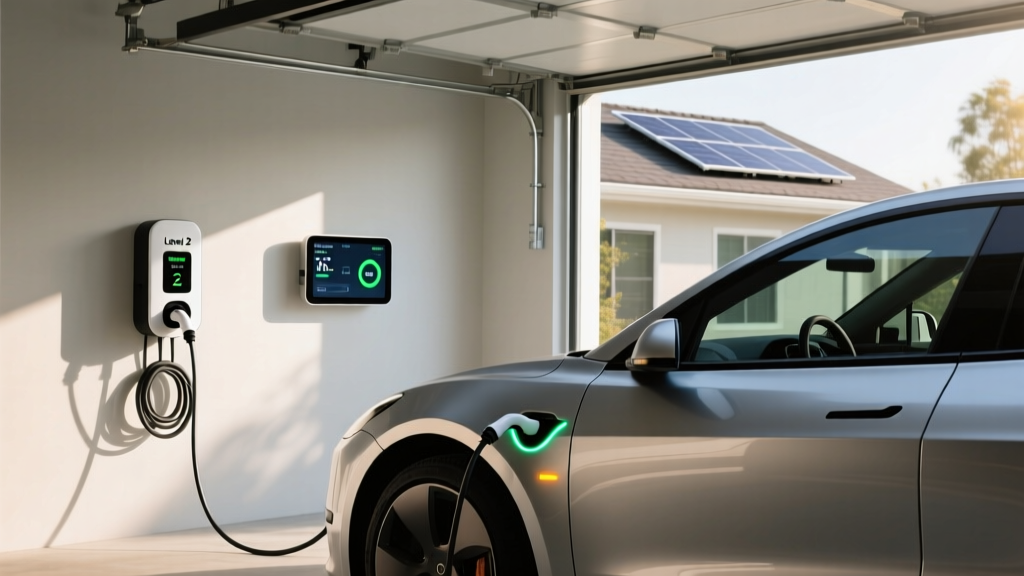
The single highest-impact range extender for BEV owners is a home Level 2 charger. Here's why: drivers who charge at home depart every morning with a full or near-full battery, effectively "extending" their daily usable range compared to those who rely on public DC fast charging and habitually run their packs down to 20% between sessions. A Level 2 home setup also enables battery preconditioning, scheduled charging during off-peak electricity rates, and—critically—eliminates the need to detour to a public charger on your commute.
Charging Levels Explained: kW, Miles Per Hour, and Real-World Timing
Before choosing equipment, you need to understand the three charging levels and how they translate to actual range added. Note: kW (kilowatts) measures power—the rate of energy delivery—while kWh (kilowatt-hours) measures energy capacity, like gallons in a tank. A 100 kWh battery charged at 10 kW takes roughly 10 hours from empty to full.
| Level | Voltage / Amperage | Power (kW) | Miles of Range Added Per Hour | Typical Use Case |
|---|---|---|---|---|
| Level 1 | 120V / 12A | ~1.4 kW | 3–5 mi/hr | Overnight trickle; PHEVs; emergency top-up |
| Level 2 | 240V / 32–48A | 7.7–11.5 kW | 25–44 mi/hr | Daily home charging; workplace |
| DC Fast Charge | 400–800V DC | 50–350 kW | 150–1,000+ mi/hr (peak) | Road trips; 10–80% in 18–45 min |
Real-world timing example: A 2025 Hyundai Ioniq 5 (77.4 kWh usable battery, EPA 305 mi) charging from 10% to 80% on a 350 kW DC fast charger takes approximately 18 minutes under ideal thermal conditions. On a 48A Level 2 home charger (11.5 kW), that same 10–80% session takes roughly 5 hours—perfect for overnight. On Level 1 (1.4 kW), it would take nearly 40 hours. For daily driving of 30–50 miles, Level 2 replenishes your used range in 1–2 hours, making it the effective range extender that resets your odometer every morning.
Cold-weather caveat: At 20°F, expect Level 2 charging speeds to drop 10–20% unless your vehicle has active battery preconditioning. DC fast charging in freezing temps can be 40–50% slower until the battery warms above ~50°F. Vehicles with heat pumps and thermal management (Tesla, Hyundai/Kia E-GMP, GM Ultium) handle this better than passive-cooled packs.
Home Charger Installation: Electrical Requirements, Costs, and Panel Gotchas
The most common question from new EV owners: "How much does it cost to install a home EV charger?" The honest answer ranges from $300 to $4,500+, depending entirely on your home's electrical panel capacity and the distance from panel to charger location.
Electrical Requirements for a 48A Level 2 Charger
- Circuit: Dedicated 60A breaker (NEC requires continuous loads to use only 80% of circuit capacity, so a 48A charger needs a 60A circuit)
- Wire: 6 AWG copper (or 4 AWG aluminum) for runs up to ~100 feet; thicker gauge for longer runs
- Voltage: 240V split-phase (standard US residential)
- Outlet option: NEMA 14-50 receptacle (allows portable charger use) or hardwired connection (required for some 48A+ units and often preferred by inspectors)
- GFCI: NEC 2020/2023 requires GFCI protection for outdoor receptacles; hardwired units often exempt but varies by jurisdiction
- Permit: Required in most municipalities; typically $50–$200
Panel Upgrade: The $1,500–$3,500 Surprise
If your home has a 100A main service panel (common in homes built before 1990), adding a 60A EV circuit may exceed your panel's capacity—especially if you're already running electric range, dryer, and HVAC. An electrician will perform a load calculation per NEC Article 220. If you're over capacity, you'll need either:
- Panel upgrade to 200A: $1,800–$3,500 including permit, new panel, and utility coordination
- Load management device: $300–$600 installed; dynamically reduces charger amperage when other large loads activate (e.g., Emporia Load Manager, Wallbox Power Meter)
- Downsize the charger: A 32A charger (40A circuit) draws less and may fit existing capacity
| Component | Simple Install (Panel Adjacent, 200A Service) | Complex Install (Long Run, Panel Upgrade Needed) |
|---|---|---|
| Level 2 Charger (40–48A) | $400–$700 | $400–$700 |
| Electrician Labor (2–4 hrs simple / 6–10 hrs complex) | $300–$600 | $900–$1,800 |
| Materials (wire, conduit, breaker, outlet) | $100–$250 | $300–$600 |
| Permit & Inspection | $50–$150 | $100–$250 |
| Panel Upgrade (if needed) | $0 | $1,800–$3,500 |
| Total Range | $850–$1,700 | $3,500–$6,850 |
Federal incentive note: The IRS §30C Alternative Fuel Vehicle Refueling Property Credit covers 30% of home charging equipment and installation costs, up to $1,000, but only for residents in eligible census tracts (typically rural or low-income communities per IRS guidelines). Check your eligibility with a tax professional before counting on this credit.
Connector Compatibility: NACS, CCS, and CHAdeMO in 2026
The connector landscape has consolidated significantly since Ford and GM adopted the North American Charging Standard (NACS) for their 2025+ models. Here's where things stand for home and public charging:
| Connector | Brands Using It (New Vehicles) | Home Charger Availability |
|---|---|---|
| NACS (J3400) | Tesla, Ford, GM, Rivian, Volvo, Polestar, Hyundai (2026+) | Tesla Wall Connector, Emporia, Enel X; adapters from CCS manufacturers |
| CCS1 | Hyundai/Kia (2025 and prior), VW, BMW, Mercedes, Stellantis | ChargePoint, Emporia, Wallbox, Enel X JuiceBox |
| CHAdeMO | Nissan Leaf (legacy); no new US models after 2025 | Limited; most home chargers CCS/NACS only |
Adapter strategy: If you drive a CCS-equipped vehicle but want access to Tesla Superchargers (now open to non-Tesla vehicles via Magic Dock or adapter), a CCS-to-NACS adapter ($200–$300 from manufacturers like Lectron or A2Z) is essential. For home charging, most Level 2 chargers are available with either a NACS or CCS connector—choose the one matching your vehicle to avoid daily adapter hassle.
Equipment Recommendations: Best Home Level 2 Chargers for Range Extension
These are the chargers we've tested and recommend based on reliability, smart features, and power output. Each supports the daily top-up routine that serves as your effective range extender.
Tesla Wall Connector (Gen 4)
- Power: 48A / 11.5 kW (on 60A circuit)
- Connector: NACS (native); CCS via adapter
- Cable length: 24 ft
- Smart features: Wi-Fi, OTA updates, load sharing (pair two units on one circuit), access control
- Price: ~$450
- Best for: Tesla and NACS-adopting owners; best value for 48A output
Emporia Level 2 EV Charger
- Power: 48A / 11.5 kW (configurable down to 16A for load management)
- Connector: NACS or CCS (select at purchase)
- Cable length: 24 ft
- Smart features: Wi-Fi, app scheduling, solar integration, optional load management module ($99) to avoid panel upgrade
- Price: ~$399
- Best for: Homes with solar panels; budget-conscious buyers wanting full 48A
ChargePoint Home Flex (2nd Gen)
- Power: Up to 50A / 12 kW (on 60A circuit); adjustable down to 16A via DIP switches
- Connector: NACS or CCS (select at purchase)
- Cable length: 23 ft
- Smart features: Wi-Fi, app scheduling, Alexa integration, detailed energy reporting
- Price: ~$649
- Best for: Owners wanting flexible amperage adjustment and established brand support
Cost Per Mile: Home Charging vs. Public DC Fast vs. Gasoline
The financial case for a home charger as your primary range extender is overwhelming when you compare per-mile fueling costs. Below is a realistic breakdown based on a midsize EV averaging 3.0 mi/kWh (e.g., Tesla Model Y, Hyundai Ioniq 5) and a comparable gas car at 28 MPG combined.
| Scenario | Cost per kWh | Cost per Mile (at 3.0 mi/kWh) | Annual Cost (12,000 mi) |
|---|---|---|---|
| Home Level 2 — Off-Peak TOU Rate | $0.08–$0.12 | $0.03–$0.04 | $360–$480 |
| Home Level 2 — Standard Rate | $0.14–$0.18 | $0.05–$0.06 | $600–$720 |
| Public Level 2 (Workplace/Shopping) | $0.20–$0.30 | $0.07–$0.10 | $840–$1,200 |
| DC Fast Charge (Electrify America, Tesla) | $0.35–$0.55 | $0.12–$0.18 | $1,440–$2,160 |
| Gasoline Car (28 MPG, $3.40/gal) | — | $0.12 | $1,440 |
Key insight: Charging exclusively at home on off-peak rates saves $960–$1,080 annually versus gasoline. But if you rely entirely on DC fast charging, your per-mile cost matches or exceeds gasoline—which is why a home Level 2 setup is the single most cost-effective range extender strategy available. Time-of-use (TOU) plans from your utility can drop overnight rates to $0.06–$0.10/kWh; schedule your charger to activate between midnight and 5 AM.
Safety, Code, and Outdoor Installation Considerations
A Level 2 charger is a continuous high-amperage load running 4–8 hours nightly. Cutting corners on installation invites fire risk, failed inspections, and insurance claim denials. Here's what your installation must address:
- Dedicated circuit: Your EV charger must be on its own breaker—never shared with dryer, range, or HVAC
- Hardwired vs. outlet: Hardwired connections eliminate the #1 failure point (loose NEMA 14-50 receptacles overheating under sustained load). If using a 14-50 outlet, specify a commercial-grade receptacle (Hubbell 9450A or Cooper) and have the electrician torque terminals to spec
- Outdoor rating: If mounted outside, the charger must carry a NEMA 4 or IP65 rating. All recommended units above meet this standard
- GFCI protection: Required for outdoor receptacles per NEC 2020+; hardwired units typically exempt but confirm with your local AHJ (Authority Having Jurisdiction)
- Cable management: A 24-foot cable draped across a driveway is a trip hazard and code violation in many areas. Install a cable organizer or retractable reel
- Surge protection: A whole-home surge protector ($200–$400 installed) protects your charger and vehicle from grid voltage spikes—especially important in areas with frequent lightning or unstable utility power
Building Your Daily Range Extender Routine
Equipment alone doesn't eliminate range anxiety—habits do. Here's a framework that works for drivers covering 30–80 miles daily:
- Set charge limit to 80% for daily use (unless you have an LFP battery, which tolerates 100% daily charging). This preserves long-term battery health while still giving you 80% of EPA range every morning—roughly 240 miles on a 300-mile EPA vehicle.
- Schedule charging to finish 30 minutes before departure. This allows battery preconditioning (on equipped vehicles) and ensures you leave with maximum range without the pack sitting at high SoC for hours.
- Use TOU rates. Set your charger or vehicle app to begin charging at the start of your utility's off-peak window (typically 9 PM–midnight start).
- Precondition while plugged in. In cold weather, use your vehicle's scheduled departure feature to warm the battery and cabin using grid power—not battery power—before you leave. This alone can recover 10–15% of winter range loss.
- Track efficiency seasonally. Expect 3.5–4.0 mi/kWh in summer and 2.5–3.0 mi/kWh in winter. Adjust your charge limit accordingly—bump to 90% in December if your commute is long.
Frequently Asked Questions
How much does it cost to install a home EV charger?
A straightforward Level 2 installation on an existing 200A panel with the charger mounted near the electrical panel typically costs $850–$1,700 (equipment, labor, materials, and permit). If your home needs a panel upgrade from 100A to 200A, total costs range from $3,500–$6,850. Always get three quotes from licensed electricians and confirm they perform a NEC Article 220 load calculation before quoting.
How fast will each charging level add range?
Level 1 (120V) adds 3–5 miles per hour—suitable only for PHEVs with small batteries. Level 2 (240V, 48A) adds 25–44 miles per hour depending on vehicle efficiency, replenishing a typical 75 kWh battery from 10–80% in about 5 hours. DC fast charging adds 150–1,000+ miles per hour at peak, but charge curves taper significantly above 80% SoC, making 10–80% the practical fast-charge window (18–45 minutes depending on vehicle and charger power).
Which connector/charger is compatible with my EV?
For 2025–2026 models: Tesla, Ford, GM, Rivian, and Volvo use NACS. Most Hyundai, Kia, VW, BMW, and Mercedes models use CCS1. Nissan Leaf (legacy) uses CHAdeMO. Match your home charger connector to your vehicle's port to avoid daily adapter use. For public DC fast charging, a CCS-to-NACS adapter ($200–$300) unlocks Tesla Superchargers for CCS vehicles.
How much does charging cost per mile vs. gas?
Home charging on off-peak rates costs $0.03–$0.04 per mile (at 3.0 mi/kWh and $0.10/kWh). Gasoline at $3.40/gallon in a 28 MPG car costs $0.12 per mile. Public DC fast charging at $0.45/kWh costs $0.15 per mile—more than gasoline. The home charger is where EV economics win decisively.
What electrical upgrades might I need?
Homes with 100A service panels often need a panel upgrade to 200A ($1,800–$3,500) or a load management device ($300–$600) that dynamically reduces charger amperage when other large appliances activate. Homes with 200A+ service and available breaker slots typically need only a new 60A breaker, wire run, and outlet or hardwired connection. Your electrician's load calculation will determine which path applies.