The EV DC fast charger market has expanded dramatically through 2025 and into 2026, with networks like Tesla Supercharger, Electrify America, EVgo, and ChargePoint deploying 350 kW and even 500 kW-capable stalls across the country. But for most EV owners, the charging conversation starts at home. Understanding the interplay between public DC fast charging infrastructure and residential Level 2 setups is essential for making smart purchase and installation decisions.
This guide breaks down every charging tier, what home installation actually costs (including panel upgrades), which connector your EV needs, and how charging expenses compare to gasoline on a per-mile basis — all with exact numbers.
Charging Levels Explained: Speeds, Power, and Range Added
Before evaluating equipment or installers, you need clarity on the three charging tiers. The critical distinction: kW (kilowatts) measures power — how fast energy flows into your battery. kWh (kilowatt-hours) measures energy — the total capacity stored in your battery. A 75 kWh battery charged at 11 kW gains roughly 75 kWh ÷ 11 kW ≈ 6.8 hours for a full charge. Charging is never perfectly linear, but this relationship anchors your expectations.
| Level | Voltage | Max Power (kW) | Miles of Range Added Per Hour | Typical Use Case |
|---|---|---|---|---|
| Level 1 | 120V AC | 1.4–1.9 kW | 3–5 miles | Overnight trickle; PHEV top-ups |
| Level 2 | 240V AC | 7.2–19.2 kW | 20–60 miles | Home daily charging; workplace |
| DC Fast (Level 3) | 200–900V DC | 50–500 kW | 150–1,200+ miles (peak) | Road trips; rapid public top-ups |
Real-world context: Those "miles per hour" figures assume moderate efficiency (~3.5 mi/kWh). A heavy truck like the Rivian R1T or a cold-soaked battery will see lower returns. DC fast charging rates are peak numbers — most EVs taper charge speed significantly above 80% State of Charge (SoC) to protect battery health. A vehicle advertising "250 kW peak" may sustain that rate for only 10–15 minutes before dropping to 100 kW or less.
How Fast Will Each Level Charge a Typical EV Battery?
Let's ground this with real charging time examples using common 2026 battery sizes. These assume a 10%–80% charge window, which is the practical fast-charging range most manufacturers recommend for battery longevity.
| Vehicle (Battery Size) | Level 2 at 11.5 kW (48A) | DC Fast (Peak Rate) | 10–80% Time |
|---|---|---|---|
| Tesla Model Y (75 kWh usable) | ~5.5 hours (0–100%) | 250 kW peak (V3 Supercharger) | ~20 minutes |
| Hyundai Ioniq 5 (77.4 kWh) | ~6.5 hours (0–100%) | 240 kW peak (800V architecture) | ~18 minutes |
| Ford F-150 Lightning (131 kWh ext.) | ~11 hours (0–100%) | 150 kW peak | ~41 minutes |
| Chevrolet Equinox EV (85 kWh) | ~7 hours (0–100%) | 150 kW peak | ~30 minutes |
The Hyundai Ioniq 5 and Kia EV6, with their 800V electrical architecture, can sustain higher charge rates longer than 400V competitors. That real-world difference matters more than the peak number on a spec sheet.
Home Charger Installation: Costs, Electrical Requirements, and Gotchas
A Level 2 home charger is where most EV owners do 80–90% of their charging. But installation costs vary enormously depending on your electrical panel's capacity and the distance from panel to charger location.
Electrical Requirements
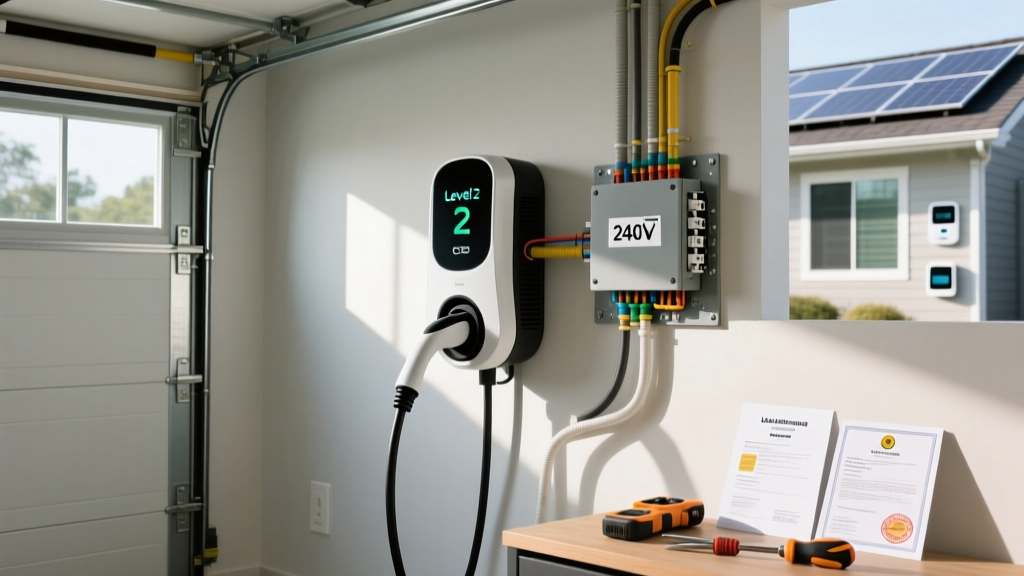
Most Level 2 chargers require a dedicated 240V circuit. Common configurations:
- 40-amp circuit / 32A continuous — delivers 7.7 kW; suitable for most EVs overnight
- 50-amp circuit / 40A continuous — delivers 9.6 kW; faster, recommended for larger batteries
- 60-amp circuit / 48A continuous — delivers 11.5 kW; ideal for 100+ kWh batteries
The National Electrical Code (NEC) requires EV circuits to be rated at 125% of the continuous load. A charger drawing 40A continuously needs a 50A breaker. Always have a licensed electrician verify your panel's available capacity before purchasing equipment.
Panel Upgrade Reality
Many homes built before 2000 have 100-amp or 150-amp main panels. Adding a 50A EV circuit may push total load beyond safe capacity, triggering a panel upgrade to 200A — the single largest variable in installation cost. A panel upgrade typically runs $1,500–$3,500 depending on local utility requirements and whether a new service drop is needed.
An alternative: some utilities and municipalities now permit automated load management devices (like the Emporia Smart Load Management Center) that dynamically throttle charger amperage when household demand spikes, potentially avoiding a panel upgrade entirely.
| Component | Cost Range | Notes |
|---|---|---|
| Level 2 Charger Equipment | $300–$700 | Varies by power output and smart features |
| Electrician Labor (short run <25 ft) | $500–$1,200 | Includes wiring, breaker, conduit, outlet/hardwire |
| Electrician Labor (long run >50 ft) | $1,200–$2,500 | Longer wire runs, potential trenching |
| Permit & Inspection | $50–$300 | Required in most jurisdictions |
| Panel Upgrade (if needed) | $1,500–$3,500 | 100A/150A → 200A service upgrade |
| Total (no panel upgrade) | $850–$2,200 | Most common scenario |
| Total (with panel upgrade) | $2,350–$5,700 | Older homes with limited panel capacity |
Many utility companies offer rebates of $250–$500 for Level 2 charger installations — check with your local provider. The federal residential clean energy credit does not cover EV chargers after 2022; however, the Alternative Fuel Vehicle Refueling Property Credit (Form 8911) may cover up to 30% of home charger equipment and installation costs (capped at $1,000) for qualifying census tracts. Consult a tax professional for eligibility.
Which Connector Does Your EV Need?
The connector landscape in North America consolidated significantly in 2024–2025 when nearly every major automaker adopted the North American Charging Standard (NACS), originally developed by Tesla. By 2026, NACS is the dominant connector on new EVs, but CCS1 vehicles remain widespread on the road.
| Connector | Brands Using It (2026 Models) | Network Access | Adapter Needed? |
|---|---|---|---|
| NACS (Tesla) | Tesla, Ford, GM, Rivian, Volvo, Polestar, Hyundai/Kia (2025+), BMW, Mercedes | Tesla Supercharger + growing third-party | CCS→NACS adapter for older CCS vehicles ($150–$250) |
| CCS1 | VW ID.4 (pre-2025), older Hyundai/Kia, some Stellantis models | Electrify America, EVgo, ChargePoint DC | NACS→CCS adapter available from Tesla ($200) |
| CHAdeMO | Nissan Leaf (legacy only; 2026 Leaf uses NACS) | Limited and declining network | No practical adapter to NACS/CCS |
If you're buying a new EV in 2026, it almost certainly has a NACS port. If you own a 2023–2024 CCS-equipped vehicle, adapters are now widely available to access Tesla Superchargers, which operate the largest and most reliable DC fast charging network in North America.
Equipment Recommendations: Best Level 2 Home Chargers for 2026
Here are proven Level 2 chargers we recommend based on reliability, power output, smart features, and value. All prices reflect early 2026 retail.
Tesla Wall Connector (Gen 4)
- Power Output: Up to 11.5 kW (48A on 60A circuit)
- Connector: NACS native
- Cable Length: 24 ft
- Smart Features: Wi-Fi, OTA updates, access control, scheduling via Tesla app
- Price: ~$475
- Best For: Tesla owners and NACS-equipped vehicles; best value at high power
ChargePoint Home Flex
- Power Output: Up to 12 kW (50A on 60A circuit); configurable down to 16A
- Connector: J1772 (NACS adapter included for 2025+ model)
- Cable Length: 23 ft
- Smart Features: Wi-Fi, Alexa integration, detailed energy tracking, flexible amperage
- Price: ~$650
- Best For: Multi-EV households, older J1772 vehicles, renters who may move
Emporia Vue EV Charger
- Power Output: Up to 11.5 kW (48A)
- Connector: J1772 (NACS adapter available)
- Cable Length: 24 ft
- Smart Features: Integrated with Emporia Vue energy monitor, solar-aware scheduling, load management
- Price: ~$400
- Best For: Solar homes, energy monitoring enthusiasts, budget-conscious buyers
Grizzl-E Smart
- Power Output: Up to 10 kW (40A)
- Connector: J1772 (NACS adapter optional)
- Cable Length: 24 ft
- Smart Features: OCPP-compatible, adjustable amperage, rugged outdoor-rated enclosure
- Price: ~$450
- Best For: Extreme climates (rated -40°F), outdoor installations, Canadian/Northern US owners
Safety and Code Considerations
Every installation must comply with NEC Article 625 governing EV charging equipment. Key requirements:
- Dedicated circuit: Your EV charger cannot share a circuit with other major appliances
- GFCI protection: Required for all receptacle-based (plug-in) installations per 2023 NEC update; hardwired units may be exempt in some jurisdictions
- Outdoor rating: If installed outside, the unit must carry a NEMA 4 or NEMA 4X rating for weather resistance
- Strain relief: Cable management and strain-relief brackets are required to prevent connector damage
Always hire a licensed electrician who pulls a permit. Unpermitted work can void homeowner's insurance coverage and cause issues during a home sale.
Cost to Charge: Per-Mile Economics vs. Gasoline
Electricity pricing varies dramatically by location, time of day, and whether you're charging at home or on the road. Here's how the math works out for a typical midsize EV achieving 3.5 miles per kWh (roughly 28.5 kWh/100mi — similar to a Tesla Model Y or Hyundai Ioniq 5).
| Scenario | $/kWh | Cost Per Mile | Equivalent Gas MPG at $3.50/gal |
|---|---|---|---|
| Home (off-peak utility rate) | $0.09–$0.14 | $0.026–$0.040 | 88–135 MPG |
| Home (standard residential rate) | $0.14–$0.20 | $0.040–$0.057 | 61–88 MPG |
| Home with solar (net cost) | $0.04–$0.08 | $0.011–$0.023 | 152–318 MPG |
| Public Level 2 (ChargePoint, etc.) | $0.25–$0.49 | $0.071–$0.140 | 25–49 MPG |
| DC Fast (Tesla Supercharger avg.) | $0.28–$0.38 | $0.080–$0.109 | 32–44 MPG |
| DC Fast (Electrify America peak) | $0.43–$0.56 | $0.123–$0.160 | 22–28 MPG |
The takeaway: Home charging on an off-peak or time-of-use plan delivers the lowest per-mile cost — often 3–5x cheaper than gasoline. Public DC fast charging at premium rates can approach or even exceed the cost of a fuel-efficient gas car, which is why relying exclusively on public fast charging erodes much of the EV cost advantage.
For reference, the U.S. Department of Energy's fueleconomy.gov provides MPGe ratings and energy cost estimates for every EV sold in the US, updated for current electricity and fuel prices.
The State of the EV DC Fast Charger Market in 2026
The public DC fast charging infrastructure landscape has matured considerably. Key developments shaping the market:
- Tesla Supercharger network openness: Since late 2024, Tesla has opened most Supercharger stalls to NACS-equipped non-Tesla EVs, adding roughly 25,000+ fast-charging stalls to the accessible network for Ford, GM, Rivian, and Hyundai/Kia owners.
- 350 kW+ deployments: Electrify America, EVgo, and the new Ionna network (a joint venture of BMW, GM, Honda, Hyundai, Kia, Mercedes, and Stellantis) are deploying 350 kW and 400 kW chargers capable of fully utilizing 800V-architecture vehicles.
- Reliability improvements: Following years of criticism, major networks have improved uptime to 95–98% according to industry tracking, though individual station experiences still vary.
- NACS standardization: With nearly universal adoption of NACS for new vehicles, the connector fragmentation that confused buyers in 2022–2023 is largely resolved. CCS1 infrastructure is being retrofitted with NACS connectors.
- Megawatt charging (MCS): Early deployments of 1+ MW chargers are appearing along freight corridors for electric semi-trucks, though these are not relevant to passenger EVs.
For the typical EV owner in 2026, the charging ecosystem works well if you have reliable home Level 2 access. Road-trip charging is faster and more accessible than ever, though rural corridors and apartment dwellers without home charging still face real challenges.
Frequently Asked Questions
How much does it cost to install a home EV charger?
A typical Level 2 home charger installation costs $850–$2,200 if your electrical panel has sufficient capacity. If a panel upgrade from 100A/150A to 200A is required, total costs rise to $2,350–$5,700. The equipment itself ranges from $300–$700, with electrician labor and permits making up the remainder.
How fast will each charging level add range?
Level 1 (120V) adds 3–5 miles per hour. Level 2 (240V) adds 20–60 miles per hour depending on amperage and vehicle efficiency. DC fast charging can add 150–300+ miles in 15–25 minutes at peak rates, though charge speed tapers significantly above 80% SoC.
Which connector/charger is compatible with my EV?
Virtually all new EVs sold in 2026 use the NACS connector. If you own a 2022–2024 vehicle with CCS1, adapters to NACS are available for $150–$250. CHAdeMO is limited to older Nissan Leafs with no practical adapter path. Check your vehicle's charge port before purchasing a home charger.
How much does charging cost per mile vs gas?
Home charging at off-peak rates costs roughly $0.03–$0.04 per mile, equivalent to a gas car getting 88–135 MPG at $3.50/gallon. Public DC fast charging at $0.35/kWh costs about $0.10 per mile, similar to a 35 MPG gas car. Home charging delivers the strongest savings; exclusive public charging narrows the gap considerably.
What electrical upgrades might I need?
The most common upgrade is a 200-amp panel replacement if your existing 100A or 150A panel lacks capacity for a dedicated 40–60A EV circuit. Other potential needs include: a new 240V outlet (NEMA 14-50) or hardwired junction box, conduit runs through walls or underground, and possibly a utility service upgrade if the transformer serving your home is undersized. An electrician can perform a load calculation to determine what's required.
Is a plug-in (NEMA 14-50) or hardwired charger better?
Hardwired installations avoid the NEC GFCI breaker requirement (which can cause nuisance trips on some circuits) and are generally more reliable. Plug-in NEMA 14-50 outlets offer portability — useful if you rent or plan to move the charger. Both are code-compliant when installed correctly; the choice depends on your situation.
Do I need a smart charger or is a basic unit sufficient?
A basic "dumb" charger works perfectly for charging. Smart features — Wi-Fi scheduling, energy monitoring, solar integration, and utility demand-response programs — add convenience and can save money on time-of-use electricity plans. If your utility offers off-peak rates, a smart charger that schedules charging to those windows pays for itself within months.