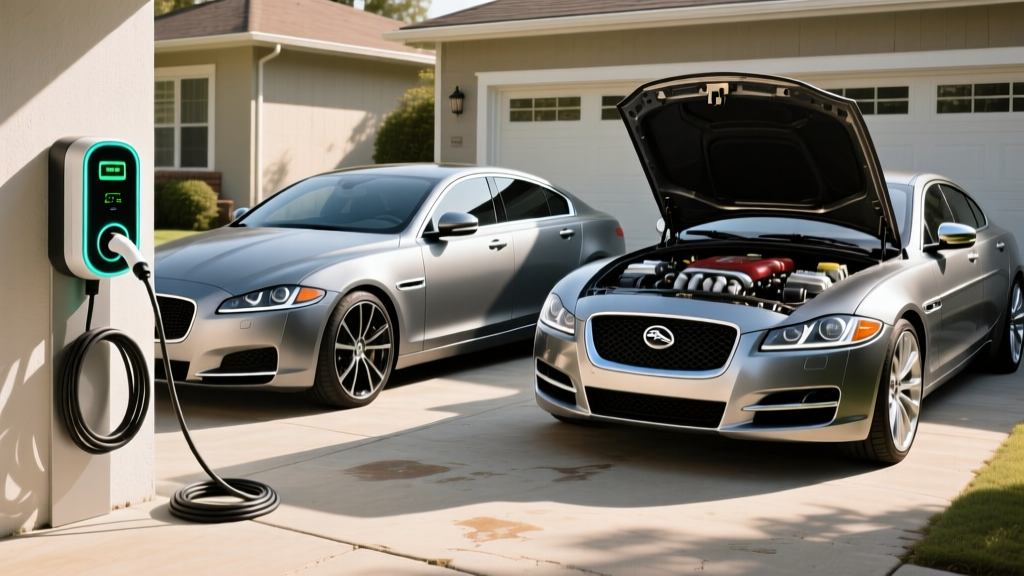
If you're cross-shopping a used luxury sport sedan like the 2009 Jaguar XF Supercharged against a modern EV, the sticker price is only half the equation. The 2009 XF Supercharged's 5.0-liter supercharged V8 produces 470 horsepower and returns an EPA-estimated 15 MPG city / 21 MPG highway. That thirst at the pump is exactly what drives many performance-sedan buyers toward electrification. But before you plug in, you need to understand EV charging infrastructure — what it costs to install, how fast each level delivers range, and whether your per-mile energy spend actually beats $4-a-gallon premium.
This guide breaks down every charging variable — from Level 1 trickle charging to DC fast charging — so you can compare apples to apples against a supercharged V8 baseline.
Charging Levels Explained: Speed in kW and Miles Per Hour
The single most important distinction in EV charging is between kW (kilowatts), which measures power — the rate at which energy flows — and kWh (kilowatt-hours), which measures energy — the total capacity stored in the battery. Think of kW as how wide the hose is and kWh as how big the bucket is.
Here's what each charging level delivers in real-world terms:
| Level | Voltage | Power (kW) | Miles of Range Per Hour | Best For |
|---|---|---|---|---|
| Level 1 (120V) | 120V AC | 1.0–1.4 kW | 3–5 miles | Overnight top-ups, PHEVs, emergency use |
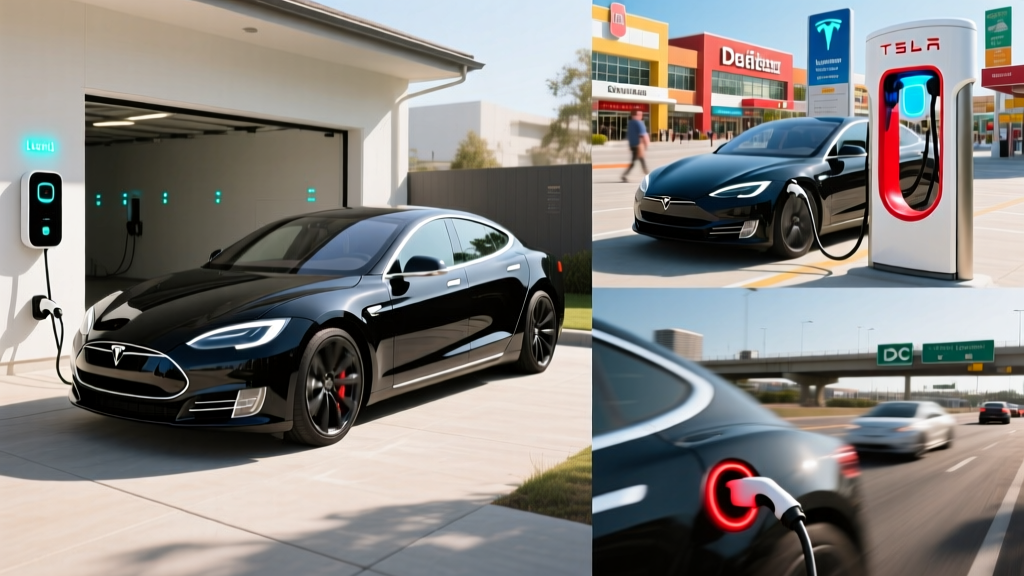
| Level 2 (240V) | 240V AC | 3.3–19.2 kW | 12–75 miles | Daily home charging, workplace, shopping centers |
| DC Fast Charging | 400–800V DC | 50–350 kW | 150–1,000+ miles (equivalent rate) | Road trips, highway corridors, quick top-ups |
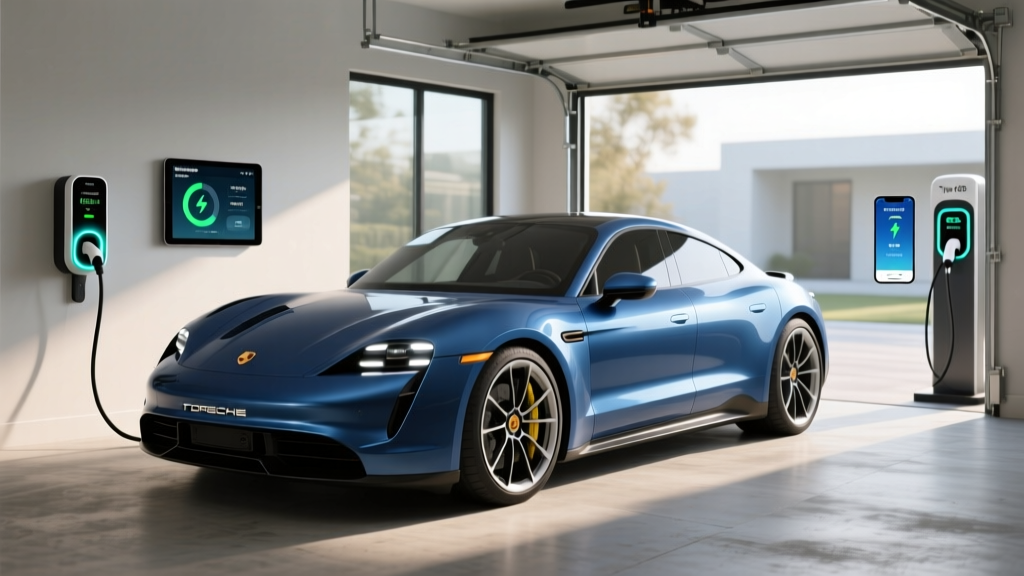
A few nuances matter here. Level 2 charging at 11.5 kW (48A on a 60A circuit) will fully replenish a 75 kWh battery overnight in roughly 7 hours. DC fast charging rates peak at the beginning of a session and taper significantly above 80% state of charge — so a charger rated for 250 kW may average 120–150 kW over a 10–80% session. This charge-curve taper is why manufacturers quote 10–80% times rather than 0–100%.
- 75 kWh battery (e.g., Tesla Model 3 RWD): ~25 min at a 170 kW DC fast charger; ~7 hours on 11.5 kW Level 2
- 100 kWh battery (e.g., Ford F-150 Lightning Extended Range): ~34 min at a 150 kW DC fast charger; ~9 hours on 11.5 kW Level 2
- 58 kWh battery (e.g., Hyundai Ioniq 5 Standard Range): ~18 min at a 240 kW DC fast charger (800V architecture); ~5.5 hours on 11.5 kW Level 2
How Much Does It Cost to Install a Home EV Charger?
Home Level 2 charging is where most EV owners do 80–90% of their charging. The total installed cost varies enormously based on your home's electrical panel, the distance from panel to charger location, and local permit fees.
| Component | Typical Range | Notes |
|---|---|---|
| Level 2 Charger Equipment | $300–$700 | Smart Wi-Fi-enabled units; basic models from $200 |
| Electrician Labor | $500–$2,000 | Depends on run length, conduit, and wall type |
| Electrical Permit | $50–$250 | Varies by municipality; required for code compliance |
| Panel Upgrade (if needed) | $1,500–$4,000 | Common in homes with 100A service; upgrading to 200A |
| Total (no panel upgrade) | $850–$2,950 | Most homes with 200A service fall in this range |
| Total (with panel upgrade) | $2,350–$6,950 | Older homes, especially pre-1990 builds |
Electrical requirements: A typical Level 2 charger delivering 11.5 kW requires a 240V, 60-amp dedicated circuit (the charger draws a continuous 48A, and the National Electrical Code requires the circuit be rated at 125% of continuous load). If your electrical panel lacks two adjacent open breaker slots or is already near capacity, a panel upgrade or sub-panel installation becomes necessary.
For the 2009 Jaguar XF Supercharged comparison: you'd never spend $2,000+ to "install" a gas pump, but the EV charger pays for itself through per-mile fuel savings, as we'll calculate below.
Which Connector and Charger Is Compatible With Your EV?
As of 2026, the North American connector landscape has consolidated significantly, but you'll still encounter three main connector standards:
| Connector | Brands Using It | Notes |
|---|---|---|
| NACS (Tesla / SAE J3400) | Tesla, Ford, GM, Rivian, Volvo, Polestar, Mercedes-Benz, Nissan, BMW, Hyundai/Kia (2025+) | Now the dominant standard; provides access to Tesla Supercharger network |
| CCS1 (Combined Charging System) | Legacy VW ID.4 (pre-2025), some Stellantis models, older Hyundai/Kia | Being phased out by most automakers; adapters available |
| CHAdeMO | Nissan Leaf (legacy) | Effectively discontinued for new models; limited DC fast-charger availability |
If you're buying a new 2026 EV, it almost certainly uses NACS. If you own an older CCS1-equipped vehicle, a CCS-to-NACS adapter (approximately $200–$300) unlocks the Tesla Supercharger network — which operates over 6,000 stations and 65,000+ stalls in North America. Most home Level 2 chargers come with a J1772 connector (the AC charging standard), and NACS-equipped vehicles ship with a J1772-to-NACS adapter in the box.
Cost Per Mile: EV Charging vs the 2009 Jaguar XF Supercharged
This is where the economics get stark. The 2009 Jaguar XF Supercharged requires premium unleaded (91+ octane) and delivers roughly 18 MPG combined in mixed driving. Let's run the numbers against common EV charging scenarios.
| Scenario | Rate | Cost Per Mile | Annual Cost (12,000 mi) |
|---|---|---|---|
| 2009 XF Supercharged (18 MPG, $4.50/gal premium) | $4.50/gal | $0.250 | $3,000 |
| Home Level 2 — Off-Peak Utility Rate | $0.08/kWh | $0.024 | $288 |
| Home Level 2 — Average US Residential Rate | $0.165/kWh | $0.050 | $600 |
| Public Level 2 (ChargePoint, EVgo) | $0.30/kWh | $0.090 | $1,080 |
| DC Fast Charging (Electrify America, Tesla Supercharger) | $0.48/kWh | $0.144 | $1,728 |
Assumptions: EV efficiency of 3.0 miles/kWh (roughly 100 MPGe), which is typical for a midsize sedan like the Tesla Model 3 or Hyundai Ioniq 6. According to fueleconomy.gov, the average EV achieves 3–4 miles per kWh depending on weight and aerodynamics.
The takeaway: Even at the most expensive DC fast-charging rates, an EV costs 42% less per mile than fueling the supercharged Jaguar. At home off-peak rates, you're spending roughly 90% less per mile. Over five years and 60,000 miles, home charging saves approximately $13,500 compared to premium fuel in the XF — more than covering the cost of the charger installation many times over.
Recommended Home Level 2 Chargers for 2026
Here are three proven Level 2 chargers that cover different budgets and feature sets. All deliver a NACS or J1772 connector compatible with the vast majority of 2026 EVs.
Emporia Vue EV Charger — Best Value
- Power Output: 11.5 kW (48A on 60A circuit)
- Connector: J1772 (NACS adapter included)
- Cable Length: 24 feet
- Smart Features: Wi-Fi, energy monitoring, scheduling via app, solar integration
- Price: ~$399
- Why it works: Hardwired or NEMA 14-50 plug; integrates with Emporia's whole-home energy monitor for load management
ChargePoint Home Flex — Best Smart Charger
- Power Output: Up to 12 kW (50A, adjustable from 16A–50A)
- Connector: J1772 or NACS (configurable at purchase)
- Cable Length: 23 feet
- Smart Features: Wi-Fi, Alexa/Google Home, ChargePoint app scheduling, Amazon utility rate integration
- Price: ~$549
- Why it works: Amperage is adjustable via DIP switches to match your circuit capacity — ideal if your panel can't support a full 60A breaker
Tesla Wall Connector — Best for NACS-Native Vehicles
- Power Output: 11.5 kW (48A on 60A circuit)
- Connector: NACS native (no adapter needed for Tesla, Ford, GM, Rivian, etc.)
- Cable Length: 24 feet
- Smart Features: Wi-Fi, power sharing (link two units on one circuit), OTA updates
- Price: ~$425
- Why it works: Cleanest installation for NACS vehicles; power-sharing feature lets you charge two EVs on a single 60A circuit
Safety, Code, and Installation Considerations
EV charging draws significant continuous current — far more than any other household appliance. Cutting corners on installation is a fire and insurance risk. Here's what proper installation requires:
- Dedicated circuit: Your Level 2 charger must have its own dedicated double-pole breaker. Sharing a circuit with a dryer, oven, or HVAC system is a code violation.
- GFCI protection: The 2023 NEC update (and adopted in most jurisdictions by 2026) requires GFCI protection for all EV charging circuits. Some chargers have built-in GFCI; if yours doesn't, your electrician must install a GFCI breaker.
- Outdoor rating: If mounting outside, ensure the charger carries a NEMA 4 or IP65 rating. All three chargers above are outdoor-rated, but the connector holster should also be weather-shielded.
- Wire gauge: A 60A circuit requires 6 AWG copper wire (or 4 AWG aluminum) for runs up to 50 feet. Longer runs may require upsizing to prevent voltage drop. This is why electricians charge more for long conduit runs from the panel to the garage.
- Permit and inspection: Most municipalities require an electrical permit for EV charger installation. The inspection ensures the circuit, wire gauge, and grounding meet code. Skipping the permit can void homeowner's insurance claims related to electrical fires.
- Load calculation: A licensed electrician will perform a load calculation (NEC Article 220) to verify your panel can handle the additional 48A continuous draw. If your panel is at 80%+ capacity, a panel upgrade or a smart load-management device (like the Emporia Smart Load Center) becomes necessary.
Federal Tax Credits and Utility Rebates for Home Charging
The IRS Residential Clean Energy Credit (IRC §25C) covers 30% of the cost of home EV charging equipment and installation, up to a $1,000 annual cap. This applies to the charger hardware and the electrician's labor for the dedicated circuit — but not a full panel upgrade.
- §30D (New Clean Vehicle Credit): Up to $7,500 toward the purchase of a qualifying new EV. Subject to MSRP caps ($55K sedans, $80K SUVs/trucks), buyer income limits ($150K single / $300K joint), and battery critical-mineral sourcing rules. Point-of-sale transfer available.
- §25C (Energy Efficient Home Improvement Credit): 30% of home charger equipment + install, capped at $1,000/year. This is the credit that applies to your charger installation.
Always consult a tax professional and check irs.gov for current-year eligibility, as rules and sourcing requirements change annually.
Many utilities also offer rebates of $250–$1,000 for Level 2 charger installation, and some provide free off-peak charging rates for EV owners who enroll in time-of-use programs. Check with your local utility before purchasing equipment — some require specific charger models to qualify.
Putting It All Together: Should You Trade the Supercharged V8 for an EV?
The 2009 Jaguar XF Supercharged is a compelling driver's car — 470 HP, a 5.0-liter supercharged V8, and a 0–60 time of approximately 4.9 seconds. But the ownership math is punishing: $3,000+ annually in fuel, plus premium maintenance (supercharger belt service, ZF transmission fluid, air suspension repairs on aging British luxury iron).
A modern EV like the 2026 Tesla Model 3 Performance (0–60 in 2.9 seconds, EPA 341 miles, starting around $52,990) or the Hyundai Ioniq 5 N (0–60 in 3.4 seconds, EPA 260 miles, $66,100) matches or exceeds the XF's performance while slashing per-mile energy costs by 60–90%. Factor in the $1,000 charger tax credit, utility rebates, and the near-elimination of drivetrain maintenance, and the EV wins on total cost of ownership within 2–3 years for most drivers.
The critical first step is verifying your home's electrical capacity. If you have 200A service and a garage or driveway within 50 feet of your panel, budget $1,000–$2,500 for a professional Level 2 installation and start saving immediately. If you need a panel upgrade, the investment is larger ($3,000–$6,000 total), but the per-mile savings against a 15-MPG supercharged V8 pay it back faster than you'd expect.
Frequently Asked Questions
How much does it cost to install a home EV charger?
Expect $850–$2,950 if your home has 200-amp electrical service and no panel upgrade is needed. If your home requires a panel upgrade from 100A to 200A service, total costs range from $2,350–$6,950 including equipment, electrician labor, permit, and the panel upgrade itself.
How fast will each charging level add range?
Level 1 (120V) adds 3–5 miles per hour. Level 2 (240V) adds 12–75 miles per hour depending on amperage (a 48A/11.5 kW charger adds roughly 35–40 miles per hour). DC fast charging can add 150–300+ miles in a 20–30 minute session, depending on the vehicle's charge acceptance rate and battery state of charge.
Which connector/charger is compatible with my EV?
Most 2025–2026 EVs now use the NACS (SAE J3400) connector. Older models may use CCS1 or CHAdeMO. For home Level 2 charging, all EVs accept a J1772 connector (NACS vehicles use a J1772-to-NACS adapter, typically included with the vehicle). Check your vehicle's charge port or owner's manual to confirm.
How much does charging cost per mile vs gas?
At the US average residential electricity rate of $0.165/kWh and an EV efficiency of 3 mi/kWh, home charging costs roughly $0.05 per mile. A 2009 Jaguar XF Supercharged at 18 MPG combined on $4.50 premium costs $0.25 per mile — five times more. Even DC fast charging at $0.48/kWh costs $0.14 per mile, still 44% less than the Jaguar.
What electrical upgrades might I need?
The most common upgrade is a panel capacity increase from 100A to 200A service ($1,500–$4,000). You may also need additional breaker slots, a sub-panel, or a smart load-management device if your panel is near capacity. A licensed electrician will perform an NEC Article 220 load calculation to determine what's required.