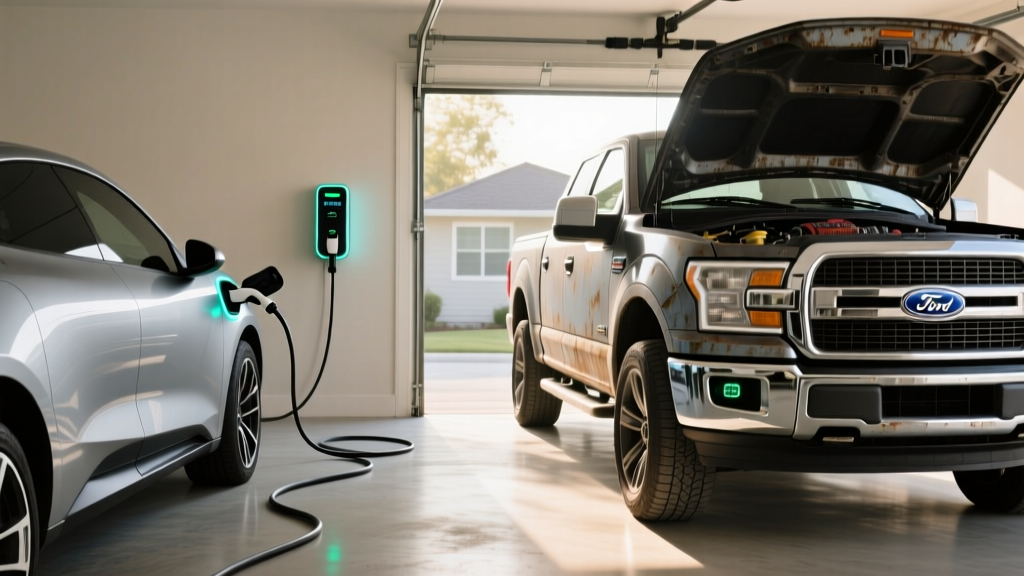
If you've ever filled the tank of a 2003 Ford F-150 Harley-Davidson supercharged and watched the dollars climb past $60 for a single fill-up, you already understand why EV owners obsess over charging costs. That supercharged 5.4L Triton V8 was rated at just 12 MPG combined by the EPA, making it one of the thirstiest production trucks of its era. Today, a modern electric vehicle can travel the same distance on electricity that costs a fraction of what that Harley-Davidson F-150 demands in premium fuel.
But understanding EV charging — the levels, the costs, the home installation requirements, and the connector landscape — is far more complex than pulling up to a gas pump. This guide breaks down everything you need to know about charging an EV at home and on the road, with direct cost comparisons to the 2003 Ford F-150 Harley-Davidson supercharged as a baseline for what you might be leaving behind.
Charging Levels Explained: Level 1, Level 2, and DC Fast Charging
EV charging happens at three distinct levels, each defined by the power (measured in kilowatts, or kW) delivered to the vehicle's battery. A critical distinction: kW measures power (how fast energy flows), while kWh measures energy (the total capacity stored in the battery). Think of kW as the size of the hose and kWh as the size of the bucket.
| Level | Voltage | Power (kW) | Miles of Range per Hour | Typical Use Case |
|---|---|---|---|---|
| Level 1 | 120V AC | 1.0–1.4 kW | 3–5 miles | Overnight trickle; PHEV topping off |
| Level 2 | 240V AC | 3.3–19.2 kW | 12–75 miles | Daily home and workplace charging |
| DC Fast Charging | 200–800V DC | 50–350 kW | 150–1,200+ miles (peak) | Road trips and rapid top-ups |
Level 1 uses a standard household 120V outlet. It's universally available but painfully slow — adding roughly 4 miles of range per hour. A 75 kWh battery (like the one in a Ford Mustang Mach-E Extended Range) would take over 60 hours from empty to full. Level 1 is practical only for plug-in hybrids with small batteries or BEV owners with very short commutes.
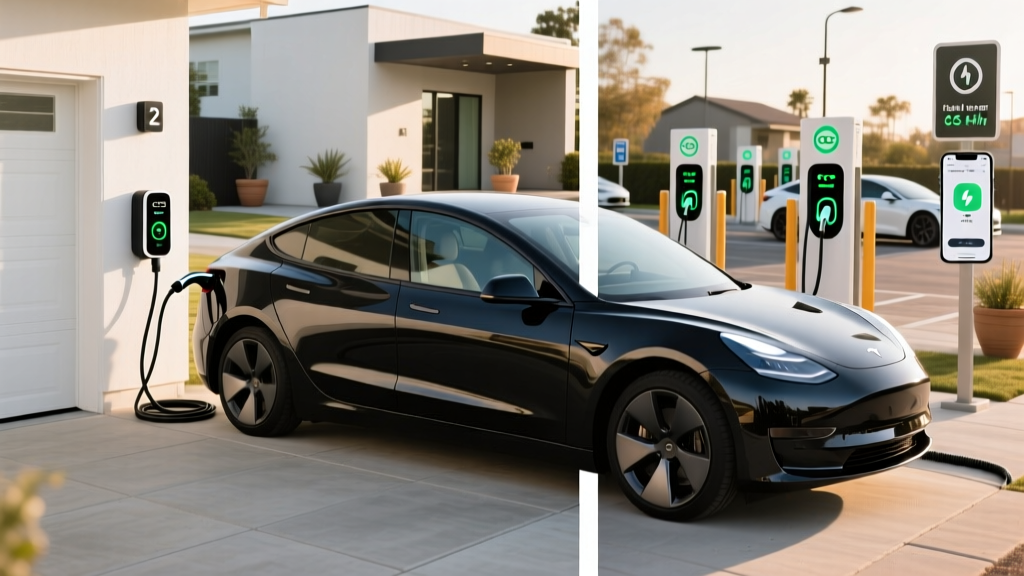
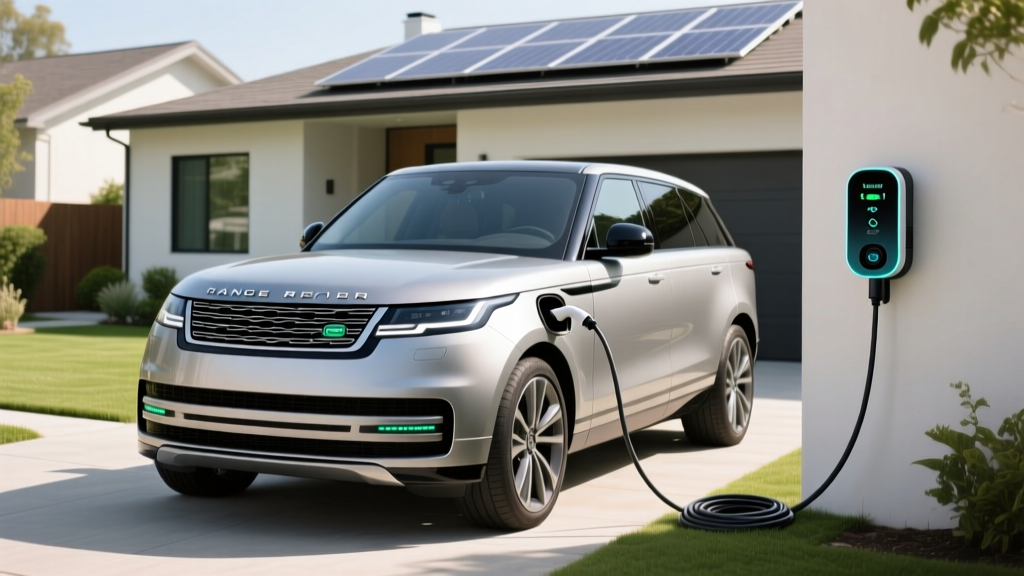
Level 2 requires a 240V circuit — the same voltage as a clothes dryer or electric oven. This is the backbone of home EV charging. At 48 amps (11.5 kW), you can add roughly 40–45 miles of range per hour, fully recharging most EVs overnight in 6–10 hours.
DC Fast Charging bypasses the vehicle's onboard charger and feeds direct current straight into the battery at high power. Modern EVs on 350 kW chargers can add 100+ miles in under 10 minutes. However, peak speeds are not sustained — the charge curve tapers significantly above 80% state of charge (SoC) to protect battery health. A vehicle advertising "250 kW peak" may only sustain that rate between 10–40% SoC before tapering to 100 kW, then 50 kW, then lower.
How Much Does It Cost to Install a Home EV Charger?
Home Level 2 charging is where most EV owners do 80–90% of their charging. But installation costs vary dramatically depending on your home's electrical infrastructure. Here's a realistic breakdown based on 2026 electrician rates and equipment pricing.
| Component | Typical Cost Range | Notes |
|---|---|---|
| Level 2 Charger (Equipment) | $300–$750 | Smart Wi-Fi chargers cost more; basic units are cheaper |
| Electrician Labor | $500–$2,500 | Depends on run length, conduit, and wall type |
| Electrical Permit | $50–$250 | Required in most jurisdictions; varies by municipality |
| Panel Upgrade (if needed) | $1,500–$4,000+ | 100A panels often need upgrading to 200A for EV + existing loads |
| Total (no panel upgrade) | $850–$3,500 | Most homes with 200A service and short conduit runs |
| Total (with panel upgrade) | $2,500–$7,000+ | Older homes with 100A or 150A service |
The panel-upgrade gotcha: Homes built before 2000 — the same era as that 2003 F-150 Harley-Davidson — frequently have 100A or 150A electrical panels. A Level 2 charger drawing 48A requires a dedicated 60A breaker. Your electrician will perform a load calculation per NEC Article 220 to determine if your panel has headroom. If it doesn't, a panel upgrade to 200A or even 400A becomes mandatory, adding significant cost.
Some utilities and state programs offer rebates of $250–$1,000 toward charger installation. Check with your local utility before scheduling work. The federal Residential Clean Energy Credit (25C) also covers up to 30% of charger equipment and installation costs (capped at $1,000) through 2032, though eligibility depends on your tax situation — consult a tax professional.
Electrical Requirements: What Your Home Needs for Level 2 Charging
A proper Level 2 home charging setup requires attention to several electrical specifications:
- Circuit: A dedicated 240V circuit with a breaker rated 125% above the charger's continuous draw. A 48A charger requires a 60A breaker; a 40A charger needs a 50A breaker.
- Wire gauge: 6 AWG copper for 50A circuits; 4 AWG for 60A circuits (varies by run length and local code).
- NEMA outlet vs. hardwired: A NEMA 14-50 outlet offers flexibility (you can unplug and take the charger with you), but hardwired installations avoid the GFCI breaker nuisance-tripping issues that some jurisdictions require on 240V receptacles.
- GFCI protection: NEC 2020 and later require GFCI protection on 240V receptacles used for EV charging in garages. Hardwired units are exempt. Many EV chargers have built-in ground-fault protection, making hardwired installations simpler.
- Outdoor rating: If charging outside, the charger must carry a NEMA 4 or IP65 weatherproof rating, and the circuit must be GFCI-protected.
Safety note: Never use extension cords or adapter pigtails to reach a charging outlet. EV charging draws sustained high current for hours — undersized cords can overheat and cause fires. Install the outlet or hardwired connection within the charger's cable reach of your parking spot.
Connector Compatibility: NACS, CCS1, and CHAdeMO
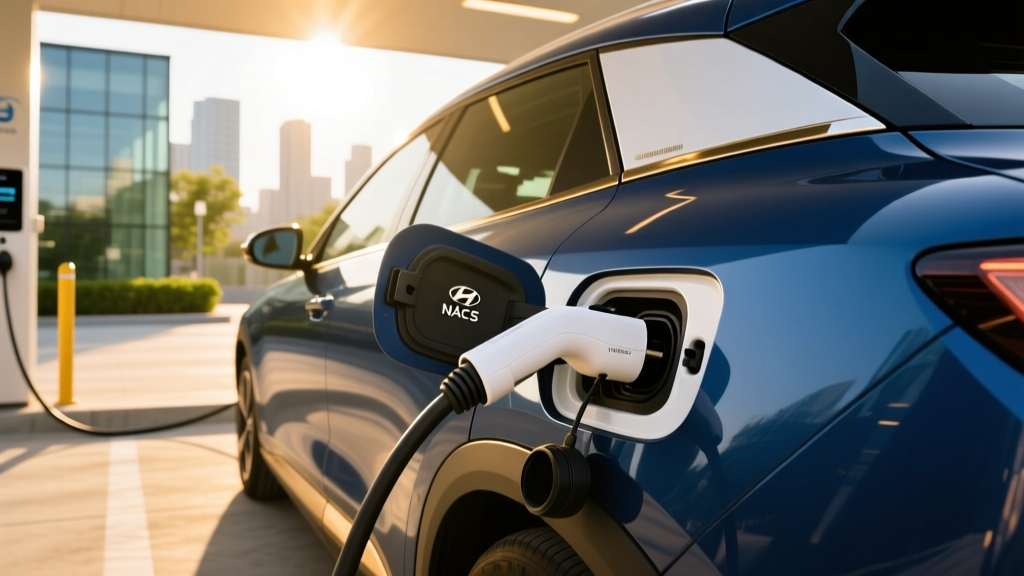
The EV connector landscape has consolidated significantly since 2024, when Ford, GM, Rivian, and most major automakers adopted Tesla's North American Charging Standard (NACS). Here's where things stand for 2026 model-year vehicles:
| Connector | Brands Using It | DC Fast Charging Network Access |
|---|---|---|
| NACS (Tesla standard) | Tesla, Ford, GM, Rivian, Hyundai, Kia, BMW, Mercedes, Volvo, Polestar, Lucid, Fisker | Tesla Supercharger network (20,000+ stalls), plus growing third-party NACS stations |
| CCS1 | Volkswagen, Stellantis (some models), legacy EVs (2015–2024 models) | Electrify America, EVgo, ChargePoint, and other CCS networks |
| CHAdeMO | Nissan Leaf (legacy only — no new CHAdeMO vehicles sold in US since 2024) | Limited and shrinking network |
Adapter needs: If you own a CCS1-equipped EV (say, a 2023 VW ID.4) and want access to Tesla Superchargers, Tesla sells a CCS-to-NACS adapter (~$250). Ford and Rivian also provide adapters for their customers. Conversely, NACS-equipped vehicles can use CCS networks with a NACS-to-CCS adapter. Confirm adapter compatibility with your specific vehicle and charger before purchasing — not all adapters support DC fast charging.
Charging Cost Per Mile vs. the 2003 Ford F-150 Harley-Davidson Supercharged
Let's put real numbers behind the cost comparison. The 2003 Ford F-150 Harley-Davidson edition with the supercharged 5.4L V8 was EPA-rated at approximately 12 MPG combined (10 city / 14 highway). It requires premium fuel (91+ octane). At $4.20/gallon for premium (2026 national average), here's how it compares to charging common EVs:
| Vehicle / Scenario | Energy Cost | Efficiency | Cost Per Mile |
|---|---|---|---|
| 2003 F-150 Harley-Davidson SC (premium gas) | $4.20/gallon | 12 MPG combined | $0.35/mile |
| EV — Home Level 2 (national avg $0.16/kWh) | $0.16/kWh | 3.0 mi/kWh (avg EV) | $0.053/mile |
| EV — Home off-peak TOU rate ($0.09/kWh) | $0.09/kWh | 3.0 mi/kWh | $0.03/mile |
| EV — Public Level 2 ($0.30/kWh avg) | $0.30/kWh | 3.0 mi/kWh | $0.10/mile |
| EV — DC Fast Charging ($0.48/kWh avg) | $0.48/kWh | 3.0 mi/kWh | $0.16/mile |
| EV — Tesla Supercharger ($0.30/kWh avg) | $0.30/kWh | 3.5 mi/kWh (efficient sedan) | $0.086/mile |
The takeaway: Even at the most expensive DC fast-charging rates, an EV costs roughly half per mile compared to the supercharged Harley-Davidson F-150. Charge at home on an off-peak time-of-use plan and you're looking at $0.03/mile — less than one-tenth of the F-150's fuel cost. Over 15,000 annual miles, that's a difference of $4,800 per year in energy costs alone.
According to the EPA's fueleconomy.gov, the average US electricity rate for EV charging is approximately $0.16/kWh, but time-of-use plans from utilities can drop that to $0.07–$0.10/kWh during overnight hours — the ideal window for home charging.
Charging Time Examples: What to Expect with Common Battery Sizes
Charging time depends on battery capacity (kWh) and the power (kW) available. Here are real-world estimates for popular EV battery sizes:
| Battery Size (Usable kWh) | Example Vehicles | Level 2 at 11.5 kW (48A) | DC Fast 10–80% |
|---|---|---|---|
| 60 kWh | Chevy Equinox EV, base Tesla Model 3 | ~5.5 hours (0–100%) | ~20–25 min (at 150+ kW) |
| 75 kWh | Tesla Model Y LR, Hyundai Ioniq 5 | ~7 hours (0–100%) | ~18–22 min (at 250 kW) |
| 85–90 kWh | Ford F-150 Lightning Ext., Rivian R1T | ~8 hours (0–100%) | ~25–35 min (at 150–200 kW) |
| 100+ kWh | GMC Hummer EV, Lucid Air Grand Touring | ~10–11 hours (0–100%) | ~20–35 min (at 300+ kW peak) |
Charge curve reality check: Advertised "10–80% in 18 minutes" figures assume optimal battery temperature (preconditioning engaged) and a charger capable of sustaining peak power. In cold weather (below 40°F), a battery that hasn't been preconditioned may accept only 40–60% of its peak charge rate, stretching a 20-minute session to 40+ minutes. Always precondition your battery before a DC fast-charging stop — most EVs do this automatically when you navigate to a charger.
And that 80–100% top-off? It can take as long as the 10–80% session due to aggressive tapering. For road trips, the fastest strategy is to charge to 80% and go, making multiple shorter stops rather than waiting for a full charge.
Recommended Home EV Chargers for 2026
These are the Level 2 chargers we recommend based on reliability, features, connector availability, and value:
ChargePoint Home Flex (NACS or CCS)
- Power: Up to 12 kW (50A) on a 60A circuit; adjustable down to 16A
- Connector: Available in NACS or CCS1 configurations
- Cable length: 23 feet
- Smart features: Wi-Fi, scheduling, energy tracking, Alexa integration
- Price: ~$550–$650
- Best for: Flexibility — the adjustable amperage works on circuits from 20A to 60A, making it ideal for homes where a full 60A circuit isn't feasible
Tesla Wall Connector (NACS)
- Power: Up to 11.5 kW (48A) on a 60A circuit
- Connector: NACS (native); includes J1772 adapter tip for non-Tesla EVs
- Cable length: 24 feet
- Smart features: Wi-Fi, over-the-air updates, power sharing (link two units on one circuit), Tesla app integration
- Price: ~$475
- Best for: Tesla owners and NACS-adopting Ford/GM/Rivian owners; the power-sharing feature is excellent for two-EV households
Emporia Vue Level 2 Charger (NACS or J1772)
- Power: Up to 11.5 kW (48A)
- Connector: NACS or J1772 options
- Cable length: 24 feet
- Smart features: Wi-Fi, detailed energy monitoring, solar integration (pair with Emporia Vue home energy monitor), scheduled charging
- Price: ~$400–$500
- Best for: Budget-conscious buyers who want smart features; excellent energy monitoring for solar-equipped homes
Grizzl-E Smart (J1772/NACS adapter-ready)
- Power: Up to 10 kW (40A) on a 50A circuit
- Connector: J1772 (NACS via adapter)
- Cable length: 24 feet
- Smart features: OCPP-compatible, works with multiple charging apps
- Price: ~$450
- Best for: Cold-climate durability — rated to -40°F and built in Canada; rugged outdoor installations
Frequently Asked Questions
How much does it cost to install a home EV charger?
A typical Level 2 home charger installation runs $850–$3,500 if your electrical panel has sufficient capacity. If your home needs a panel upgrade from 100A to 200A service, expect total costs of $2,500–$7,000+. The charger unit itself costs $300–$750, with electrician labor ($500–$2,500) and permits ($50–$250) making up the remainder.
How fast will each charging level add range?
Level 1 (120V) adds 3–5 miles per hour. Level 2 (240V at 48A/11.5 kW) adds roughly 40–45 miles per hour. DC fast charging at 150–350 kW can add 100–200+ miles in 10–15 minutes, though the rate tapers significantly above 80% SoC.
Which connector and charger is compatible with my EV?
For 2026 model-year vehicles, nearly all new EVs sold in the US now use the NACS connector. CCS1 is found on 2024 and older models from VW, and CHAdeMO is limited to legacy Nissan Leafs. Check your vehicle's charge port or owner's manual, and match your home charger's connector accordingly. Adapters are available for cross-compatibility.
How much does EV charging cost per mile vs. gas?
Home charging at the national average of $0.16/kWh costs roughly $0.053/mile for an average EV. Off-peak rates can drop this to $0.03/mile. By comparison, the 2003 Ford F-150 Harley-Davidson supercharged at 12 MPG on premium fuel costs about $0.35/mile. Even the most expensive DC fast charging ($0.48/kWh) comes in at $0.16/mile — still less than half the F-150's fuel cost.
What electrical upgrades might I need for a home charger?
The most common upgrade is a panel capacity increase. Homes with 100A or 150A service may need an upgrade to 200A to accommodate a 48A EV charger alongside existing loads (HVAC, electric range, dryer). Your electrician will perform a NEC Article 220 load calculation. Other potential upgrades include running new conduit from the panel to the garage, installing a sub-panel, or adding a smart load-management device (like the Emporia Smart Load Center) that dynamically reduces charger power when other circuits are in heavy use — avoiding a panel upgrade altogether.
Is it cheaper to charge at home or use public chargers?
Home charging is dramatically cheaper. Public Level 2 chargers average $0.25–$0.40/kWh, and DC fast chargers average $0.40–$0.60/kWh, compared to $0.09–$0.16/kWh at home. Public charging exists for road trips and for drivers without home charging access, but relying on it exclusively can double or triple your per-mile energy cost.
Can I charge my EV from a regular 120V outlet?
Yes, but Level 1 charging at 120V adds only 3–5 miles of range per hour. It's adequate for PHEVs with 20–40 miles of electric range or for BEV owners who drive fewer than 30 miles per day and can charge for 10+ hours overnight. For any EV with a battery over 60 kWh, Level 1 is impractically slow as a primary charging method.
The Bottom Line: From Supercharged V8 to Electrified Efficiency
The 2003 Ford F-150 Harley-Davidson supercharged was an icon of early-2000s excess — 380 horsepower from a supercharged Triton V8, premium audio, and custom leather, all at the cost of 12 MPG. Two decades later, the math has changed entirely. A modern electric truck like the Ford F-150 Lightning delivers comparable (or greater) torque, seats five, and costs $0.05/mile to fuel at home — a savings of over $4,500 annually for a driver covering 15,000 miles.
The transition does require upfront investment: $850–$3,500 for a home Level 2 installation (more if your panel needs upgrading), and an understanding of the connector and charging-speed landscape. But once that infrastructure is in place, daily charging is as simple as plugging in overnight and waking up to a full "tank" every morning — at a cost that would have seemed impossible to the engineers who bolted a supercharger onto that 5.4L V8 back in 2003.
For authoritative data on EV efficiency, visit fueleconomy.gov. For tax credit and charger incentive details, consult the IRS Residential Clean Energy Credit page and speak with a qualified tax professional about your eligibility.