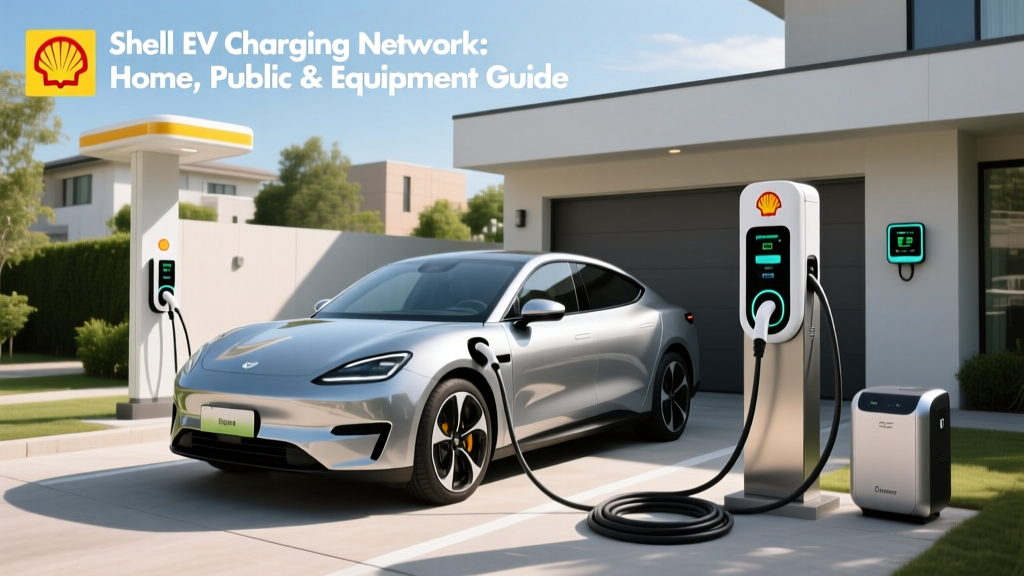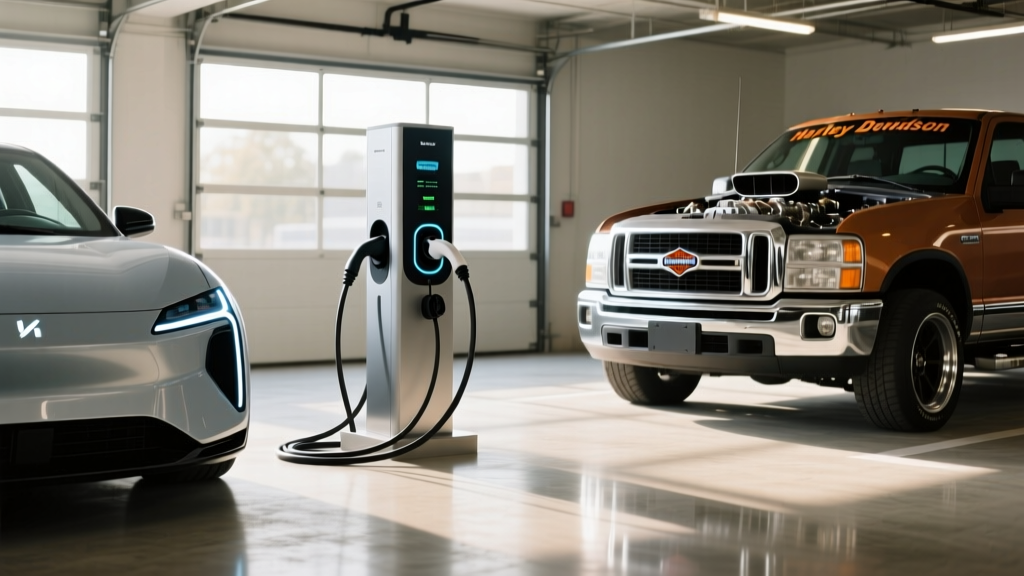
Searches for the 2002 F-150 Harley Davidson Supercharged endure because that 340-hp, Eaton-supercharged 5.4L V-8 represents an era of unapologetic truck performance. It also represents an era of unapologetic fuel bills. If you've cross-shopped that collectible against a modern electric truck or SUV, the most useful comparison isn't 0-60 times — it's what you spend per mile, and what it takes to refuel at home. This guide maps every EV charging tier against the real-world economics of keeping a supercharged V-8 on the road.
Charging Levels Explained: kW, Miles Per Hour, and the kWh Distinction
The single most important literacy point in EV ownership is the difference between kW (kilowatts) and kWh (kilowatt-hours). kW is power — the rate electricity flows, like gallons-per-minute from a hose. kWh is energy — the total amount stored or delivered, like gallons in a tank. A 100 kWh battery charged at 10 kW takes 10 hours in ideal conditions. Confusing them is the #1 source of buyer disappointment.
| Level | Voltage / Amps | Power (kW) | Miles of Range / Hour | Best Use |
|---|---|---|---|---|
| Level 1 (120V) | 120V / 12A | ~1.4 kW | 3-5 mi/hr | Overnight top-up, PHEVs |
| Level 2 (240V) | 240V / 32-48A | 7.7-11.5 kW | 25-44 mi/hr | Daily home charging |
| DC Fast | 400-800V DC | 50-350 kW | 150-1,200 mi/hr (peak) | Road trips, quick stops |
Note that "miles per hour" figures assume ~3-3.5 mi/kWh efficiency (typical for crossovers like the Ioniq 5 or Model Y; large trucks like the F-150 Lightning or Rivian R1T are closer to 2 mi/kWh). A 350-kW Electrify America stall doesn't deliver 350 kW for the full session — the charge curve tapers sharply above ~60-80% state of charge to protect the battery. Expect a 10-80% session on a 350-kW stall to take 18-25 minutes for a modern 77-100 kWh pack, not the theoretical minimum.
How Much Does It Cost to Install a Home EV Charger?
This is the question that blocks more EV purchases than range anxiety. The honest answer: $500 to $2,500 for a straightforward install, and $2,500 to $6,000+ if your electrical panel needs upgrading. Here's the real breakdown, based on 2026 national averages and typical permit fees.
| Item | Simple Install (panel near garage) | Complex Install (long run or panel upgrade) |
|---|---|---|
| Level 2 EVSE hardware (40-48A) | $350 - $700 | $350 - $700 |
| Electrician labor (licensed) | $300 - $800 | $1,200 - $2,500 |
| Conduit, wire (6 AWG copper typical) | $50 - $150 | $200 - $600 |
| Permit & inspection | $50 - $200 | $100 - $300 |
| Panel upgrade (100A → 200A) | N/A | $1,500 - $3,500 |
| Total | $750 - $1,850 | $3,350 - $7,600 |
Homes built before the 1980s — the same era a well-kept 2002 F-150 Harley Davidson Supercharged is just aging out of — often have 100-amp service. A 48-amp EV charger draws 60 amps on the breaker (NEC 125% rule for continuous loads), which may require a NEC-compliant panel upgrade. Always have a licensed electrician perform a load calculation before committing to equipment. Some utilities now offer managed-charging programs or rebates that offset panel-upgrade cost — worth asking before you pull the permit.
Connector Compatibility: NACS, CCS1, and CHAdeMO in 2026
The connector landscape has consolidated dramatically. Tesla's NACS (North American Charging Standard) is now the dominant plug for new vehicles sold in North America, with Ford, GM, Rivian, Volvo, Hyundai/Kia, and most legacy OEMs adopting it starting in the 2025-2026 model years. CCS1 remains common on older VW ID.4, BMW i4, and pre-2025 Hyundai/Kia models. CHAdeMO is effectively legacy (Nissan Leaf, Mitsubishi Outlander PHEV) — still supported at many stations but not being deployed on new hardware.
| Connector | Vehicles Using It | Home Charger Availability |
|---|---|---|
| NACS (Tesla-style) | Tesla, Ford (2025+), GM (2025+), Rivian, Hyundai/Kia (2025+), Volvo, Polestar | Wide — Tesla Wall Connector, ChargePoint, Emporia, Grizzl-E NACS |
| CCS1 | VW ID.4 (pre-2025), BMW i4/iX, older Hyundai/Kia, Chevy Bolt (discontinued) | Wide — ChargePoint Home Flex, Emporia, JuiceBox |
| CHAdeMO | Nissan Leaf, Mitsubishi Outlander PHEV (legacy) | Limited — mostly J1772 Level 2; DC fast stations dwindling |
If you own a CCS-equipped EV but want access to Tesla Superchargers (the most reliable DC network by uptime, per JD Power and PlugShare data), a NACS-to-CCS adapter is required — Tesla, Lectron, and A2Z sell these for roughly $180-$250. Home Level 2 charging uses the J1772 physical standard for non-Tesla vehicles; NACS home chargers typically include a J1772 adapter in the box.
Cost Per Mile: EV Charging vs. the Supercharged 5.4L V-8
This is where the 2002 F-150 Harley Davidson Supercharged comparison becomes concrete. At 12 MPG combined and $3.50/gallon, you're spending roughly $0.29 per mile on gasoline. EV cost per mile depends on where and when you charge — home off-peak electricity is a fraction of public DC fast pricing.
| Scenario | $/kWh | Efficiency (mi/kWh) | $/mile | Annual cost (12,000 mi) |
|---|---|---|---|---|
| Home off-peak (utility rate) | $0.13 | 3.0 | $0.043 | $520 |
| Home on-peak | $0.22 | 3.0 | $0.073 | $880 |
| Public Level 2 (workplace/mall) | $0.30 | 3.0 | $0.100 | $1,200 |
| DC fast (Electrify America/EA) | $0.48 | 3.0 | $0.160 | $1,920 |
| 2002 F-150 Harley SC (12 MPG) | $3.50/gal | 0.408 mi/kWh-eq | $0.292 | $3,500 |
A home-charged EV saves $2,600-$3,000 annually versus the supercharged truck — enough to recoup a Level 2 install in under a year and cover the EV's higher insurance premiums (typically 10-15% above ICE equivalents). Even exclusive DC-fast-charging undercuts gasoline by ~$1,500/year. The caveat: if you lack home charging access, the economics narrow sharply. Apartment dwellers relying on public DC fast charging will see annual costs closer to the Harley's.
Charging Time Examples: 10-80% for Common Battery Sizes
Real-world charging times are longer than peak-kW marketing suggests because the charge curve tapers. Here's what to expect on a 350-kW DC fast charger for 2026-era packs, assuming battery preconditioning is active and ambient temperature is 60-80°F:
- 60 kWh pack (Chevy Bolt-era / base Leaf): 10-80% in ~28-35 min on 50-150 kW; these packs rarely accept 350 kW.
- 77-84 kWh pack (Ioniq 5, Model Y, EV6): 10-80% in ~18-22 min on a 350-kW stall (Ioniq 5/EV6 peak ~240 kW, Model Y peaks ~250 kW but sustains well).
- 100-131 kWh pack (F-150 Lightning Extended, Rivian R1T Max): 10-80% in ~30-42 min; large packs absorb more total energy but still taper above 80%.
- PHEV 15-25 kWh pack: Level 2 (7.7 kW) fully charges in 2-3.5 hours; DC fast charging is rare on PHEVs and typically capped at 50 kW.
For home Level 2 at 11.5 kW (48A on a 60A breaker), expect roughly 8-9 hours for a 77-kWh pack from near-empty — which aligns perfectly with overnight charging and is why Level 2 is the practical standard for daily use.
Equipment Recommendations: 2026 Home Charger Picks
Every charger below is hardwired or NEMA 14-50 plug-in, UL-listed (or ETL-equivalent), and Energy Star certified where applicable. Prices reflect 2026 street pricing; utility rebates may reduce cost by $250-$500 in participating regions.
Tesla Wall Connector (NACS)
- Power: 11.5 kW (48A)
- Connector: NACS native, J1772 adapter included
- Cable: 24 ft
- Smart: Wi-Fi, OTA updates, Power Sharing with 2nd unit, access control
- Price: ~$475
- Best for: Tesla and NACS-equipped Ford/GM/Hyundai owners
ChargePoint Home Flex (J1772 / NACS)
- Power: Up to 12 kW (50A, adjustable down)
- Connector: J1772 standard; NACS pigtail available
- Cable: 23 ft
- Smart: Wi-Fi, app scheduling, Alexa, utility DR programs
- Price: ~$599-$699
- Best for: CCS/J1772 vehicles, utility demand-response enrollment
Emporia Level 2 Smart Charger
- Power: 11.5 kW (48A)
- Connector: J1772 or NACS options
- Cable: 24 ft
- Smart: Wi-Fi, integrates with Emporia Vue energy monitor, solar-aware
- Price: ~$399
- Best for: Solar-home owners, budget-conscious smart charging
Grizzl-E Smart (J1772 / NACS)
- Power: 10 kW (40A) or 11.5 kW (48A)
- Connector: J1772 standard; NACS version available
- Cable: 24 ft
- Smart: OCPP-compatible, works with Home Assistant, no cloud required
- Price: ~$449-$549
- Best for: Cold-climate installs (-40°F rated), privacy-focused users
Safety, Code, and the Panel-Upgrade Gotcha
NEC Article 625 governs EV charging installations. Key requirements that affect your budget and safety:
- Dedicated circuit: A Level 2 EVSE must be on its own breaker — no shared loads (garage outlets, lighting). A 48A charger requires a 60A breaker per the 125% continuous-load rule.
- GFCI protection: 2023 NEC and later require GFCI on 240V receptacles used for EV charging (NEMA 14-50). Hardwired units are generally exempt from GFCI at the breaker, which eliminates nuisance trips — one reason electricians often recommend hardwiring.
- Outdoor rating: If the charger is mounted outside, it must be NEMA 3R or 4 rated. All four picks above are outdoor-rated.
- Wire gauge: 6 AWG copper THHN is standard for 48-50A circuits; long runs (over 100 ft) may require 4 AWG to limit voltage drop to 3%.
- Permit: Most jurisdictions require a permit and inspection. Skipping it risks insurance denial on any electrical fire and code-violation fines at resale.
The panel-upgrade gotcha deserves emphasis: a 100A service with existing heavy loads (electric range, dryer, HVAC) may have zero capacity left for a 60A EV breaker. A licensed electrician will run a load calculation per NEC 220. If you're over 80% utilization, options are (a) panel upgrade to 200A ($1,500-$3,500), (b) a smart load-management device like the Emporia Smart Stack or Span panel that throttles the charger when other loads spike, or (c) downgrading to a 32A (7.7 kW) charger that fits existing capacity.
Frequently Asked Questions
How much does it cost to install a home EV charger?
A straightforward Level 2 install on an existing 200A panel with a short wire run costs $750-$1,850 including hardware, electrician, and permit. Older homes needing a panel upgrade or long conduit runs can spend $3,350-$7,600. Always get a load calculation first.
How fast will each charging level add range?
Level 1 (120V): 3-5 miles per hour. Level 2 (240V, 48A): 25-44 miles per hour depending on vehicle efficiency. DC fast charging: peaks of 150-1,200 miles per hour but sustained only for 10-80% sessions lasting 18-42 minutes depending on pack size.
Which connector/charger is compatible with my EV?
2025-2026 model-year vehicles from Tesla, Ford, GM, Rivian, Hyundai/Kia, Volvo, and Polestar use NACS. Pre-2025 VW, BMW, and older Hyundai/Kia use CCS1. Nissan Leaf and older Mitsubishi use CHAdeMO. For home Level 2, match the EVSE connector to your vehicle or use an adapter.
How much does charging cost per mile vs gas?
Home off-peak charging averages $0.04-$0.05 per mile; public DC fast charging averages $0.15-$0.18 per mile. The 2002 F-150 Harley Davidson Supercharged at 12 MPG and $3.50/gallon costs roughly $0.29 per mile — 6-7× more than home-charged electricity.
What electrical upgrades might I need?
The most common upgrade is a 100A-to-200A panel swap ($1,500-$3,500) if your existing panel lacks capacity for a 60A breaker. Alternatives include smart load-management devices, downgrading to a 32A charger, or adding a dedicated sub-panel. A licensed electrician's load calculation is the first step.
Do I qualify for any charger-installation tax credit?
The federal 30C Alternative Fuel Infrastructure Tax Credit covers 30% of home charger hardware and installation, up to $1,000, but only for equipment placed in service in eligible census tracts (per IRS guidance). Check your census tract and consult a tax professional before relying on the credit.
Sources: EPA fueleconomy.gov for 2002 F-150 SVT Lightning/Harley MPG data; IRS.gov for 30C and 30D credit rules; NEC/NFPA for Article 625 installation requirements. Prices and incentive rules reflect 2026 conditions and are subject to change.