Free Supercharging on the Model 3: What's Actually Included?
Tesla periodically runs promotions where tesla offers free supercharging on new model 3 vehicle purchases, typically structured as a set number of free miles (often 10,000 miles) or a time-limited period (e.g., one year). However, as of early 2026, free Supercharging is not a permanent standard inclusion on new Model 3 vehicles. It appears as a limited-time referral bonus, end-of-quarter incentive, or regional promotion rather than a standing feature.
When Tesla does offer free Supercharging, it usually applies to:
- New Model 3 vehicles ordered and delivered within the promotional window
- Miles credited to the owner's Tesla account (non-transferable to subsequent owners on most post-2017 vehicles)
- Supercharger network usage only — not Destination Chargers or third-party DC fast chargers
Understanding EV Charging Levels: Speed, Power, and Practical Use
Before evaluating any charging promotion, you need to understand the three charging tiers and what they deliver in real-world terms. The critical distinction: kW (kilowatts) measures power — how fast energy flows into the battery. kWh (kilowatt-hours) measures energy — the total capacity of the battery. A 60 kWh battery charged at 11.5 kW takes roughly 5.2 hours from 0–100% (minus taper losses).
| Level | Voltage | Power (kW) | Miles of Range Added per Hour | Best Use Case |
|---|---|---|---|---|
| Level 1 | 120V AC | 1.0–1.4 kW | 3–5 mi/hr | Overnight top-up, PHEVs, low-mileage drivers |
| Level 2 | 240V AC | 7.2–19.2 kW | 25–65 mi/hr | Daily home charging, workplace charging |
| DC Fast Charging | 400–800V DC | 50–350 kW | 150–1,000+ mi/hr (peak) | Road trips, quick top-ups on the go |
For a Tesla Model 3 Long Range (75 kWh usable battery, EPA 363 miles), here's what that looks like in practice:
- Level 1 (120V/12A): ~1.4 kW — adds ~5 miles of range per hour. A 10–80% charge takes roughly 37 hours. Viable only for low-mileage days.
- Level 2 (240V/48A): ~11.5 kW — adds ~44 miles per hour. A 10–80% charge takes roughly 4.5 hours. This is the daily-charging sweet spot.
- DC Fast (Tesla Supercharger V4, 250 kW peak): 10–80% in approximately 25–30 minutes, though the charge curve tapers significantly above 60% SoC. Peak speed is not sustained speed — expect an average of ~150 kW across the session.
How Much Does It Cost to Install a Home EV Charger?
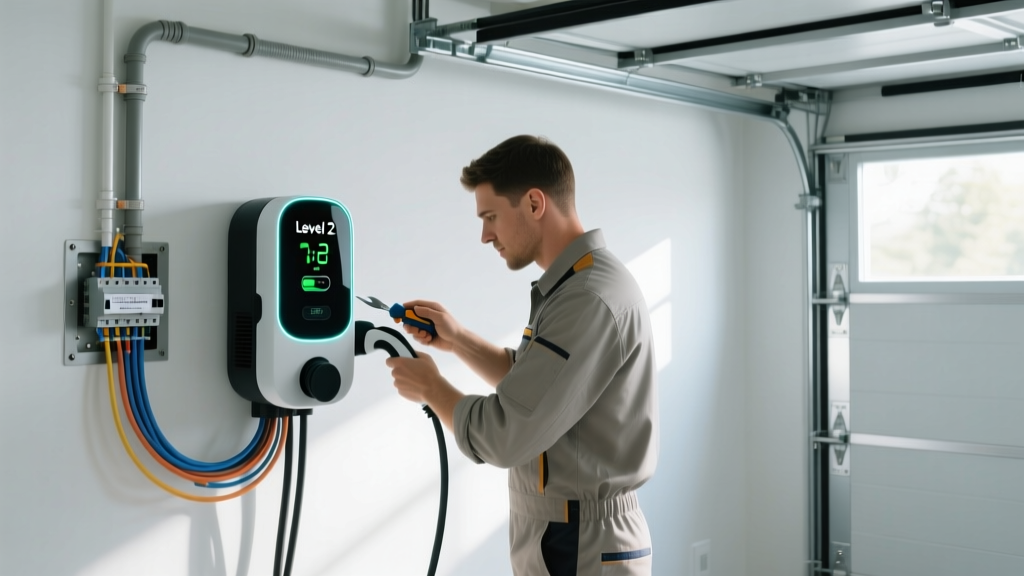
Home Level 2 charging is where the economics of EV ownership truly work. But installation costs vary dramatically based on your home's electrical infrastructure. Here's a realistic breakdown for a 240V/48A hardwired Level 2 charger installation:
| Component | Typical Range | Notes |
|---|---|---|
| Level 2 Charger (Equipment) | $300–$700 | Quality smart chargers (ChargePoint, Emporia, Wallbox) |
| Electrician Labor | $400–$1,500 | Depends on run length from panel to garage/driveway |
| Electrical Permit | $50–$200 | Required in most jurisdictions; varies by locality |
| Panel Upgrade (if needed) | $1,500–$3,500 | Required if existing panel is 100A or lacks spare breaker slots |
| Conduit/Wire/Misc Materials | $100–$400 | Longer runs from panel increase material costs |
| Total (No Panel Upgrade) | $850–$2,800 | Most homes with 200A service and nearby panel |
| Total (With Panel Upgrade) | $2,350–$6,300 | Homes with older 100A service or full panels |
The panel-upgrade gotcha: Many homes built before 2000 have 100-amp or 150-amp electrical panels. A 48A EV charger draws roughly 11.5 kW continuously, which requires a 60A dedicated breaker (NEC requires circuits rated at 125% of continuous load). If your panel is near capacity, an upgrade to 200A service is mandatory — and this is the single biggest cost variable. Always get a licensed electrician's load calculation before committing.
The federal Residential Clean Energy Credit (IRS §25D) does not cover EV chargers as of 2026. The separate Alternative Fuel Vehicle Refueling Property Credit (§30C) offers up to $1,000 for home charger equipment and installation, but it is subject to census-tract eligibility restrictions. Check the IRS §30C page and consult a tax professional to confirm eligibility.
Connector Compatibility: NACS, CCS1, CHAdeMO, and Adapters
The North American charging connector landscape has consolidated significantly. Tesla's NACS (North American Charging Standard) connector is now the dominant standard, with Ford, GM, Rivian, Hyundai, Kia, BMW, and most major automakers adopting it for 2025+ models.
| Connector | Brands Using It | Notes |
|---|---|---|
| NACS (Tesla) | Tesla, Ford, GM, Rivian, Hyundai, Kia, BMW, Volvo, Mercedes-Benz, Honda (new EVs) | Native on Tesla; adapter or native port on others |
| CCS1 | Legacy VW ID.4 (pre-2026), some older BMW/Stellantis EVs | Requires NACS-to-CCS adapter for Supercharger access |
| CHAdeMO | Nissan Leaf (discontinued), Mitsubishi Outlander PHEV (legacy) | Limited DC fast-charging network support |
For Tesla Model 3 owners: Your vehicle uses the native NACS connector. You have direct access to Tesla's Supercharger network (17,000+ stalls in North America) without any adapter. For non-Tesla Level 2 chargers at home or work, the Model 3 includes a J1772 adapter in the glovebox — all Level 2 public and home chargers use J1772 or have a NACS cable.
For non-Tesla EV owners: If your vehicle has a CCS1 port (common on 2022–2024 models), you'll need a NACS-to-CCS adapter ($150–$250) to access Tesla Superchargers. Ford and GM provide these adapters to owners. Newer 2025+ models from these brands ship with native NACS ports.
How Much Does Charging Cost Per Mile vs. Gas?
Charging cost is where the Model 3's economics become compelling — even without free Supercharging. The Model 3 Long Range achieves approximately 132 MPGe combined (source: EPA fueleconomy.gov), consuming roughly 25 kWh per 100 miles.
| Scenario | Cost per kWh / Gallon | Cost per Mile (Model 3) | Cost per Mile (30 MPG Gas Sedan @ $3.40/gal) |
|---|---|---|---|
| Home Level 2 (national avg. residential) | $0.16/kWh | $0.040 | $0.113 |
| Home Level 2 (off-peak TOU rate) | $0.09/kWh | $0.023 | $0.113 |
| Home Level 2 (peak TOU rate) | $0.28/kWh | $0.070 | $0.113 |
| Tesla Supercharger (avg. 2026) | $0.35/kWh | $0.088 | $0.113 |
| Electrify America / EVgo (avg.) | $0.42/kWh | $0.105 | $0.113 |
Even at average Supercharger pricing, the Model 3 costs less per mile than a 30 MPG gas sedan. At home off-peak rates, it's roughly 80% cheaper per mile. Over 15,000 annual miles, home charging at $0.16/kWh saves approximately $1,095/year compared to gas at $3.40/gallon.
Free Supercharging promotions amplify this savings on road trips. A 10,000-mile free Supercharging credit saves roughly $880 at current Supercharger rates — a meaningful bonus, but not the primary economic driver of EV ownership.
Recommended Home Level 2 Chargers for 2026
If you're buying a Model 3 (or any NACS-equipped EV), here are the chargers worth considering. All recommendations below are NACS-native or available with NACS connectors:
Tesla Wall Connector
- Power Output: Up to 11.5 kW (48A) at 240V
- Connector: Native NACS (no adapter needed)
- Cable Length: 24 ft
- Smart Features: Wi-Fi, OTA updates, power sharing between units, Tesla app integration
- Price: ~$475
- Best For: Tesla-only households; cleanest integration
ChargePoint Home Flex (NACS)
- Power Output: Up to 12 kW (50A) at 240V
- Connector: Available with NACS plug
- Cable Length: 23 ft
- Smart Features: Wi-Fi, Alexa integration, scheduling, energy tracking, works with all EVs
- Price: ~$599
- Best For: Mixed-EV households; excellent app experience
Emporia Vue Level 2 Charger
- Power Output: Up to 11.5 kW (48A) at 240V
- Connector: NACS and J1772 versions available
- Cable Length: 24 ft
- Smart Features: Wi-Fi, solar integration, whole-home energy monitoring, load management
- Price: ~$399
- Best For: Budget-conscious buyers; solar-panel owners
Wallbox Pulsar Plus (NACS)
- Power Output: Up to 11.5 kW (48A) at 240V
- Connector: NACS available
- Cable Length: 25 ft
- Smart Features: Wi-Fi + Bluetooth, Eco-Smart (solar matching), compact form factor
- Price: ~$549
- Best For: Tight garage spaces; solar integration
Installation note: All 48A chargers require a dedicated 60A breaker. If your panel doesn't have capacity, consider a 32A charger (7.7 kW) on a 40A breaker — it still adds ~30 miles of range per hour and avoids a panel upgrade in many homes.
Safety, Electrical Code, and Installation Requirements
EV charging is a continuous high-load electrical application. Cutting corners here creates fire risk. Key requirements:
- Dedicated circuit: Your EV charger must be on its own dedicated breaker — never shared with other appliances. A 48A charger requires a 60A breaker per NEC 210.20(A) continuous-load rules.
- GFCI protection: NEC 2020 and later require GFCI protection for outdoor receptacles used for EV charging. Hardwired installations (recommended for 48A+) avoid the nuisance-tripping issues common with GFCI breakers on high-draw EV circuits.
- Outdoor rating: If your charger is installed outdoors, it must be NEMA 4 rated (weatherproof). All chargers listed above carry outdoor ratings.
- Wire gauge: 48A continuous load requires 4 AWG copper wire (or 2 AWG aluminum) for runs up to ~100 feet. Longer runs may require upsizing to prevent voltage drop.
- Permit and inspection: Most jurisdictions require an electrical permit for EV charger installations. The inspection ensures code compliance and is often required for insurance coverage and §30C tax credit claims.
Frequently Asked Questions
Does the Tesla Model 3 come with free Supercharging in 2026?
Not as a standard feature. Tesla occasionally offers limited-time free Supercharging promotions — typically 10,000 miles or one year — on new Model 3 orders during specific promotional periods. These are not guaranteed and change frequently. Check Tesla's current offers or your purchase agreement for specifics. The vehicle does come with a NACS connector for seamless Supercharger access (paid per kWh).
How much does it cost to install a home EV charger?
A typical Level 2 home charger installation costs $850–$2,800 if your electrical panel has adequate capacity. If a panel upgrade from 100A to 200A is needed, total costs range from $2,350–$6,300. Equipment itself (the charger) costs $300–$700. Always get a licensed electrician's load calculation first.
How fast will each charging level add range to my Model 3?
Level 1 (120V) adds ~5 miles per hour. Level 2 (240V/48A) adds ~44 miles per hour. DC fast charging at a Tesla Supercharger (250 kW peak) can add up to 175 miles in 15 minutes, though the charge curve tapers significantly above 60% SoC. For daily use, Level 2 home charging is the most practical and cost-effective option.
Which connector and charger is compatible with my Tesla Model 3?
The Model 3 uses the native NACS connector for DC fast charging and Level 2 charging. For home installation, the Tesla Wall Connector (NACS, $475) provides the simplest integration. Third-party chargers like the ChargePoint Home Flex and Emporia Vue are available with NACS connectors and offer broader smart-home compatibility. The Model 3 also includes a J1772 adapter for use with older public Level 2 stations.
How much does charging cost per mile compared to gas?
At the national average residential electricity rate of $0.16/kWh, a Model 3 Long Range costs approximately $0.04 per mile to charge at home. A comparable 30 MPG gas sedan at $3.40/gallon costs $0.113 per mile. Even at Supercharger rates (~$0.35/kWh), the Model 3 costs ~$0.088/mile — still less than gas. Off-peak home charging can drop the cost to under $0.025/mile.
What electrical upgrades might I need for a home charger?
The most common and costly upgrade is a panel upgrade from 100A to 200A service ($1,500–$3,500), required when your existing panel lacks capacity for a 60A dedicated breaker. Other potential needs include: replacing a Federal Pacific or Zinsco panel (known fire hazards, $2,000–$4,000), running new conduit for long wire runs, or upgrading the meter base. A licensed electrician's load calculation will determine your specific requirements before any work begins.