What You Actually Pay to Charge an EV
The sticker on a DC fast charger reads $0.48/kWh. Your home utility bill says $0.13/kWh. The gas station across the street charges $3.40 per gallon. Which one saves you money — and by how much? The answer depends on where you plug in, what you drive, and how your local utility structures its rates.
This guide breaks down the real charging costs for electric cars across every scenario a US-based EV owner will face: overnight home charging on a Level 2 circuit, public Level 2 top-ups at workplaces and shopping centers, and DC fast charging on road trips. We'll also cover what it costs to install a home charger (including the panel upgrade most older homes need) and which equipment actually delivers on its promises.
Before we get into dollars, let's lock down one critical distinction that trips up new EV owners: kW (kilowatts) measures power — how fast energy flows into your battery. kWh (kilowatt-hours) measures energy — the total amount stored. You pay per kWh consumed, and your charger's kW rating determines how quickly you accumulate those kWh. Think of kW as the flow rate of a hose and kWh as the total gallons in the bucket.
Charging Levels Explained: Speed, Power, and Range Added
Every EV sold in the US charges at one of three levels. The speed gap between them is enormous — and it directly shapes your ownership experience and your wallet.
| Level | Voltage | Power (kW) | Miles of Range Added per Hour | Typical Use Case |
|---|---|---|---|---|
| Level 1 | 120V AC | 1.0–1.4 kW | 3–5 mi/hr | Emergency / overnight trickle for PHEVs |
| Level 2 | 240V AC | 3.3–19.2 kW | 12–75 mi/hr | Home daily charging, workplace, public destinations |
| DC Fast Charge | 200–900V DC | 50–350 kW | 150–1,000+ mi/hr (peak) | Road trips, highway corridors, quick top-ups |
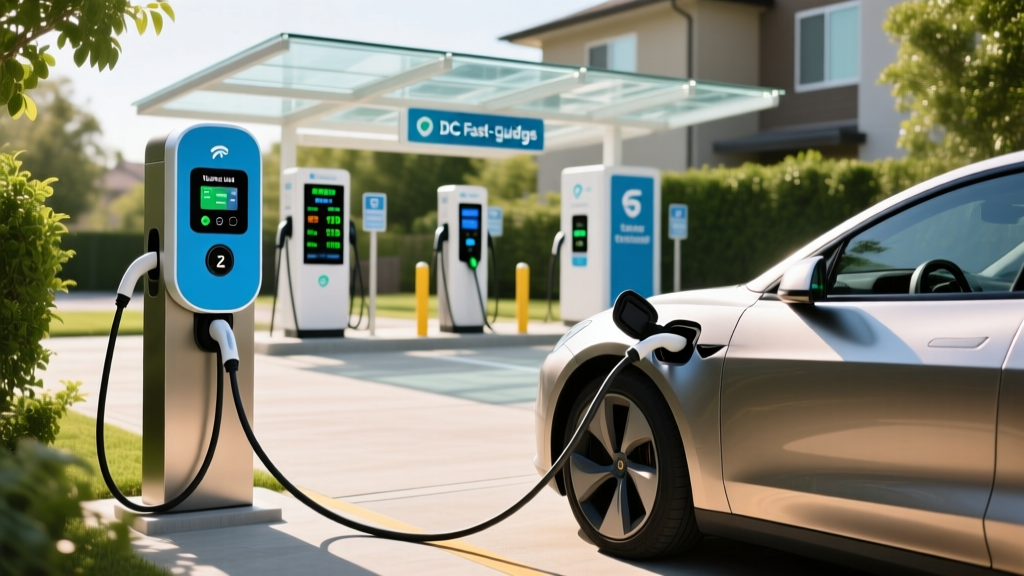
A few real-world numbers make this concrete. A Tesla Model Y (75 kWh usable battery, ~310 miles EPA range) charging on a 48-amp (11.5 kW) Level 2 home charger adds roughly 44 miles of range per hour — enough to fully replenish a daily commute in under two hours. That same Model Y on a 250 kW Supercharger peaks at roughly 250 kW for the first few minutes, then tapers, averaging around 100–130 kW across a 10–80% session that takes approximately 22–27 minutes.
The taper is unavoidable physics: as the battery's state of charge (SoC) rises, the battery management system (BMS) reduces charge rate to protect cell health. Charging from 80–100% on DC fast charging can take as long as the 10–80% portion. This is why most EV owners target 80% at DC fast chargers and finish the last 20% at home overnight.
How Much Does It Cost to Charge an Electric Car?
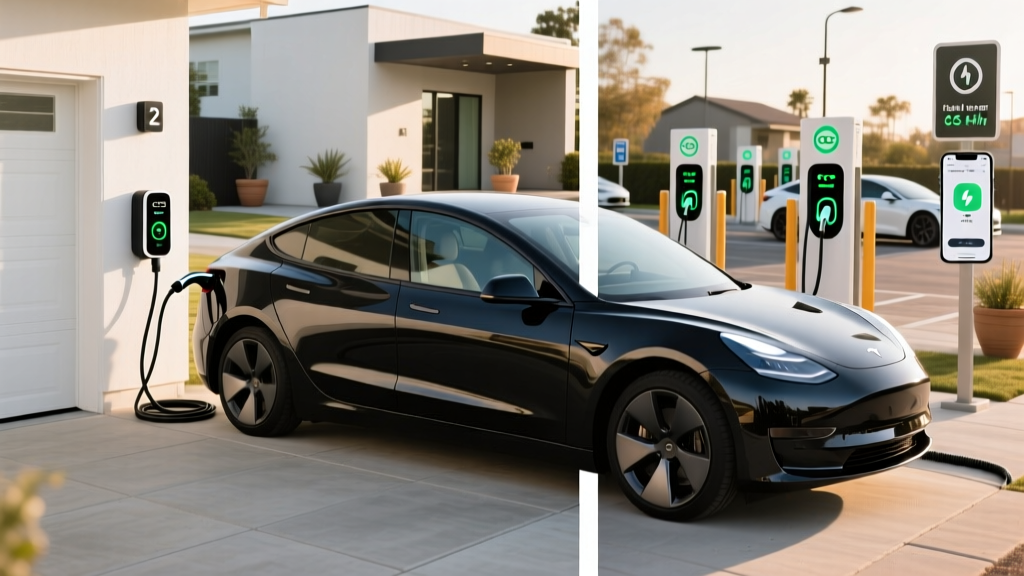
Charging costs for electric cars vary by a factor of 4x or more depending on where you plug in. Here's what US EV owners actually pay in 2026, based on utility rate data and public network pricing.
| Scenario | Typical $/kWh | Cost to Add 200 Miles* | Cost per Mile |
|---|---|---|---|
| Home Level 2 (national avg residential rate) | $0.13–$0.16 | $7.80–$9.60 | $0.039–$0.048 |
| Home Level 2 (off-peak TOU rate) | $0.06–$0.10 | $3.60–$6.00 | $0.018–$0.030 |
| Public Level 2 (workplace, retail) | $0.20–$0.35 | $12.00–$21.00 | $0.060–$0.105 |
| DC Fast Charging (Electrify America, EVgo, Tesla) | $0.35–$0.58 | $21.00–$34.80 | $0.105–$0.174 |
| Gas car (28 MPG combined, $3.40/gal) | — | $24.29 | $0.121 |
*Based on a vehicle consuming 30 kWh per 100 miles (roughly 3.3 mi/kWh), typical of a midsize crossover EV like the Hyundai Ioniq 5 or Ford Mustang Mach-E.
The takeaway: home charging on an off-peak time-of-use (TOU) plan is the cheapest way to fuel any vehicle on the road — roughly a quarter of the per-mile cost of gasoline. Public DC fast charging, however, can exceed the cost of gas on a per-mile basis. This isn't a flaw in EVs; it's the convenience premium of highway fast charging, analogous to buying coffee at an airport versus brewing it at home.
Real-World Charging Session Costs
Let's price out specific sessions for common EVs:
- Tesla Model 3 (57.5 kWh usable, ~341 mi EPA): A 10–80% home charge uses ~40 kWh. At $0.14/kWh, that's $5.60 for ~240 miles of range. At a $0.48/kWh DC fast charger: $19.20.
- Ford F-150 Lightning Extended Range (131 kWh usable, ~320 mi EPA): A 10–80% session uses ~92 kWh. At home ($0.14/kWh): $12.88. At a DC fast charger ($0.48/kWh): $44.16.
- Chevrolet Equinox EV (85 kWh usable, ~315 mi EPA): A 10–80% session uses ~60 kWh. At home: $8.40. DC fast: $28.80.
According to fueleconomy.gov, the most efficient EVs in 2026 (like the Tesla Model 3 and Hyundai Ioniq 6) achieve 130+ MPGe, which translates to roughly $500–$600 per year in electricity costs for 15,000 miles of driving on average residential rates. A comparable gas car at 30 MPG and $3.40/gallon costs about $1,700 annually.
How Much Does It Cost to Install a Home EV Charger?
The total cost to install a Level 2 home charger ranges from roughly $800 on the very low end (simple setup, short wire run, existing panel capacity) to $4,500+ for homes needing a panel upgrade. Most homeowners fall in the $1,200–$2,800 range.
| Component | Low End | Typical | High End | Notes |
|---|---|---|---|---|
| Level 2 charger (hardware) | $250 | $400–$600 | $700–$900 | 32A–48A smart chargers; see equipment picks below |
| Electrical permit | $50 | $100–$200 | $350 | Required in most US jurisdictions; varies by city/county |
| Electrician labor (install on existing 200A panel) | $400 | $600–$1,200 | $1,800 | Depends on wire run distance, conduit, drywall work |
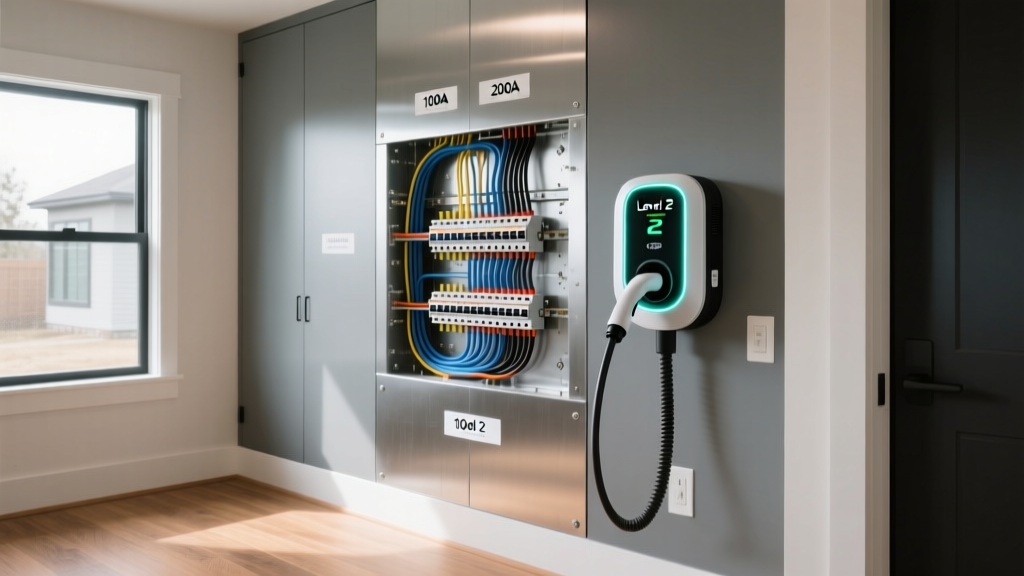
| Panel upgrade (100A → 200A service) | — | $1,500–$3,000 | $4,000+ | Needed if existing panel lacks capacity; common in pre-1990 homes |
| Total (no panel upgrade) | $700 | $1,100–$2,000 | $2,950 | |
| Total (with panel upgrade) | $2,200 | $2,600–$5,000 | $7,000+ |
What Determines Your Installation Cost
Three factors dominate the quote you'll receive from a licensed electrician:
- Wire run distance: The farther your electrical panel is from the charger location (garage or exterior wall), the more copper wire and conduit are needed. A panel in the garage next to the parking spot might cost $500 in labor; a panel in the basement feeding a charger on the outside of a two-story house can push past $1,500.
- Panel capacity: A 48-amp charger draws 60 amps of circuit capacity (NEC code requires circuits rated at 125% of continuous load). If your panel is 200 amps and already near capacity with HVAC, an electric range, and a dryer, you may need a panel upgrade or a load management device that throttles the charger when other high-draw appliances are running.
- Local code requirements: Some jurisdictions now require GFCI breakers on EV circuits (adds $50–$150), exterior-rated conduit for outdoor runs, or dedicated subpanels for garages. Your electrician will pull the permit and handle inspection.
A critical note: never install a charger without a permit and inspection. Unpermitted electrical work can void your homeowner's insurance, cause fire hazards, and create problems at resale. The National Electrical Code (NEC) Article 625 governs EV charging equipment installation, and local inspectors enforce it.
Electrical Requirements: What Your Home Needs
Most EV owners install a 240-volt, 48-amp Level 2 charger on a dedicated 60-amp circuit. Here's why those numbers matter:
- 240V is the same voltage as your electric dryer or oven — it delivers power far more efficiently than a standard 120V outlet.
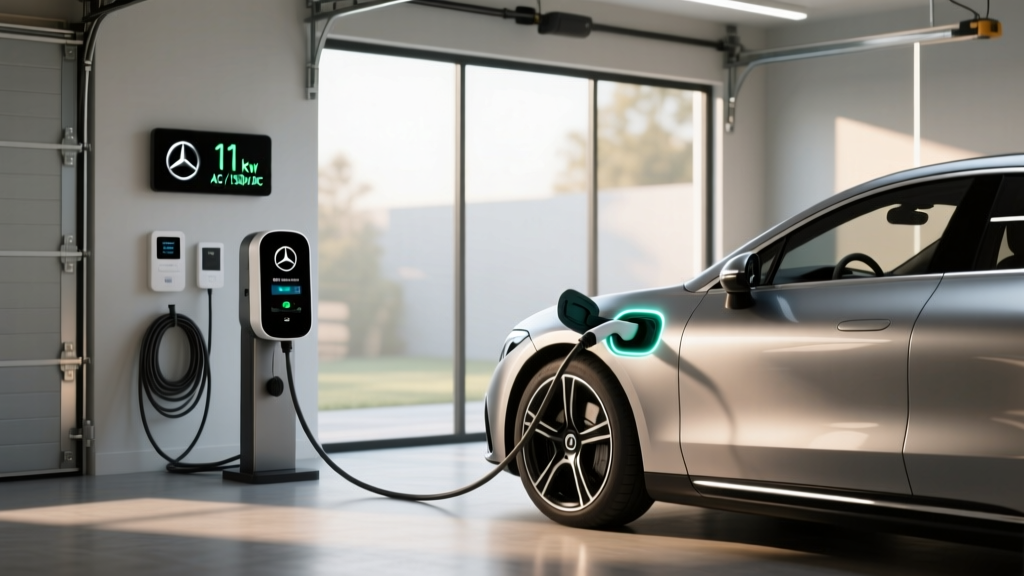
- 48 amps of continuous draw provides up to 11.5 kW of power (240V × 48A = 11,520W). This adds roughly 40–44 miles of range per hour to most EVs.
- 60-amp circuit is required because the NEC mandates that continuous loads (anything running 3+ hours, which includes EV charging) cannot exceed 80% of the circuit breaker rating. So a 48A charger needs a 60A breaker.
Do You Need a Panel Upgrade?
If your home has a 200-amp main panel and you're adding a 60-amp EV circuit, your electrician will perform a load calculation per NEC Article 220. This adds up all existing circuits and determines whether there's headroom. Homes with gas appliances (furnace, water heater, range) typically have ample capacity. All-electric homes with older 150A or 100A panels are more likely to need an upgrade.
A load-management device (like the Emporia V2 with smart load balancing or a Tesla Wall Connector paired with a Powerwall) can sometimes avoid a panel upgrade by dynamically reducing charger amperage when the house is drawing heavily. These systems cost $100–$300 extra but can save thousands on a panel replacement.
Connector Compatibility: Which Plug Does Your EV Use?
The connector landscape in 2026 has simplified considerably since the industry-wide shift to NACS (North American Charging Standard), but you still need to know what's on your car.
| Connector | Description | Brands Using It (2026) | Adapter Needed? |
|---|---|---|---|
| NACS (Tesla / J3400) | Compact, no locking pins; used for AC Level 2 and DC fast charging | Tesla (all), Ford, GM, Rivian, Volvo, Polestar, BMW, Mercedes, Hyundai, Kia, Subaru, Lucid, Fisker | Most new EVs ship native NACS. Older CCS vehicles need a CCS-to-NACS adapter ($200–$300) for Supercharger access. |
| CCS1 (Combined Charging System) | Bulkier, locking pins; being phased out for new models | Remaining 2023–2025 model-year vehicles still on the road; VW ID.4 (through 2025 MY) | CCS-to-NACS adapter required for Tesla Supercharger access; native CCS still available at Electrify America and some EVgo stations. |
| CHAdeMO | Legacy DC fast standard; no new vehicles since ~2022 | Nissan Leaf (discontinued 2025), Mitsubishi Outlander PHEV (older model years) | CHAdeMO stations are declining; no adapter to NACS exists for DC charging. |
If you're buying a 2026 model-year EV, it will almost certainly have a NACS port. If you own a 2023–2025 CCS-equipped vehicle, you'll want a CCS-to-NACS adapter to access the Tesla Supercharger network — which, as of 2026, includes over 30,000 stalls across the US and is open to non-Tesla vehicles via the Tesla app.
Home Charger Equipment: What to Buy
Not all Level 2 chargers are equal. Here are four well-regarded options for 2026, chosen for reliability, smart features, and real-world performance.
ChargePoint Home Flex
- Power output: Up to 12 kW (50 amps) on a 60A circuit; configurable down to 16A for smaller circuits
- Connector: NACS (2026 model); CCS1 available for older vehicles
- Cable length: 23 feet
- Smart features: Wi-Fi, app scheduling, Alexa integration, energy tracking, TOU rate optimization
- Price: ~$550–$650
- Best for: Flexible amperage settings for homes with limited panel capacity
Emporia Level 2 Smart EV Charger
- Power output: Up to 11.5 kW (48 amps) on a 60A circuit
- Connector: NACS (J3400)
- Cable length: 24 feet
- Smart features: Integrated with Emporia Vue energy monitor, solar-aware charging, TOU scheduling, load management
- Price: ~$350–$450
- Best for: Budget-conscious buyers who want energy monitoring and solar integration
Tesla Wall Connector
- Power output: Up to 11.5 kW (48 amps) on a 60A circuit
- Connector: NACS (native Tesla plug)
- Cable length: 24 feet
- Smart features: Wi-Fi, OTA updates, power sharing (link up to 6 units on one circuit), access control
- Price: ~$420–$475
- Best for: Tesla owners and households with multiple EVs (power-sharing feature)
Grizzl-E Smart
- Power output: Up to 10 kW (40 amps) on a 50A circuit
- Connector: NACS (J3400); also available with J1772
- Cable length: 24 feet
- Smart features: OCPP-compatible, app scheduling, works with most utility demand-response programs
- Price: ~$450–$550
- Best for: Cold-climate durability (rated to -40°F) and utility demand-response participation
One often-overlooked spec: cable length. A 23–24 foot cable gives you flexibility to reach a charge port on either side of the vehicle, regardless of how you park. Chargers with 18-foot cables can leave you short if your charge port is on the far side from the wall unit.
Safety and Code Considerations
EV charging draws high current for many hours — often 6 to 10 hours overnight. That's a sustained electrical load unlike anything else in your home. Here's what to get right:
- Dedicated circuit: Your Level 2 charger must be on its own dedicated circuit — no sharing with other outlets or appliances. This is a NEC requirement, not a recommendation.
- GFCI protection: NEC 2023 (and adopted in most 2026 jurisdictions) requires GFCI (ground-fault circuit interrupter) protection on EV charging circuits. Some chargers have built-in GFCI; if not, your electrician will install a GFCI breaker ($50–$150 more than a standard breaker).
- Outdoor rating: If your charger is mounted outside or in an open carport, both the unit and the receptacle (if hardwired is not used) must carry a NEMA 3R or NEMA 4 outdoor rating. All four chargers listed above meet this standard.
- Hardwired vs plug: Hardwired installations (no plug; wires go directly into the unit) are generally preferred for 48A+ chargers because they eliminate the NEMA 14-50 receptacle as a potential failure point. Some utilities and jurisdictions now require hardwired connections for circuits over 40 amps. The NEMA 14-50 plug offers portability — you can take the charger when you move — but it introduces a connection that can loosen over time with thermal cycling.
- Wire gauge: A 60-amp circuit requires 6 AWG copper wire (THHN in conduit) or 4 AWG if using NM-B (Romex) cable per NEC 310. Your electrician will specify the correct gauge for your installation.
Charging Time Examples: How Long Does It Actually Take?
Charge time depends on battery size, charger power, and the vehicle's onboard charger limit. Here are 10–80% times for common scenarios:
| Vehicle (Battery Size) | Level 2 at 11.5 kW (48A Home) | DC Fast at 150 kW | DC Fast at 250 kW | DC Fast at 350 kW |
|---|---|---|---|---|
| Tesla Model 3 LR (75 kWh) | ~4.5 hours | ~30 min | ~22 min | N/A (vehicle max ~250 kW) |
| Hyundai Ioniq 5 (77.4 kWh) | ~4.8 hours | ~28 min | ~18 min | ~18 min (800V architecture) |
| Ford F-150 Lightning ER (131 kWh) | ~8.0 hours | ~52 min | ~41 min | N/A (vehicle max ~155 kW) |
| Chevrolet Equinox EV (85 kWh) | ~5.3 hours | ~33 min | ~25 min | N/A (vehicle max ~150 kW) |
Two critical caveats: First, the vehicle's onboard charger limits AC Level 2 speed. The F-150 Lightning's onboard charger maxes at 19.2 kW (80A), but most EVs cap at 11.5 kW (48A) — meaning a 19.2 kW home charger won't help a car limited to 11.5 kW. Second, DC fast charging speeds depend on the vehicle's peak charge rate and its charge curve. The Ioniq 5's 800-volt architecture sustains high charge rates longer than a 400V system, which is why it hits 10–80% faster on a 350 kW charger even though its battery is smaller than the Lightning's.
FAQ: Charging Costs for Electric Cars
Is charging an EV really cheaper than gas?
Yes, if you charge at home. At the US average residential electricity rate of ~$0.16/kWh and a vehicle efficiency of 3.3 mi/kWh, you pay roughly $0.048 per mile — about 60% less than a 28 MPG gas car at $3.40/gallon ($0.121/mile). On an off-peak TOU rate of $0.08/kWh, the cost drops to $0.024/mile, an 80% savings. However, exclusive reliance on DC fast charging at $0.48+/kWh can push per-mile costs above gas. Home charging access is the single biggest factor in EV operating cost.
How much does it cost to install a home EV charger?
Expect $1,100–$2,000 for a typical installation on an existing 200A panel (charger hardware + electrician labor + permit). If your home needs a panel upgrade from 100A to 200A, add $1,500–$3,000+, bringing the total to $2,600–$5,000. Get at least three quotes from licensed electricians, and confirm they pull a permit and schedule an inspection.
Should I charge to 100% every night?
No, unless you have an LFP (lithium iron phosphate) battery. NMC/NCA batteries (used in most long-range EVs) last longest when kept between 20–80% daily. Set your car's charge limit to 80% for daily use and only charge to 100% before a long road trip. LFP batteries (found in the base Tesla Model 3 RWD and some other models) are designed for regular 100% charging — check your owner's manual.
Do public charging networks require subscriptions?
Most networks (Electrify America, EVgo, ChargePoint) offer both pay-as-you-go and subscription plans. Subscriptions typically cost $4–$7/month and reduce the per-kWh rate by 15–25%. If you DC fast charge more than twice a month, the subscription usually pays for itself. Tesla Superchargers require no subscription — you pay through your Tesla account or the app for non-Tesla vehicles.
Can I use a regular 120V outlet to charge my EV?
Yes, but slowly. Level 1 charging at 120V/12A delivers about 1.4 kW, adding roughly 3–5 miles of range per hour. A full charge from 10–80% on a 75 kWh battery would take over 35 hours. Level 1 is practical for PHEVs with small batteries (10–20 kWh) or as an emergency backup for BEVs, but it won't keep up with daily driving of more than 30–40 miles.
For the most current utility rate data in your area, check the US Energy Information Administration's state electricity profiles. For EV efficiency ratings and MPGe data across all models, fueleconomy.gov remains the authoritative source. And if you're evaluating whether a home charger installation qualifies for the Alternative Fuel Vehicle Refueling Property Credit (IRS Form 8911) — up to $1,000 for residential charging equipment — consult a tax professional, as eligibility depends on census tract and income requirements.