Getting the wiring right for a home EV charger is the single most important factor in daily electric vehicle ownership. A properly installed Level 2 home charger delivers 20–40 miles of range per hour of charging, turning overnight downtime into a full battery every morning. But the EV charger wiring process involves decisions about circuit capacity, panel headroom, conduit runs, and equipment selection that directly affect both safety and charging performance.
This guide breaks down the electrical requirements, realistic installation costs, equipment options, and connector compatibility you need to wire a home EV charger correctly in 2026.
Understanding EV Charging Levels and Wiring Requirements
Every EV owner interacts with three charging tiers. The wiring and electrical demands differ substantially between them.
| Level | Voltage | Power (kW) | Miles of Range Per Hour | Typical Wiring |
|---|---|---|---|---|
| Level 1 | 120V AC | 1.0–1.4 kW | 3–5 mi/hr | Standard 15A/20A household outlet (NEMA 5-15/5-20) |
| Level 2 | 240V AC | 3.3–19.2 kW | 12–70+ mi/hr | Dedicated 240V circuit, 20A–80A breaker, hardwired or NEMA 14-50/6-50 receptacle |
| DC Fast Charging | 400–900V DC | 50–350+ kW | 150–1,000+ mi/hr (peak) | Commercial-grade 480V three-phase service; not applicable to residential wiring |
Key distinction: kW (kilowatts) measures power — the rate of energy flow, like water pressure in a hose. kWh (kilowatt-hours) measures energy — the total amount stored in your battery, like gallons in a tank. A 75 kWh battery charged at 7.7 kW takes roughly 10 hours from empty to full (minus charging losses). Understanding this difference is essential when evaluating charger specs and your home's electrical capacity.
Electrical Requirements for Home EV Charger Wiring
Most home EV charger installations use a 240-volt, 40-amp or 48-amp dedicated circuit. This supports 7.7 kW to 11.5 kW of continuous charging power — enough to fully replenish a 60–100 kWh battery overnight.
Circuit Sizing and the 80% Rule
The National Electrical Code (NEC) requires that continuous loads — anything drawing power for 3+ hours, which includes EV charging — use no more than 80% of a circuit breaker's rated capacity. This means:
- A 40-amp breaker supports up to 32 amps continuous (7.7 kW at 240V)
- A 50-amp breaker supports up to 40 amps continuous (9.6 kW at 240V)
- A 60-amp breaker supports up to 48 amps continuous (11.5 kW at 240V)
Wire gauge must match the breaker: 8 AWG copper for 40A circuits, 6 AWG for 50A, and 4 AWG for 60A runs. Longer conduit runs may require upsizing to account for voltage drop.
Does Your Electrical Panel Have Enough Capacity?
This is where many installations get complicated. Your main service panel has a total amperage rating — typically 100A, 150A, or 200A in residential homes. Adding a 40–60A EV circuit to an older 100A panel that's already near capacity can trip the main breaker or create a fire hazard.
A licensed electrician will perform a load calculation per NEC Article 220, summing your existing circuits and anticipated loads. If your panel lacks headroom, options include:
- Panel upgrade (100A → 200A): $1,500–$3,500, common in pre-1990 homes
- Sub-panel installation: $800–$1,500, useful if the EV charger is far from the main panel (e.g., detached garage)
- Smart load management: devices like the Emporia Smart EV Charger or Sense Energy Monitor dynamically throttle EV charging when household demand spikes, potentially avoiding a panel upgrade
- Lower-amperage circuit: A 20A/240V circuit (3.8 kW) may suffice for PHEV owners or low-mileage commuters, requiring minimal panel headroom
How Much Does EV Charger Wiring and Installation Cost?
Installation costs vary dramatically based on your home's age, panel capacity, and the distance between your panel and the charger location. Here's a realistic breakdown for a typical Level 2 home installation in 2026:
| Component | Simple Install (Near Panel) | Standard Install | Complex Install (Panel Upgrade) |
|---|---|---|---|
| Level 2 EVSE Equipment | $350–$700 | $350–$700 | $350–$700 |
| Electrician Labor | $300–$600 | $600–$1,200 | $1,200–$2,000 |
| Materials (Wire, Conduit, Breaker) | $100–$250 | $250–$600 | $400–$800 |
| Permit & Inspection | $50–$150 | $100–$250 | $150–$300 |
| Panel Upgrade (if needed) | — | — | $1,500–$3,500 |
| Total Estimated Cost | $800–$1,700 | $1,300–$2,750 | $3,600–$7,300 |
Utility rebates can help. Many utilities offer $250–$1,000 rebates for Level 2 charger installation, and some cover panel upgrade costs partially. Check your local utility's EV program before scheduling work. Additionally, the federal Residential Clean Energy Credit (IRS Form 5695) may cover 30% of charger equipment and installation costs up to $1,000 — though eligibility depends on your location and tax situation. Consult a tax professional for your specific case.
Charging Time Examples: How Long Does Each Level Take?
Charging time depends on your battery's usable capacity (in kWh) and the charger's sustained power output (in kW). Here are realistic estimates for common EV battery sizes, accounting for ~90% charging efficiency and the charge-curve taper that slows speeds above 80% state of charge:
| Battery Size (Usable kWh) | Example Vehicles | Level 1 (1.4 kW) | Level 2 (7.7 kW / 32A) | Level 2 (11.5 kW / 48A) | DC Fast 10–80% |
|---|---|---|---|---|---|
| 15–20 kWh | PHEVs (RAV4 Prime, Wrangler 4xe) | 11–14 hours | 2–3 hours | 1.5–2 hours | N/A (most PHEVs lack DCFC) |
| 58–62 kWh | VW ID.4, Hyundai Ioniq 5 (Std Range) | 42–44 hours | 8–9 hours | 5.5–6.5 hours | ~18–24 min (at 150+ kW) |
| 75–82 kWh | Tesla Model Y LR, Ford Mustang Mach-E ER | 54–59 hours | 10–12 hours | 7–8 hours | ~20–28 min (at 150–250 kW) |
| 90–100 kWh | Tesla Model S, Rivian R1T (Max Pack), Lucid Air | 64–71 hours | 13–15 hours | 8.5–10 hours | ~20–35 min (at 250–350 kW) |
Real-world charging curve reality: The peak kW number on a DC fast charger spec sheet is not sustained for the entire session. A vehicle that peaks at 250 kW may only hold that rate between 10–30% SoC, then taper to 150 kW, then 80 kW, then 40 kW as the battery fills. The 10–80% time is the metric that matters for road trips. For home Level 2 charging, the curve taper is less pronounced — you'll get close to the rated kW through most of the charge cycle.
Connector Compatibility: Which Plug Fits Your EV?
The North American EV market has largely consolidated around the NACS (North American Charging Standard) connector, originally developed by Tesla. As of 2025–2026, nearly every major automaker has adopted NACS on new vehicles. However, hundreds of thousands of CCS1-equipped EVs remain on the road, and adapter needs are a real consideration.
| Connector | Brands Using It (New Vehicles) | Home Charger Availability | Notes |
|---|---|---|---|
| NACS (Tesla plug) | Tesla, Ford, GM, Rivian, Volvo, Polestar, Hyundai/Kia (2025+), Honda, BMW, Mercedes-Benz (newer models) | Tesla Wall Connector, ChargePoint Home Flex (NACS), Emporia, Autel | Now the dominant standard; native access to Tesla Supercharger network |
| CCS1 (Combo) | VW, Audi (older models), BMW (older), some Stellantis, legacy EVs (2024 and earlier) | ChargePoint Home Flex (CCS), Enel X JuiceBox, Lectron | Declining on new vehicles; adapters (CCS-to-NACS) available ~$100–$200 |
| CHAdeMO | Nissan Leaf (legacy only, discontinued in US) | Limited home options | Effectively obsolete in North America; no new vehicles use it |
Adapter guidance: If you own a CCS1-equipped EV but want to buy a NACS home charger (or vice versa), certified adapters from companies like Lectron, A2Z, and Tesla's official CCS adapter ($175–$250) work well for both home and public charging. Verify the adapter's rated amperage matches your charger's output — a 48A charger needs an adapter rated for at least 48A.
Level 2 Charger Equipment Recommendations for 2026
Not all Level 2 chargers are equal. Here are proven units spanning different budgets and feature sets, all compatible with standard 240V residential wiring:
Tesla Wall Connector (NACS) — $475
- Max Power: 11.5 kW (48A on 60A circuit)
- Connector: NACS native; CCS adapter available separately
- Cable Length: 24 feet
- Smart Features: Wi-Fi, OTA firmware updates, Power Sharing (link two units on one circuit), access control, energy tracking via Tesla app
- Best For: Tesla owners and NACS-adopted EVs; cleanest integration with Tesla ecosystem
- Limitation: No built-in CCS; requires adapter for non-Tesla NACS vehicles at some public chargers
ChargePoint Home Flex — $649 (CCS) / $699 (NACS)
- Max Power: 12 kW (50A on 60A circuit); configurable down to 16A
- Connector: Available in NACS or CCS1; J1772 adapter included with NACS version
- Cable Length: 23 feet
- Smart Features: Wi-Fi, Alexa/Google Home integration, scheduling, detailed session history, ChargePoint network account integration
- Best For: Multi-EV households, CCS owners wanting future-proofing, smart home integration
- Limitation: Higher price point; app occasionally slow to update session data
Emporia Level 2 EV Charger — $349–$399
- Max Power: 11.5 kW (48A) or 9.6 kW (40A) depending on model
- Connector: NACS or J1772 (with adapter)
- Cable Length: 24 feet
- Smart Features: Wi-Fi, solar integration (pair with Emporia Vue energy monitor for solar-aware charging), scheduling, load management
- Best For: Budget-conscious buyers, solar panel owners, homes needing load management to avoid panel upgrades
- Limitation: Build quality feels less premium than Tesla or ChargePoint; basic display
Enel X JuiceBox Pro — $599
- Max Power: 9.6 kW (40A on 50A circuit)
- Connector: J1772 (CCS-compatible with adapter)
- Cable Length: 25 feet
- Smart Features: Wi-Fi, scheduling, energy usage reports, Alexa support
- Best For: Commercial/fleet applications, CCS legacy vehicles, installations prioritizing cable reach
- Limitation: Lower max power than competitors; Enel X has reduced consumer support footprint
Hardwired vs. plug-in: Chargers rated above 40A (9.6 kW+) typically require hardwiring directly to the circuit — no plug or receptacle. Chargers at 40A or below can use a NEMA 14-50 receptacle, which adds flexibility (you can unplug and take the charger when you move) but requires a properly installed 50A outlet with a NEMA-rated industrial-grade receptacle. Cheap 14-50 outlets from big-box stores have been linked to melting under sustained EV loads; specify a Hubbell 9450A or Bryant 9450FR.
Cost to Charge: Home Electricity vs. Gas Per Mile
One of the strongest economic arguments for EV ownership is the per-mile fuel cost advantage. Here's how home and public charging compare to gasoline:
| Scenario | Rate | Efficiency | Cost Per Mile |
|---|---|---|---|
| Home Charging (national avg. electricity) | $0.16/kWh | 3.0 mi/kWh (100 MPGe) | $0.053/mi |
| Home Charging (off-peak TOU rate) | $0.08/kWh | 3.0 mi/kWh | $0.027/mi |
| Home Charging (high-cost state: CA avg.) | $0.30/kWh | 3.0 mi/kWh | $0.10/mi |
| Public Level 2 (ChargePoint, EVgo) | $0.30–$0.45/kWh | 3.0 mi/kWh | $0.10–$0.15/mi |
| DC Fast Charging (Electrify America, Tesla Supercharger) | $0.35–$0.55/kWh | 3.0 mi/kWh | $0.12–$0.18/mi |
| Gasoline (28 MPG combined, $3.40/gal) | $3.40/gal | 28 mi/gal | $0.121/mi |
| Gasoline (truck/SUV, 20 MPG, $3.40/gal) | $3.40/gal | 20 mi/gal | $0.170/mi |
The takeaway: Home charging at off-peak rates delivers fuel costs at roughly one-quarter to one-sixth the per-mile cost of gasoline. Even at California's higher electricity rates, home charging beats gas. Public DC fast charging approaches gas parity on a per-mile basis, which is why home charging access is so critical to EV economics.
For a driver covering 12,000 miles annually with off-peak home charging at $0.08/kWh, annual fuel cost is approximately $320. The equivalent gas vehicle at 25 MPG and $3.40/gallon spends $1,632 — a $1,312 annual savings. Over five years, that's $6,560 in fuel savings alone, often exceeding the installation cost of a home charger.
Safety, Permits, and Electrical Code Considerations
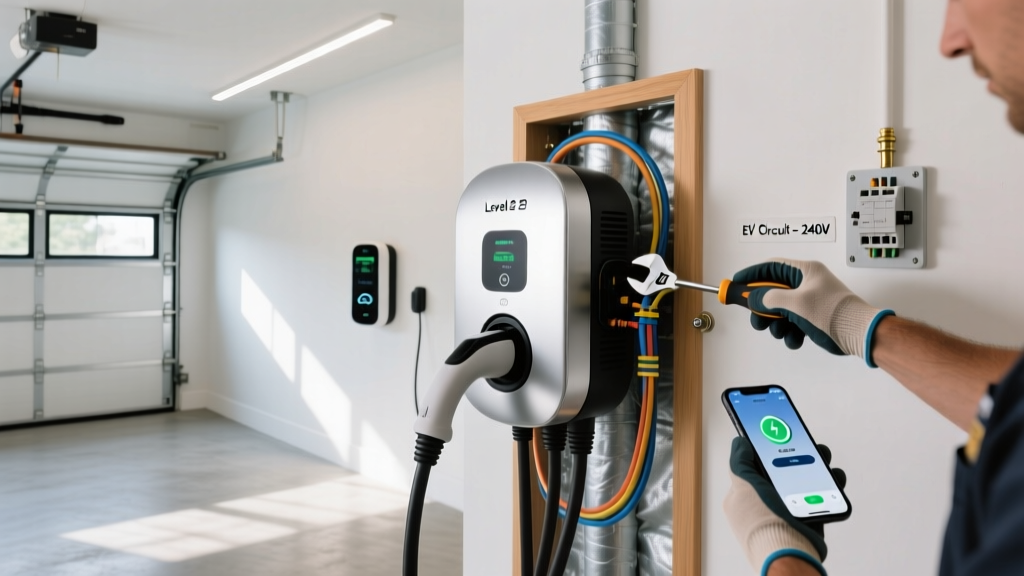
EV charger wiring is not a DIY project. The sustained high-current draw (8+ hours at 32–48 amps) places demands on residential wiring that differ fundamentally from intermittent loads like dryers or ovens.
Code Requirements and Best Practices
- Dedicated circuit: Your EV charger must have its own dedicated breaker — no sharing with other appliances. This is a NEC requirement, not a suggestion.
- GFCI protection: The 2020 NEC (Article 625.54) requires GFCI protection for receptacles used for EV charging. Hardwired installations may be exempt depending on local jurisdiction, and many electricians prefer hardwiring partly to avoid nuisance GFCI trips (some EVSEs have built-in ground-fault detection that conflicts with external GFCI breakers).
- Outdoor rating: If your charger is installed outdoors or in an unenclosed carport, the EVSE must carry a NEMA 4 or NEMA 4X rating for weather resistance. All units listed above meet this standard.
- Permit and inspection: Most jurisdictions require an electrical permit for EV charger installation. The inspection ensures proper wire gauge, breaker sizing, grounding, and conduit work. Skipping the permit can void your homeowner's insurance coverage for electrical fires.
- Cable management: Use a wall-mounted cable organizer or EVSE holster to keep the charging cable off the ground, preventing abrasion and trip hazards.
When to Upgrade Your Panel
Consider a panel upgrade if your electrician's load calculation shows less than 20% headroom on your existing panel after adding the EV circuit, or if you plan to add electric heat pumps, solar inverters, or battery storage in the future. A 200A panel provides sufficient headroom for most all-electric households. According to the U.S. Department of Energy, planning for future electrification during an EV charger install can save thousands compared to doing separate upgrades later.
Frequently Asked Questions
How much does it cost to install a home EV charger?
A straightforward Level 2 installation near an adequate electrical panel typically costs $800–$1,700 including equipment, labor, materials, and permits. Standard installations with longer wire runs cost $1,300–$2,750. Homes requiring a panel upgrade (common in pre-1990 construction) can see total costs of $3,600–$7,300. Utility rebates and the federal Residential Clean Energy Credit (30% up to $1,000) can offset a portion of these costs.
How fast will each charging level add range?
Level 1 (120V) adds 3–5 miles per hour — adequate for PHEVs with small batteries but impractical for full EVs. Level 2 (240V) adds 12–70+ miles per hour depending on amperage: a 32A/7.7 kW charger adds roughly 25–30 miles per hour, while a 48A/11.5 kW charger adds 35–45 miles per hour. DC fast charging adds 150–1,000+ miles per hour at peak rates but is only available at commercial stations.
Which connector and charger is compatible with my EV?
Check your vehicle's charge port. If it's a 2025+ model from Tesla, Ford, GM, Rivian, Hyundai, Kia, or most other major brands, it likely uses NACS. Older EVs (2024 and earlier, excluding Tesla) mostly use CCS1. CHAdeMO is limited to the discontinued Nissan Leaf. For home chargers, match the connector: buy a NACS charger for NACS vehicles, CCS for CCS vehicles, or use a certified adapter (~$100–$250) for cross-compatibility.
How much does charging cost per mile compared to gas?
Home charging at the national average electricity rate ($0.16/kWh) costs about $0.053 per mile for a typical EV — roughly one-third the cost of gasoline at $3.40/gallon in a 28 MPG vehicle ($0.121/mi). With off-peak time-of-use rates ($0.08/kWh), the cost drops to $0.027/mi, about one-fifth the cost of gas. Public DC fast charging ($0.35–$0.55/kWh) approaches gas parity at $0.12–$0.18/mi.
What electrical upgrades might I need for EV charger wiring?
The most common upgrade is a panel replacement from 100A to 200A service ($1,500–$3,500), needed in older homes with limited capacity. You may also need a sub-panel ($800–$1,500) if the charger location is far from the main panel, upgraded wire gauge for long conduit runs, or a smart load management device to avoid overloading existing service. Your electrician will determine requirements through a NEC Article 220 load calculation.
Can I install an EV charger myself?
Level 1 (120V) requires no installation — just plug into a standard outlet on a dedicated circuit. Level 2 (240V) installation involves high-amperage wiring that requires a licensed electrician in virtually all jurisdictions. DIY 240V work without a permit can void insurance, fail inspection, and create serious fire and electrocution risk. The sustained high-current nature of EV charging makes professional installation non-negotiable for safety.
Proper EV charger wiring is an investment that pays dividends every day you own an electric vehicle. A well-executed Level 2 installation delivers reliable overnight charging at a fraction of gasoline costs, while protecting your home's electrical system and meeting all code requirements. Get quotes from at least two licensed electricians, verify they have specific EV charger installation experience, and insist on a permit and inspection — it's the foundation of safe, efficient home charging for years to come.