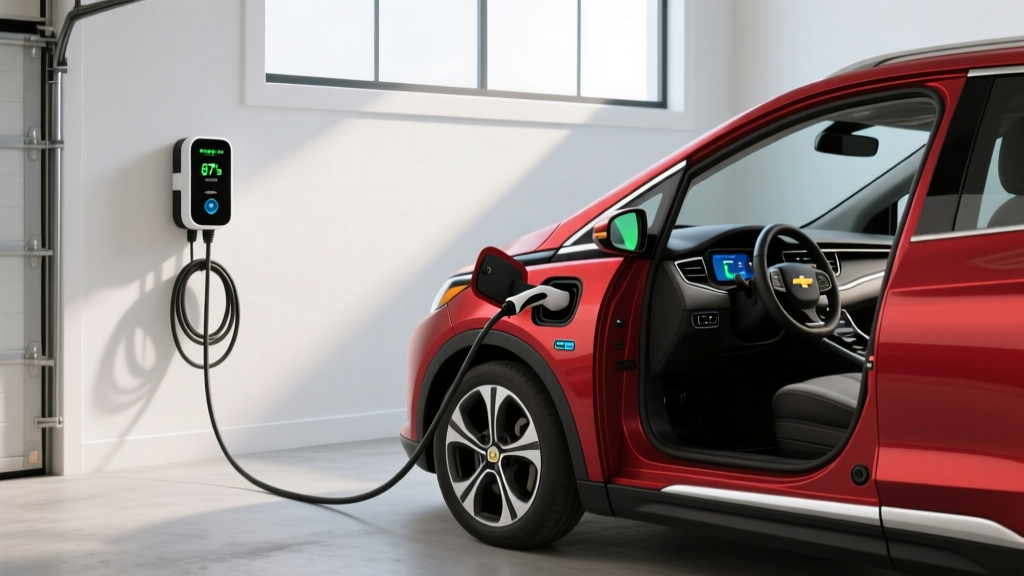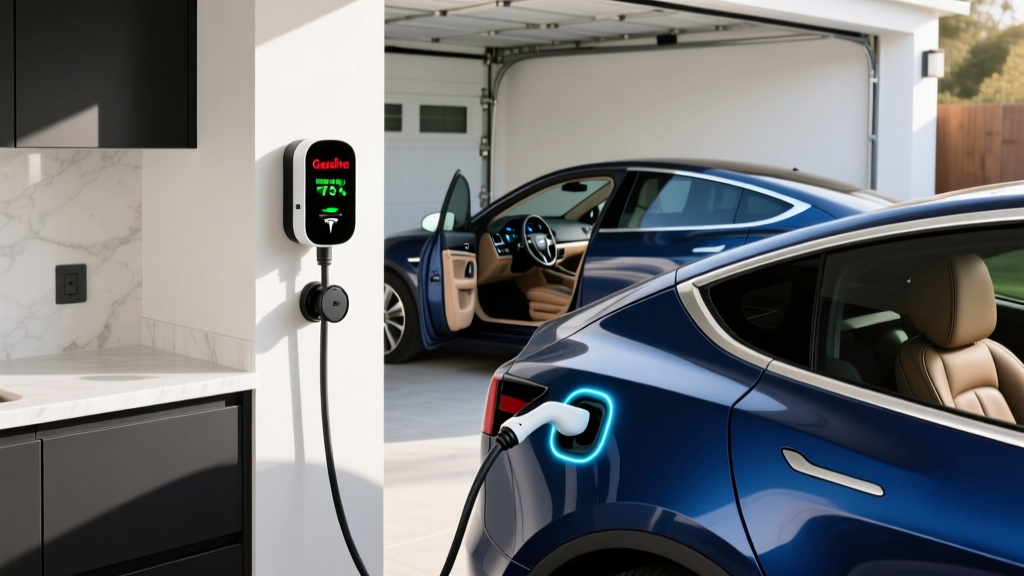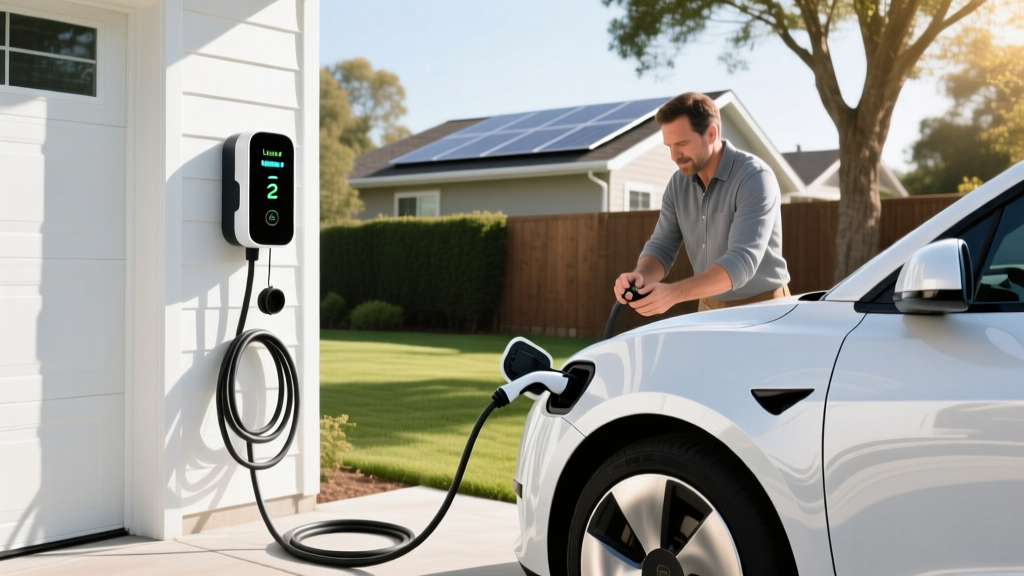
The federal electric vehicle charger tax credit — officially known as the Alternative Fuel Vehicle Refueling Property Credit (IRS §30C) — can cover up to 30% of the cost to buy and install a home EV charger, capped at $1,000. For most buyers spending $600–$1,200 on a Level 2 wall connector plus a few hundred more on electrical work, that credit meaningfully shrinks the upfront investment. But the rules around eligibility, census-tract requirements, and qualifying expenses trip up a lot of first-time EV owners.
This guide breaks down exactly how the credit works, what it covers, how to pair it with a smart home charger installation, and the real-world costs you should expect from equipment through final permit sign-off.
How the Electric Vehicle Charger Tax Credit Works
The §30C credit reimburses 30% of qualified refueling property expenditures for your primary residence. For residential EV charging equipment, the maximum credit is $1,000 per tax year. The credit applies to both the charger hardware and the labor/electrical work directly associated with its installation.
Congress extended and modified §30C under the Inflation Reduction Act, adding a geographic restriction that took effect in 2023: to qualify, your home must be located in a qualified census tract — an area that meets specific low-income or rural criteria defined by the Treasury Department. This is the single biggest gotcha. Many suburban and urban homeowners discovered their address does not qualify.
§30C Eligibility Checklist
- Equipment installed at your primary residence (not rental or commercial property)
- Home address falls within a qualified census tract per IRS guidance
- Charger must be new (used equipment does not qualify)
- Equipment must be certified for EV charging (UL-listed or equivalent)
- Credit covers hardware + installation labor + electrical upgrades directly tied to the charger
- Maximum residential credit: $1,000 (30% of costs up to ~$3,333)
- Nonrefundable credit — you must have sufficient federal tax liability to absorb it
- File IRS Form 8911 with your annual tax return
The credit is nonrefundable, meaning it can reduce your federal tax liability to zero but won't generate a refund beyond that. If your total tax owed in the installation year is less than $1,000, you cannot carry the unused portion forward.
For full eligibility details and qualified census tract lookups, consult the IRS §30C guidance page and consider confirming your address eligibility with a tax professional before committing to a purchase.
Understanding Charging Levels: Speed, Power, and Range Added
Before choosing equipment, you need to understand the three charging tiers and what each delivers in practical terms. The critical distinction: kW (kilowatts) measures power — the rate at which energy flows into your battery. kWh (kilowatt-hours) measures energy — the total capacity stored. A 60 kWh battery charged at 7.2 kW takes roughly 8+ hours from empty; at 150 kW DC, it takes under 30 minutes to 80%.
| Level | Voltage | Power (kW) | Miles Added/Hour | Best Use Case |
|---|---|---|---|---|
| Level 1 | 120V AC | 1.0–1.4 kW | 3–5 mi/hr | Overnight top-ups, PHEVs, low-mileage drivers |
| Level 2 | 240V AC | 3.3–19.2 kW | 12–75 mi/hr | Daily home charging, most EV owners' primary method |
| DC Fast | 400–800V DC | 50–350 kW | 150–1,000+ mi/hr | Road trips, rapid top-ups, no home garage access |
Most EV owners install a Level 2 charger at home — typically a 240V unit delivering 7.2–11.5 kW (32–48 amps). This handles daily driving needs comfortably: a 48-amp charger adds roughly 35 miles of range per hour, fully replenishing a 75 kWh battery overnight in about 8 hours.
DC fast charging is public infrastructure only (you won't install a 150 kW station in your garage). It's essential for road trips but not part of the §30C credit equation for most homeowners.
Home Charger Installation: Electrical Requirements and Costs
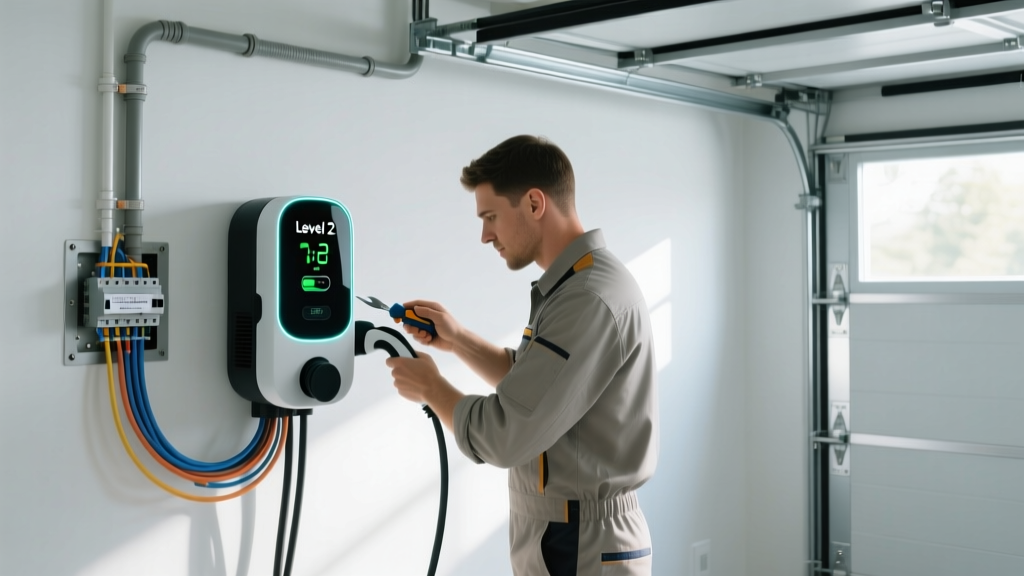
The total cost to install a home Level 2 EV charger breaks into two buckets: the charger equipment itself and the electrical installation work. The §30C credit covers both, which is where the savings stack up.
Electrical Requirements for Level 2
A Level 2 charger requires a dedicated 240V circuit — the same voltage your electric dryer or oven uses. The amperage depends on the charger:
- 32-amp charger (7.7 kW): Requires a 40-amp breaker (NEC rule: continuous loads can't exceed 80% of breaker rating)
- 40-amp charger (9.6 kW): Requires a 50-amp breaker
- 48-amp charger (11.5 kW): Requires a 60-amp breaker
Your electrical panel must have enough spare capacity (in amps) to support the new circuit. Many modern homes with 200-amp service have room; older homes with 100-amp panels often do not.
Panel Upgrade: The Hidden Cost
If your panel lacks capacity, an upgrade to 200-amp service typically costs $1,500–$3,500 depending on your utility, local labor rates, and whether new conduit runs are needed. This is not a corner to cut — an overloaded panel is a fire hazard. A licensed electrician will perform a load calculation before recommending a circuit addition or panel upgrade.
| Component | Low End | High End | Notes |
|---|---|---|---|
| Level 2 Charger (hardware) | $300 | $750 | Smart Wi-Fi chargers cost more; basic units less |
| Electrician labor (simple install) | $300 | $800 | Short run from panel to garage, existing capacity |
| Electrician labor (complex install) | $800 | $2,000 | Long conduit run, drywall work, outdoor mount |
| Permit fee | $50 | $250 | Varies by municipality; some waive for EV installs |
| Panel upgrade (if needed) | $1,500 | $3,500 | Older homes with 100A service |
| Total (no panel upgrade) | $650 | $2,550 | §30C credit covers up to 30% ($195–$765) |
| Total (with panel upgrade) | $2,150 | $6,050 | §30C credit still capped at $1,000 |
For a straightforward install — panel has capacity, garage is adjacent to the electrical room, short wire run — expect to spend roughly $900–$1,500 all-in. At that level, the §30C credit at 30% returns $270–$450.
Which Connector and Charger Fits Your EV?
The connector landscape shifted significantly in 2024–2025 when most major automakers adopted the North American Charging Standard (NACS), originally developed by Tesla. Here's where each brand stands as of the 2026 model year:
| Connector | Brands Using It | Home Charger Availability | Adapter Needed? |
|---|---|---|---|
| NACS (Tesla plug) | Tesla, Ford, GM, Rivian, Volvo, Polestar, Mercedes, Nissan (new) | Tesla Wall Connector, Emporia, Autel, ChargePoint | No for native NACS vehicles |
| CCS1 | Hyundai, Kia, BMW, VW, older Ford/GM (pre-2025) | ChargePoint, Emporia, JuiceBox, Autel | NACS-to-CCS adapter for Superchargers |
| CHAdeMO | Nissan Leaf (legacy), Mitsubishi Outlander PHEV | Limited home options; mostly public DC | Adapters rare; plan for CCS/NACS transition |
Practical recommendation: If you drive a 2025+ Ford, GM, Rivian, or Tesla, buy a NACS-connector home charger. If you drive a Hyundai Ioniq 5/6 or Kia EV6/EV9 (which retain CCS1), buy a CCS1 (J1772-connector) charger. Most chargers ship with J1772 connectors; NACS-native home units from Tesla and third parties are now widely available.
If you own a CCS vehicle and want access to Tesla Superchargers, Tesla sells a CCS-to-NACS adapter (~$250). Keep in mind that adapter use may slightly reduce peak DC charge rates due to additional resistance.
Recommended Home Chargers: Equipment Picks for 2026
These Level 2 chargers meet UL safety certification, offer smart features, and work with the §30C credit as qualified refueling property:
Tesla Wall Connector (Gen 4)
- Power: Up to 11.5 kW (48A)
- Connector: NACS native
- Cable length: 24 ft
- Smart features: Wi-Fi, OTA updates, load sharing, Tesla app integration
- Price: ~$425
- Best for: Tesla, Ford, GM, Rivian, and other NACS-adopting vehicles
Emporia Vue Level 2 Charger
- Power: Up to 11.5 kW (48A)
- Connector: J1772 (works with all CCS vehicles; NACS adapter available)
- Cable length: 24 ft
- Smart features: Energy monitoring, solar integration, scheduling, app control
- Price: ~$399
- Best for: Solar-home owners wanting charge-to-solar; Hyundai/Kia/VW drivers
ChargePoint Home Flex
- Power: Up to 12 kW (50A, configurable down to 16A)
- Connector: J1772
- Cable length: 23 ft
- Smart features: Alexa integration, scheduling, amperage adjustment, detailed app
- Price: ~$549
- Best for: Homes with limited panel capacity (can dial down amps); smart-home enthusiasts
Autel MaxiCharger Home
- Power: Up to 12 kW (50A)
- Connector: J1772 or NACS (two SKUs)
- Cable length: 25 ft
- Smart features: RFID authentication, load balancing, app, LTE optional
- Price: ~$499–$549
- Best for: Multi-EV households wanting RFID access control
Charging Cost per Mile: EV vs. Gasoline
One of the strongest ownership arguments for EVs is fuel cost — but the savings depend heavily on where and when you charge. Here's how the math works out in real 2026 scenarios:
| Scenario | Rate | Cost per kWh | Cost per Mile* | Annual Cost (12,000 mi) |
|---|---|---|---|---|
| Home, off-peak utility rate | $0.11/kWh | $0.11 | $0.033 | $396 |
| Home, average US rate | $0.16/kWh | $0.16 | $0.048 | $576 |
| Home, high-cost state (CA/MA) | $0.28/kWh | $0.28 | $0.084 | $1,008 |
| Public Level 2 (ChargePoint, etc.) | $0.35/kWh | $0.35 | $0.105 | $1,260 |
| DC fast charging (EA, EVgo) | $0.48/kWh | $0.48 | $0.144 | $1,728 |
| Gasoline vehicle (27 MPG avg, $3.40/gal) | — | — | $0.126 | $1,512 |
*Based on an EV averaging 3.5 miles per kWh (≈300 Wh/mi), typical of a mid-size crossover like the Tesla Model Y or Hyundai Ioniq 5.
Home charging on off-peak rates delivers the most dramatic savings: roughly 4 cents per mile versus 12.6 cents for gas. Even at California's higher residential rates, home charging still beats gasoline per mile. But exclusive reliance on DC fast charging actually exceeds gas cost per mile — reinforcing why home Level 2 access is the economic foundation of EV ownership.
Safety, Permits, and Code Compliance
EV chargers draw significant continuous current. Proper installation isn't optional — it protects your home, your vehicle, and your insurance coverage.
Key Electrical Code Requirements
- Dedicated circuit: Your Level 2 charger must be on its own breaker — no sharing with other outlets or appliances.
- 80% continuous-load rule: NEC requires that continuous loads (anything running 3+ hours, which includes EV charging) use no more than 80% of the breaker rating. A 48A charger needs a 60A breaker.
- GFCI protection: Outdoor installations require Ground Fault Circuit Interrupter protection. Many modern chargers have built-in GFCI; your electrician will confirm compliance.
- Outdoor rating: If mounting outside, the charger and connector must carry a NEMA 4 or IP65 weather-resistance rating.
- Permit: Most jurisdictions require an electrical permit for a new 240V circuit. Your electrician typically pulls this. The inspection ensures code compliance and protects your homeowner's insurance claim in the event of an electrical fire.
Skip the permit and you risk voiding your insurance, failing a future home inspection, and — critically — losing the §30C credit, which requires the installation to meet all applicable codes.
Frequently Asked Questions
How much does it cost to install a home EV charger?
Expect $650–$2,550 for a straightforward installation (equipment + electrician + permit) if your panel has capacity. Add $1,500–$3,500 if you need a panel upgrade. The §30C electric vehicle charger tax credit covers 30% of qualifying costs up to $1,000.
How fast will each charging level add range?
Level 1 (120V) adds 3–5 miles per hour. Level 2 (240V, 48A) adds roughly 35 miles per hour. DC fast charging (150+ kW) can add 200+ miles in 15–20 minutes, though charge speed tapers significantly above 80% state of charge to protect battery health.
Which connector is compatible with my EV?
2025–2026 Tesla, Ford, GM, Rivian, and Volvo/Polestar vehicles use NACS. Hyundai, Kia, BMW, and VW currently use CCS1 (J1772 for AC). Match your home charger's connector to your vehicle. CCS vehicles can access Tesla Superchargers with a $250 adapter.
How much does charging cost per mile vs. gas?
Home charging on average US electricity rates costs about $0.048/mile versus $0.126/mile for a 27 MPG gas vehicle — roughly 62% cheaper. Off-peak home rates drop to $0.033/mile. Exclusive DC fast charging at $0.48/kWh costs about $0.144/mile, actually exceeding gasoline.
What electrical upgrades might I need?
Most commonly, a new 240V dedicated circuit with an appropriately sized breaker (40–60A). If your home has 100-amp electrical service, a panel upgrade to 200 amps is often required, adding $1,500–$3,500. Your electrician will perform a load calculation to determine this before any work begins.
Do I qualify for the electric vehicle charger tax credit?
Check the IRS §30C page and confirm your home is in a qualified census tract. You must own the home, install new (not used) certified equipment at your primary residence, and have enough federal tax liability to absorb the nonrefundable credit. File Form 8911 with your return. Consult a tax professional for your specific situation.
Can I claim the §30C credit and the §30D vehicle credit in the same year?
Yes. The §30C charger credit and the §30D new clean vehicle credit are separate provisions. If you buy a qualifying EV and install a home charger in the same tax year, you can claim both — subject to each credit's individual eligibility rules and caps.