Why an EV Charger Splitter Might Solve Your Home Charging Problem
If your home's electrical panel is maxed out — or if the only available 240V circuit is the one your dryer already uses — you have a few options: pay $2,000–$4,000 for a panel upgrade, run a dedicated new circuit (often $800–$2,500 depending on distance and conduit), or use an EV charger splitter to share the existing outlet. The splitter approach is gaining traction among EV owners in older homes where panel capacity is tight and electrician quotes for new circuits run high.
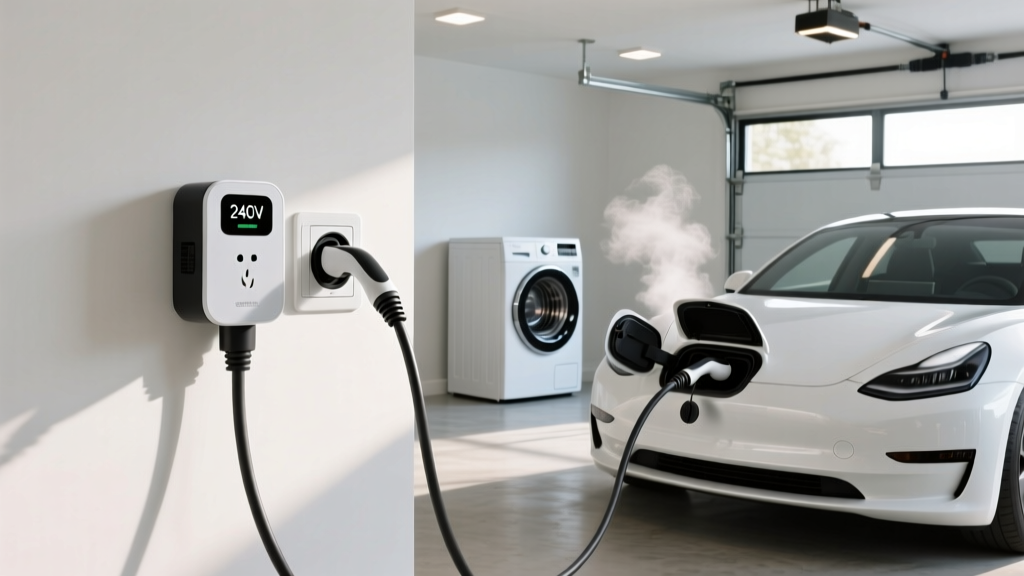
An EV charger splitter (also called a dryer-EV splitter or smart outlet switcher) is a device that connects to a single 240V NEMA outlet — typically a NEMA 14-50 or 14-30 — and provides two output ports: one for your dryer and one for your EV charger. The device manages power delivery so both appliances never draw full current simultaneously, keeping the circuit within its rated amperage.
This guide covers the electrical realities, safety code, costs, and whether a splitter is right for your setup — or if a dedicated circuit is the smarter long-term play.
How EV Charger Splitters Work: Load Sharing on a Single Circuit
A typical NEMA 14-50 outlet is on a 50-amp breaker, which means the continuous load should not exceed 40 amps (80% of breaker rating per NEC 210.20). A clothes dryer typically draws 20–30 amps when running. A Level 2 EV charger set to 32 or 40 amps would exceed the circuit if both ran simultaneously.
Smart splitters solve this with load-sensing logic:
- Priority mode: When the dryer turns on, the splitter cuts or throttles EV charging. When the dryer cycle ends, full power resumes to the EV.
- Simultaneous split: The splitter allocates a fixed share — say 20A to the dryer and 20A to the EV — so both run at reduced power.
- Scheduled mode: You set EV charging to off-peak hours (e.g., 11 PM–6 AM) when the dryer is idle, avoiding conflict entirely.
Basic passive splitters (simple Y-cables) do not manage load — they rely on you to never run both devices at once. These are cheaper but carry real risk of tripping the breaker or overheating the circuit if you forget. Smart splitters with active load management are strongly preferred.
Charging Levels and Speeds: What You Get Through a Splitter
Because a splitter shares a circuit, your EV's Level 2 charging speed depends on how much amperage is available after the dryer's draw. Here's how all three charging levels compare for context:
| Level | Voltage | Max Power (kW) | Miles of Range Added per Hour | Typical Use |
|---|---|---|---|---|
| Level 1 | 120V | 1.2–1.9 kW | 3–5 mi/hr | Emergency / overnight trickle |
| Level 2 | 240V | 3.3–19.2 kW | 12–75 mi/hr | Home, workplace, public AC |
| DC Fast | 400–800V DC | 50–350 kW | 150–1,000+ mi/hr | Road trips, highway corridors |
On a shared 50A circuit with a smart splitter giving the EV 32A (7.7 kW), a typical mid-size EV like the Hyundai Ioniq 5 (84 kWh usable battery) adds roughly 28–30 miles of range per hour. A full 10–80% charge (roughly 59 kWh needed) takes about 7.5–8 hours — fine for overnight charging.
If the splitter allocates only 20A (4.8 kW) while the dryer runs, that drops to roughly 17–18 miles per hour. You'll still wake up with a full battery if you plug in by 9 PM, but it's noticeably slower than a dedicated 48A circuit delivering 11.5 kW.
Home Installation Costs: Splitter vs. Dedicated Circuit vs. Panel Upgrade
Here's where the splitter pitch becomes compelling — or falls apart, depending on your home. Let's break down the actual costs:
| Component | Splitter on Existing Outlet | New Dedicated 240V Circuit | Panel Upgrade + New Circuit |
|---|---|---|---|
| Equipment (splitter / charger) | $250–$600 (splitter) + $300–$700 (EVSE) | $300–$700 (EVSE) | $300–$700 (EVSE) |
| Electrician labor | $150–$400 (wiring check, outlet inspection) | $500–$1,800 (run new line, mount outlet) | $1,500–$3,500 (panel swap + new circuits) |
| Permit & inspection | $50–$150 | $100–$300 | $200–$500 |
| Panel upgrade (if needed) | Not required | Not required (if panel has capacity) | $2,000–$4,000 |
| Total estimated range | $750–$1,850 | $900–$2,800 | $4,000–$8,700 |
The splitter route saves significant money if your existing 14-50 outlet is in good condition, on a properly rated breaker, and located near where you park. But if that outlet is 40 feet from your parking spot, in a laundry room behind the dryer, or shows signs of wear (discoloration, warmth during use), a new dedicated circuit is the safer and more practical choice.
Panel upgrade gotcha: Homes built before 1990 often have 100-amp main panels. Adding a 50A EV circuit to a panel already running central AC, an electric range, and a dryer may exceed the panel's capacity. An electrician will perform a load calculation per NEC Article 220. If you're over 80% of panel capacity, you'll need an upgrade — or a smart splitter becomes your most cost-effective path.
Connector Compatibility: NACS, CCS, and Making the Splitter Work with Your EV
As of the 2026 model year, the North American Charging Standard (NACS, also known as the Tesla connector) has become the dominant EV connector. Ford, GM, Rivian, Hyundai, Kia, and most other manufacturers have transitioned to NACS. CCS1 remains on some 2023–2025 models still on the road, and CHAdeMO is effectively legacy (Nissan Leaf only).
| Connector | Brands Using It | Adapter Needed for Splitter? |
|---|---|---|
| NACS (Tesla-style) | Tesla, Ford, GM, Rivian, Hyundai, Kia, Volvo, Polestar, BMW, Mercedes | No — most Level 2 EVSEs now ship with NACS |
| CCS1 | 2023–2025 VW ID.4, some older BMW, Audi, Porsche models | NACS-to-CCS adapter (~$100–$200) if EVSE is NACS |
| CHAdeMO | Nissan Leaf (2025 and earlier) | Limited adapter options; best to use CHAdeMO-compatible EVSE |
The splitter itself is connector-agnostic — it sits between the wall outlet and your EVSE (the charging cable/box). So the connector on the EVSE end needs to match your car. When buying an EVSE to use with a splitter, choose one with the correct native plug or budget for the adapter.
Cost to Charge: Home vs. Public vs. Gas — Per-Mile Comparison
One of the strongest arguments for home Level 2 charging — whether via splitter or dedicated circuit — is the per-mile fuel cost. Here's how it compares:
| Scenario | Cost per kWh | Vehicle Efficiency | Cost per Mile |
|---|---|---|---|
| Home Level 2 (off-peak TOU rate) | $0.08–$0.14 | 3.0 mi/kWh (e.g., Ioniq 5, Model 3) | $0.03–$0.05 |
| Home Level 2 (standard rate) | $0.14–$0.22 | 3.0 mi/kWh | $0.05–$0.07 |
| Public Level 2 (ChargePoint, etc.) | $0.25–$0.49 | 3.0 mi/kWh | $0.08–$0.16 |
| DC Fast Charging (Electrify America, Tesla Supercharger) | $0.30–$0.55 | 3.0 mi/kWh | $0.10–$0.18 |
| Gasoline (28 MPG combined, $3.40/gal) | — | 28 mi/gal | $0.12 |
Even at standard residential rates, home EV charging costs roughly half what gasoline costs per mile. With a time-of-use (TOU) plan and off-peak scheduling — easy to set up on most smart EVSEs — you can drop below $0.04/mile. Over 12,000 miles per year, that's $480 in electricity vs. $1,440 in gas, saving roughly $960 annually.
The splitter doesn't change your electricity rate, but it does make home Level 2 charging accessible without a $3,000+ electrical upgrade — which means you start saving sooner.
Top EV Charger Splitters and Compatible EVSEs for 2026
The splitter market is still niche compared to EVSEs, but a few proven options exist. Here's what we recommend pairing:
Smart Splitters (Active Load Management)
- NeoCharge Smart Splitter (2nd Gen): The most widely reviewed consumer option. Supports NEMA 14-50 and 14-30 outlets, auto-detects which device is demanding power, and switches priority. Rated for 50A total, with a built-in 30-second delay to prevent rapid switching. Price: ~$350–$450. No app — purely hardware-based sensing. Limitation: not a load-balancer; it gives full power to one device at a time.
- Y-splitter cables with manual priority (various brands): Simple NEMA 14-50 Y-cables from companies like EVSEadapters or custom electrical suppliers. $80–$150. Require manual discipline — unplug one before using the other. Not recommended unless you have strict routines.
Compatible Level 2 EVSEs to Pair with a Splitter
- ChargePoint Home Flex (NACS): Up to 50A (12 kW) on a dedicated circuit, but adjustable down to 16A–32A via the app — essential for shared-circuit use. 23-foot cable, Wi-Fi connected, works with Alexa/Google Home. Price: ~$550–$650. At 32A on a shared 50A circuit, delivers 7.7 kW.
- Grizzl-E Smart (NACS): Built in Canada, rated for extreme cold (-40°C). Adjustable amperage (16A–40A), OCPP-compatible for utility programs, 24-foot cable. Price: ~$450–$550. Robust aluminum enclosure suits garage or outdoor mounting.
- Tesla Wall Connector (NACS): Up to 48A (11.5 kW), 24-foot cable, Wi-Fi firmware updates, power-sharing feature for multiple Wall Connectors. Price: ~$475. Can be dip-switch-configured to 32A for shared-circuit use. Best native NACS option for Tesla and NACS-equipped vehicles.
- Emporia Vue Level 2 EVSE: Budget-friendly at ~$300–$400, up to 48A, integrates with Emporia's whole-home energy monitor. 24-foot cable, app-controlled scheduling. Good choice if you want to track exactly how much energy the EV uses vs. the dryer.
Safety, NEC Code, and What Your Electrician Will Check
Using an EV charger splitter is not code-violating by default, but it must be done correctly. Here's what matters:
Circuit Rating and Continuous Load
NEC Article 625 classifies EV charging as a continuous load (operating for 3+ hours). This means the circuit must be rated for 125% of the charging current. On a 50A breaker, the maximum continuous draw is 40A. If your splitter allows the EV to draw 40A continuous while the dryer also pulls current, you'll trip the breaker. Set your EVSE to 32A or lower on a shared 50A circuit.
Outlet Condition and Wiring Gauge
Many NEMA 14-50 outlets in older homes were installed for dryers with 6-gauge or even 8-gauge wire — fine for intermittent dryer use but potentially inadequate for hours of sustained EV charging. Your electrician should verify:
- Wire gauge matches breaker size (6 AWG copper for 50A)
- Outlet shows no signs of thermal damage (melting, discoloration)
- Connections at the breaker and outlet are torqued to spec — loose connections cause heat buildup under continuous load
- The outlet is on a dedicated breaker (not shared with other circuits beyond what the splitter manages)
GFCI Protection
NEC 2020 and later require GFCI protection for 240V outlets in garages. Some older installations pre-date this requirement. If your garage outlet lacks GFCI, your electrician may recommend adding a GFCI breaker (~$80–$150 plus labor) — or note that a hardwired EVSE on a new circuit bypasses this requirement entirely (hardwired connections don't require GFCI under current code).
Outdoor Rating
If your 14-50 outlet is outdoors (carport, driveway), the splitter and EVSE must both carry a NEMA 4 or IP65 weather rating. The NeoCharge Smart Splitter is rated for indoor use only — outdoor installations require a weatherproof enclosure or an outdoor-rated splitter solution.
Permit and Inspection
Most jurisdictions require an electrical permit for any new EV charging equipment, including splitters on existing circuits. Permit costs typically run $50–$150. An inspector will verify wire gauge, breaker rating, outlet condition, and GFCI compliance. Skipping the permit risks insurance claim denial if an electrical fire originates from the circuit.
When a Splitter Makes Sense — and When It Doesn't
Choose an EV charger splitter if:
- Your home has a 100A panel with no room for a new 50A circuit
- The existing 14-50 outlet is within cable reach of your parking spot
- You charge overnight and don't need simultaneous dryer + full-speed EV charging
- Your budget for electrical work is under $1,500
- You drive fewer than 40 miles daily and overnight charging at reduced speed is sufficient
Choose a dedicated circuit instead if:
- Your panel has capacity (200A service with headroom)
- You want maximum Level 2 speed (40–48A) for larger batteries (100+ kWh trucks/SUVs)
- The nearest 240V outlet is far from your parking spot
- You frequently need the dryer and EV charging simultaneously (large household, laundry-heavy days)
- You plan to add a second EV in the next 2–3 years
Frequently Asked Questions
How much does it cost to install a home EV charger with a splitter?
Expect $750–$1,850 total: $350–$450 for a smart splitter, $300–$650 for a Level 2 EVSE, $150–$400 for an electrician to inspect the existing outlet and circuit, and $50–$150 for a permit. This is significantly less than a new dedicated circuit ($900–$2,800) or a panel upgrade ($4,000–$8,700).
How fast will each charging level add range?
Level 1 (120V) adds 3–5 miles per hour. Level 2 at 32A (7.7 kW, typical splitter allocation) adds roughly 28–30 miles per hour for an efficient mid-size EV. Level 2 at 48A (11.5 kW, dedicated circuit) adds 40–44 miles per hour. DC fast charging at 150+ kW can add 150–300+ miles in 20–30 minutes, depending on the vehicle's charge curve and battery state of charge.
Which connector/charger is compatible with my EV?
For 2026 models, most new EVs use NACS. If you drive a 2023–2025 model with CCS1, you'll need a NACS-to-CCS adapter (~$100–$200) if your EVSE has a NACS plug. The splitter itself is connector-agnostic — it only manages the 240V outlet side. Match your EVSE's connector to your car's charge port.
How much does charging cost per mile vs gas?
Home Level 2 charging at off-peak rates costs $0.03–$0.05 per mile. Standard residential rates bring it to $0.05–$0.07/mile. A comparable gas vehicle at 28 MPG and $3.40/gallon costs $0.12/mile. Over 12,000 miles/year, home EV charging saves $840–$1,080 annually on fuel.
What electrical upgrades might I need?
If your existing 14-50 outlet is in good condition on properly sized wiring (6 AWG for 50A), you may need nothing beyond the splitter and EVSE. Common upgrades include: replacing a worn outlet ($20–$50 part + labor), adding GFCI breaker protection ($80–$150 + labor), or upgrading wire gauge if the existing wire is undersized. If your panel is at capacity, a load calculation by a licensed electrician will determine whether a panel upgrade ($2,000–$4,000) is required — this is where the splitter becomes a genuine cost-saver.
Is it safe to use a splitter long-term?
A smart splitter with active load management, installed on a properly rated and inspected circuit, is safe for long-term use. The key risks come from passive Y-cables without load management, worn outlets not rated for continuous high-amperage draw, and undersized wiring. Have a licensed electrician inspect the circuit before use, and replace any outlet that shows warmth or discoloration during charging sessions.
Sources: U.S. Department of Energy / fueleconomy.gov — EV Charging Technology; NFPA National Electrical Code (NEC) Articles 210, 225, 625; IRS §30D Clean Vehicle Credit — eligibility rules for charger-related tax benefits.