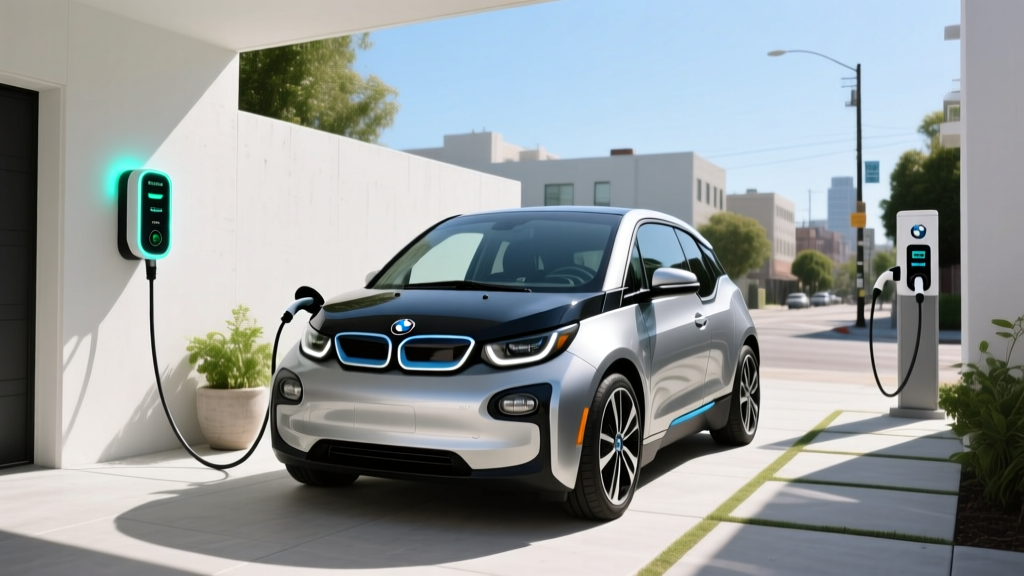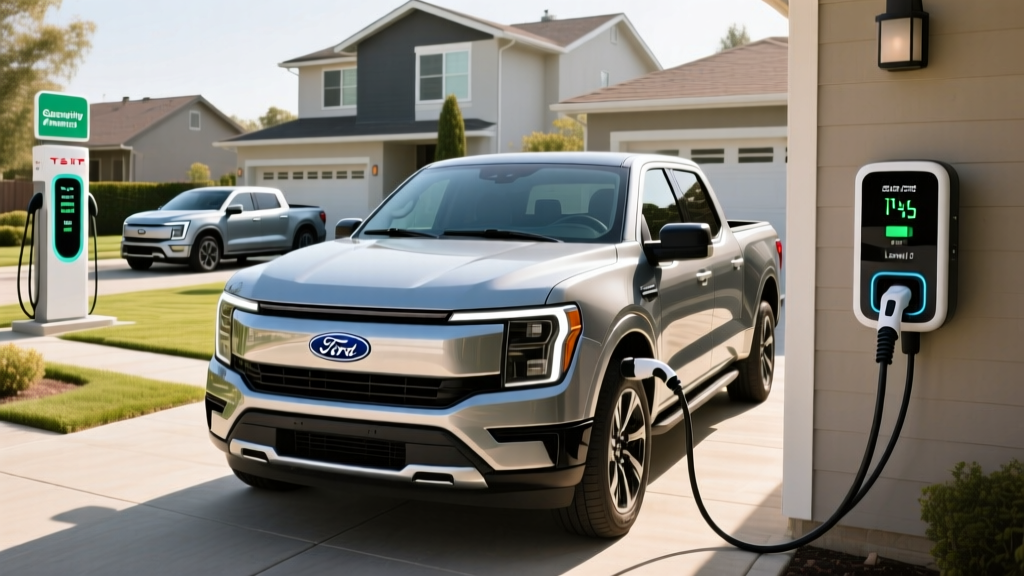
If you have shopped for an electric vehicle or a home charging station in the last two years, you have likely encountered the phrase "charger ending" — a shorthand way of referring to the physical connector and plug standard that your EV uses to accept electricity. In 2026, the North American charging landscape has consolidated dramatically around the North American Charging Standard (NACS), but CCS1 and CHAdeMO vehicles remain on the road in large numbers, and understanding which charger ending you need is essential for both home installation and public charging.
This guide breaks down every major charger ending available to US buyers, the electrical requirements behind each charging level, real-world installation costs, and exactly what you will pay per mile compared to gasoline. Whether you are plugging in a brand-new Tesla, a Ford F-150 Lightning with a CCS adapter, or a used Nissan Leaf, the numbers below will tell you what to expect.
Charging Levels Explained: kW, kWh, and Miles Per Hour
Before comparing connector types, it is critical to separate two terms that are frequently confused: kW (kilowatts) measures the rate of power delivery — how fast energy flows into your battery. kWh (kilowatt-hours) measures total energy capacity — how much your battery holds. Think of kW as the diameter of a hose and kWh as the size of the bucket.
The three charging levels available to US EV owners differ in voltage, amperage, and the practical speed at which they add range:
| Level | Voltage | Max Power (kW) | Miles of Range Added Per Hour | Typical Use Case |
|---|---|---|---|---|
| Level 1 | 120V AC | 1.4 kW (12A) | 3–5 miles | Overnight top-up, PHEVs, emergencies |
| Level 2 | 240V AC | 7.2–19.2 kW (30–80A) | 20–60 miles | Daily home and workplace charging |
| DC Fast Charge | 400–900V DC | 50–350 kW | 150–1,200 miles (10–80% session) | Road trips, highway corridors |
A practical example: a 2026 Hyundai Ioniq 5 with an 84 kWh (usable) battery and roughly 3.5 miles per kWh efficiency will gain about 280 EPA-rated miles on a full charge. On a Level 2 charger delivering 11.5 kW, that battery goes from 10% to 80% in roughly 5.1 hours. On a 350 kW DC fast charger, the same 10–80% session takes approximately 18 minutes — though the charge curve tapers significantly above 80%, which is why manufacturers quote 10–80% times rather than 0–100%.
Every Charger Ending in 2026: NACS, CCS1, and CHAdeMO
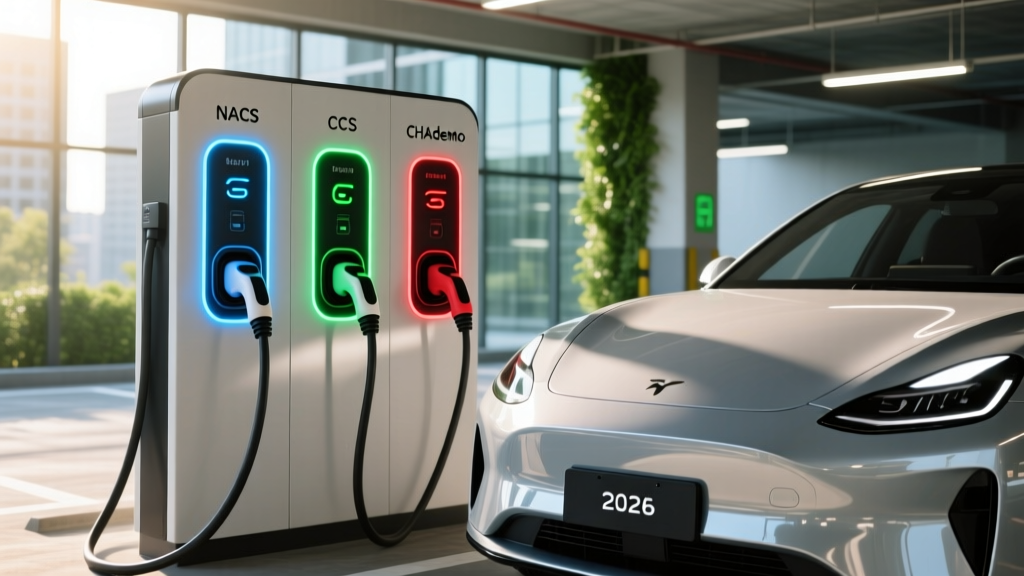
The "charger ending" — the plug that physically connects your vehicle to a charging station — has undergone a massive industry shift. Here is where each standard stands as of the 2026 model year:
| Connector | Also Known As | Brands Using It (2026 Models) | Max AC Level 2 kW | Max DC Fast kW | Status |
|---|---|---|---|---|---|
| NACS | J3400 / Tesla connector | Tesla, Ford, GM, Rivian, Volvo, Polestar, Mercedes-Benz, BMW, Hyundai, Kia, Subaru | 19.2 kW | 350 kW | Industry standard — adopted by nearly all major OEMs |
| CCS1 | Combined Charging System | Legacy models (pre-2025 VW ID.4, older BMW i4, Stellantis EVs); adapters available | 19.2 kW | 350 kW | Legacy — phased out on new models, still supported at public stations |
| CHAdeMO | — | Nissan Leaf (all years), Mitsubishi Outlander PHEV (older) | 6.6 kW | 100 kW (rarely 50 kW) | Discontinued — no new vehicles; limited public availability |
What this means for buyers: If you purchase any new EV from a major manufacturer in 2026, it almost certainly has a NACS port. If you own a 2023–2024 CCS-equipped vehicle (such as a VW ID.4 or Hyundai Ioniq 5 from those years), you can purchase a CCS-to-NACS adapter (typically $200–$300) to access the Tesla Supercharger network, which now hosts over 30,000 NACS stalls open to non-Tesla vehicles. CHAdeMO owners face the most constrained future — new CHAdeMO public stations are virtually nonexistent, though existing installations continue to operate.
How Much Does It Cost to Install a Home EV Charger?
Home Level 2 charging is the backbone of practical EV ownership. The total installed cost depends on your home's electrical panel capacity, the distance from the panel to the charger location, and local permit fees. Here is a realistic breakdown based on 2026 electrician rates:
| Component | Simple Install (Panel Nearby) | Complex Install (Panel Far / Upgrade Needed) |
|---|---|---|
| Level 2 Charger Equipment (hardwired, 48A) | $400–$700 | $400–$700 |
| Electrician Labor (2–4 hrs simple / 6–12 hrs complex) | $600–$1,200 | $1,800–$4,000 |
| Electrical Permit | $50–$200 | $50–$200 |
| Panel Upgrade (100A → 200A, if needed) | N/A | $2,000–$5,000 |
| Conduit, Wiring, Misc. Materials | $100–$300 | $500–$1,500 |
| Total Installed Cost | $1,150–$2,400 | $4,750–$11,400 |
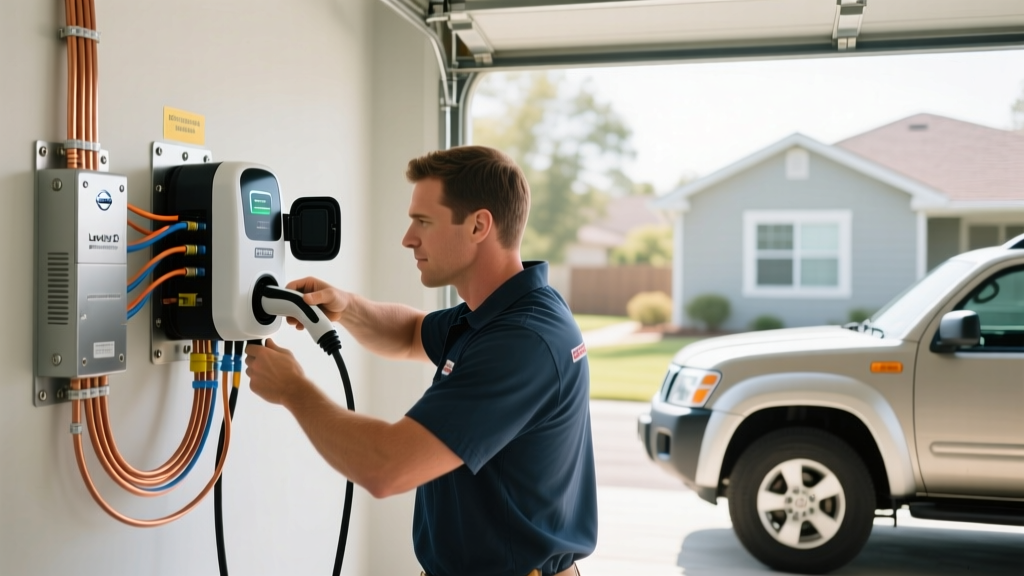
Electrical requirements for a standard 48-amp Level 2 charger: You need a dedicated 60-amp, 240-volt circuit (the charger draws 80% of the breaker rating continuously, per the National Electrical Code). This requires 6 AWG copper wire for runs up to 50 feet; longer runs may need 4 AWG to prevent voltage drop. Your electrical panel must have at least two adjacent open slots and sufficient remaining capacity — a load calculation performed by a licensed electrician will determine whether your existing panel can handle the additional draw.
Charging Time Examples: 10–80% for Common Battery Sizes
Charging speed is not linear. DC fast chargers deliver peak kW only when the battery State of Charge (SoC) is low — typically between 10% and 40%. Above 60%, the battery management system progressively reduces the charge rate to protect cell health. This "charge curve taper" is why manufacturers and testing bodies quote 10–80% times.
Here are realistic 10–80% charging times for representative 2026 EVs at different charger types:
| Vehicle Example | Battery (kWh Usable) | Level 2 at 11.5 kW | DC Fast at 150 kW | DC Fast at 350 kW |
|---|---|---|---|---|
| 2026 Tesla Model Y Long Range | 75 kWh | ~4.6 hours | ~28 min | ~15 min |
| 2026 Ford F-150 Lightning Extended | 112 kWh | ~6.8 hours | ~42 min | ~25 min |
| 2026 Hyundai Ioniq 5 | 84 kWh | ~5.1 hours | ~32 min | ~18 min |
| 2026 Chevrolet Equinox EV | 85 kWh | ~5.2 hours | ~35 min | ~22 min |
Note that the 350 kW advantage over 150 kW is modest in real-world minutes — this is because very few EVs can sustain 350 kW throughout the charging session. Vehicles with 800-volt architectures (Hyundai Ioniq 5, Kia EV6, Porsche Taycan) sustain higher power longer than 400-volt platforms, making them meaningfully faster at 350 kW stations.
Cost to Charge: Per-Mile Comparison vs. Gasoline
The economic case for EV charging hinges on where and when you charge. Electricity rates vary enormously by utility, time of day, and region. Below are representative 2026 scenarios for a mid-size EV averaging 3.5 miles per kWh (roughly 110 MPGe combined):
| Charging Scenario | Rate ($/kWh) | Cost Per Mile (at 3.5 mi/kWh) | Equivalent MPG at $3.50/gal Gas |
|---|---|---|---|
| Home off-peak (time-of-use rate) | $0.08–$0.12 | $0.023–$0.034 | 103–152 MPG |
| Home standard rate (no TOU) | $0.14–$0.18 | $0.040–$0.051 | 68–87 MPG |
| Public Level 2 (ChargePoint, etc.) | $0.25–$0.40 | $0.071–$0.114 | 31–49 MPG |
| DC Fast Charging (Electrify America, EVgo) | $0.35–$0.55 | $0.100–$0.157 | 22–35 MPG |
| Tesla Supercharger (2026 average) | $0.28–$0.38 | $0.080–$0.109 | 32–44 MPG |
The takeaway: Home charging during off-peak hours delivers fuel costs equivalent to 100+ MPG — roughly one-quarter the per-mile cost of a 30 MPG gasoline vehicle at $3.50/gallon. However, exclusive reliance on public DC fast charging narrows that advantage considerably, approaching gasoline costs in some markets. This is why home Level 2 access remains the single most important factor in EV ownership economics.
The IRS §30D federal tax credit of up to $7,500 (subject to MSRP caps, buyer income limits, and battery sourcing requirements) can offset a significant portion of an EV's purchase price. Additionally, the Alternative Fuel Vehicle Refueling Property Credit (IRC §30C) may cover up to 30% of home charger equipment and installation costs (capped at $1,000), though eligibility depends on census tract qualifications. Consult a tax professional for your specific situation.
Equipment Recommendations: Top Level 2 Chargers for 2026
Below are three widely recommended Level 2 home chargers that span different budgets and feature sets. All are UL-listed, support NACS natively (or via included adapter), and are compatible with common smart-home platforms:
Tesla Wall Connector (Gen 4)
- Power Output: Up to 11.5 kW (48A on 60A circuit)
- Connector: NACS native; J1772 adapter included
- Cable Length: 24 feet
- Smart Features: Wi-Fi, OTA updates, load sharing (pair up to 6 units on one circuit), Tesla app scheduling
- Price: ~$475
- Best For: Tesla owners and NACS-equipped vehicles; multi-EV households
Emporia Vue Level 2 Charger
- Power Output: Up to 11.5 kW (48A)
- Connector: NACS (2026 model); CCS adapter available
- Cable Length: 24 feet
- Smart Features: Energy monitoring, solar integration, time-of-use scheduling, Alexa/Google Home
- Price: ~$400
- Best For: Solar-panel owners wanting to charge on excess production; budget-conscious buyers
ChargePoint Home Flex (Gen 2)
- Power Output: Configurable 16A–50A (up to 12 kW on 60A circuit)
- Connector: NACS or J1772 (select at purchase)
- Cable Length: 23 feet
- Smart Features: App-based scheduling, charging history, Alexa integration, adjustable amperage via DIP switch
- Price: ~$599
- Best For: Homes with limited panel capacity (dial down to 32A/24A to avoid panel upgrade)
Key selection criteria: Match the charger's maximum amperage to your available circuit. A 48A charger needs a 60A circuit; a 32A charger needs only a 40A circuit. If your panel is constrained, choosing a lower-amperage charger can save thousands by avoiding a panel upgrade. All three chargers above support NACS — the dominant connector for 2026 vehicles.
Safety, Code, and Installation Best Practices
EV charging places a sustained, high-current load on your home's electrical system — far more demanding than intermittent appliances like dryers or ovens. Proper installation is not optional:
- Dedicated circuit required: NEC Article 625 mandates that EV supply equipment be on a dedicated branch circuit with no other outlets or loads.
- GFCI protection: The 2023 NEC update requires GFCI (ground-fault circuit interrupter) protection for all indoor and outdoor receptacles used for EV charging. Hardwired installations (recommended for 48A+ chargers) use the charger's internal GFCI.
- Outdoor rating: If mounting outdoors, ensure the charger carries a NEMA 4 or IP65 rating. The Tesla Wall Connector, ChargePoint Home Flex, and Emporia Vue all meet this standard.
- Permit and inspection: Nearly all US jurisdictions require an electrical permit for new 240V circuits. The inspection verifies wire gauge, breaker sizing, grounding, and GFCI compliance. Skipping the permit risks insurance denial in the event of an electrical fire.
- Hardwired vs. plug-in: Hardwired installations (no plug — wires connect directly inside the charger enclosure) are preferred for 48A chargers because they eliminate the NEMA 14-50 receptacle as a potential failure point. If you choose a plug-in setup, use an industrial-grade receptacle (Hubbell or Bryant brand) rated for continuous high-current use.
Frequently Asked Questions
Which charger ending is compatible with my EV?
Check your vehicle's charge port or the manufacturer's spec sheet. Nearly every new EV sold in 2026 uses NACS (the Tesla-style connector). Vehicles from 2020–2024 may use CCS1 (a larger, round-bottom plug). The Nissan Leaf uses CHAdeMO. If your EV has CCS1 and you want to use Tesla Superchargers, a CCS-to-NACS adapter ($200–$300) is required.
How fast will each charging level add range?
Level 1 (120V) adds 3–5 miles per hour — suitable only for PHEVs or overnight top-ups. Level 2 (240V, 48A) adds 30–45 miles per hour, fully replenishing most EVs overnight. DC fast charging adds 150–300+ miles in a 20–30 minute session, depending on battery size, architecture (400V vs 800V), and station power output.
How much does it cost to install a home EV charger?
A straightforward installation (panel nearby, no upgrade needed) costs $1,150–$2,400 including equipment, electrician labor, and permit. A complex installation requiring a panel upgrade, long wire runs, or trenching can reach $4,750–$11,400. The federal §30C credit may cover up to $1,000 of this cost if you are in an eligible census tract.
How much does charging cost per mile vs. gas?
At home on off-peak electricity ($0.10/kWh), an efficient EV costs roughly $0.03 per mile — equivalent to a gasoline car achieving 117 MPG. On public DC fast chargers ($0.45/kWh), cost rises to about $0.13 per mile — comparable to a 27 MPG gasoline car. Home charging is where the economics overwhelmingly favor EVs.
What electrical upgrades might I need?
Homes with 100-amp service or panels near capacity may need an upgrade to 200-amp service ($2,000–$5,000). You may also need a new circuit breaker, appropriate-gauge wiring (6 AWG for 60A circuits), and possibly a sub-panel if the charger is far from the main panel. A licensed electrician's load calculation is the definitive answer.
Can I charge a CCS car at a NACS Supercharger?
Yes, with an adapter. Ford, GM, Rivian, and other automakers have approved specific CCS-to-NACS adapters for Supercharger use. Tesla also offers an official adapter. Verify that your specific adapter is on Tesla's approved list before relying on it for road trips.
The charger ending on your EV determines where you can plug in, how fast you can charge, and what adapters you may need. In 2026, NACS has won the standards war, but CCS and CHAdeMO vehicles remain fully chargeable with the right equipment. Prioritize home Level 2 installation, understand your panel's capacity, and match your charger's amperage to your circuit — the numbers, not the marketing, will guide you to the right setup.