Shopping for a home Level 2 charger and drowning in specs like "32-amp" and "48-amp" with no idea what they mean for your daily driving? You're not alone. The amperage rating of your EV charger is the single biggest factor determining how fast you'll add range overnight — and whether your home's electrical panel can even support it.
This guide breaks down exactly what ev charger amps mean in practical terms: how many miles per hour you'll gain at 16A, 32A, and 48A, what your electrical panel needs to support each tier, what installation actually costs in 2026, and which specific chargers deliver the best value at each amperage level.
What EV Charger Amps Actually Mean (kW vs. kWh vs. Amps)
Before comparing numbers, let's eliminate the most common confusion in EV charging:
- Amps (A) — the electrical current flowing through the circuit. Your charger's amp rating determines its maximum power draw.
- kW (kilowatts) — the rate of power delivery. Think of it as how fast energy flows into your battery. Calculated as: Volts × Amps ÷ 1,000 = kW.
- kWh (kilowatt-hours) — the total energy stored in your battery. Think of it as the "gallons in the tank." A 75 kWh battery holds 75 kWh of energy.
For a 240-volt Level 2 circuit (standard for home EV charging in the US), the math is straightforward:
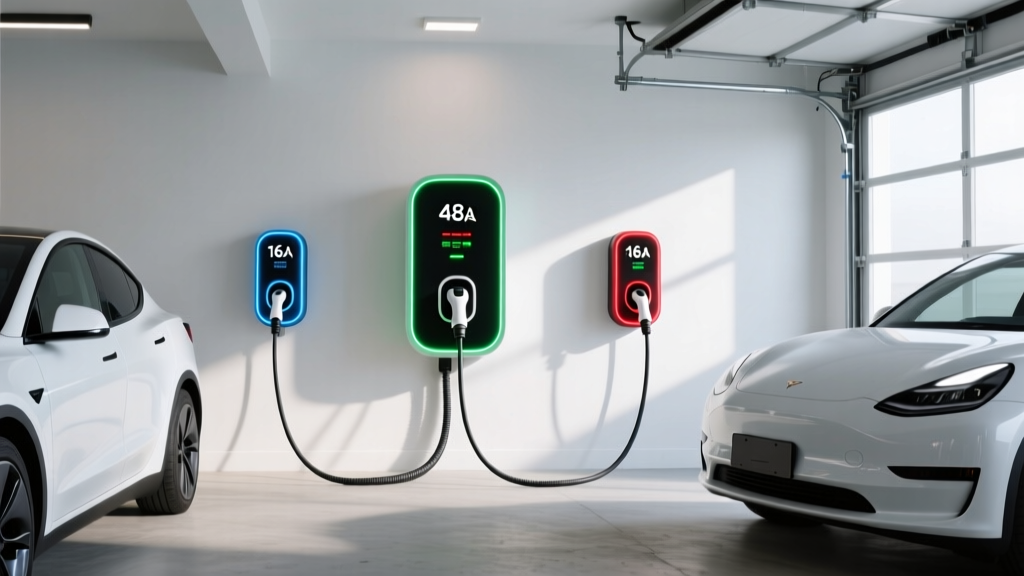
- 16A × 240V = 3.84 kW
- 32A × 240V = 7.68 kW
- 48A × 240V = 11.52 kW
Most EVs accept up to 11.5 kW on Level 2 (the Tesla Model 3/Y and Hyundai Ioniq 5 are rated at 11.5 kW; the Ford F-150 Lightning accepts up to 19.2 kW on its extended-range onboard charger). Your car's onboard charger caps the maximum AC power it can accept — plugging a car limited to 7.7 kW into a 48A/11.5 kW charger won't charge it any faster than a 32A/7.7 kW unit.
Charging Levels: Speeds, Amps, and Miles Per Hour
Here's how the three charging tiers compare in real-world terms. Miles-per-hour figures assume an average efficiency of 3.0 miles per kWh (typical for a mid-size crossover like the Tesla Model Y or Hyundai Ioniq 5; larger vehicles like the Rivian R1S average closer to 2.3 mi/kWh).
| Level | Voltage / Amps | Power (kW) | Miles Added Per Hour | Typical Use Case |
|---|---|---|---|---|
| Level 1 | 120V / 12A | 1.4 kW | ~4 mi/hr | Emergency / PHEV overnight top-up |
| Level 2 (16A) | 240V / 16A | 3.8 kW | ~11 mi/hr | Budget install, small-panel homes |
| Level 2 (32A) | 240V / 32A | 7.7 kW | ~23 mi/hr | Most common residential setup |
| Level 2 (48A) | 240V / 48A | 11.5 kW | ~34 mi/hr | Faster home charging, larger batteries |
| DC Fast (Level 3) | 400-800V DC | 50-350 kW | ~150-1,000+ mi/hr | Road trips, public fast-charging stations |
Real-world context: A 32A Level 2 charger adding 23 miles per hour will fully replenish a Tesla Model Y Long Range (EPA 320 miles, ~75 kWh usable battery) from 10% to 80% in roughly 7.5 hours — perfect for overnight charging. The same car on a 48A charger does 10-80% in about 5 hours. On a DC fast charger peaking at 250 kW, that 10-80% session takes approximately 25 minutes.
Electrical Requirements by Amp Level: What Your Panel Needs
The National Electrical Code (NEC) requires that continuous loads (anything running 3+ hours, which includes EV charging) use no more than 80% of a circuit breaker's rated capacity. This is why charger amp ratings don't match breaker sizes directly:
| Charger Amps | Required Breaker Size | Wire Gauge (Copper) | Panel Headroom Needed |
|---|---|---|---|
| 16A | 20A | 12 AWG | ~20A spare capacity |
| 32A | 40A | 8 AWG | ~40A spare capacity |
| 48A | 60A | 6 AWG | ~60A spare capacity |
Panel upgrade reality: Most modern homes with 200A service have enough headroom for a 48A/60A breaker circuit. Older homes with 100A panels often max out with existing loads (HVAC, electric range, dryer) and may need a panel upgrade to 200A — a significant added cost. A licensed electrician will perform a load calculation per NEC Article 220 to determine your available capacity. Don't skip this step; an overloaded panel is a fire risk.
Some homeowners opt for a load-management smart charger (like the Emporia Level 2 with load balancing) that dynamically reduces charging amps when other circuits draw heavily. This can avoid a panel upgrade entirely in marginal cases.
Home EV Charger Installation Cost Breakdown (2026)
Installation costs vary enormously based on your panel location relative to the charger, local permit fees, and whether upgrades are needed. Here's what to budget based on thousands of real installs tracked across the industry:
| Cost Component | Simple Install (panel nearby) | Complex Install (long run / upgrades) |
|---|---|---|
| Charger hardware (hardwired, 32-48A) | $350 – $700 | $350 – $700 |
| Electrician labor (2-4 hrs simple / 6-10 hrs complex) | $500 – $1,200 | $1,500 – $3,500 |
| Permit and inspection | $50 – $250 | $50 – $250 |
| Wire and conduit materials | $100 – $300 | $300 – $800 |
| Panel upgrade (100A → 200A, if needed) | — | $1,500 – $3,500 |
| Total | $1,000 – $2,450 | $3,700 – $8,750 |
Federal incentive: The Residential Clean Energy Credit (IRS Form 5695) covers 30% of EV charger hardware and installation costs, up to $1,000, for equipment placed in service through 2032. This applies to your federal tax liability — consult a tax professional for eligibility specifics. Some states and utilities stack additional rebates on top; check the Alternative Fuels Data Center for state-level incentive databases.
How Much Does Charging Cost Per Mile vs. Gas?
The economics depend heavily on your local electricity rate and whether you charge at home or rely on public DC fast charging. Here's a realistic comparison using national averages:
| Scenario | Rate / Price | Cost Per Mile (3 mi/kWh EV) | Annual Cost (12,000 mi) |
|---|---|---|---|
| Home charging (national avg. $0.17/kWh) | $0.17/kWh | $0.057/mi | $680 |
| Home off-peak TOU rate ($0.08/kWh) | $0.08/kWh | $0.027/mi | $320 |
| Public Level 2 ($0.25-$0.49/kWh avg.) | $0.35/kWh | $0.117/mi | $1,400 |
| DC fast charging ($0.35-$0.65/kWh avg.) | $0.50/kWh | $0.167/mi | $2,000 |
| Gas car (27 MPG avg., $3.40/gal) | $3.40/gal | $0.126/mi | $1,510 |
Home charging on an off-peak time-of-use plan delivers the strongest economics — roughly 80% cheaper per mile than a comparable gas car. Relying exclusively on DC fast charging erases most of the cost advantage. This is why a home Level 2 installation pays for itself within 1-3 years for most drivers.
Charging Time Examples: 10-80% by Battery Size and Amp Level
These estimates assume charging from 10% to 80% State of Charge (SoC). Charging slows significantly above 80% due to the charge curve taper — battery management systems reduce current to protect cell health, which is why DC fast chargers quote "10-80%" times rather than 0-100%.
| Battery Size (usable kWh) | Example Vehicle | 16A (3.8 kW) | 32A (7.7 kW) | 48A (11.5 kW) |
|---|---|---|---|---|
| 60 kWh | Chevrolet Equinox EV | ~11 hrs | ~5.5 hrs | ~3.6 hrs |
| 75 kWh | Tesla Model Y LR | ~14 hrs | ~6.8 hrs | ~4.5 hrs |
| 84 kWh | Hyundai Ioniq 5 (Long Range) | ~15.5 hrs | ~7.6 hrs | ~5.1 hrs |
| 100 kWh | Ford F-150 Lightning (Ext. Range) | ~18.5 hrs | ~9.1 hrs | ~6.1 hrs |
| 131 kWh | Rivian R1T (Max Pack) | ~24 hrs | ~11.9 hrs | ~8.0 hrs |
For daily driving of 30-40 miles, even a 16A charger provides enough overnight replenishment for most commuters. The 32A tier comfortably handles 100+ mile daily commutes with margin. The 48A tier matters most for larger batteries (trucks, large SUVs) or drivers who need maximum flexibility for unexpected long trips.
Connector Compatibility: NACS, CCS1, and CHAdeMO in 2026
The connector landscape has consolidated significantly. As of 2026, the North American Charging Standard (NACS), originally developed by Tesla, has been adopted by nearly every major automaker for new vehicles. Here's the current breakdown:
| Connector | Brands Using It (New Vehicles) | Adapter Needed for Tesla Superchargers? |
|---|---|---|
| NACS (native) | Tesla, Ford, GM, Rivian, Volvo, Polestar, Mercedes-Benz (2025+), Hyundai/Kia (2025+), BMW, Nissan (2025+) | No — direct compatibility |
| CCS1 | Remaining 2024-2025 models, some VW/ID.4 (pre-2026), older BMW i4/iX | Yes — CCS-to-NACS adapter (~$200-$250) for Supercharger access |
| CHAdeMO | Nissan Leaf (discontinued), Mitsubishi Outlander PHEV (older) | Limited — CHAdeMO infrastructure is declining |
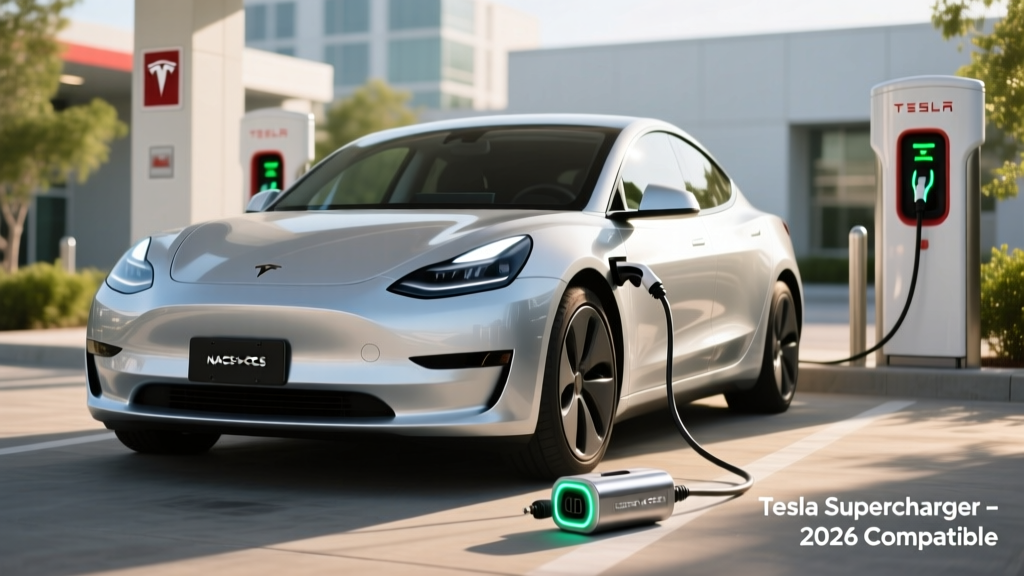
For home Level 2 charging, all vehicles use the J1772 connector (or NACS, which supports AC Level 2 through the same pins). Tesla vehicles ship with a J1772-to-NACS adapter. If you buy a third-party Level 2 charger with a J1772 plug, it will work with every EV on the road (Tesla owners use their included adapter). Chargers with a native NACS plug are now available and eliminate the adapter step for Tesla and newer NACS-equipped vehicles.
Recommended Home EV Chargers by Amp Level (2026 Picks)
Best 48A Hardwired: ChargePoint Home Flex (NACS)
- Power: Up to 11.5 kW (48A) on a 60A circuit; adjustable down to 16A
- Connector: NACS (native); J1772 version also available
- Cable length: 23 feet
- Smart features: Wi-Fi, app scheduling, energy tracking, Alexa integration, load-sharing with second unit
- Price: ~$599 (hardware only)
- UL-listed, indoor/outdoor rated (NEMA 4)
Best 32A Value: Emporia Vue Level 2 EV Charger
- Power: Up to 7.7 kW (32A) on a 40A circuit
- Connector: J1772 (universal with Tesla adapter)
- Cable length: 24 feet
- Smart features: Real-time energy monitoring, solar integration, automatic load management to avoid panel overload
- Price: ~$399 (hardware only)
- Load-balancing capability can avoid a panel upgrade
Best Budget 16A/Plug-in: Lectron V-BOX Pro (J1772)
- Power: Up to 3.8 kW (16A) on a standard NEMA 14-50 or 6-20 outlet
- Connector: J1772
- Cable length: 20 feet
- Smart features: Basic LED status, no Wi-Fi (non-smart)
- Price: ~$199
- Good for: renters, budget installs, PHEV owners with small batteries
Safety, Code, and Installation Best Practices
EV charging is a high-draw, continuous electrical load. Cutting corners here risks fire, failed inspections, and voided homeowner's insurance. Non-negotiable requirements:
- Dedicated circuit: Your EV charger must have its own breaker — never share a circuit with other appliances. A 48A charger on a 60A breaker means that breaker serves nothing else.
- GFCI protection: NEC 2020 and later requires Ground Fault Circuit Interrupter protection for all EV charging outlets (hardwired units often have built-in GFCI). Your electrician will ensure compliance with your local code cycle.
- Outdoor rating: If mounting outside, the charger must carry a NEMA 3R or NEMA 4 rating (weather-resistant). All chargers recommended above meet this standard.
- Permit and inspection: Nearly all US jurisdictions require an electrical permit for a new 240V circuit. The inspection ensures code compliance and protects your insurance coverage. Budget $50-$250 and 1-2 weeks for this process.
- Hardwired vs. plug: Hardwired installations (no plug, direct wire connection) are required for 48A/60A circuits in most jurisdictions and eliminate the risk of plug overheating. NEMA 14-50 outlets (50A) are acceptable for 32A and 40A chargers and offer portability if you move.
Frequently Asked Questions
How much does it cost to install a home EV charger?
A straightforward 32A or 48A Level 2 installation with the panel nearby typically costs $1,000-$2,450 total (hardware + electrician + permit). Complex installs requiring long wire runs, conduit, or a panel upgrade to 200A can reach $3,700-$8,750. The 30% federal tax credit (up to $1,000) offsets part of this cost.
How fast will each charging level add range?
Level 1 (120V, 12A) adds roughly 4 miles per hour. Level 2 at 16A adds ~11 mi/hr, 32A adds ~23 mi/hr, and 48A adds ~34 mi/hr for a typical crossover EV. DC fast charging at 150+ kW adds 150-1,000+ miles per hour but is not practical for daily home use due to cost and infrastructure.
Which connector/charger is compatible with my EV?
For home Level 2 charging, any J1772 charger works with every EV sold in the US (Tesla owners use the included J1772-to-NACS adapter). For new 2025-2026 vehicles from Ford, GM, Rivian, Hyundai, Kia, and others, NACS-native chargers are now available and eliminate the adapter. For DC fast charging, check whether your vehicle has CCS1, NACS, or CHAdeMO — the Alternative Fuels Data Center station locator maps compatible chargers near you.
How much does charging cost per mile vs. gas?
Home charging at the national average rate of $0.17/kWh costs about $0.057 per mile — roughly 55% less than a 27 MPG gas car at $3.40/gallon ($0.126/mi). On an off-peak time-of-use plan at $0.08/kWh, the cost drops to $0.027/mi — a 79% savings. Public DC fast charging at $0.50/kWh costs $0.167/mi, which is actually more expensive than gas.
What electrical upgrades might I need?
Homes with 100A electrical service often need a panel upgrade to 200A to support a 48A charger, costing $1,500-$3,500. Homes with 200A service usually have sufficient capacity, but a licensed electrician must perform a load calculation. If your panel is at capacity, alternatives include installing a lower-amp charger (16A or 32A), using a smart load-management charger, or adding a secondary panel.