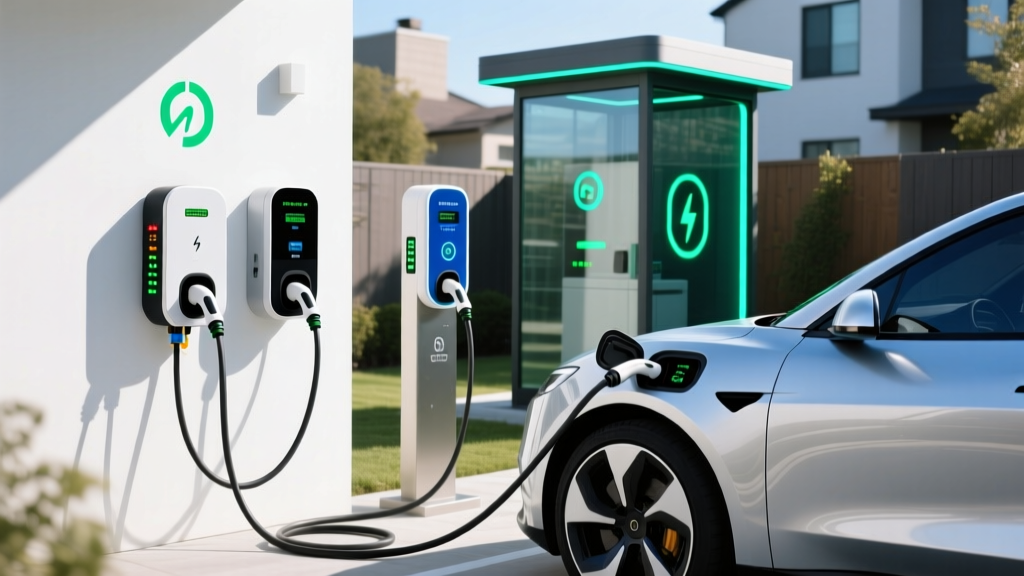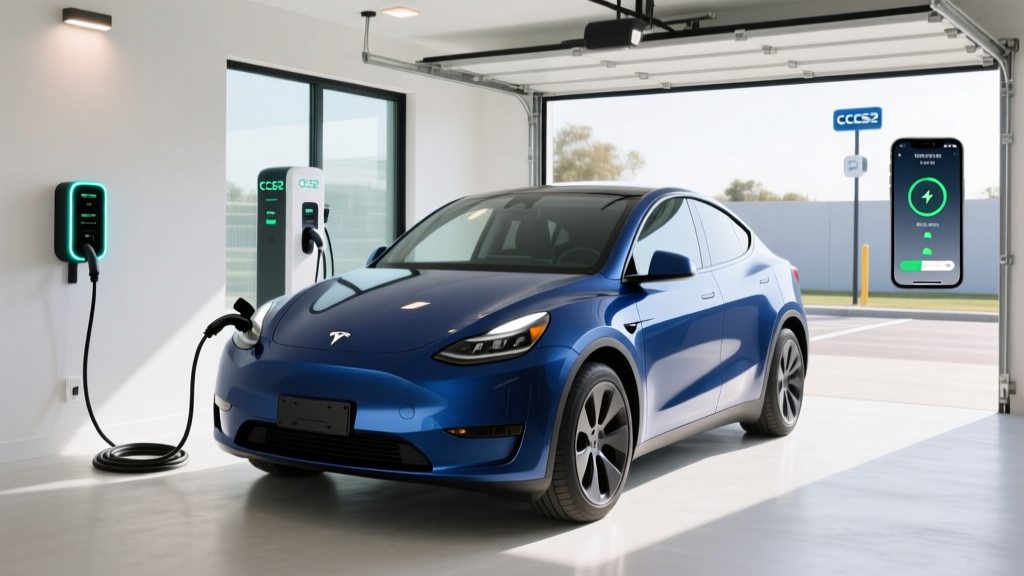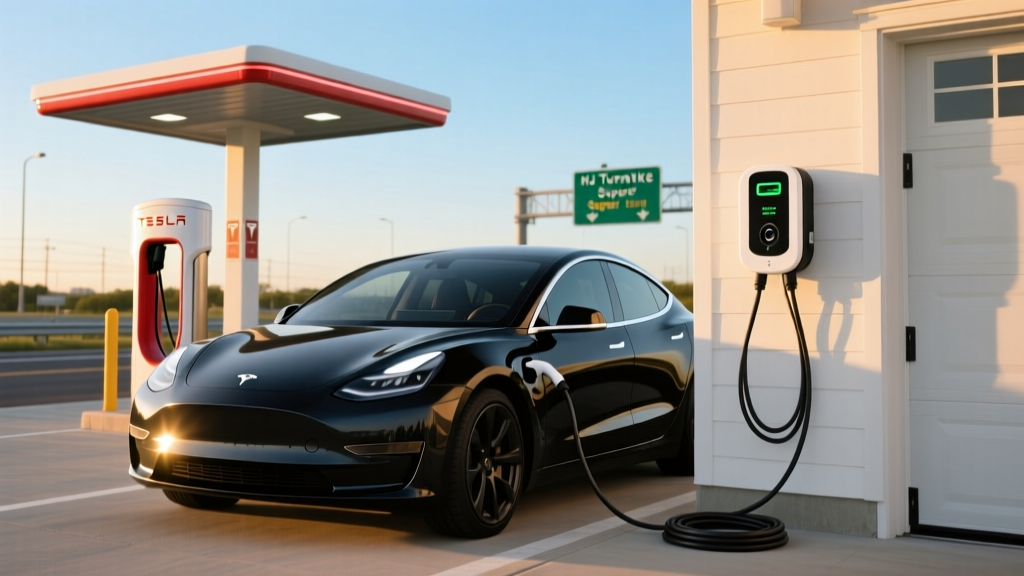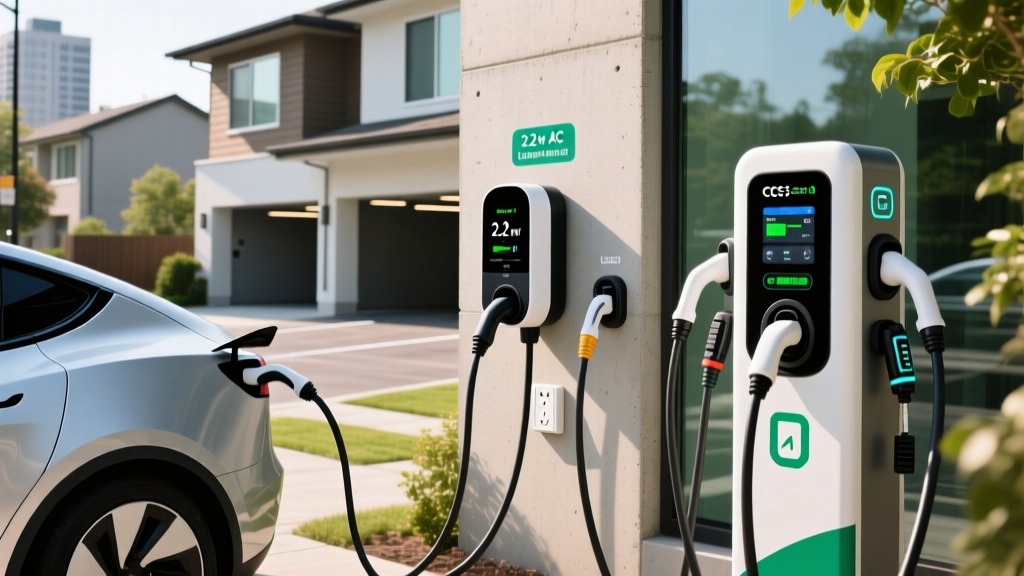
If you've searched for a charger 2.2 kW unit or any home EV charging equipment, you've likely hit a wall of conflicting specs: kW versus kWh, NACS versus CCS, 240V versus 120V. This guide cuts through the noise with exact numbers — charge rates, installation costs, per-mile economics, and the electrical upgrades your home might actually need in 2026.
Before we get into hardware, a critical distinction that trips up even experienced buyers: kW (kilowatts) measures power — the rate at which electricity flows into your car. kWh (kilowatt-hours) measures energy — the total capacity of your battery. A 60 kWh battery charged at 10 kW takes roughly six hours. Think of kW as the width of a hose and kWh as the size of the bucket.
Charging Levels Explained: Speeds, Power, and Real-World Range Added
Every EV sold in the US charges on one of three tiers. The numbers below reflect typical real-world delivery, not just peak marketing claims — because charge curves taper, especially above 80% state of charge (SoC).
| Level | Voltage | Power (kW) | Miles of Range per Hour | Typical Use |
|---|---|---|---|---|
| Level 1 (120V) | 120V AC | 1.0–1.9 kW (often ~1.4 kW) | 3–5 mi/hr | Overnight top-up, low-mileage drivers, PHEVs |
| Level 1 (2.2 kW variant) | 120V/240V adapter | ~2.2 kW | 5–8 mi/hr | Portable trickle for extended parking |
| Level 2 (240V) | 240V AC | 7.2–19.2 kW | 20–60 mi/hr | Home daily charging, workplace, public L2 |
| DC Fast (Level 3) | 400–900V DC | 50–350 kW | 150–1,200+ mi/hr (peak) | Road trips, highway corridors, rapid top-ups |
The charger 2.2 kW tier sits between standard Level 1 (1.4 kW from a regular 120V outlet) and full Level 2. Some portable EVSE units and European-market Schuko-adapted chargers deliver around 2.2 kW on a standard 120V/15A circuit (or 230V/10A abroad). At 2.2 kW, a 75 kWh battery (like the Ford Mustang Mach-E Extended Range) gains roughly 7 miles of range per hour — enough to recover 70–80 miles over a 10-hour workday or overnight. It's a legitimate option for plug-in hybrids with smaller batteries (a Toyota RAV4 Prime's 18.1 kWh pack fills in about 8 hours at 2.2 kW) but painfully slow for a full BEV from empty.
For DC fast charging, peak kW is not sustained kW. A vehicle rated for 250 kW peak may only hold that rate from 10–30% SoC before tapering. Expect a realistic 10–80% session on a 350 kW-capable vehicle (like the Hyundai Ioniq 5 with its 800V architecture) to take approximately 18 minutes under ideal thermal conditions, while a 400V vehicle peaking at 150 kW (like the Chevrolet Equinox EV) will need 30–35 minutes for the same 10–80% session. Always precondition your battery — most EVs do this automatically when you navigate to a charger — to hit advertised charge rates.
Home Charger Installation: Electrical Requirements and Real Costs
Installing a Level 2 home charger is the single biggest ownership upgrade most EV buyers make. The total cost depends on your electrical panel's capacity, the distance from panel to charger location, and local permitting requirements.
Electrical Requirements for Level 2
A typical Level 2 home charger draws 240V AC on a dedicated circuit. Common configurations:
- 32A circuit (7.7 kW): Requires a 40A breaker (NEC requires 125% headroom for continuous loads). Suitable for most daily driving under 40 miles.
- 40A circuit (9.6 kW): Requires a 50A breaker. The sweet spot for most homes — charges a 75 kWh battery overnight in under 8 hours.
- 48A circuit (11.5 kW): Requires a 60A breaker. Ideal for large-battery trucks/SUVs (Ford F-150 Lightning, Rivian R1S) or two-EV households using a load-sharing charger.
- 80A circuit (19.2 kW): Requires a 100A breaker. Available on the Tesla Wall Connector and a few others — overkill for most, but future-proofs for large batteries.
What Electrical Upgrades Might You Need?
Homes built before 1990 often have 100A main service panels that may lack spare breaker slots or total amperage headroom for a 40A+ EV circuit alongside existing loads (electric range, dryer, HVAC). A licensed electrician will perform a load calculation per NEC Article 220 to determine if your panel can handle the added draw. If not, options include:
- Panel upgrade (200A service): $1,500–$4,000 depending on utility requirements, trenching, and local labor rates.
- Smart load management device: Products like the Emporia Smart Load Center or Span panel dynamically share capacity between EV charging and household loads, avoiding a full panel upgrade. Cost: $500–$2,500 installed.
- Sub-panel installation: If your charger is far from the main panel (detached garage, carport), a sub-panel may be required. Adds $300–$800.
| Component | Simple Install (panel nearby, 200A service) | Complex Install (panel upgrade, long conduit run) |
|---|---|---|
| Level 2 charger hardware (40A/9.6 kW) | $350–$650 | $350–$650 |
| Electrician labor (2–4 hrs simple / 6–12 hrs complex) | $300–$800 | $1,000–$2,500 |
| Materials (conduit, wire, breaker, mounting) | $100–$300 | $300–$800 |
| Permit and inspection | $50–$200 | $50–$300 |
| Panel upgrade (if needed) | $0 | $1,500–$4,000 |
| Total estimated range | $800–$1,950 | $3,200–$8,250 |
Always hire a licensed electrician and pull a permit. Unpermitted EV charger installs can void homeowner's insurance claims and create fire risk — a dedicated circuit with proper wire gauge (typically 6 AWG copper for 40A, 4 AWG for 48A) and GFCI protection per NEC 2023/2026 code is non-negotiable for outdoor installations.
Connector Compatibility: NACS, CCS1, and CHAdeMO in 2026
The connector landscape has consolidated significantly. As of 2026, nearly every major automaker has adopted the North American Charging Standard (NACS) — originally developed by Tesla — for new vehicles. Here's what fits what:
| Connector | Brands Using It (Native) | Adapter Situation |
|---|---|---|
| NACS (Tesla standard) | Tesla (all), Ford, GM, Rivian, Volvo, Polestar, Mercedes-Benz, BMW, Hyundai/Kia (2025+), Subaru, Lucid, Fisker | Legacy CCS vehicles can use CCS-to-NACS adapters (~$200–$300) for Tesla Supercharger access |
| CCS1 (Combined Charging System) | Legacy VW ID.4 (pre-2025), older Hyundai/Kia, BMW i4/iX (pre-2025), Stellantis EVs | CCS1 vehicles need a NACS-to-CCS adapter for Supercharger access; Electrify America and most non-Tesla DC networks still have CCS1 cables |
| CHAdeMO | Nissan Leaf (discontinued after 2025 MY), Mitsubishi Outlander PHEV (older) | Effectively a legacy standard; no adapters to NACS for DC fast charging; CHAdeMO stations increasingly rare |
For home Level 2 charging, the connector is less critical because J1772 (the older standard) and NACS both deliver the same AC power — and Tesla includes a J1772-to-NACS adapter with every vehicle. If you're buying a home charger in 2026, choosing a NACS-terminated unit (like the Tesla Wall Connector) gives you native compatibility with the growing majority of EVs, while a J1772-terminated charger (like the ChargePoint Home Flex) works with everything via adapter.
Charging Cost Per Mile: Home Electricity vs. Public Charging vs. Gas
The economics of EV charging depend entirely on where you charge. Here's a realistic comparison using 2026 national averages and a representative EV efficiency of 3.0 miles/kWh (roughly 112 MPGe, typical of a mid-size crossover like the Tesla Model Y or Hyundai Ioniq 5).
| Scenario | Cost per kWh | Cost per Mile (at 3 mi/kWh) | Equivalent MPG at $3.40/gal |
|---|---|---|---|
| Home Level 2, off-peak utility rate | $0.08–$0.14 | $0.03–$0.05 | 68–113 MPG |
| Home Level 2, standard residential rate (US avg) | $0.16–$0.18 | $0.05–$0.06 | 57–68 MPG |
| Public Level 2 (ChargePoint, EVgo L2) | $0.25–$0.49 | $0.08–$0.16 | 21–43 MPG |
| DC Fast Charging (Tesla Supercharger, EA) | $0.28–$0.56 | $0.09–$0.19 | 18–38 MPG |
| Gasoline vehicle (28 MPG combined avg) | $3.40/gal | $0.12 | 28 MPG |
The takeaway: home charging is where EV economics win decisively. At off-peak rates, you're paying the equivalent of 100+ MPG. But rely exclusively on public DC fast chargers and your per-mile cost can equal or exceed a fuel-efficient gas car. For a driver covering 12,000 miles annually with 80% home charging at $0.15/kWh and 20% DC fast charging at $0.40/kWh, annual fuel cost is approximately $680 — versus $1,457 for a 28 MPG gas car. That's roughly $777 in annual savings, or $3,885 over five years.
Many utilities offer time-of-use (TOU) plans that drop rates to $0.06–$0.10/kWh between midnight and 6 AM. Pair a TOU plan with your charger's scheduled charging feature and you'll minimize costs automatically. Check your utility's EV-specific rate plans — they're often not advertised prominently.
Charging Time Examples: 10–80% for Common Battery Sizes
Battery preconditioning, ambient temperature, and the vehicle's charge curve all affect real-world charging times. The figures below assume a preconditioned battery at moderate temperatures (60–80°F) and a charger capable of delivering the vehicle's peak rate:
- Compact EV, 58 kWh usable (e.g., VW ID.4 Standard Range): Peak 135 kW DC fast — 10–80% in approximately 28 minutes. Level 2 at 9.6 kW — 10–80% in about 4 hours 15 minutes.
- Mid-size crossover, 77 kWh usable (e.g., Tesla Model Y Long Range): Peak 250 kW DC fast — 10–80% in approximately 22 minutes. Level 2 at 11.5 kW (48A) — 10–80% in about 4 hours 40 minutes.
- 800V architecture, 77 kWh usable (e.g., Hyundai Ioniq 5): Peak 240+ kW DC fast — 10–80% in approximately 18 minutes. Level 2 at 10.9 kW — 10–80% in about 4 hours 55 minutes.
- Full-size truck, 131 kWh usable (e.g., Ford F-150 Lightning Extended Range): Peak 155 kW DC fast — 10–80% in approximately 41 minutes. Level 2 at 19.2 kW (80A) — 10–80% in about 4 hours 35 minutes.
Note that the last 20% (80–100%) takes nearly as long as the first 70% due to charge-curve taper. For road trips, plan to charge from 10–80% and move on rather than waiting for a full battery — you'll spend less time plugged in overall.
Recommended Home EV Chargers for 2026
These are the units that consistently perform well in real-world use, with verified power output, connector options, and current pricing:
Tesla Wall Connector (Gen 4)
- Power: Up to 48A / 11.5 kW (hardwired) or 40A / 9.6 kW (NEMA 14-50 plug)
- Connector: NACS native; J1772 adapter included
- Cable length: 24 ft
- Smart features: Wi-Fi, OTA updates, Power Sharing (link up to 6 units on one circuit for multi-EV homes), access control
- Price: ~$425 (NACS) / ~$425 (J1772 variant)
- Best for: Tesla owners and the growing NACS-native fleet; cleanest install with integrated cable management
ChargePoint Home Flex (2nd Gen)
- Power: Up to 50A / 12 kW (adjustable down to 16A for smaller circuits)
- Connector: J1772 native (works with all EVs via Tesla's included adapter)
- Cable length: 23 ft
- Smart features: Wi-Fi, Alexa integration, scheduling, energy tracking, flexible amperage dip-switch settings
- Price: ~$550–$650
- Best for: Mixed-EV households, renters who may move (NEMA 14-50 plug version is portable)
Emporia Level 2 EV Charger
- Power: Up to 48A / 11.5 kW (hardwired) or 40A / 9.6 kW (plug-in)
- Connector: J1772
- Cable length: 24 ft
- Smart features: Wi-Fi, solar integration (pairs with Emporia Vue energy monitor for solar-aware charging), TOU scheduling, load management
- Price: ~$350–$400 (best value in smart chargers)
- Best for: Solar-equipped homes, budget-conscious buyers who still want smart features
Grizzl-E Smart (United Chargers)
- Power: Up to 40A / 9.6 kW
- Connector: J1772
- Cable length: 24 ft
- Smart features: OCPP-compatible (open protocol), adjustable amperage, extreme cold rated (-40°F), rugged aluminum case
- Price: ~$400–$500
- Best for: Cold-climate installations, outdoor mounts, buyers who value durability over app features
Safety, Code, and Installation Best Practices
EV charging draws sustained high current for hours — unlike a dryer or oven that cycles on and off. This makes proper installation critical. Per the National Electrical Code (NEC), key requirements include:
- Dedicated circuit: Your EV charger must be on its own breaker — no sharing with other appliances.
- GFCI protection: Required for all outdoor receptacles and increasingly for indoor EV installations per 2023/2026 NEC revisions. Hardwired units with built-in ground fault detection may satisfy this without a GFCI breaker.
- Outdoor rating: If mounted outside, the charger must carry a NEMA 4 (or IP65+) weather rating. All units listed above qualify.
- Wire gauge: Must match the breaker size and run length. Undersized wire causes voltage drop, heat buildup, and fire risk. Your electrician will calculate this — don't DIY this portion.
- Permit and inspection: Most jurisdictions require an electrical permit for a new 240V circuit. The inspection verifies wire gauge, breaker sizing, grounding, and GFCI compliance. Skip this and you risk insurance denial in the event of an electrical fire.
The US Department of Energy also recommends having your electrician evaluate your entire home's electrical load — not just the charger circuit — especially if you plan to add solar, a heat pump, or a second EV in the coming years.
Frequently Asked Questions
How much does it cost to install a home EV charger?
A straightforward Level 2 installation with a nearby 200A panel typically costs $800–$1,950 total (charger + electrician + permit). If your home needs a panel upgrade to 200A service, expect $3,200–$8,250. The charger hardware itself ranges from $350–$650 for quality smart units.
How fast will each charging level add range?
Level 1 (120V, ~1.4 kW): 3–5 miles per hour. A 2.2 kW portable charger: 5–8 miles per hour. Level 2 (240V, 9.6 kW): roughly 30–35 miles per hour. DC fast charging (150–350 kW): 150–1,200+ miles per hour at peak, though sustained rates taper significantly above 50–60% SoC.
Which connector/charger is compatible with my EV?
For 2026 models, most new EVs from Ford, GM, Rivian, Hyundai, Kia, Volvo, BMW, and Mercedes use NACS. Older models and some remaining inventory use CCS1. The Nissan Leaf used CHAdeMO but has been discontinued. For home Level 2, any J1772 charger works with every EV (Tesla includes an adapter), and any NACS charger works with the growing NACS-native fleet.
How much does charging cost per mile vs. gas?
Home charging at the US average rate ($0.17/kWh) costs about $0.05–$0.06 per mile — equivalent to a 57–68 MPG gas car. Off-peak utility rates drop this to $0.03–$0.05/mile (68–113 MPG equivalent). Public DC fast charging at $0.40/kWh costs roughly $0.13/mile — comparable to a 26 MPG gas car. The savings come from charging at home.
What electrical upgrades might I need?
If your home has a 100A main panel (common in pre-1990 construction), you'll likely need a 200A service upgrade ($1,500–$4,000) or a smart load management system to avoid one. Homes with existing 200A service usually have sufficient capacity for a 40A EV circuit. A licensed electrician will perform a NEC Article 220 load calculation to determine your specific needs.
For authoritative information on home charging incentives and electrical safety standards, refer to the Alternative Fuels Data Center and your local utility's EV program page — many utilities offer rebates of $250–$1,000 that offset installation costs, and some state programs cover panel upgrades for income-qualified homeowners.