If you've spent time in EV forums or owner groups, you've likely encountered the term charger hell — the frustrating limbo of unreliable public chargers, confusing connector types, and vague home-installation quotes. It's the single biggest friction point for new EV buyers and a genuine barrier to adoption. But charger hell isn't inevitable. With the right home setup and a clear understanding of public infrastructure, most EV owners charge at home 85-95% of the time and rarely think about it.
This guide gives you the exact numbers: charging speeds in kW, real installation costs with electrician breakdowns, connector compatibility for every major 2026 EV brand, and cost-per-mile comparisons against gasoline. No fluff, no marketing superlatives — just the data you need to plan your charging life.
Charging Levels Explained: Speed, Power, and What You Actually Get
The most common mistake new EV buyers make is confusing kW (kilowatts) with kWh (kilowatt-hours). Here's the fix: kW is the rate of energy flow — like water pressure from a hose. kWh is the total energy stored — like the size of the bucket. Your battery capacity is measured in kWh (e.g., 75 kWh); your charger's output is measured in kW (e.g., 11.5 kW).
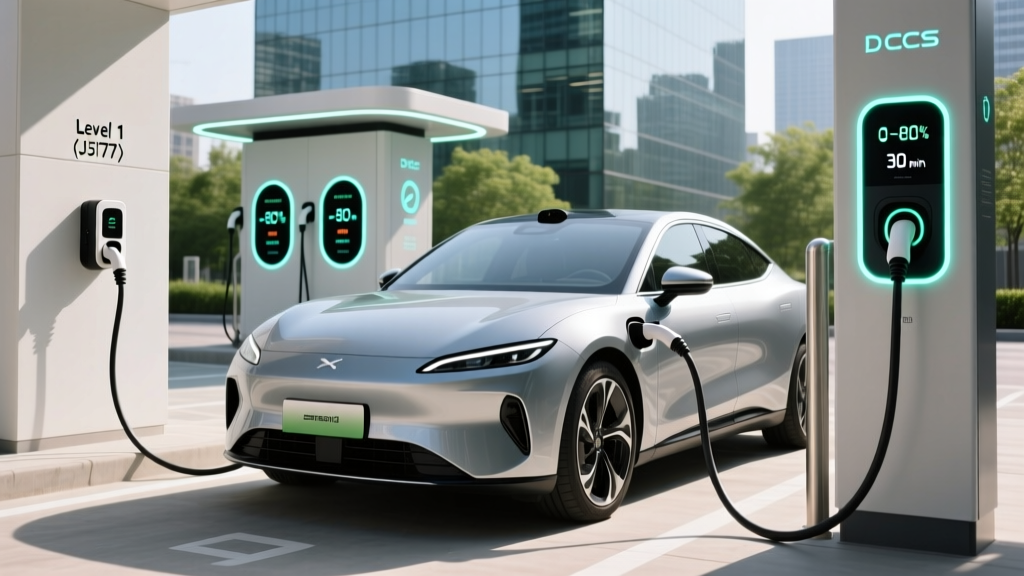
There are three charging levels relevant to EV owners. Here's what each delivers in practice:
| Level | Voltage | Power (kW) | Miles of Range per Hour | Best Use Case |
|---|---|---|---|---|
| Level 1 (120V) | 120V AC | 1.0–1.4 kW | 3–5 miles | Overnight trickle; PHEVs; emergency top-ups |
| Level 2 (240V) | 240V AC | 3.3–19.2 kW | 12–75 miles | Daily home charging; workplace; destination |
| DC Fast Charging | 400–800V DC | 50–350 kW | 150–1,000+ miles | Road trips; quick top-ups; fleet operations |
Real-world context: A Tesla Model Y with a 75 kWh (usable) battery charging on a 48-amp Level 2 circuit (11.5 kW) will go from 20% to 80% in roughly 4.5 hours. That same vehicle on a 250 kW DC fast charger will hit 10-80% in approximately 20–25 minutes, though the charge curve tapers significantly above 80% — a physics reality that no manufacturer can engineer away.
For daily driving of 30-40 miles, even Level 1 can technically suffice for many commuters. But Level 2 at home is the baseline for practical EV ownership: it's faster, more efficient (less energy lost to heat), and enables preconditioning — warming or cooling the battery before a DC fast-charge stop to maximize charge speed.
Home Charger Installation: Costs, Electrical Requirements, and Panel Upgrades
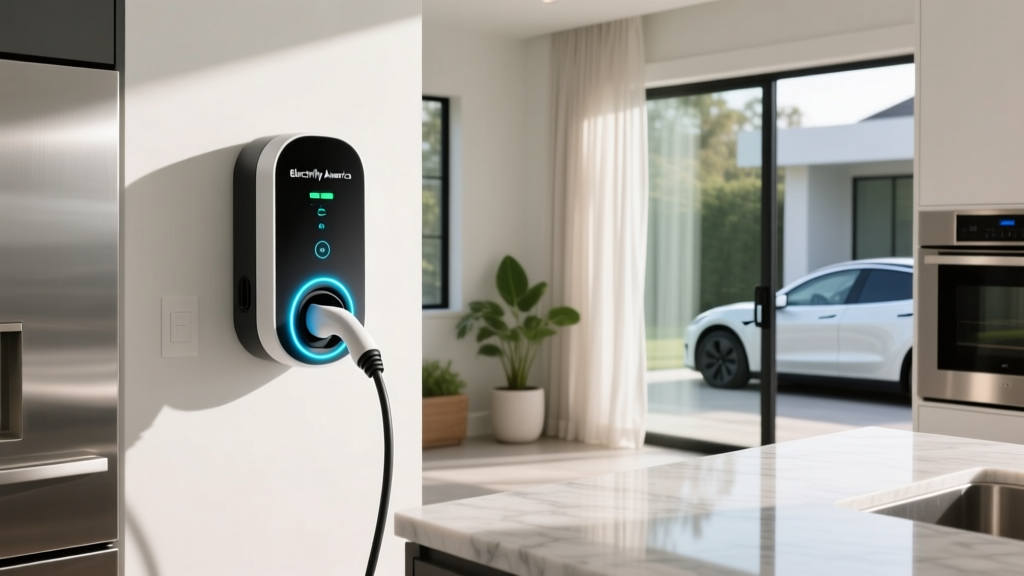
Home Level 2 charging is where most EV owners escape charger hell entirely. But installation costs vary wildly depending on your home's electrical panel, the distance from the panel to the charger location, and local permit requirements.
Standard electrical requirements for a Level 2 home charger:
- Circuit: Dedicated 240V circuit, typically 40A or 50A (supports 32A or 40A continuous charging, respectively — NEC requires circuits rated 125% above continuous load)
- Wire gauge: 6 AWG copper for 50A circuits; 8 AWG for 40A (varies by run length)
- Breaker: Double-pole breaker in your main panel
- GFCI protection: Required by NEC 2020 and later for EV charging outlets (or built into the charger itself for hardwired units)
- Outdoor rating: NEMA 4 or NEMA 4X enclosure if mounted outside
Here's a realistic cost breakdown for a typical 48-amp Level 2 home charger installation in 2026:
| Cost Component | Simple Install (panel nearby) | Complex Install (long run / panel upgrade) |
|---|---|---|
| Charger equipment (48A smart charger) | $400–$650 | $400–$650 |
| Electrician labor (2–6 hours) | $300–$600 | $800–$1,800 |
| Materials (wire, conduit, breaker) | $100–$200 | $300–$600 |
| Permit and inspection | $50–$150 | $100–$300 |
| Electrical panel upgrade (if needed) | $0 | $1,500–$3,500 |
| Total estimated cost | $850–$1,600 | $3,100–$6,850 |
The panel upgrade reality: If your home has a 100-amp electrical panel — common in homes built before the 1990s — adding a 50A EV circuit may exceed your panel's capacity, especially if you already run electric appliances, HVAC, and a dryer. A panel upgrade to 200A is a significant but one-time investment. Always have a licensed electrician perform a load calculation before quoting your install. Some utilities offer rebates for panel upgrades tied to EV adoption — check with your local provider.
Hardwired vs. plug-in (NEMA 14-50): A hardwired charger avoids the need for a GFCI breaker (saving $80-$150) and is generally more reliable. A NEMA 14-50 outlet gives you portability — useful if you plan to move or take the charger to a second property. Both are valid; discuss with your electrician based on your situation.
For authoritative installation guidance, the U.S. Department of Energy's home charging page provides detailed requirements and a qualified installer locator.
Connector Compatibility: NACS, CCS1, CHAdeMO, and Adapter Needs
The connector landscape shifted dramatically between 2023 and 2026. Tesla's North American Charging Standard (NACS) has been adopted by nearly every major automaker, and as of 2025, most new EVs ship with a native NACS port. Here's where each brand stands for the 2026 model year:
| Connector | Brands Using It (Native) | DC Fast-Charger Availability | Adapter Needed? |
|---|---|---|---|
| NACS (Tesla standard) | Tesla, Ford, GM, Rivian, Hyundai/Kia (2025+), Volvo, Polestar, BMW, Mercedes, Subaru | Tesla Superchargers (20,000+ stalls), Electrify America (partial), EVgo | CCS-to-NACS adapters available for older CCS vehicles (~$200-$300) |
| CCS1 | VW (ID.4 through 2024), older Ford/GM/Hyundai models, Stellantis, Honda Prologue (2024-2025) | Electrify America, EVgo, ChargePoint, Ionity (Europe) | NACS-to-CCS adapters available (~$200-$350) |
| CHAdeMO | Nissan Leaf (legacy), Mitsubishi Outlander PHEV (older) | Declining; some Electrify America and legacy stations | Limited adapter options; network shrinking |
What this means practically: If you're buying a new EV in 2026, it almost certainly has a NACS port. This gives you access to the Tesla Supercharger network — the most reliable and extensive DC fast-charging infrastructure in North America, with over 20,000 stalls. If you own a 2022-2024 model with CCS1, a NACS adapter (sold by Tesla, Ford, and third parties) unlocks Supercharger access, though charge speeds may be limited by the adapter's rated throughput.
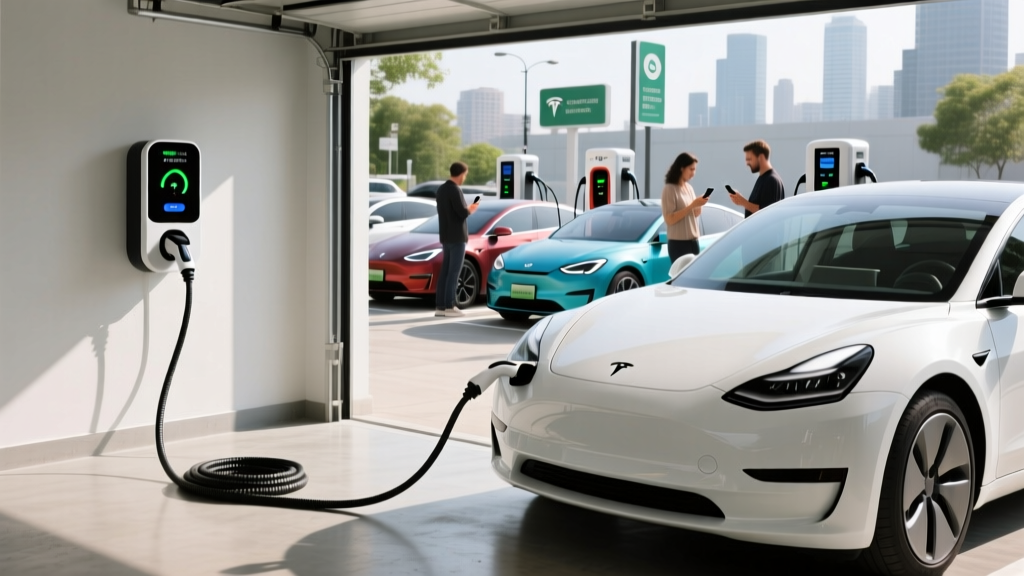
Home Level 2 connectors use the J1772 standard for all non-Tesla EVs, or a proprietary Tesla connector. Most Level 2 home chargers ship with J1772; Tesla includes a J1772 adapter with every vehicle. If you own both a Tesla and a non-Tesla EV, a universal Level 2 charger with swappable connectors (like the Tesla Universal Wall Connector) handles both.
Level 2 Charger Equipment Picks: Power, Features, and Pricing
Not all Level 2 chargers are equal. Key differentiators include max power output (amps), cable length, smart features (Wi-Fi, scheduling, load management), build quality, and UL certification. Here are four well-regarded options for 2026:
ChargePoint Home Flex (2026)
- Power: Up to 50A (12 kW) — adjustable down to 16A for smaller circuits
- Connector: J1772 (NACS adapter included or available)
- Cable length: 23 feet
- Smart features: Wi-Fi, app scheduling, energy tracking, Alexa integration
- Installation: Hardwired or NEMA 14-50 plug
- Price: ~$549
Best for: Most homes; flexible amperage settings accommodate older panels.
Tesla Universal Wall Connector
- Power: Up to 48A (11.5 kW)
- Connector: Integrated NACS + J1772 adapter (charges both Tesla and non-Tesla)
- Cable length: 24 feet
- Smart features: Wi-Fi, OTA updates, Power Sharing (link multiple units on one circuit), Tesla app integration
- Installation: Hardwired only
- Price: ~$599
Best for: Multi-EV households with at least one Tesla; cleanest dual-connector solution.
Emporia Vue EV Charger
- Power: Up to 48A (11.5 kW)
- Connector: J1772 (NACS version available)
- Cable length: 24 feet
- Smart features: Real-time energy monitoring, solar integration, load management with Emporia Vue panel monitor
- Installation: Hardwired or NEMA 14-50
- Price: ~$399
Best for: Solar-equipped homes; budget-conscious buyers who want energy visibility.
Grizzl-E Smart (United Chargers)
- Power: Up to 40A (9.6 kW)
- Connector: J1772 or NACS (select at purchase)
- Cable length: 24 feet
- Smart features: Wi-Fi, OCPP protocol support, adjustable amperage, extreme cold rating (-40°F)
- Installation: Hardwired or NEMA 14-50
- Price: ~$499
Best for: Cold-climate installations; rugged build; OCPP support for utility demand-response programs.
Amperage selection tip: Don't automatically buy a 48A charger. If your panel can only spare a 40A circuit, a 32A charger (7.7 kW) is the correct, code-compliant match. A good electrician will calculate your available capacity and recommend the right circuit size. Oversizing a circuit is a safety and code violation.
Cost to Charge: Home vs. Public vs. Gasoline — The Real Numbers
Charging cost is where EV ownership either shines or disappoints, depending entirely on where and when you charge. Here's a data-driven breakdown using a representative midsize EV with 3.0 miles per kWh efficiency (e.g., 2026 Tesla Model Y, Hyundai Ioniq 5, Chevrolet Equinox EV):
| Scenario | Rate ($/kWh) | Cost to Add 200 Miles | Cost Per Mile |
|---|---|---|---|
| Home — off-peak utility rate (utility average) | $0.09–$0.14 | $6.00–$9.33 | $0.03–$0.047 |
| Home — standard residential rate (national avg.) | $0.16–$0.18 | $10.67–$12.00 | $0.053–$0.06 |
| Public Level 2 (workplace, shopping, destination) | $0.20–$0.35 | $13.33–$23.33 | $0.067–$0.117 |
| DC Fast Charging (Electrify America, EVgo, Tesla) | $0.30–$0.55 | $20.00–$36.67 | $0.10–$0.183 |
| Gasoline equivalent (25 MPG combined, $3.40/gal) | $3.40/gallon | $27.20 | $0.136 |
The takeaway: Home off-peak charging delivers fuel costs at roughly one-quarter to one-third the price of gasoline. Even at standard residential rates, you're saving 50-60% per mile. But exclusive reliance on DC fast charging can push your per-mile cost above gasoline — a scenario that creates charger hell for apartment dwellers and street-parkers without home charging access.
Time-of-use (TOU) rates are critical. Many utilities offer EV-specific plans with off-peak rates between 11 PM and 6 AM as low as $0.06-$0.09/kWh. Scheduling your charger (via the charger app or vehicle settings) to charge during these windows maximizes savings. Check your utility's EV rate plans — this single step can cut your annual fuel cost by hundreds of dollars.
For current national electricity rate data, the U.S. Energy Information Administration (EIA) publishes monthly average residential electricity prices by state.
DC Fast Charging in Practice: Charge Curves, 10-80% Times, and Taper Reality
DC fast-charging specs are the most misused numbers in EV marketing. A vehicle might advertise "250 kW peak charging," but that peak is sustained for only a portion of the session. Understanding the charge curve is essential for realistic road-trip planning.
Here's what 10-80% charging looks like for common 2026 EVs on appropriate DC fast chargers:
- Hyundai Ioniq 5 (84 kWh battery, 800V architecture): Peaks at ~235 kW, 10-80% in approximately 18 minutes on a 350 kW charger. Sustains high power longer due to 800V system.
- Tesla Model Y Long Range (75 kWh, 400V): Peaks at ~250 kW at V4 Superchargers, 10-80% in approximately 22-25 minutes. Power tapers noticeably above 60%.
- Chevrolet Equinox EV (85 kWh, Ultium): Peaks at ~190 kW, 10-80% in approximately 25-28 minutes.
- Ford F-150 Lightning (extended range, 131 kWh): Peaks at ~150 kW, 10-80% in approximately 38-42 minutes — the large battery means more total energy even at moderate charge rates.
- BMW iX xDrive50 (111.5 kWh): Peaks at ~200 kW, 10-80% in approximately 31-34 minutes.
Why charging slows above 80%: Lithium-ion cells accept charge fastest at low states of charge. As the battery fills, the battery management system (BMS) reduces current to protect cell health and prevent lithium plating. This is why most road-trip route planners target 10-80% stops — the final 20% can take as long as the first 60%. Plan accordingly: charge to 80%, then drive.
Preconditioning matters. If you navigate to a DC fast charger using your vehicle's built-in navigation, most modern EVs will precondition (warm) the battery to the optimal temperature for fast charging — typically 85-95°F at the cell level. Arriving at a fast charger with a cold battery (below 50°F) without preconditioning can cut your peak charge rate by 30-50% and add 10-15 minutes to your stop.
Safety, Electrical Code, and What Your Inspector Will Check
EV charging is a continuous high-draw electrical load — effectively running a large appliance for hours at a time. Safety isn't optional, and cutting corners here risks fire, equipment damage, and voided insurance coverage.
Key safety and code requirements (NEC 2020/2023, adopted in most jurisdictions):
- Dedicated circuit: Your EV charger must be on its own dedicated breaker — no sharing with other outlets or appliances.
- GFCI protection: Required for receptacle-based (plug-in) EV chargers. Hardwired units with integrated ground-fault protection satisfy this requirement without a GFCI breaker. Note: some electricians report nuisance GFCI trips with certain plug-in charger/breaker combinations — a hardwired install avoids this.
- Outdoor rating: Outdoor chargers or outlets must be rated NEMA 4 (weatherproof) with an in-use cover for receptacles.
- Wire sizing: Must match the breaker amperage and account for voltage drop on runs over 100 feet. Undersized wire causes heat buildup and is a fire hazard.
- Permit and inspection: Required in virtually all jurisdictions. The inspector will verify wire gauge, breaker sizing, grounding, GFCI compliance, and proper mounting. Skipping a permit can cause problems at home sale and may void homeowner's insurance claims related to electrical fire.
Load management systems (offered by Emporia, Tesla Power Sharing, and some utility programs) allow two chargers to share a single circuit, dynamically allocating current based on each vehicle's needs. This is a legitimate, code-compliant way to charge two EVs on a single 60A circuit without a panel upgrade.
For electrical code specifics, always defer to a licensed electrician familiar with your local jurisdiction. The National Electrical Code (NEC) sets the baseline, but local amendments vary. The National Fire Protection Association maintains NEC resources and code adoption maps by state.
Public Charging Reliability: Navigating What's Left of Charger Hell
Public charging reliability has improved substantially since 2023, but it remains uneven. Here's the honest 2026 picture:
- Tesla Supercharger network: Consistently the most reliable, with 95%+ uptime. Now open to non-Tesla EVs (with NACS port or adapter) at many locations. Pricing typically $0.25-$0.40/kWh depending on location and time.
- Electrify America: Improved significantly after 2024 infrastructure investments. Expect 85-90% uptime at newer stations; older locations still have occasional outages. Pricing ~$0.35-$0.55/kWh for guests; subscription plans reduce rates.
- EVgo: Growing network, especially in urban areas and along highways. Reliability ~85-90%. Pricing varies; membership plans offer reduced rates.
- ChargePoint: Extensive Level 2 network, growing DC fast presence. Reliability varies by site host (retail, workplace, municipality). App is robust.
Practical tips for avoiding public charger hell:
- Always carry a CCS-to-NACS or NACS-to-CCS adapter appropriate for your vehicle — redundancy is your best defense.
- Check charger status in PlugShare or the network's app before driving to a station. User reports flag broken stalls in near-real-time.
- Plan road trips with a buffer: identify at least two charging options within a 20-mile window of your target stop.
- If a charger stalls mid-session, try a different stall at the same station before moving to another location — individual dispenser failures are more common than full-station outages.
- Precondition your battery before every DC fast stop. The time savings are substantial, especially in cold weather.
Frequently Asked Questions
How much does it cost to install a home EV charger?
For a straightforward installation with your electrical panel nearby and sufficient capacity, expect $850–$1,600 total (equipment + electrician + permit). If your panel needs upgrading to 200A or the charger is far from the panel, costs can reach $3,100–$6,850. Get at least two quotes from licensed electricians and confirm they perform a load calculation.
How fast will each charging level add range?
Level 1 (120V) adds 3–5 miles per hour. Level 2 (240V, 48A) adds approximately 30–40 miles per hour for most EVs. DC fast charging adds 150–300+ miles in 15–25 minutes depending on the vehicle's peak charge rate, battery size, and state of charge. These numbers assume moderate temperatures — cold weather reduces all charging speeds.
Which connector/charger is compatible with my EV?
For 2026 model-year vehicles: Tesla, Ford, GM, Rivian, Hyundai, Kia, BMW, Mercedes, Volvo, and Subaru use NACS. Older CCS1 vehicles (2022-2024 models from most brands) can use a NACS adapter to access Tesla Superchargers. CHAdeMO is limited to legacy Nissan Leaf and Mitsubishi models. For Level 2 home charging, all non-Tesla EVs use J1772; Tesla includes a J1772 adapter.
How much does charging cost per mile vs. gas?
At home on off-peak electricity ($0.09–$0.14/kWh), expect $0.03–$0.05 per mile — roughly one-quarter the cost of gasoline at $3.40/gallon and 25 MPG. At standard residential rates ($0.16–$0.18/kWh), you'll pay $0.05–$0.06 per mile. Exclusive DC fast charging ($0.30–$0.55/kWh) pushes costs to $0.10–$0.18 per mile, which can exceed gasoline for less efficient EVs.
What electrical upgrades might I need?
The most common upgrade is a panel capacity increase from 100A to 200A, costing $1,500–$3,500. You may also need a new breaker slot (if your panel is full), upgraded service wire from the utility, or a whole-home surge protector. Homes with 200A panels and gas appliances typically have sufficient headroom for a 48A EV circuit without upgrades. A licensed electrician's load calculation is the definitive answer.
Can I charge two EVs at home without a panel upgrade?
Yes, using a load management system. Products like the Tesla Universal Wall Connector with Power Sharing or the Emporia Vue system with load management allow two chargers to share a single 60A circuit, dynamically splitting current. This is code-compliant and avoids the cost of a panel upgrade or second dedicated circuit, though simultaneous charging will be slower for each vehicle.