If your garage outlet is 15 feet from where you park, the temptation to grab an extension cord is real. But plugging an EV into a standard household extension cord is one of the most common — and potentially dangerous — mistakes new EV owners make. This guide breaks down exactly what an electric car charging extension cord can and cannot do, the safety risks involved, and the proper solutions that keep your home, your car, and your insurance policy intact.
Why Extension Cords and EVs Are a Risky Combination
Electric vehicles draw a continuous, high-amperage load for hours at a time — a fundamentally different electrical demand than plugging in a lamp or phone charger. A typical Level 1 EV charger pulls 12 amps at 120 volts continuously for 8–20+ hours. That sustained draw generates heat at every connection point and along every foot of wire.
Most household extension cords are rated for intermittent use, not the continuous 80%+ load that EV charging represents. Here's what goes wrong:
- Voltage drop: Over long runs, thin-gauge wire causes voltage to sag below what your EV charger expects, triggering fault codes or reducing charge speed.
- Heat buildup: Undersized cords can overheat at the plug ends, melting insulation and creating fire risk inside walls or garages.
- Connection failures: Each adapter or junction point introduces resistance. A loose plug in a daisy-chained cord can arc under sustained load.
- Code violations: The National Electrical Code (NEC Article 625) governs EV charging equipment. Using unlisted extension cords for EV charging may violate local electrical codes and void home insurance coverage in the event of a fire.
Understanding EV Charging Levels: What Power Are We Talking About?
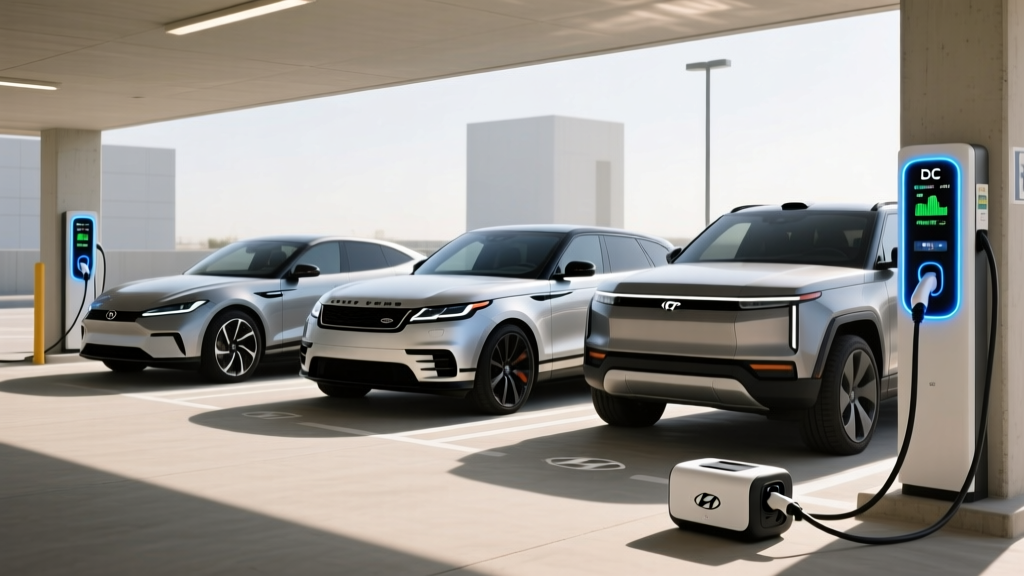
Before evaluating whether any cord can handle the job, you need to understand the power levels involved. EV charging operates across three tiers, each with dramatically different electrical requirements.
| Level | Voltage / Amperage | Power (kW) | Miles of Range / Hour | Circuit Required |
|---|---|---|---|---|
| Level 1 | 120V / 12–16A | 1.4–1.9 kW | 3–5 miles | Standard 15A or 20A 120V outlet |
| Level 2 | 240V / 16–80A | 3.8–19.2 kW | 12–60+ miles | Dedicated 240V circuit (NEMA 14-50 or hardwired) |
| DC Fast Charging | 400–900V DC / 50–500A | 50–350 kW | 150–1,000+ miles (peak) | Commercial utility connection (not home-applicable) |
Critical distinction: kW (kilowatts) measures power — the rate at which energy flows. kWh (kilowatt-hours) measures energy — the total amount stored in your battery. A 10 kW charger delivers 10 kWh of energy in one hour. Never confuse these units when sizing equipment or cords.
- 75 kWh battery (e.g., Tesla Model Y, Ford Mustang Mach-E): Level 1 (1.4 kW) = ~54 hours from 10–80%. Level 2 at 11.5 kW = ~5 hours. DC fast at 150 kW peak = ~25 minutes (10–80%).
- 84 kWh battery (e.g., Hyundai Ioniq 5): Level 1 = ~60 hours. Level 2 at 11.5 kW = ~5.5 hours. DC fast at 240 kW peak = ~18 minutes (10–80%), though sustained rate tapers above 80%.
- 131 kWh battery (e.g., Ford F-150 Lightning Extended Range): Level 1 = ~94 hours. Level 2 at 19.2 kW = ~5.5 hours. Level 2 at 11.5 kW = ~9 hours.
Level 1 Extension Cords: The Only Scenario Where It's Marginally Acceptable
Level 1 charging at 120V is the one scenario where a purpose-built EV extension cord can work — with strict caveats. Your EV's included mobile charger typically draws 12 amps continuously on a standard 120V outlet. If you must extend the reach, follow these rules:
Minimum Extension Cord Specs for Level 1 (120V) Charging
- Wire gauge: 10 AWG (American Wire Gauge) minimum. 12 AWG is acceptable only for runs under 25 feet. Never use 14 or 16 AWG.
- Length: 25 feet maximum. Beyond that, voltage drop becomes significant even at 10 AWG.
- Rating: Must be rated for at least 15 amps continuous duty. Look for cords labeled SJTW, SJOOW, or specifically marketed for EV use.
- Single cord only: Never daisy-chain two extension cords. Each connection point is a failure point under sustained load.
- No reels or coiled cords: Coiled wire traps heat. Always fully uncoil any cord during use.
- Grounded (3-prong): Mandatory. Never use a 2-prong adapter or ground-lift cheat.
Several companies manufacture EV-specific Level 1 extension cords that meet these specs. Brands like EvseAdapters and Lectron offer 10 AWG, 25-foot cords with NEMA 5-15 or 5-20 configurations, typically priced between $60–$120. These are built with heavier insulation and higher-temperature ratings than hardware-store cords.
What Level 1 Extension Cords Cannot Do
Even a properly spec'd Level 1 cord does not solve the fundamental limitation: Level 1 charging adds only 3–5 miles of range per hour. For a driver who commutes 40+ miles daily, Level 1 is insufficient regardless of cord length. It's best suited for overnight top-ups on plug-in hybrids with smaller batteries or for BEV owners who drive under 30 miles per day and can charge for 10+ hours overnight.
Level 2 Extension Cords: Why They're Almost Never the Right Answer
Level 2 charging operates at 240V and draws between 16 and 80 amps — a completely different class of electrical load. Here's why extension cords for Level 2 are problematic:
The Electrical Reality of 240V, High-Amperage Loads
A 48-amp Level 2 charger (the most common home unit) pulls 48 amps continuously at 240V, delivering 11.5 kW of power. Per NEC Article 625.41, EV charging is classified as a continuous load, meaning the circuit must be rated for 125% of the actual draw. A 48A charger requires a 60-amp dedicated circuit.
An extension cord capable of safely carrying 48 amps at 240V over even 10 feet would need to be 6 AWG or thicker — essentially the same gauge as the permanent wiring in your walls. Such a cord would be heavy, stiff, expensive ($200–$400+), and would need properly rated NEMA 14-50 or 6-50 connectors on both ends.
While some specialty vendors sell NEMA 14-50 extension cords (6 AWG, rated for 50A), these are intended for temporary use with RVs or welders — not as a daily EV charging solution. The connectors are not designed for the thousands of insertion/removal cycles that daily EV charging entails, and the connection points remain a source of resistance and heat.
The Right Solution: A Properly Installed Level 2 Charger with Adequate Cable
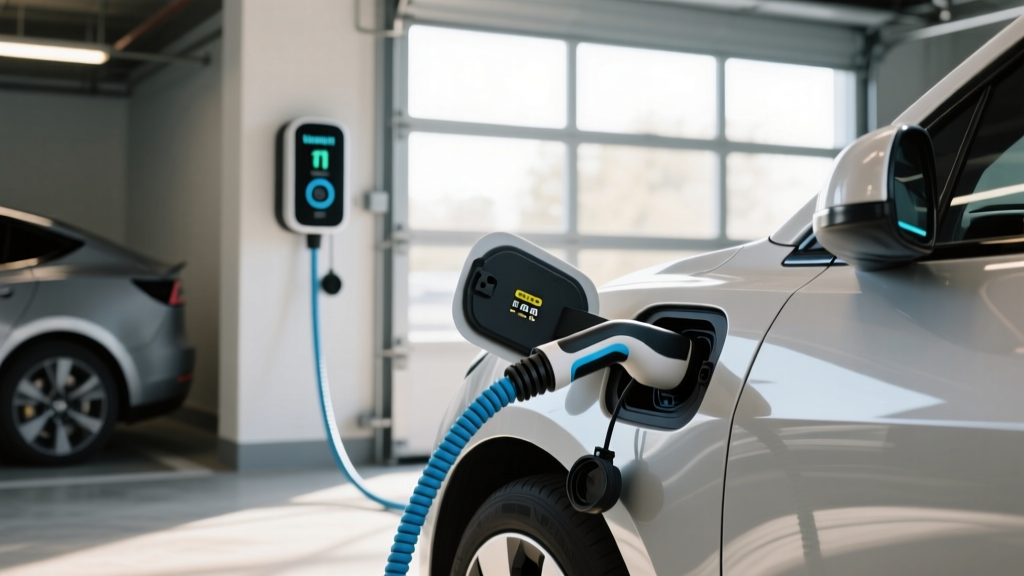
Instead of an extension cord, the correct approach is to install a Level 2 wall connector with a cable long enough to reach your vehicle's charge port. Most quality Level 2 chargers come with 18–25 foot cables. If that's not enough, the solution is to move the charger location or add a second charging circuit — not to extend the cord.
Home EV Charger Installation: Electrical Requirements and Costs
Installing a dedicated Level 2 charger eliminates the extension cord problem entirely. Here's what a proper installation involves, what it costs, and where older homes may need upgrades.
Electrical Requirements for a Level 2 Home Charger
- Voltage: 240V (same as your electric dryer or oven)
- Amperage: 32A, 40A, or 48A chargers are most common, requiring 40A, 50A, or 60A dedicated circuits respectively
- Circuit type: Dedicated — meaning no other outlets or appliances share the circuit
- Outlet or hardwired: NEMA 14-50 outlet (50A, allows charger to be unplugged) or hardwired connection (required for circuits above 50A and for many 48A chargers per NEC 2023 code updates)
- GFCI protection: NEC 2020 and later requires GFCI (Ground Fault Circuit Interrupter) protection for all EV charging outlets. Many modern EVSEs have built-in GFCI, but your electrician will confirm compliance.
- Outdoor rating: If installed outside, the charger must carry a NEMA 4 or NEMA 4X weather rating. The circuit breaker and any outdoor outlets must be in weatherproof enclosures.
Installation Cost Breakdown
| Item | Simple Install (Panel Adjacent) | Moderate Install (50–80 ft Run) | Complex Install (Panel Upgrade + Long Run) |
|---|---|---|---|
| Level 2 Charger (Equipment) | $350–$700 | $350–$700 | $350–$700 |
| Electrician Labor | $300–$600 | $600–$1,500 | $1,500–$3,000+ |
| Permit & Inspection | $50–$150 | $50–$200 | $100–$300 |
| Electrical Panel Upgrade (if needed) | N/A | N/A | $1,500–$4,000 |
| Conduit, Wire, Breaker | $50–$150 | $150–$500 | $300–$1,000 |
| Total Estimated Cost | $750–$1,600 | $1,150–$2,900 | $3,750–$9,000+ |
Panel upgrade reality check: Homes built before 1990 often have 100-amp electrical panels. Adding a 60-amp EV circuit to an already-loaded 100A panel may exceed capacity, especially if you also run electric heat, a dryer, and an oven. Upgrading to a 200-amp panel typically costs $1,500–$4,000 depending on your utility and local labor rates. Some utilities offer rebates for panel upgrades tied to EV adoption — check with your local provider.
Per the IRS §30D clean vehicle credit rules, while the charger itself doesn't qualify for the new-vehicle tax credit, the Alternative Fuel Vehicle Refueling Property Credit (IRS Form 8911) may cover up to 30% of home charger equipment and installation costs (up to $1,000), subject to income limits and census-tract eligibility. Consult a tax professional for your specific situation.
Connector Compatibility: What Plugs Into What?
The EV industry has largely standardized around the NACS (North American Charging Standard) connector, originally developed by Tesla and now adopted by nearly every major automaker for 2025–2026 model-year vehicles. Here's where each brand stands:
| Connector | Brands Using It (Native) | Adapter Needed? |
|---|---|---|
| NACS (Tesla) | Tesla (all models), Ford (2025+), GM (2025+), Rivian (2025+), Volvo/Polestar (2025+), Hyundai/Kia (2026+), BMW, Mercedes-Benz, Lucid | Older CCS vehicles need CCS-to-NACS adapter (~$150–$250) |
| CCS1 | Legacy models: 2021–2024 GM, Ford, VW ID.4 (pre-2025), Hyundai/Kia (pre-2026), some Stellantis | NACS-to-CCS adapter needed for Tesla Superchargers |
| CHAdeMO | Nissan Leaf (all years), Mitsubishi Outlander PHEV (older) | CHAdeMO-to-NACS adapters are rare and expensive ($400+); CHAdeMO infrastructure is declining |
For home charger purchases in 2026: Buy a NACS-connector charger unless you own a CHAdeMO vehicle (Nissan Leaf). If you currently own a CCS1 vehicle but plan to switch to a NACS-equipped car in the next few years, some chargers like the Tesla Wall Connector (NACS) can be used with a CCS adapter for your current car, future-proofing your investment.
Recommended Level 2 Home Chargers: Equipment Comparison
These are the chargers we recommend based on power output, cable length, build quality, smart features, and price — all of which eliminate the need for an extension cord.
Tesla Wall Connector (Gen 3)
- Power output: Up to 11.5 kW (48A) on a 60A circuit
- Connector: NACS (native Tesla plug)
- Cable length: 24 feet
- Smart features: Wi-Fi, over-the-air updates, load sharing (pair two units on one circuit), Tesla app monitoring
- Price: ~$475
- Best for: Tesla owners and NACS-equipped 2025+ vehicles. Excellent value for the power output.
ChargePoint Home Flex
- Power output: Up to 12 kW (50A) on a 60A circuit, configurable down to 16A for smaller circuits
- Connector: Available in NACS or CCS1 (J1772+CCS combo)
- Cable length: 23 feet
- Smart features: Wi-Fi, ChargePoint app with scheduling, energy tracking, Alexa integration, amperage dial adjustment
- Price: ~$550–$650
- Best for: Multi-EV households or buyers who want adjustable amperage to match their existing circuit.
Emporia Level 2 EV Charger
- Power output: Up to 11.5 kW (48A) on a 60A circuit
- Connector: J1772 (CCS1 compatible); NACS version available
- Cable length: 24 feet
- Smart features: Wi-Fi, Emporia app, real-time energy monitoring, solar integration (pairs with Emporia Vue home energy monitor), scheduling
- Price: ~$400
- Best for: Budget-conscious buyers with solar panels who want granular energy monitoring. Best price-to-power ratio.
Grizzl-E Smart
- Power output: Up to 10 kW (40A) on a 50A circuit
- Connector: J1772 (CCS1 compatible); NACS adapter available
- Cable length: 24 feet
- Smart features: Wi-Fi, OCPP protocol support, adjustable amperage (16A–40A), rugged aluminum enclosure
- Price: ~$450–$550
- Best for: Outdoor installations and extreme climates (rated -40°F to +122°F). Canadian-built with a 3-year warranty.
Charging Cost Per Mile: EV vs. Gas
One of the strongest arguments for home charging is cost. Here's how EV electricity costs compare to gasoline on a per-mile basis.
| Scenario | Rate | Cost Per Mile (3.5 mi/kWh EV) | Annual Cost (12,000 mi) |
|---|---|---|---|
| Home charging (off-peak utility rate) | $0.08–$0.12/kWh | $0.023–$0.034 | $275–$410 |
| Home charging (standard rate) | $0.13–$0.18/kWh | $0.037–$0.051 | $445–$620 |
| Public Level 2 (ChargePoint, etc.) | $0.25–$0.49/kWh | $0.071–$0.140 | $855–$1,680 |
| DC Fast Charging (Electrify America, EVgo) | $0.35–$0.55/kWh | $0.100–$0.157 | $1,200–$1,885 |
| Gasoline (28 MPG avg, $3.40/gal) | $3.40/gallon | $0.121 | $1,455 |
Home off-peak charging is roughly 4–5x cheaper per mile than gasoline. Even public DC fast charging is often cheaper than gas, though the savings narrow considerably. The economics strongly favor installing a proper home Level 2 charger rather than relying on public infrastructure or trying to make do with a Level 1 extension cord setup.
Efficiency varies by vehicle. The Hyundai Ioniq 6 achieves roughly 4.0–4.5 miles per kWh (one of the most efficient EVs on the market), while the GMC Hummer EV manages roughly 1.5–1.8 miles per kWh. Check your specific vehicle's MPGe rating on fueleconomy.gov for precise figures.
Safety and Code Considerations for Home EV Charging
Whether you're considering a temporary extension cord or a permanent Level 2 installation, these electrical safety principles apply:
Non-Negotiable Safety Requirements
- Dedicated circuit: Your Level 2 charger must be on its own circuit with no shared loads. A tripped breaker because someone turned on the garage freezer while your car was charging is more than an inconvenience — it can strand you.
- GFCI protection: Required by NEC 2020+ for all EV charging receptacles. Protects against ground faults, especially critical for outdoor or garage installations where moisture is present.
- Permit and inspection: Most jurisdictions require an electrical permit for EV charger installation. The inspection ensures the work meets code. Skipping this can void insurance coverage and create problems when selling your home.
- Outdoor-rated equipment: If your charger is outside, it must carry at minimum a NEMA 4 rating (protection against splashing water and dust). NEMA 4X adds corrosion resistance for coastal environments.
- No extension cords for Level 2: This bears repeating. The NEC does not permit extension cords as a substitute for permanent wiring for EV charging (NEC 400.10 prohibits flexible cords as a substitute for fixed wiring).
When to Upgrade Your Electrical Panel
You likely need a panel upgrade if:
- Your home has a 100-amp or smaller main panel
- Your existing panel is already near capacity (electric range, electric dryer, electric heat, hot tub)
- Your panel uses fuse-style breakers (common in pre-1970 homes)
- An electrician's load calculation shows insufficient headroom for a 40–60A EV circuit
A licensed electrician will perform a load calculation per NEC Article 220 to determine whether your panel can accommodate an EV circuit. Some newer solutions, like the Span smart electrical panel or utility-managed load controllers, can dynamically manage loads to avoid a full panel upgrade by reducing EV charge rate when other appliances are running.
Frequently Asked Questions
Can I use a regular extension cord to charge my electric car?
No. Standard 16-gauge household extension cords are not rated for the sustained high-amperage load of EV charging and pose a serious fire risk. If you must extend Level 1 (120V) charging reach temporarily, use only a 10 AWG or thicker cord specifically rated for EV use, limited to 25 feet, and never daisy-chain multiple cords. For Level 2 (240V) charging, extension cords should not be used at all — install a proper wall connector with adequate cable length instead.
How much does it cost to install a home EV charger?
A straightforward Level 2 installation (charger near the electrical panel) typically costs $750–$1,600 including equipment, labor, and permits. A moderate installation with a 50–80 foot wire run costs $1,150–$2,900. If your home needs an electrical panel upgrade from 100A to 200A, total costs can reach $3,750–$9,000+. Get at least three quotes from licensed electricians and ask about utility rebates.
How fast will each charging level add range?
Level 1 (120V, ~1.4 kW): 3–5 miles of range per hour. Level 2 (240V, 11.5 kW typical): 30–40 miles per hour for most EVs. DC Fast Charging (150–350 kW): can add 150–300+ miles in 20–30 minutes, though charge speed tapers significantly above 80% State of Charge due to battery protection protocols.
Which connector and charger is compatible with my EV?
For 2025–2026 model-year vehicles, most new EVs use the NACS (Tesla) connector, including Ford, GM, Rivian, Volvo, and Hyundai/Kia models. Older 2021–2024 EVs from these brands may still use CCS1. The Nissan Leaf uses CHAdeMO. Check your vehicle's charge port or owner's manual, and buy a home charger with the matching connector. Adapters exist for cross-compatibility but add cost and a potential failure point.
How much does charging cost per mile compared to gas?
Home charging at off-peak utility rates ($0.08–$0.12/kWh) costs roughly $0.02–$0.03 per mile in an average-efficiency EV — about 4–5x cheaper than gasoline at $3.40/gallon in a 28 MPG car ($0.12/mile). Public DC fast charging at $0.35–$0.55/kWh costs $0.10–$0.16 per mile, which is comparable to or slightly cheaper than gas. Home charging is where the real savings materialize.
What electrical upgrades might I need for a Level 2 charger?
You may need a panel upgrade (100A to 200A) if your home is older or already has many electric appliances. You'll definitely need a new dedicated 240V circuit (40A–60A) with appropriate-gauge wiring, a new breaker, and either a NEMA 14-50 outlet or hardwired connection. All work must be permitted and inspected per local code. A licensed electrician should perform a load calculation before recommending a circuit size.
Is there a tax credit for installing a home EV charger?
Possibly. The Alternative Fuel Vehicle Refueling Property Credit (filed via IRS Form 8911) can cover up to 30% of charger equipment and installation costs, capped at $1,000. Eligibility depends on your income and whether you live in a qualifying census tract (generally non-urban or low-income areas). The credit is non-refundable and subject to change — consult a tax professional and verify current rules on irs.gov before purchasing.