The Three EV Charging Levels: Speeds That Actually Matter
Before comparing connectors, you need to understand the three charging tiers defined by SAE and adopted across the industry. The critical distinction: kW (kilowatts) measures power — how fast energy flows into your battery. kWh (kilowatt-hours) measures energy — the total capacity stored. A 10 kW charger delivers 10 kWh in one hour; a 150 kW DC fast charger delivers that same 10 kWh in about four minutes.
| Level | Voltage | Power (kW) | Miles Added/Hour | Typical Use |
|---|---|---|---|---|
| Level 1 | 120V AC | 1.2–1.9 kW | 3–5 mi/hr | Overnight trickle, PHEVs, emergency |
| Level 2 | 240V AC | 3.3–19.2 kW | 12–75 mi/hr | Home daily charging, workplaces, hotels |
| DC Fast (Level 3) | 400–900V DC | 50–350+ kW | 150–1,200 mi/hr (peak) | Road trips, highway corridors |
Real-world context: A 75 kWh battery (like the Tesla Model Y Long Range or Ford Mustang Mach-E Extended Range) charging at a 48-amp Level 2 station (11.5 kW) will go from 10% to 80% in roughly 5.5 hours. That same battery on a 250 kW DC fast charger hits 10–80% in about 20–25 minutes, though peak rates only sustain through ~50% State of Charge before the charge curve tapers to protect battery health.
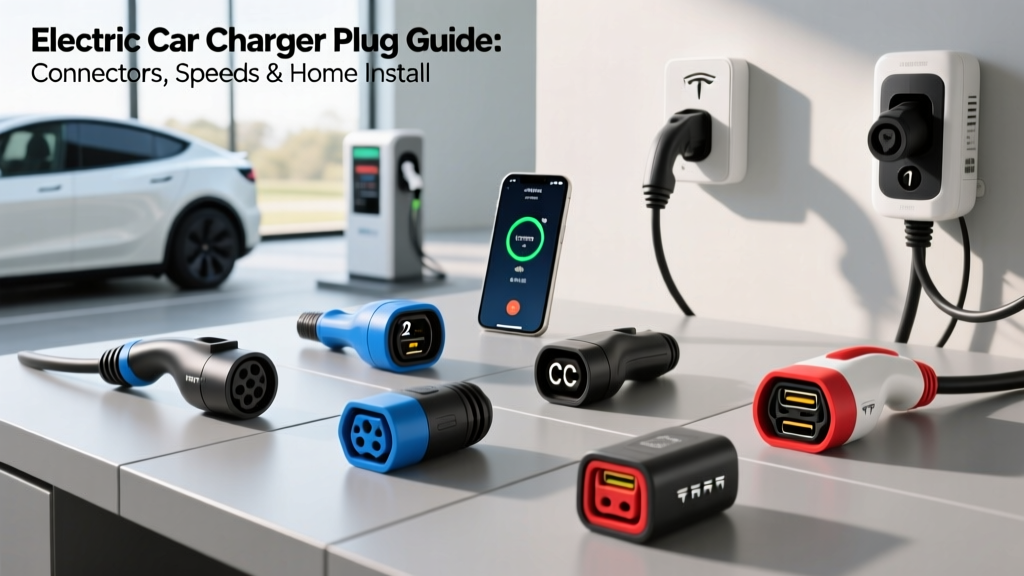
Electric Vehicle Charging Standards: NACS, CCS1, and CHAdeMO
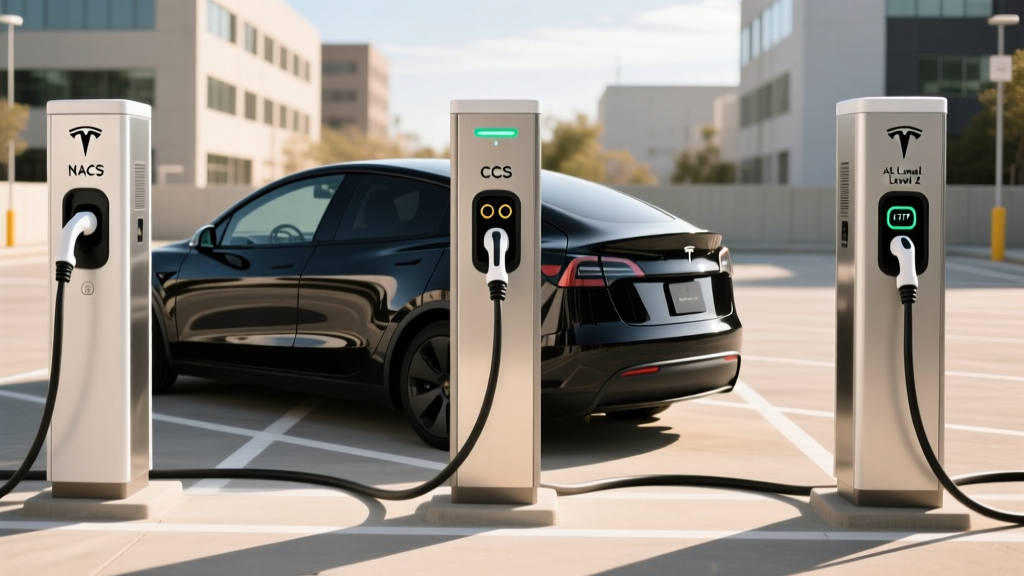
The North American EV market consolidated dramatically around the North American Charging Standard (NACS), originally Tesla's proprietary connector and opened to the industry in late 2022. By 2026, nearly every major automaker — Ford, GM, Rivian, Hyundai, Kia, BMW, Volvo, Mercedes-Benz — has adopted NACS as the native port on new vehicles.
| Connector | AC Level 2 | DC Fast | Vehicles Using It (2026) | Network Access |
|---|---|---|---|---|
| NACS (J3400) | Yes (native) | Yes (native) | Tesla (all), Ford F-150 Lightning/Mach-E (2025+), GM Ultium (2025+), Rivian, Hyundai Ioniq 5/6 (2025+), Kia EV6/EV9 (2025+), Volvo, BMW | Tesla Supercharger, Electrify America, EVgo, ChargePoint |
| CCS1 (Combo) | Yes (J1772 upper) | Yes (DC pins) | VW ID.4 (pre-2025), older Ford/GM EVs, Chevy Bolt, BMW i4 (pre-2025), Porsche Taycan (pre-2025) | Electrify America, EVgo, ChargePoint |
| CHAdeMO | Requires J1772 | Yes (separate port) | Nissan Leaf (all years), Mitsubishi Outlander PHEV (older) | Declining; limited to legacy stations |
Adapter reality for 2026: If you drive an older CCS1-equipped EV (like a 2023 VW ID.4 or Chevy Bolt EUV), you need a CCS-to-NACS adapter (~$150–$250) to access Tesla Superchargers, which now number over 30,000 stalls in North America. Tesla sells an official adapter, and third-party options from Lectron and A2Z exist but vary in reliability. CHAdeMO adapters to NACS are not commercially viable — if you own a Nissan Leaf, plan your road trips around Electrify America and EVgo stations that still maintain CHAdeMO cables, though many are being phased out.
For Level 2 home charging, J1772 remains the universal AC standard, and NACS vehicles accept J1772 via a small adapter (included with most new NACS EVs). This means any existing Level 2 home charger with a J1772 plug works with any EV on the market.
Home Charger Installation: Electrical Requirements and Real Costs
Most EV owners install a 240V Level 2 charger on a dedicated 40-amp or 60-amp circuit. A 48-amp charger (the sweet spot for most homes) requires a 60-amp breaker per NEC 80% continuous-load rules. Here's the honest cost breakdown, which varies wildly based on your electrical panel's proximity to the install location and its remaining capacity.
| Component | Simple Install (panel adjacent, capacity available) | Complex Install (panel upgrade, long conduit run) |
|---|---|---|
| Level 2 EVSE equipment (40–48A) | $400–$700 | $400–$700 |
| Electrician labor (2–4 hrs simple / 8–16 hrs complex) | $400–$800 | $1,600–$3,500 |
| Permit and inspection | $50–$200 | $100–$300 |
| Electrical panel upgrade (100A → 200A, if needed) | $0 | $1,500–$3,000 |
| Conduit, wiring (6 AWG copper, 50+ ft runs) | $100–$250 | $400–$800 |
| Total | $950–$1,950 | $4,000–$8,300 |
Panel upgrade reality: Homes built before 2000 often have 100-amp or 150-amp panels already near capacity with HVAC, electric range, and dryer loads. Adding a 60-amp EV circuit may exceed the panel's rating, triggering a mandatory upgrade to 200 amps — the single biggest cost variable in EV home charging. Get a load calculation from a licensed electrician before purchasing equipment.
The federal Residential Clean Energy Credit (IRS §25D) does not cover EV chargers, but the Alternative Fuel Vehicle Refueling Property Credit (§30C) provides up to $1,000 (30% of cost, capped) for home charger equipment and installation through 2032, subject to census-tract eligibility. Check your ZIP code against IRS guidance before assuming qualification.
Level 2 Charger Equipment Picks for 2026
Not all Level 2 chargers are equal. Key specs: amperage (determines kW output), cable length (25 ft is the practical minimum for most garages), NEMA 14-50 plug vs hardwired (hardwired allows up to 80A; plug-in maxes at 48A on a 14-50 receptacle), and smart features like Wi-Fi scheduling for off-peak utility rates.
ChargePoint Home Flex (Best Overall)
- Power: Up to 50A (12 kW) on 60A circuit, adjustable down to 16A
- Connector: NACS native (2025+ models); J1772 for older versions
- Cable: 23 ft
- Smart: Wi-Fi, app scheduling, Alexa, utility demand-response
- Price: ~$599 (NACS) / $549 (J1772)
Tesla Wall Connector (Best for NACS Owners)
- Power: Up to 48A (11.5 kW) on 60A circuit
- Connector: NACS native; J1772 adapter included
- Cable: 24 ft
- Smart: Wi-Fi, OTA updates, Power-Share (two units on one circuit)
- Price: ~$475
Emporia Level 2 EV Charger (Best Budget Smart)
- Power: Up to 48A (11.5 kW) on 60A circuit
- Connector: J1772 (NACS adapter included)
- Cable: 24 ft
- Smart: Wi-Fi, energy monitoring, solar integration, scheduling
- Price: ~$399
FLO Home X5 (Best for Cold Climates)
- Power: 48A (11.5 kW) on 60A circuit
- Connector: J1772 (NACS adapter available)
- Cable: 25 ft, cold-rated to -40°F
- Smart: Basic app, robust build quality
- Price: ~$695
Charging Cost Per Mile: Home vs Public vs Gas
The economics of EV charging depend entirely on where and when you plug in. A kWh is a unit of energy; the price per kWh determines your cost per mile based on your vehicle's efficiency (measured in kWh/100mi on the EPA window sticker or fueleconomy.gov).
| Scenario | Price per kWh | Vehicle: 30 kWh/100mi (e.g., Model Y, Ioniq 5) | Cost per Mile |
|---|---|---|---|
| Home off-peak (utility time-of-use rate) | $0.08–$0.12 | 30 × $0.10 = $3.00/100mi | $0.030 |
| Home standard rate (no TOU plan) | $0.14–$0.18 | 30 × $0.16 = $4.80/100mi | $0.048 |
| Public Level 2 (ChargePoint, EVgo) | $0.25–$0.40 | 30 × $0.32 = $9.60/100mi | $0.096 |
| DC Fast Charging (Electrify America, Tesla) | $0.35–$0.55 | 30 × $0.45 = $13.50/100mi | $0.135 |
| Gasoline comparison (30 MPG, $3.50/gal) | — | — | $0.117 |
The takeaway: Home charging at off-peak rates costs roughly 3–4 cents per mile, a fraction of gasoline. But exclusive reliance on DC fast charging at $0.45+/kWh can actually exceed the cost of a 30 MPG gas car. This is why home Level 2 access is the single biggest determinant of EV ownership economics. If you cannot charge at home (apartment dwellers, street parking), a PHEV or a high-MPG hybrid may save more money long-term.
For a concrete example: driving 12,000 miles/year in a Hyundai Ioniq 5 (30 kWh/100mi combined per fueleconomy.gov) at home off-peak rates of $0.10/kWh costs ~$360/year in electricity. The same miles in a Toyota RAV4 gas (30 MPG combined) at $3.50/gallon costs ~$1,400/year. That's a $1,040 annual fuel savings — though insurance premiums and higher upfront EV pricing partially offset this.
DC Fast Charging Time Examples: What to Expect on Road Trips
DC fast charging speed depends on three factors: the station's maximum kW output, your vehicle's maximum acceptance rate, and the battery's charge curve (which tapers significantly above 80% SoC to prevent lithium plating and heat damage).
Hyundai Ioniq 5 (84 kWh battery, NMC chemistry): Peaks at 240 kW on a 350 kW Electrify America station. Charges 10–80% in approximately 18 minutes in warm weather (70°F+). In cold weather (below 32°F), preconditioning via the car's navigation-routed charging is essential; without it, peak rates may drop to 80–120 kW, extending 10–80% to 35+ minutes.
Tesla Model Y Long Range (~75 kWh battery): Peaks at 250 kW at V3 Superchargers. 10–80% in roughly 22 minutes. The V4 Supercharger architecture (deploying through 2026) supports up to 350 kW, but current Model Y vehicles are limited to 250 kW by their onboard charge system.
Chevrolet Silverado EV (200+ kWh Ultium battery): Peaks at 350 kW on compatible stations, but the massive battery means 10–80% still takes approximately 40 minutes at sustained high rates — a tradeoff of range (EPA 400+ mi) vs charge time.
Cold-weather charging: Battery chemistry slows ion movement at low temperatures. Without active preconditioning (warming the battery to ~70°F before arrival via navigation-routed charging), expect 40–60% longer charge times in sub-freezing conditions. This is physics, not a defect — NMC and LFP chemistries both suffer, though LFP is slightly more tolerant.
Safety, Code, and Permit Considerations
The National Electrical Code (NEC Article 625) governs EV charging installations. Key requirements that your electrician must follow:
- Dedicated circuit: EVSE must be on its own breaker — no sharing with other loads.
- GFCI protection: Required for all outdoor receptacles and recommended (sometimes mandated) for indoor garage installations.
- Continuous load derating: A 48A charger requires a 60A breaker (48 ÷ 0.8 = 60). Never undersize the breaker.
- Wire gauge: 6 AWG copper for 60A circuits; 4 AWG for 80A circuits over longer runs.
- Outdoor rating: If mounting outside, the EVSE must carry a NEMA 3R or 4 rating (weather-resistant). All chargers listed above meet this standard.
- Permit required: Most jurisdictions require an electrical permit and post-installation inspection. Skipping this voids homeowner's insurance coverage for electrical fires.
Do not install a NEMA 14-50 receptacle yourself unless you have electrical training. Improper torque on terminal lugs is a leading cause of outlet overheating and fire. Use a licensed electrician and insist on a torque-screwdriver verification.
Frequently Asked Questions
How much does it cost to install a home EV charger?
A straightforward Level 2 installation (panel has capacity, charger mounts near the panel) runs $950–$1,950 including equipment, electrician labor, and permit. Complex installs requiring a 200-amp panel upgrade, long conduit runs through finished walls, or trenching to a detached garage can reach $4,000–$8,300. The federal §30C tax credit may offset up to $1,000 of this cost if you're in an eligible census tract.
How fast will each charging level add range?
Level 1 (120V): 3–5 miles per hour — adequate only for PHEVs with small batteries or overnight trickle-charging a BEV you drive less than 30 miles daily. Level 2 (240V, 48A): 30–40 miles per hour for most EVs, fully replenishing a 75–85 kWh battery overnight in 7–9 hours. DC Fast (150–350 kW): 150–1,200 miles per hour at peak, though sustained average is lower due to charge-curve taper; expect 10–80% in 18–40 minutes depending on battery size and station power.
Which connector is compatible with my EV?
If your EV is a 2025+ model from Tesla, Ford, GM, Rivian, Hyundai, Kia, BMW, or Volvo, it almost certainly has a native NACS port and can use Tesla Superchargers and all major networks without an adapter. If you have a 2024 or older EV from VW, BMW, Ford, or GM, you likely have CCS1 and need a CCS-to-NACS adapter (~$150–$250) for Supercharger access. Nissan Leaf owners have CHAdeMO and face declining public charging options; consider a home Level 2 charger as your primary solution. For Level 2 home charging, all EVs accept J1772 (or NACS with a J1772 adapter, typically included with the vehicle).
How much does charging cost per mile vs gas?
At home off-peak rates ($0.10/kWh), a typical EV like the Ioniq 5 or Model Y costs 3–4 cents per mile. Gasoline at $3.50/gallon in a 30 MPG vehicle costs ~12 cents per mile. However, DC fast charging at $0.45/kWh pushes EV costs to ~13–14 cents per mile — slightly more than gas. The economic case for EVs requires regular home or workplace charging access.
What electrical upgrades might I need?
The most common upgrade is a panel replacement from 100A or 150A to 200A service, costing $1,500–$3,000. This is likely if your panel is already near capacity with electric heat, A/C, range, and dryer. Other potential upgrades: replacing a Federal Pacific or Zinsco panel (known fire hazards, mandatory replacement), adding a sub-panel in a detached garage ($800–$1,500), or upgrading the utility service drop if your home has only 100A from the street (utility coordination required, may add $500–$2,000 and weeks of lead time). A licensed electrician's load calculation is the only way to know for certain.
Sources: EPA efficiency data from fueleconomy.gov; IRS §30C refueling property credit rules from irs.gov; NEC Article 625 EV charging code requirements via NFPA.org.