If you're shopping for an EV or just took delivery of one, the phrase "electric car charger plug" probably sends you down a rabbit hole of acronyms, adapter questions, and conflicting forum advice. Which connector does your car actually use? Can you plug into any public station? And what exactly do you need to install at home?
This guide cuts through the confusion with exact specs: charging speeds in kilowatts (kW), miles of range added per hour, real installation costs broken down by component, and the connector landscape as it stands in 2026 — where the North American Charging Standard (NACS) has largely won, but millions of CCS1-equipped EVs still need reliable access.
The Three Charging Levels: Speed, Power, and What They Mean for Your Daily Routine
Before comparing plugs, you need to understand the three charging tiers. The critical distinction: kW (kilowatts) measures power — how fast energy flows into your battery. kWh (kilowatt-hours) measures energy — the total capacity of your battery, like gallons in a gas tank. A 75 kWh battery charged at 11.5 kW takes roughly 6.5 hours from empty to full; that same battery at a 150 kW DC fast charger can go from 10% to 80% in about 25–30 minutes, depending on the charge curve.
| Level | Voltage | Max Power (kW) | Miles of Range Added per Hour | Typical Use Case |
|---|---|---|---|---|
| Level 1 (120V) | 120V AC | 1.2–1.9 kW | 3–5 miles | Overnight trickle; PHEV top-ups; emergency |
| Level 2 (240V) | 240V AC | 3.3–19.2 kW | 12–75 miles | Home daily charging; workplace; shopping centers |
| DC Fast Charge | 200–900V DC | 50–350 kW | 150–1,200+ miles/hr equivalent | Road trips; highway corridors; 10–80% in 15–40 min |
Real-world nuance: Level 2 speeds depend on both the charger and your car's onboard charger. A Tesla Wall Connector delivers up to 11.5 kW (48A), but a plug-in hybrid with a 3.3 kW onboard charger will only pull 3.3 kW regardless of what the wallbox can supply. Always check your vehicle's max AC charge rate.
DC fast charging is not linear. A vehicle advertising a "peak 250 kW" charge rate typically sustains that speed only between roughly 10–30% state of charge (SoC), then tapers progressively. Expect a 10–80% session on a 250 kW-capable EV at a 350 kW station to average 120–170 kW over the full session. That's why we quote 10–80% times rather than peak rates.
Electric Car Charger Plug Types: NACS, CCS1, and CHAdeMO Compared
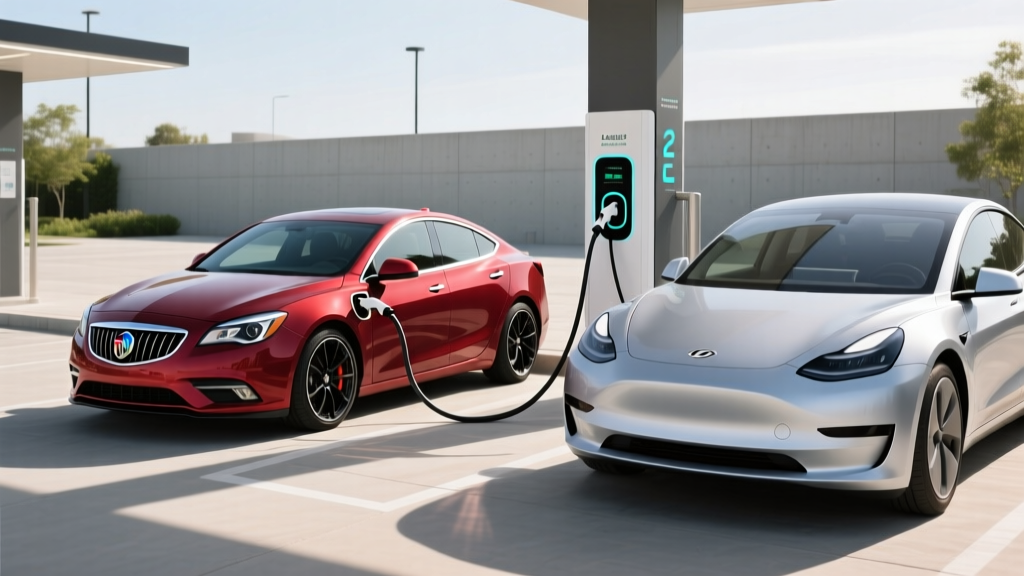
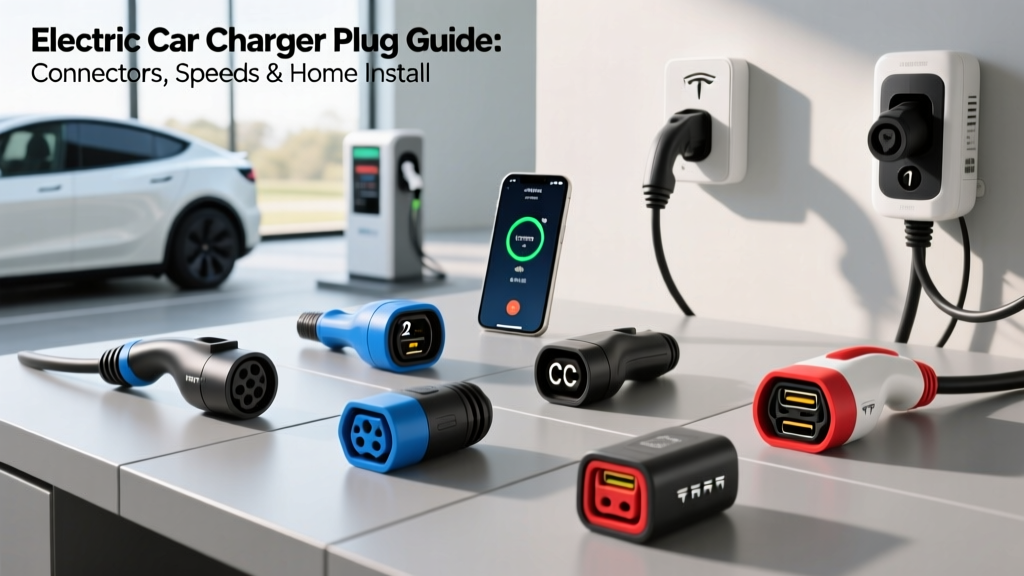
The connector — the physical electric car charger plug that mates your vehicle to the station — has undergone a seismic shift since 2022 when Tesla opened its proprietary connector as the North American Charging Standard (NACS). By 2026, nearly every major automaker has transitioned new vehicles to NACS, but CCS1 (Combined Charging System) and the legacy CHAdeMO plug still populate roads and charging networks.
| Connector | AC Charging | DC Fast Charging | Automakers Using (Native) | Network Access |
|---|---|---|---|---|
| NACS (J3400) | Yes (single plug) | Yes (single plug) | Tesla, Ford, GM, Rivian, Volvo, Polestar, Mercedes-Benz, BMW, Hyundai/Kia (2025+), Toyota (bZ series 2025+), Subaru, Lucid, Fisker | Tesla Supercharger (native), Electrify America, EVgo, ChargePoint (increasingly NACS-equipped) |
| CCS1 | J1772 upper + 2 DC pins below | Yes | Older VW ID.4, Audi e-tron (pre-2025), Porsche Taycan (pre-2025), Stellantis EVs (pre-2025), legacy Hyundai/Kia | Electrify America, EVgo, ChargePoint; requires NACS adapter for Superchargers |
| CHAdeMO | J1772 (separate AC) | Yes (round twin-pin DC) | Nissan LEAF (all years), Mitsubishi Outlander PHEV (DC) | Limited; being phased out on new station deployments |
Adapter reality for 2026: If you own a CCS1-equipped vehicle (say, a 2023 VW ID.4 or 2024 Hyundai Ioniq 5 pre-switch), you can access Tesla Superchargers using a NACS-to-CCS adapter. Tesla sells an official adapter (~$200), and third-party options from Lectron and A2Z exist. Ford and GM provide adapters to existing CCS1 customers as well. Conversely, NACS-native vehicles rarely need an adapter at non-Tesla networks, as most major providers have added NACS cables to new and retrofitted stations.
CHAdeMO is effectively legacy. Nissan's new Ariya and future models use NACS. If you drive a LEAF, CHAdeMO stations still exist but new deployments overwhelmingly favor NACS and CCS. Plan public charging accordingly.
Home EV Charger Installation: Electrical Requirements, Costs, and Panel Upgrades
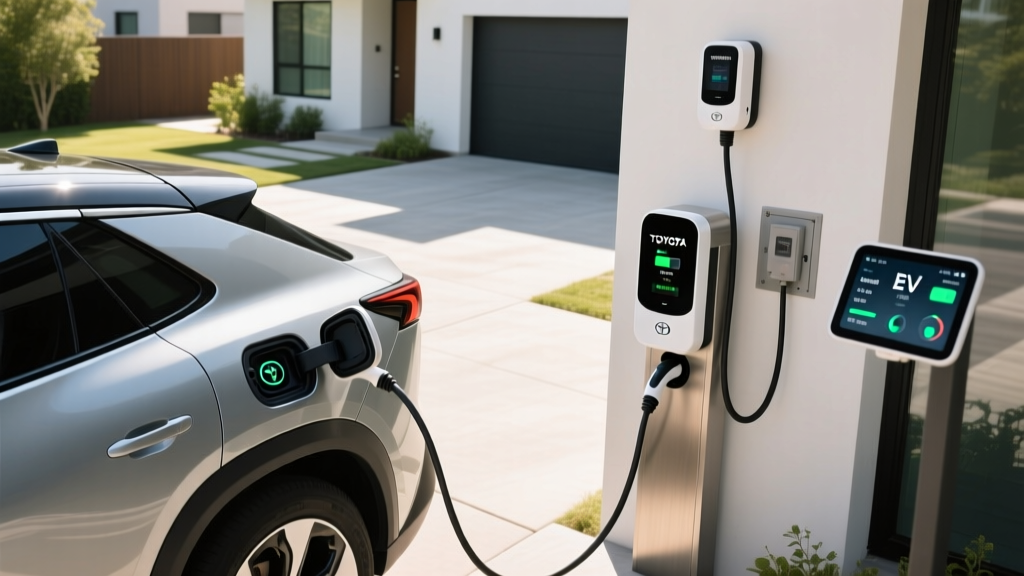
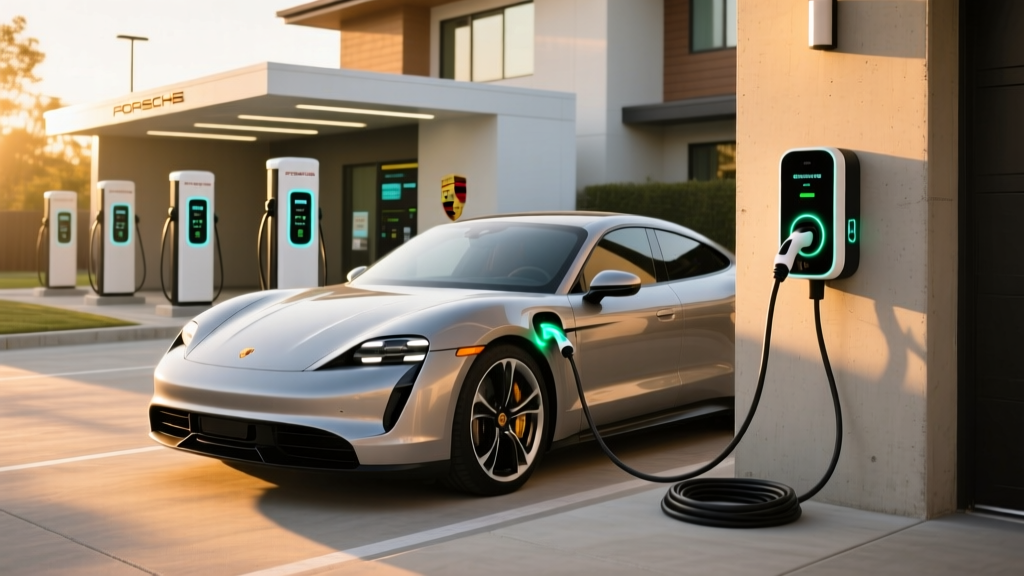
Installing a Level 2 home charger is the single highest-impact upgrade for EV ownership. You'll need a dedicated 240V circuit — the same voltage your electric dryer or oven uses — and a hardwired or plug-in (NEMA 14-50 outlet) charging unit.
Electrical Requirements
- Circuit: Dedicated 240V, typically 40A–60A breaker (continuous load rule requires the breaker to be rated 125% above the charger's max draw, so a 48A charger needs a 60A breaker)
- Wire gauge: 6 AWG copper for 40–50A circuits; 4 AWG for 60A (varies by run length and local code)
- Outlet vs. hardwire: A NEMA 14-50 outlet offers portability (take your charger when you move), but hardwired installs allow higher amperage (up to 80A/19.2 kW on some units) and avoid the GFCI breaker issues that plagued early 14-50 installations
- GFCI protection: NEC 2020+ requires GFCI protection for EV outlets; some chargers have built-in GFCI, which can cause nuisance tripping with certain breaker brands — discuss with your electrician
- Outdoor rating: If mounting outside, ensure the unit carries a NEMA 4 or IP65 rating for weather resistance
Installation Cost Breakdown
| Component | Simple Install (panel nearby, no upgrade) | Moderate Install (longer run, minor panel work) | Complex Install (panel upgrade required) |
|---|---|---|---|
| Level 2 Charger (equipment) | $300–$700 | $400–$700 | $400–$700 |
| Electrician labor | $300–$600 | $600–$1,200 | $1,000–$2,000 |
| Permit & inspection | $50–$150 | $50–$200 | $100–$300 |
| Electrical panel upgrade (100A → 200A) | N/A | N/A | $1,500–$3,500 |
| Total estimated cost | $650–$1,450 | $1,050–$2,100 | $3,000–$6,500 |
The panel upgrade gotcha: Homes built before 1990 often have 100A or even 60A service panels. Adding a 48A EV charger may push total load beyond 80% of panel capacity, triggering a utility-required upgrade to 200A. This is the single biggest cost variable. Before budgeting, have an electrician perform a load calculation — they'll sum your existing circuits (HVAC, water heater, dryer, range) against your panel's capacity. Some utilities offer rebates of $500–$1,500 for panel upgrades tied to EV adoption.
Smart alternative — load management: Devices like the Emporia Smart Load Center or chargers with built-in load management (e.g., Wallbox Pulsar Plus with Power Boost) can dynamically reduce charge rate when other household loads spike, potentially avoiding a panel upgrade entirely.
Charging Time Examples: What to Expect with Common Battery Sizes
Charge times depend on battery capacity (kWh), charger power (kW), and the vehicle's acceptance rate. Here are realistic scenarios for popular 2025–2026 EVs:
| Vehicle (Battery Size) | Level 1 (1.4 kW / 120V) | Level 2 (11.5 kW / 240V 48A) | DC Fast (10–80%) |
|---|---|---|---|
| Tesla Model Y LR (75 kWh usable) | ~54 hours | ~6.5 hours | ~22 min at 250 kW Supercharger |
| Hyundai Ioniq 5 (77.4 kWh) | ~55 hours | ~7 hours (10.9 kW onboard) | ~18 min at 350 kW station (800V architecture) |
| Ford F-150 Lightning Ext. Range (131 kWh) | ~94 hours | ~11.5 hours | ~41 min at 150 kW; ~30 min at 350 kW |
| Chevrolet Equinox EV (85 kWh) | ~61 hours | ~7.5 hours | ~30 min at 150 kW |
| Toyota bZ4X (71.4 kWh) | ~51 hours | ~6.5 hours | ~35 min at 150 kW |
Cold-weather reality check: Battery chemistry slows ion movement in cold temperatures. Expect DC fast charging speeds to drop 20–40% when battery temperature is below 32°F (0°C) unless your vehicle has active battery preconditioning. Tesla, Hyundai/Kia (E-GMP), and BMW preheat the pack when you navigate to a charger — always use this feature in winter.
Cost to Charge: Home vs. Public vs. Gas per Mile
One of the most persistent questions: how much does it actually cost to fuel an EV? The answer depends entirely on where you charge. Electricity rates vary by state, time of day, and network.
| Scenario | Rate ($/kWh) | Efficiency (kWh/100mi) | Cost per Mile | Annual Fuel Cost (12,000 mi) |
|---|---|---|---|---|
| Home (off-peak utility rate) | $0.08–$0.14 | 28–32 | $0.025–$0.045 | $300–$540 |
| Home (avg. US residential) | $0.17 | 30 | $0.051 | $612 |
| Public Level 2 (network) | $0.25–$0.49 | 30 | $0.075–$0.147 | $900–$1,764 |
| DC Fast (Electrify America, EVgo) | $0.35–$0.56 | 32 (highway driving) | $0.112–$0.179 | $1,344–$2,148 |
| Tesla Supercharger (avg.) | $0.28–$0.36 | 28 | $0.078–$0.101 | $936–$1,212 |
| Gas car (27 MPG avg., $3.40/gal) | — | — | $0.126 | $1,511 |
Key takeaway: Home charging on an off-peak or average residential rate delivers fuel costs at roughly 1/3 to 1/2 the per-mile cost of gasoline. But if you rely exclusively on DC fast charging, costs can approach or even exceed gasoline — particularly on networks with idle fees and per-session pricing. The economics of EV ownership strongly favor home or workplace charging.
According to fueleconomy.gov, the average EV achieves 3–4 miles per kWh, translating to roughly 100+ MPGe combined for most modern models. The EPA's annual fuel cost estimates for EVs consistently assume $0.15/kWh — below most public rates but realistic for home charging.
Equipment Recommendations: Top Home Level 2 Chargers for 2026
Here are proven, widely available Level 2 home chargers with exact specs. All support NACS natively or via included adapter options.
Tesla Wall Connector (Gen 3 / Universal)
- Power output: Up to 11.5 kW (48A) on a 60A circuit
- Connector: NACS native; Universal version includes CCS1 adapter compatibility via J1772 adapter
- Cable length: 24 ft
- Smart features: Wi-Fi, OTA updates, power sharing between two units, access control
- Price: ~$475 (standard) / ~$600 (Universal with Magic Dock)
- Best for: Tesla owners; NACS-native EVs; multi-Tesla households (load sharing)
ChargePoint Home Flex
- Power output: Configurable 16A–50A (3.8–12 kW) — adjust to match your circuit
- Connector: NACS (2025+ revision); J1772 still available for legacy CCS1 vehicles
- Cable length: 23 ft
- Smart features: App scheduling, Alexa integration, energy tracking, utility demand-response programs
- Price: ~$550–$650
- Best for: Flexible amperage matching; utility rebate-eligible installs; non-Tesla NACS EVs
Emporia Level 2 EV Charger
- Power output: Up to 11.5 kW (48A)
- Connector: NACS (2025+); J1772 version available
- Cable length: 24 ft
- Smart features: Solar integration (pairs with Emporia Vue energy monitor), real-time cost tracking, load management
- Price: ~$400
- Best for: Solar-equipped homes; budget-conscious buyers wanting smart features; energy monitoring enthusiasts
Wallbox Pulsar Plus
- Power output: Up to 11.5 kW (48A)
- Connector: NACS (2025+ update); J1772 available
- Cable length: 20 ft (25 ft option)
- Smart features: Power Boost dynamic load management (avoids panel overload), app control, Eco-Solar mode
- Price: ~$550–$700
- Best for: Homes near panel capacity limits (Power Boost eliminates upgrade need); compact form factor
Safety, Code, and Installation Best Practices
EV charging draws sustained high current for hours — unlike a dryer that cycles on and off. This makes proper installation non-negotiable.
- Dedicated circuit: Your EV charger must have its own dedicated breaker. Never share a circuit with other appliances.
- Continuous load derating: The NEC classifies EV charging as a continuous load (3+ hours). A 48A charger requires a 60A breaker (48A × 1.25 = 60A). Undersizing creates fire risk.
- GFCI: NEC 2020 (Article 625.54) requires GFCI protection for receptacles used for EV charging. Hardwired installations may not require external GFCI if the charger includes integrated ground-fault protection — confirm with your inspector.
- Permit and inspection: Most jurisdictions require an electrical permit for a new 240V circuit. Skipping this can void homeowner's insurance claims related to electrical fire. Budget $50–$300 depending on locality.
- Outdoor installations: Use a charger rated NEMA 4 (splash-proof) or IP65. Install a weatherproof cover if using a NEMA 14-50 outlet. Ensure the mounting surface (wall or pedestal) is structurally sound for the unit's weight plus cable pull.
- Cable management: A 24-foot cable weighs several pounds and creates trip hazards. Wall-mounted cable organizers or retractors ($20–$50) keep the installation tidy and protect connectors from ground contact.
The National Electrical Code (NEC) is updated every three years, and local amendments vary. Always hire a licensed electrician familiar with Article 625 (EV charging) rather than a general handyman.
Frequently Asked Questions
How much does it cost to install a home EV charger?
A straightforward Level 2 installation with an adequate electrical panel typically costs $650–$1,450 total (charger + electrician + permit). If your home requires a panel upgrade from 100A to 200A service, expect $3,000–$6,500 all-in. The wide range reflects your home's existing electrical infrastructure, the distance from panel to charger location, and local labor rates.
How fast will each charging level add range?
Level 1 (120V) adds roughly 3–5 miles per hour — adequate for plug-in hybrids with small batteries but impractical for full EVs. Level 2 (240V) adds 12–75 miles per hour depending on amperage and your car's onboard charger. DC fast charging adds 150–1,200+ miles per hour equivalent, which is why we measure it in 10–80% session time (typically 15–40 minutes) rather than miles per hour.
Which electric car charger plug is compatible with my EV?
Check your vehicle's charge port. If it's a 2025+ model from Tesla, Ford, GM, Rivian, Hyundai, Kia, Toyota, or most others, it likely uses NACS. If it's a 2024 or older non-Tesla EV (VW ID.4, older Ioniq 5, Audi e-tron), it uses CCS1 and needs a NACS adapter for Tesla Superchargers. The Nissan LEAF uniquely uses CHAdeMO for DC fast charging. Refer to the compatibility table above or your owner's manual.
How much does EV charging cost per mile compared to gasoline?
Home charging on average US electricity rates (~$0.17/kWh) costs roughly $0.05 per mile for a typical EV — about 60% less than a 27 MPG gas car at $3.40/gallon ($0.126/mile). Public DC fast charging at $0.35–$0.56/kWh costs $0.11–$0.18 per mile, which narrows the gap significantly. The economics strongly favor home or workplace charging.
What electrical upgrades might I need for a home charger?
The most common upgrade is a panel capacity increase from 100A to 200A, required when your existing panel can't accommodate a new 40–60A dedicated circuit alongside existing loads. Older homes (pre-1990) are most affected. A licensed electrician will perform a load calculation per NEC Article 220. Some utilities and states offer rebates of $500–$1,500 for panel upgrades paired with EV adoption. Load-management-enabled chargers (Wallbox Power Boost, Emporia) can sometimes avoid a panel upgrade by dynamically limiting charge rate.
Can I use a regular 120V outlet to charge my EV?
Yes — every EV ships with a Level 1 cable that plugs into a standard 120V household outlet. But at 1.2–1.9 kW, you'll gain only 3–5 miles of range per hour, meaning a full charge on a 75 kWh battery takes 40+ hours. Level 1 works well for plug-in hybrids (which have 10–18 kWh batteries) or as emergency top-up for BEVs, but it's not viable as a primary charging strategy for battery-electric vehicles.
Editor's note: Federal tax credit rules under IRS §30D do not currently apply to home charging equipment (the residential clean energy credit under §25D may cover some installations — consult a tax professional and see IRS guidance). Utility rebates for charger equipment and installation vary by provider; check with your local utility.