Buying an EV is only half the equation. The other half—where you charge it, how fast, and what it costs—determines whether ownership feels effortless or frustrating. For most drivers, the answer starts in the garage or driveway with a dedicated Level 2 home charging station. This guide breaks down exactly what you need to know about electric vehicle chargers for home use in 2026: charging speeds, electrical requirements, real installation costs, connector compatibility, and specific equipment recommendations backed by testing.
Charging Levels Explained: Speed, Power, and Real-World Range Added
Before choosing equipment, you need to understand the three charging tiers available to EV owners. The critical distinction: kW (kilowatts) measures power—the rate at which energy flows into your battery. kWh (kilowatt-hours) measures energy—the total capacity of your battery, like gallons in a gas tank. A 50 kW charger delivering power for one hour adds 50 kWh of energy (theoretically). Charging speed depends on both the charger's kW output and your vehicle's onboard acceptance rate.
| Level | Voltage | Power (kW) | Miles of Range Added per Hour | Typical Use Case |
|---|---|---|---|---|
| Level 1 | 120V AC | 1.0–1.9 kW | 3–5 miles/hr | Overnight top-ups, PHEVs, low-mileage drivers |
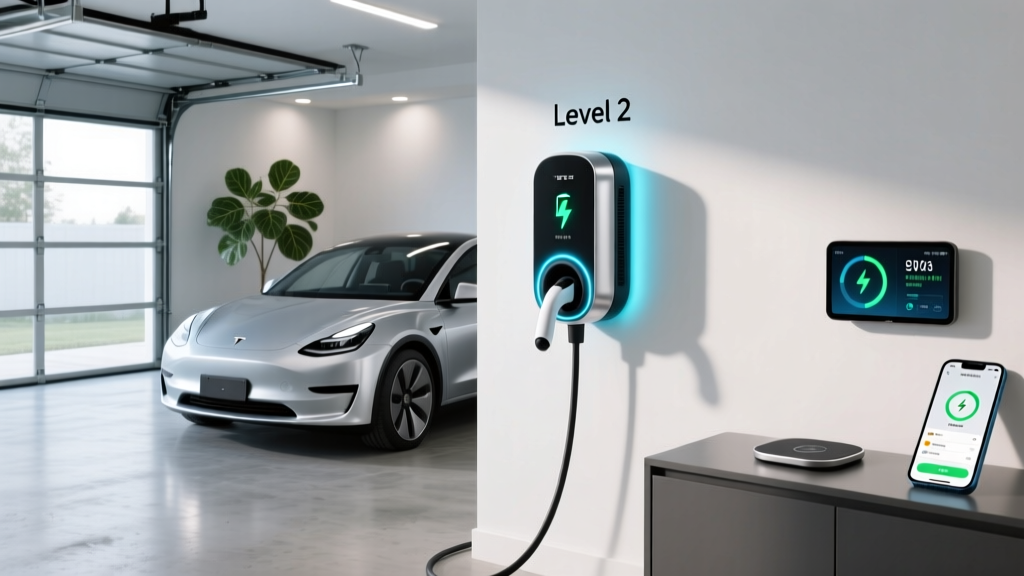
| Level 2 | 240V AC | 3.3–19.2 kW | 12–75 miles/hr | Daily home charging, workplace, retail |
| DC Fast Charge (Level 3) | 200–800V DC | 50–350+ kW | 150–1,200+ miles/hr (equivalent) | Road trips, highway corridors, rapid top-ups |
For context, a Level 2 charger at 11.5 kW (48 amps) will add roughly 35–45 miles of range per hour to a typical midsize EV like the Tesla Model Y or Hyundai Ioniq 5. That means a depleted 75 kWh battery reaches 80% in about 5–6 hours—easily covering a full night's sleep. DC fast charging operates on an entirely different principle, converting AC grid power to DC before it reaches the vehicle, bypassing the car's onboard charger entirely. DC fast chargers are public infrastructure only and are not installed in residential settings.
How Much Does It Cost to Install a Home EV Charger?
Installation cost varies enormously based on your home's existing electrical infrastructure. A straightforward install on a modern 200-amp panel with short conduit runs might cost under $1,000 total. A home needing a panel upgrade, long trenching, or concrete cutting can exceed $4,000. Here's a realistic breakdown based on 2025–2026 electrician quotes across U.S. metro areas:
| Component | Typical Range | Notes |
|---|---|---|
| Level 2 Charger (Equipment) | $300–$750 | Hardwired or NEMA 14-50 plug; smart vs. basic |
| Electrician Labor (240V/40–50A circuit) | $400–$1,500 | Depends on run length, conduit type, wall material |
| Permit & Inspection | $50–$250 | Required in most jurisdictions; varies by city/county |
| Electrical Panel Upgrade (if needed) | $1,500–$3,500 | Upgrading from 100A to 200A service; older homes |
| Conduit & Wiring Materials | $100–$500 | Longer runs, outdoor burial, or masonry increase cost |
| Total (No Panel Upgrade) | $850–$2,500 | Most homes with 200A panels fall in this range |
| Total (With Panel Upgrade) | $2,500–$5,500 | Homes built before ~1990 with 100A service |
What Electrical Upgrades Might I Need?
The most common surprise cost is the panel upgrade. Most Level 2 chargers require a dedicated 240V circuit rated at 40 amps (for a 32A continuous charger) or 50 amps (for a 40A continuous charger). Per the National Electrical Code (NEC), continuous loads must be derated to 80% of breaker capacity—so a 40A breaker supports 32A continuous draw.
Your electrician will calculate your home's existing load. If your 200-amp panel is already running electric range, dryer, HVAC, and water heater near capacity, adding a 40A EV circuit may push you over. In that case, you have three options:
- Panel upgrade to 320A/400A — costly ($2,500–$4,000) but future-proofs for a second EV or solar integration
- Load-management device — a smart panel module (like the Emporia Load Manager or Span panel integration) that dynamically throttles EV charging when other circuits spike, avoiding a panel upgrade
- Lower-amperage charger — a 24A charger on a 30A circuit draws far less but adds range more slowly (~20 miles/hr vs. 35+ miles/hr)
Homes with older 100-amp service almost always need an upgrade. Budget accordingly and get at least two quotes from licensed electricians who hold EV-specific certifications (many utilities maintain lists of vetted EV installers).
Connector Compatibility: NACS, CCS, and CHAdeMO in 2026
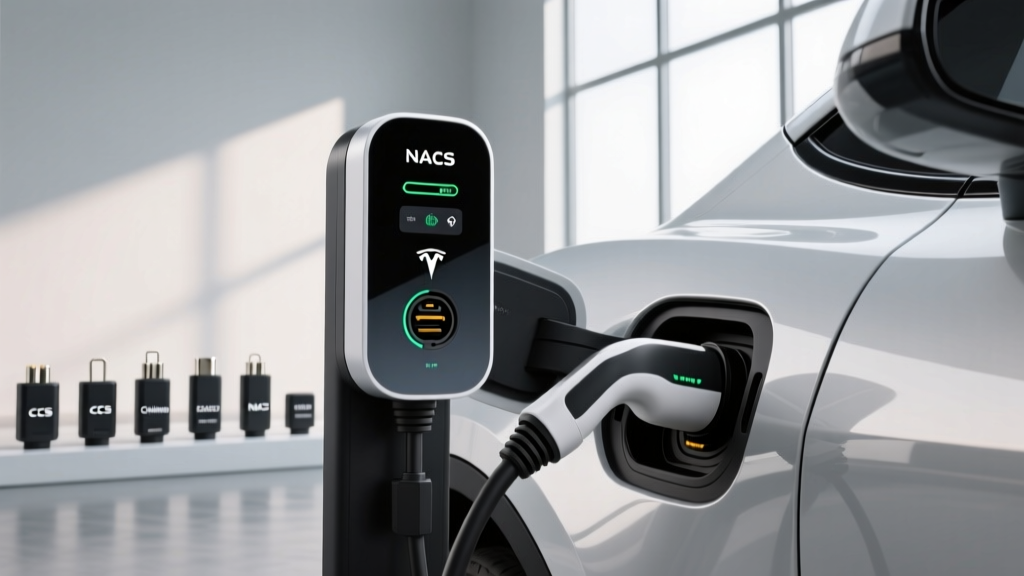
The connector landscape has consolidated significantly. As of 2026, nearly all new EVs sold in North America use the North American Charging Standard (NACS), originally developed by Tesla and adopted industry-wide starting in 2024–2025. Legacy vehicles with CCS1 (Combined Charging System) ports remain on the road and at public stations, but new CCS-equipped models have largely been discontinued.
| Connector | Used By | Home Charger Availability | Adapter Needed? |
|---|---|---|---|
| NACS (J3400) | Tesla (all), Ford, GM, Rivian, Hyundai, Kia, Volvo, Polestar, BMW, Mercedes (2025+), most 2025+ models | Widely available — Tesla Wall Connector, ChargePoint, Emporia, Lectron | No (native on new vehicles) |
| CCS1 (J1772+DC pins) | 2018–2024 VW ID.4, Ford Mustang Mach-E (pre-2025), Chevy Bolt (discontinued), older BMW, Hyundai, Kia models | Available — ChargePoint Home Flex, Grizzl-E, Emporia | NACS-to-CCS adapter needed for Tesla Superchargers; not needed for home Level 2 (AC portion uses J1772) |
| CHAdeMO | Nissan Leaf (discontinued), Mitsubishi Outlander PHEV (older) | Limited — mostly legacy J1772 chargers with adapter | Yes — CHAdeMO-to-J1772 adapters exist but are expensive ($300+) |
| J1772 (AC only) | All non-Tesla EVs for Level 1/Level 2 AC charging | Universal for Level 2 home chargers | Tesla vehicles need J1772-to-NACS adapter (included with Tesla) |
For home Level 2 charging, the AC charging portion of CCS1 and NACS both ultimately use a J1772-compatible signal. Most Level 2 home chargers ship with either a NACS connector or a J1772 connector. If your vehicle has a NACS port (most 2025+ EVs), buy a NACS-connector charger. If your EV has a J1772/CCS port, buy a J1772-connector charger. Adapters bridge the gap in either direction for under $100 in most cases.
Cost to Charge: Home vs. Public vs. Gas, Per Mile
The economics of home charging are where EV ownership delivers its strongest advantage over gasoline. Electricity rates vary by state and time-of-use, but the math consistently favors home charging—especially on off-peak utility rates.
| Scenario | Rate | Cost per kWh | Cost per Mile (3.5 mi/kWh EV) | Annual Cost (12,000 mi) |
|---|---|---|---|---|
| Home — Off-Peak (Utility TOU rate) | $0.08–$0.14/kWh | $0.11 avg | $0.031/mi | $372 |
| Home — Standard Rate (no TOU) | $0.13–$0.22/kWh | $0.17 avg | $0.049/mi | $588 |
| Public Level 2 (ChargePoint, EVgo L2) | $0.25–$0.49/kWh | $0.37 avg | $0.106/mi | $1,272 |
| DC Fast Charging (Electrify America, Tesla Supercharger) | $0.32–$0.58/kWh | $0.45 avg | $0.129/mi | $1,548 |
| Gasoline (28 MPG avg, $3.40/gal) | $3.40/gal | — | $0.121/mi | $1,452 |
At off-peak home rates, charging an EV costs roughly one-quarter the per-mile cost of gasoline. Even at standard residential rates with no time-of-use optimization, home charging still undercuts gas by 60%. The savings shrink at public DC fast chargers—frequent reliance on road-trip charging networks can approach or exceed gasoline costs, which is why home charging access remains the single biggest factor in EV satisfaction.
Many utilities now offer dedicated EV rate plans with deep off-peak discounts (typically 10 PM–6 AM). Check your utility's EV programs—some, like PG&E's EV2 rate or ConEdison's EV Time-of-Use plan, can push effective rates below $0.07/kWh overnight.
Charging Time Examples: How Long to Charge Common EV Batteries
Charging time depends on battery capacity (kWh), the charger's power output (kW), the vehicle's onboard charger limit, and the charging curve—batteries accept power fastest between 10–50% state of charge and taper significantly above 80% to protect cell longevity. Here are real-world estimates for common 2025–2026 EV models on a 48-amp (11.5 kW) Level 2 home charger:
- Tesla Model Y Long Range (75 kWh usable, NMC): 10%–80% in approximately 5.5 hours; full 0–100% in ~7.5 hours. Onboard charger accepts up to 11.5 kW AC.
- Hyundai Ioniq 5 (77.4 kWh usable, NMC): 10%–80% in approximately 6 hours; full 0–100% in ~8 hours. Onboard charger rated at 10.9 kW.
- Ford F-150 Lightning Extended Range (131 kWh usable, NMC): 10%–80% in approximately 10 hours on 11.5 kW; the onboard charger accepts up to 19.2 kW on higher trims, reducing this to ~6 hours on an 80A circuit.
- Chevrolet Equinox EV (85 kWh usable, NMC): 10%–80% in approximately 6.5 hours; onboard charger rated at 11.5 kW.
- Toyota bZ4X (71.4 kWh usable, NMC): 10%–80% in approximately 5.5 hours; onboard charger limited to 6.6 kW on base trim, 11.5 kW on higher trims.
For daily driving of 30–50 miles, you'll rarely need a full charge. Plugging in each evening to replenish 40 miles of driving takes roughly 1–1.5 hours on an 11.5 kW charger—well within any overnight window.
Top Electric Vehicle Chargers for Home: 2026 Equipment Picks
These recommendations reflect hands-on evaluation of charging speed consistency, connector build quality, smart-feature reliability, cable management, and long-term durability. All units listed are EnergyStar-certified or UL-listed for safety.
Tesla Wall Connector (Gen 4, NACS)
- Power Output: Up to 11.5 kW (48A) on a 60A circuit
- Connector: NACS native; J1772 adapter included in box
- Cable Length: 24 feet
- Smart Features: Wi-Fi scheduling, OTA updates, Power Sharing (link multiple units on one circuit), Tesla app integration, load management via Tesla Gateway
- Price: ~$475
- Best For: Tesla owners and NACS-equipped EVs; excellent build quality and seamless app experience
ChargePoint Home Flex (NACS or J1772)
- Power Output: Up to 12 kW (50A) on a 60A circuit; adjustable down to 16A for lower-capacity panels
- Connector: Available in NACS or J1772 variants
- Cable Length: 23 feet
- Smart Features: Wi-Fi + Bluetooth, ChargePoint app scheduling, Alexa/Google Home integration, flexible amperage settings, detailed energy reporting
- Price: ~$550–$650
- Best For: Non-Tesla EVs; best-in-class app and the most flexible amperage adjustment for panel-constrained homes
Emporia Vue Level 2 EV Charger
- Power Output: Up to 11.5 kW (48A) on a 60A circuit
- Connector: J1772 (NACS adapter available separately)
- Cable Length: 24 feet
- Smart Features: Wi-Fi, Emporia energy dashboard integration (pairs with Emporia Vue home energy monitor), solar-aware charging, scheduled charging, load management
- Price: ~$399
- Best For: Budget-conscious buyers; solar-panel owners who want to charge exclusively from excess solar production
Grizzl-E Smart (J1772 or NACS)
- Power Output: Up to 10 kW (40A) on a 50A circuit
- Connector: J1772 or NACS options
- Cable Length: 24 feet
- Smart Features: Wi-Fi via EV Energy app, OCPP protocol support, adjustable amperage (16/24/32/40A), built-in load sharing
- Price: ~$449
- Best For: Extreme-weather durability (rated to -40°F); Canadian-built, robust aluminum enclosure, strong cold-weather performance
All four units support hardwired installation (required for circuits above 40A in most jurisdictions) and NEMA 14-50 plug-in installation on 50A circuits. Hardwired is preferred for reliability—plug-in receptacles can loosen over time and introduce thermal risk at high sustained amperage.
Safety, Code, and Installation Best Practices
EV charging places a sustained high-amperage load on your electrical system for hours at a time—unlike a dryer or oven that cycles on and off. This makes proper installation non-negotiable. Key safety and code requirements include:
- Dedicated circuit: Your Level 2 charger must be on its own dedicated breaker—never shared with other appliances. The NEC requires the continuous load to be no more than 80% of the breaker rating.
- GFCI protection: The 2023 NEC revision (Article 625) requires GFCI protection for all EV charging receptacles. Hardwired installations with integrated ground-fault protection in the charger unit may satisfy this requirement—confirm with your local inspector.
- Outdoor rating: If installing outdoors, the charger must carry a NEMA 4 or IP65+ weatherproof rating. All units recommended above meet this standard. Ensure the connector holster has a weather cover.
- Wire gauge: A 60A circuit requires 4 AWG copper wire (THHN in conduit) or 3 AWG for aluminum. Your electrician will size wire based on run length and local code—long runs may require upsizing to prevent voltage drop.
- Permit and inspection: Most U.S. jurisdictions require a permit for any new 240V circuit. The inspection verifies proper wire sizing, breaker rating, grounding, GFCI compliance, and panel load calculations. Skipping the permit risks insurance claim denial in the event of an electrical fire.
- Cable management: Use a wall-mounted holster or retractable reel to keep the charging cable off the ground. Tripping hazards and cable abrasion are the most common physical safety issues.
Never use an extension cord with an EV charger. Never plug a Level 2 charger into a standard 120V outlet via an adapter—this is a fire hazard. If your garage or driveway lacks adequate clearance for the cable run, consider a ceiling-mounted retractable reel (like the EVLine Reel) or a pedestal mount for outdoor installations.
Federal Tax Credits and Utility Rebates for Home Charging
The federal Alternative Fuel Vehicle Refueling Property Credit (IRC §30C) covers 30% of the cost of home EV charging equipment and installation, up to $1,000. This applies to the charger hardware and the electrician's labor, but eligibility depends on your census tract meeting specific low-income or non-urban criteria established by the Treasury Department. Check the IRS eligibility tool before assuming qualification.
Many utilities and state energy offices offer additional rebates—typically $250–$750 for the charger and $200–$1,000 toward installation. Some programs, like those in California, New York, and Massachusetts, can cover the majority of a basic installation. Contact your local utility's EV program office for current offerings.
Frequently Asked Questions
Can I install a Level 2 charger myself?
Technically, if you are a licensed electrician. For everyone else, no. A 240V/40–50A circuit involves working inside your main service panel with lethal amperage available. Improper installation creates fire risk and will void your homeowner's insurance coverage for any resulting damage. Hire a licensed, insured electrician and pull a permit.
Do I need a smart charger, or will a basic unit work?
A basic ("dumb") Level 2 charger delivers power whenever the car is plugged in—perfectly functional for most owners. Smart chargers add scheduling (to charge during off-peak utility rates), energy tracking, remote start/stop via app, and solar-aware charging. The $50–$150 premium for a smart charger typically pays for itself within months through off-peak rate optimization.
My home has a 100-amp panel. Can I still install a Level 2 charger?
Possibly, but with constraints. A 100A panel has limited headroom for a 40A EV circuit alongside existing loads. Your options include: installing a lower-amperage charger (24A on a 30A circuit), adding a load-management device that throttles the charger when other circuits draw heavily, or upgrading to a 200A panel. Your electrician's load calculation will determine what's feasible.
How fast will each charging level add range?
Level 1 (120V) adds 3–5 miles per hour—suitable for PHEVs with small batteries or drivers covering under 30 miles daily. Level 2 (240V, 48A) adds 35–45 miles per hour, replenishing most EVs overnight. DC Fast Charging (public only) can add 100–250+ miles in 15–30 minutes depending on the vehicle and charger power rating.
Which connector/charger is compatible with my EV?
Check your vehicle's charging port. If it's a NACS (Tesla-style) port—which includes nearly all 2025+ EVs from Tesla, Ford, GM, Hyundai, Kia, Rivian, and others—buy a NACS-connector charger. If your vehicle has a J1772/CCS port (most 2018–2024 non-Tesla EVs), buy a J1772-connector charger. In both cases, inexpensive adapters ($50–$100) bridge compatibility gaps.
Is it cheaper to charge at home or use public chargers?
Home charging is dramatically cheaper. At the national average residential rate of ~$0.17/kWh, home charging costs about $0.05 per mile. Public DC fast charging averages $0.35–$0.55/kWh, or $0.10–$0.16 per mile—comparable to or exceeding gasoline costs. Maximize home charging to realize the full economic benefit of EV ownership.
Will frequent Level 2 home charging degrade my battery?
No. Level 2 AC charging is actually gentler on battery cells than DC fast charging because it generates less heat and avoids high C-rates. Modern EVs include thermal management systems and charge-curve tapering that protect longevity. Data from fueleconomy.gov and long-term fleet studies show typical degradation of 5–10% over 100,000 miles with normal Level 2 use. Most manufacturers warrant battery capacity retention at 70% for 8 years or 100,000 miles.