The Chevrolet Silverado EV promises up to 492 miles of EPA-estimated range in its top-spec 4WT trim — one of the longest ranges of any production electric pickup. But that headline number is only half the story. How you charge a truck with a battery pack north of 200 kWh usable capacity determines whether you wake up to a full battery every morning or spend your weekends babysitting a public DC fast charger.
This guide breaks down exactly what it takes to charge the Silverado EV at home, on the road, and at what cost — with the specific numbers, equipment picks, and electrical requirements that matter for a truck this size.
Silverado EV Range Reality Check: EPA vs. the Real World
Before wiring up a charger, you need to know how much energy you're actually replenishing. The Silverado EV lineup spans a wide range of battery sizes and configurations:
| Trim | Usable Battery (kWh) | EPA Range (mi) | Real-World Highway* | Real-World Cold† |
|---|---|---|---|---|
| 4WT (Max Range) | ~205 | 492 | ~380-410 | ~300-340 |
| 4WT (Standard) | ~170 | ~390 | ~310-340 | ~250-280 |
| RST First Edition | ~200 | 440 | ~340-370 | ~275-310 |
| Trail Boss (2025+) | ~170 | ~360 | ~290-320 | ~235-270 |
*Sustained 70-75 mph, moderate temps. †Below 32°F with cabin heat active. Source: fueleconomy.gov and real-world owner data.
Charging Levels Explained: Speeds That Matter for a 200 kWh Battery
The Silverado EV's enormous battery makes charging speed critical. A level that works fine for a 75 kWh sedan could leave a Silverado owner waiting the better part of a day.
| Level | Power (kW) | Voltage / Amps | Miles Added/Hour | 10-80% Time (205 kWh pack) |
|---|---|---|---|---|
| Level 1 (120V outlet) | 1.0-1.4 kW | 120V / 12A | ~2-3 mi/hr | ~130+ hours (impractical) |
| Level 2 (240V home) | 7.7-19.2 kW | 240V / 32-80A | ~17-42 mi/hr | ~8-19 hours |
| DC Fast (public) | 50-350 kW | DC direct | ~110-350+ mi/hr | ~35-55 minutes* |
*DC fast times reflect the Silverado EV's peak charge rate of ~200 kW on 350 kW stations, with typical charge-curve taper above 80% SoC. Actual 10-80% times vary by station output and battery temperature.
For context, a kW (kilowatt) measures power — how fast energy flows into the battery. A kWh (kilowatt-hour) measures energy capacity — how much the battery holds. Think of kW as the width of a hose and kWh as the size of the tank you're filling. The Silverado EV's tank is massive, so hose width matters enormously.
Home Charging Installation: Requirements, Costs & Panel Upgrades
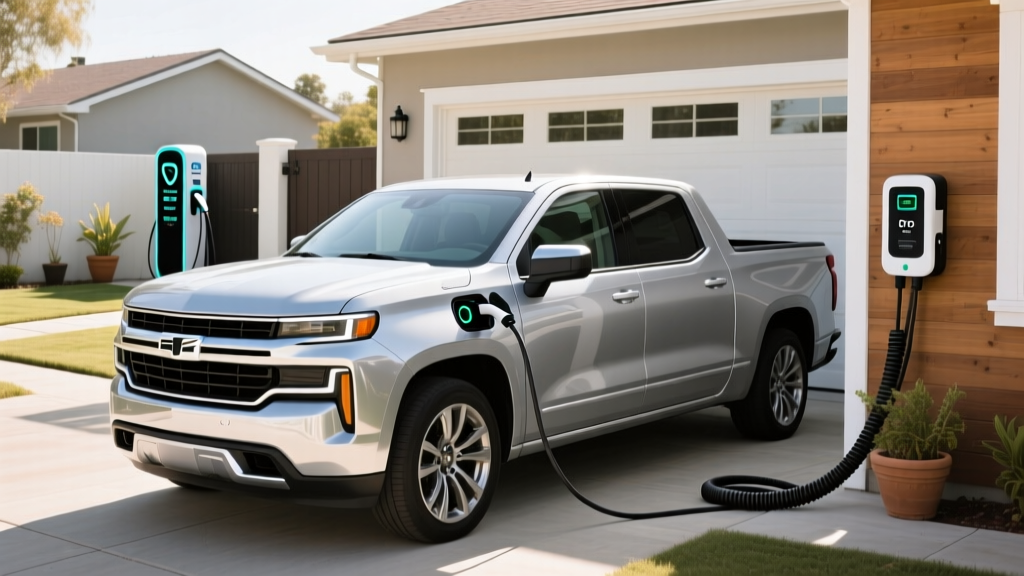
The Silverado EV comes with a portable Dual Level Charge Cord capable of Level 1 (120V) and Level 2 (240V, up to ~7.7 kW on a NEMA 14-50 outlet). For serious daily use, a dedicated wall-mounted Level 2 station is strongly recommended — especially given the truck's battery size.
Electrical Requirements
A 48-amp Level 2 charger (delivering ~11.5 kW) requires a dedicated 60-amp, 240-volt circuit. For maximum charging speed, an 80-amp charger (~19.2 kW) needs a 100-amp circuit. Most homes built before 2020 have a 100-amp or 150-amp main panel that may not have the spare capacity for a high-amperage EV circuit alongside existing loads like electric ranges, dryers, and HVAC.
Installation Cost Breakdown
| Item | Low End | High End | Notes |
|---|---|---|---|
| Level 2 charger (hardware) | $400 | $800 | 48A-80A smart chargers |
| Electrician labor (short run) | $500 | $1,200 | Panel within 20ft of garage |
| Electrician labor (long run) | $1,200 | $3,000 | Conduit, trenching, distant panel |
| Permit & inspection | $50 | $300 | Varies by municipality |
| Panel upgrade (if needed) | $2,000 | $5,000 | 100A→200A service upgrade |
| Total (no panel upgrade) | $950 | $2,300 | Typical install, short run |
| Total (with panel upgrade) | $2,950 | $8,300 | Older homes with 100A service |
Many utility companies offer rebates of $250-$1,000 for Level 2 installations, and the federal 30C tax credit covers up to 30% of home charging equipment and installation costs (capped at $1,000) through 2032, subject to census-tract eligibility. Check your utility and IRS guidance before committing.
Connector Compatibility: NACS, CCS1 & the Adapter Landscape
The 2024-2026 Silverado EV ships with the CCS1 (Combined Charging System) connector standard. However, GM has confirmed that future model years will transition to the NACS (North American Charging Standard, i.e., Tesla's connector). This matters enormously for public charging access.
| Connector | Network Access | Silverado EV Compatibility |
|---|---|---|
| CCS1 | Electrify America, EVgo, ChargePoint, most non-Tesla DCFC | Native (2024-2026 models) |
| NACS (Tesla) | Tesla Supercharger network (17,000+ stalls in North America) | Via GM-approved adapter (available from ~$225); native on future model years |
| CHAdeMO | Limited, legacy stations only | Not supported — no adapter available |
The Tesla Supercharger adapter unlocks the largest and most reliable DC fast-charging network in North America. For Silverado EV owners who road-trip, purchasing the GM NACS adapter is a practical necessity. Supercharger V3 stalls deliver up to 250 kW, and V4 stalls can deliver up to 350 kW — well-matched to the Silverado EV's ~200 kW peak acceptance rate.
Cost to Charge: Home vs. Public vs. Gas
The Silverado EV's efficiency hovers around 48-52 MPGe combined depending on trim — roughly 2.0-2.2 kWh per mile driven. That's thirstier than a compact EV but competitive for a full-size electric truck.
| Scenario | $/kWh | Cost per Mile | Cost for 400 mi |
|---|---|---|---|
| Home (off-peak utility rate) | $0.08-0.12 | $0.17-0.25 | $68-100 |
| Home (standard rate) | $0.14-0.18 | $0.29-0.38 | $116-152 |
| Public Level 2 (ChargePoint, etc.) | $0.25-0.40 | $0.52-0.84 | $208-336 |
| DC Fast Charging (EA, EVgo) | $0.35-0.55 | $0.73-1.15 | $292-460 |
| Gas equivalent (Silverado 1500 4WD, 19 MPG combined, $3.40/gal) | — | $0.18 | $72 |
At off-peak home rates, the Silverado EV costs roughly the same per mile as its gas counterpart. At public DC fast-charging prices, it costs significantly more. This is why home charging isn't just convenient — it's the economic foundation of EV truck ownership. If you can't charge at home, the Silverado EV's operating cost advantage evaporates.
Check your utility for time-of-use (TOU) plans. Charging between 11 PM and 6 AM can cut your per-kWh cost in half compared to peak afternoon rates.
Recommended Level 2 Chargers for the Silverado EV
Given the Silverado EV's large battery, prioritize chargers at 48 amps or higher. A 32-amp charger will technically work but adds range painfully slowly for a 200+ kWh pack.
ChargePoint Home Flex
Power: Up to 12 kW (50A) / 240V
Connector: CCS1 (NACS version available)
Cable length: 23 ft
Smart features: Wi-Fi, scheduling, Alexa, load sharing
Price: ~$550-650
Best all-around pick. Amperage adjustable via DIP switch. UL-listed. Works well for overnight replenishment of ~100-120 miles.
Grizzl-E Smart
Power: Up to 11.5 kW (48A) / 240V
Connector: J1772 (CCS via vehicle inlet)
Cable length: 24 ft
Smart features: OCPP, app scheduling, firmware OTA
Price: ~$450-550
Budget-friendly and rugged (IP67 outdoor-rated). Canadian-built. No frills, but extremely reliable.
Emporia Vue / Tesla Universal Wall Connector
Power: Up to 19.2 kW (80A) / 240V
Connector: NACS with J1772 adapter included
Cable length: 24 ft
Smart features: Wi-Fi, energy monitoring, load management
Price: ~$450-600
Maximum Level 2 speed for Silverado EV. Requires 100A dedicated circuit — panel upgrade likely needed. Adds ~42 miles per hour of charging.
For Silverado EV owners with access to a NACS adapter or a future native-NACS model, the Tesla Universal Wall Connector at 80A is the fastest Level 2 option available. For most homes with a 60A circuit, the ChargePoint Home Flex at 48A is the practical sweet spot.
Safety, Code & Outdoor Installation Considerations
EV charging circuits carry significant continuous current. The National Electrical Code (NEC Article 625) treats EV charging as a continuous load, meaning the circuit must be rated for 125% of the charger's maximum draw. A 48A charger requires a 60A breaker. A 32A charger requires a 40A breaker. Never undersize the breaker.
Key safety requirements:
- Dedicated circuit: The EV charger must be on its own breaker — not shared with other appliances.
- GFCI protection: Required for outdoor receptacles (NEC 2020+). Hardwired chargers with built-in GFCI may not require an additional GFCI breaker, but local codes vary.
- Outdoor rating: If your charger mounts outside or in an unsealed garage, ensure it carries an IP65 or IP67 ingress-protection rating.
- Wire gauge: 6 AWG copper for 48A circuits; 4 AWG or 3 AWG for 80A circuits over longer runs. Your electrician will calculate based on distance and voltage drop.
- Permit & inspection: Nearly all jurisdictions require an electrical permit for EV charger installation. Skipping this can void homeowner's insurance coverage for electrical fires.
For older homes, consider a smart load-management system (such as the Emporia Vue energy monitor paired with compatible chargers). These systems dynamically throttle charger amperage when other large loads (dryer, oven, AC) are active, potentially avoiding a costly panel upgrade entirely.
DC Fast Charging on the Road: What to Expect
The Silverado EV supports DC fast charging at a peak rate of approximately 200 kW on 800V-capable architecture (varies by model year and trim). On a 350 kW Electrify America or Tesla Supercharger V4 station, you can expect:
- 10-80% charge: ~35-45 minutes (205 kWh pack)
- Peak charge rate: ~195-200 kW between 10-30% SoC
- Sustained rate: Tapers to ~120-140 kW above 50% SoC, and ~50-60 kW above 80% SoC
- Miles added in 20 min: ~120-150 miles (highway-realistic)
Charge-curve taper is the key concept here. Manufacturers quote peak kW, but the battery management system progressively slows charging as the battery fills to protect cell health. For road trips, plan stops around the 10-80% window — charging from 80-100% can take as long as 10-80% due to taper. Preconditioning the battery (available via the MyChevy app or in-vehicle navigation routing to a charger) warms the pack for optimal charge acceptance, particularly in cold weather.
Frequently Asked Questions
How much does it cost to install a home EV charger for a Silverado EV?
Expect $950-$2,300 for a standard installation with adequate panel capacity. If your home needs a 200A service upgrade (common in pre-2010 homes), add $2,000-$5,000. The federal 30C credit may cover up to $1,000 of equipment and labor, and many utilities offer additional rebates.
How fast will each charging level add range to my Silverado EV?
Level 1 (120V) adds roughly 2-3 miles per hour — essentially useless for a truck with a 200+ kWh battery. Level 2 at 48A adds ~22 miles per hour, meaning an overnight session (10 hours) recovers ~220 miles. DC fast charging at 200 kW adds 120-150 miles in 20 minutes.
Which connector does the Silverado EV use?
Current 2024-2026 models use CCS1. GM has committed to transitioning to NACS (Tesla's connector) for future model years. In the meantime, a GM-approved NACS adapter (~$225) unlocks the Tesla Supercharger network — strongly recommended for road-tripping owners.
Is charging a Silverado EV cheaper than gas?
At home on off-peak electricity ($0.08-0.12/kWh), yes — roughly $0.17-0.25 per mile vs. ~$0.18/mile for a gas Silverado 1500. At public DC fast chargers ($0.35-0.55/kWh), electric costs $0.73-1.15 per mile — significantly more than gas. Home charging access is the make-or-break factor for EV truck economics.
What electrical upgrades might I need for a Silverado EV charger?
A 48A charger needs a 60A dedicated 240V circuit. If your main panel is 100A (common in homes built before 2000), you likely need a service upgrade to 200A ($2,000-$5,000). Homes with existing 200A service usually have sufficient capacity. A licensed electrician can perform a load calculation to confirm before any work begins.