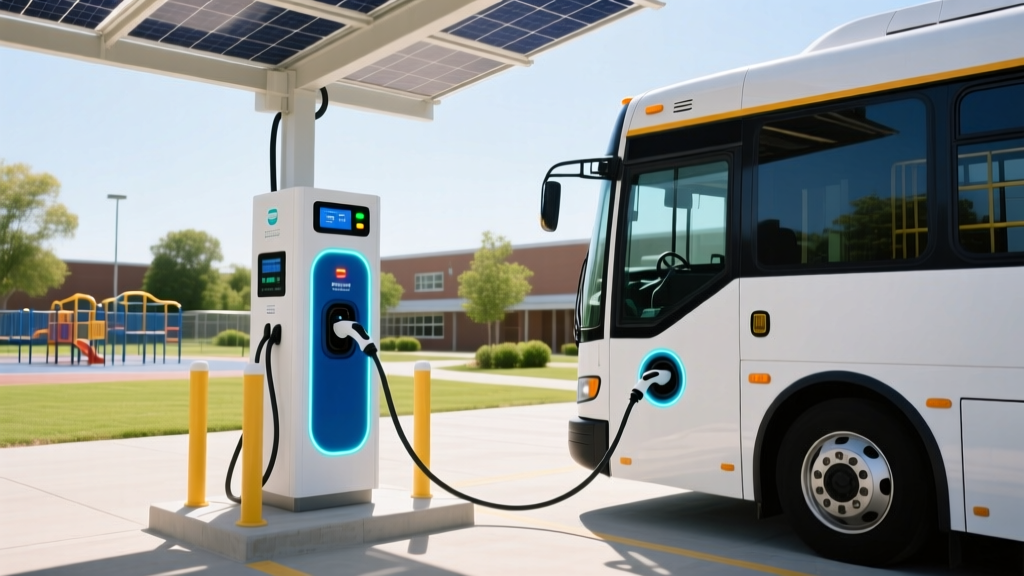
School districts across the U.S. are accelerating the shift to electric fleets, driven by EPA Clean School Bus funding, lower per-mile operating costs, and zero tailpipe emissions around children. But the backbone of any electric bus fleet isn't the bus itself — it's the charging infrastructure. Electric school bus charging stations require careful planning around power delivery, connector standards, utility coordination, and long-term scalability that go far beyond plugging in a passenger EV at home.
This guide breaks down exactly what districts, fleet managers, and transportation directors need to know about electric school bus charging stations in 2026 — from charging speeds and electrical requirements to real installation costs and per-mile economics versus diesel.
Charging Levels Explained: What School Bus Fleets Actually Need
Before specifying equipment, it's essential to understand the three charging levels and why most school bus applications require Level 2 or DC Fast Charging. The critical distinction: kW (kilowatts) measures the rate of power delivery (how fast energy flows), while kWh (kilowatt-hours) measures total energy stored in the battery (the "tank size"). A 150 kWh bus battery charged at 50 kW takes far longer than one charged at 150 kW — the math is straightforward once you separate these units.
| Level | Voltage | Power (kW) | Miles of Range Added Per Hour | Typical Use Case |
|---|---|---|---|---|
| Level 1 | 120V AC | 1.0–1.9 kW | 3–5 mi/hr | Not viable for school buses (150+ kWh batteries) |
| Level 2 | 208V–240V AC | 7.2–19.2 kW | 20–55 mi/hr | Overnight depot charging; primary fleet strategy |
| DC Fast Charge (DCFC) | 400V–800V DC | 50–350 kW | 130–400+ mi/hr | Mid-day top-ups, opportunity charging, route recovery |
For context, a typical Type C electric school bus (e.g., Blue Bird Vision Electric, Thomas Built Saf-T-Liner eC2) carries a 120–155 kWh battery pack and delivers roughly 100–130 miles of real-world range depending on route topography, climate, and HVAC load. Overnight Level 2 charging at 19.2 kW will fully replenish a 150 kWh pack in roughly 8–9 hours — well within a standard overnight layover window. DC fast charging at 60–80 kW can recover 10–80% state of charge in approximately 60–90 minutes, useful for split-shift operations or midday route recovery.
Electric School Bus Charging Station Installation: Costs & Electrical Requirements
Installing commercial-grade electric school bus charging stations involves utility coordination, switchgear upgrades, trenching, and permitting that dwarf residential EV charger installs. Here's a realistic breakdown based on 2025–2026 fleet deployment data and EPA Clean School Bus Program documentation.
Single Level 2 Depot Charger (19.2 kW)
| Component | Cost Range | Notes |
|---|---|---|
| Commercial Level 2 EVSE (e.g., ChargePoint CT4000, Blink HQ 200) | $3,500–$7,000 | Dual-port pedestal units common for fleets |
| Electrical panel/switchgear upgrade | $5,000–$25,000 | Depends on existing service capacity; 400A–800A service often needed |
| Conduit, wiring, trenching (per stall) | $3,000–$12,000 | Distance from panel to stall is the biggest variable |
| Permits & engineering | $1,500–$5,000 | Commercial electrical permit, utility interconnection agreement |
| Electrician labor (commercial rate) | $4,000–$15,000 | Union vs. non-union, prevailing wage requirements for federally funded projects |
| Total per Level 2 stall | $17,000–$64,000 | Average ~$35,000 per stall for a 4–8 bus depot |
DC Fast Charger (60–150 kW) for School Bus Fleet
| Component | Cost Range | Notes |
|---|---|---|
| DCFC unit (e.g., ABB Terra 124, BTC Power 120 kW) | $35,000–$85,000 | Higher kW = higher unit cost; dual-dispenser options available |
| Utility service upgrade / transformer | $15,000–$80,000 | May require new pad-mounted transformer or medium-voltage service |
| Switchgear, metering, protection | $10,000–$35,000 | Commercial metering, surge protection, disconnect switches |
| Conduit, wiring, concrete pad | $8,000–$25,000 | Heavy-gauge DC cabling, bollard protection, ADA compliance |
| Permits, engineering, utility interconnection | $5,000–$15,000 | Utility demand study often required for >100 kW loads |
| Electrician/contractor labor | $15,000–$40,000 | Multi-day commercial install with heavy equipment |
| Total per DCFC stall | $88,000–$280,000 | Average ~$150,000 per stall; utility make-ready costs vary wildly |
Connector Compatibility: CCS1, NACS, and the School Bus Landscape
Unlike the passenger EV market — where Tesla's North American Charging Standard (NACS) has largely won the connector war — the electric school bus segment in 2026 remains predominantly CCS1 (Combined Charging System). Here's the compatibility landscape:
| Connector | Bus Manufacturers Using It | Notes |
|---|---|---|
| CCS1 (J1772 Combo) | Blue Bird, Thomas Built (eC2), IC Bus (RE Electric), Lion Electric | Industry standard for Type A, C, and D electric school buses |
| NACS (Tesla/J3400) | Emerging on some 2026+ models; not yet standard | Some manufacturers have announced future NACS adoption; adapters available |
| CHAdeMO | Legacy only — no current U.S. school bus uses it | Being phased out across all vehicle categories |
Practical recommendation: Specify CCS1 connectors for new electric school bus charging stations in 2026. If your district is considering future NACS-equipped buses, purchase EVSE units with interchangeable connector heads or budget for CCS1-to-NACS adapters ($200–$400 per adapter). Most commercial fleet EVSE manufacturers (ChargePoint, ABB, BTC Power, Tritium) offer CCS1 as the default and can accommodate NACS via cable swap.
Charging Time Examples: Real Numbers for Common School Bus Batteries
Charging times depend on battery capacity (kWh), charger power output (kW), and the charge curve — batteries accept power fastest between 10–80% state of charge, then taper significantly to protect cell health. Here are real-world estimates for representative electric school bus battery sizes:
| Bus Model (Representative) | Battery Capacity | Level 2 at 19.2 kW (0–100%) | DCFC at 60 kW (10–80%) | DCFC at 120 kW (10–80%) |
|---|---|---|---|---|
| Type A (small, ~75 kWh usable) | 75 kWh | ~4.5 hours | ~55 minutes | ~30 minutes |
| Type C (standard, ~150 kWh usable) | 150 kWh | ~9 hours | ~100 minutes | ~55 minutes |
| Type D (large, ~210 kWh usable) | 210 kWh | ~12 hours | ~140 minutes | ~75 minutes |
Cost Per Mile: Electric School Bus vs. Diesel
The economic case for electric school buses rests heavily on fuel and maintenance savings. Here's a side-by-side cost-per-mile analysis using 2026 energy and diesel prices, aligned with fueleconomy.gov efficiency data for commercial electric vehicles.
| Metric | Electric School Bus (Type C) | Diesel School Bus (Type C) |
|---|---|---|
| Energy efficiency | ~2.0–2.5 kWh/mile | ~5.5–6.5 miles/gallon |
| Fuel/energy cost | $0.08–$0.18/kWh (varies by utility rate & time-of-use) | $3.80–$4.50/gallon (2026 national avg diesel) |
| Fuel cost per mile | $0.16–$0.45/mile | $0.58–$0.82/mile |
| Maintenance cost per mile | $0.08–$0.12/mile (no oil, filters, DEF, fewer brake replacements) | $0.20–$0.35/mile |
| Total operating cost per mile | $0.24–$0.57/mile | $0.78–$1.17/mile |
| Annual savings (12,000 mi/yr) | $6,480–$7,200/year per bus | |
Charging cost scenarios for a 150 kWh Type C bus (full charge):
- Depot overnight (off-peak utility rate, $0.08/kWh): ~$12.00 per full charge
- Depot peak rate ($0.18/kWh): ~$27.00 per full charge
- Public DC fast charging ($0.35–$0.55/kWh): ~$52.50–$82.50 per full charge — avoid this for routine fleet operations; use only for emergency midday top-ups
The takeaway is clear: electric school bus charging stations pay for themselves through fuel savings, but only if the district secures off-peak utility rates and avoids reliance on expensive public DCFC networks. Many utilities now offer dedicated commercial EV fleet rates with time-of-use pricing that makes overnight depot charging extremely economical.
Equipment Recommendations: Commercial EVSE for School Bus Fleets
Fleet-grade EVSE must deliver durability, networked management, load balancing, and ruggedized enclosures that consumer chargers simply don't offer. Here are proven platforms for electric school bus charging stations in 2026:
ChargePoint CT4000 Series (Level 2)
- Power output: Up to 19.2 kW per port (240V/80A)
- Connector: CCS1 (J1772 Combo), dual-port capable
- Cable length: 25 ft standard
- Smart features: Cloud management, load balancing, RFID access, energy metering, API integration with fleet telematics
- Price: $5,500–$7,500 per dual-port pedestal
- Best for: Large depots (5–20 buses) needing networked load management
ABB Terra 124 (DC Fast Charger)
- Power output: Up to 120 kW DC (CCS1)
- Connector: CCS1 dual-cable option; dynamic power sharing between two vehicles
- Cable length: 15 ft (DC cables are heavier/shorter than AC)
- Smart features: ABB Ability cloud, remote diagnostics, OCPP 2.0.1 protocol, integrated payment terminal option
- Price: $55,000–$75,000 per unit
- Best for: Mid-day opportunity charging, split-shift operations
Blink HQ 200 (Level 2)
- Power output: Up to 19.2 kW (240V/80A)
- Connector: CCS1 (J1772 Combo)
- Cable length: 23 ft
- Smart features: Blink Network management, load sharing, usage reporting, cellular + WiFi connectivity
- Price: $3,800–$5,200 per unit
- Best for: Budget-conscious districts with smaller fleets (2–6 buses)
BTC Power 120 kW DCFC
- Power output: 120 kW DC (configurable 60/90/120 kW)
- Connector: CCS1, dual-port with power splitting
- Cable length: 15 ft
- Smart features: OCPP compliant, remote monitoring, 10" touchscreen, credit card reader
- Price: $42,000–$60,000 per unit
- Best for: Mixed fleets needing both fast and moderate DC charging
Safety, Code, and Compliance for School Bus Charging Infrastructure
Commercial electric school bus charging stations must comply with the National Electrical Code (NEC Article 625), local building codes, and often prevailing-wage requirements when funded by federal programs. Key safety considerations:
- Dedicated circuits: Each Level 2 EVSE requires its own dedicated 240V circuit with appropriately sized breaker (typically 40A–100A). DCFC units require 480V three-phase service with dedicated switchgear.
- GFCI protection: NEC 2023/2026 requires GFCI protection for all EVSE rated 150V to ground or less and 50A or less. Commercial DCFC installations require ground-fault protection of equipment (GFPE) per Article 625.
- Outdoor rating: All outdoor depot chargers must be NEMA 3R or NEMA 4 rated (weatherproof). Coastal or high-corrosion environments require NEMA 4X stainless-steel enclosures.
- Bollard protection: Fleet charging stations should include steel bollards or concrete barriers to protect EVSE from bus maneuvering damage — a frequent and costly oversight in early deployments.
- Ventilation & fire code: While EVSE themselves don't require special ventilation, indoor charging bays may need enhanced fire suppression per NFPA 13 and local fire marshal requirements for lithium-ion battery storage/charging.
- ADA compliance: Public-facing or employee-accessible charging stations must meet ADA clearance and operability requirements for controls and cable reach.
- Utility demand charges: Commercial electricity billing includes demand charges ($/kW of peak draw) in addition to energy charges ($/kWh). A depot charging 10 buses simultaneously at 19.2 kW each creates a 192 kW demand spike — smart load management software that staggers charging sessions can reduce demand charges by 30–50%.
Frequently Asked Questions
How much does it cost to install electric school bus charging stations?
Level 2 depot chargers cost $17,000–$64,000 per stall fully installed, including equipment, electrical work, permits, and potential panel upgrades. DC fast chargers cost $88,000–$280,000 per stall. Utility make-ready costs (transformer upgrades, new service lines) are the largest variable and can sometimes be subsidized by the utility or through EPA Clean School Bus infrastructure grants.
How fast will each charging level add range to a school bus?
Level 2 at 19.2 kW adds roughly 40–55 miles of range per hour to a typical Type C electric school bus. DC fast charging at 60 kW adds approximately 130–160 miles per hour (during peak acceptance, 10–50% SoC). Level 1 is not viable — at 1.5 kW it would take over 100 hours to charge a 150 kWh bus battery.
Which connector do electric school buses use?
Virtually all current-production electric school buses in the U.S. (Blue Bird, Thomas Built, IC Bus, Lion Electric) use the CCS1 connector. NACS adoption is beginning to appear in manufacturer roadmaps but is not yet standard on school buses. Specify CCS1 for charging infrastructure and plan for adapter compatibility if future NACS buses are anticipated.
How much does charging an electric school bus cost per mile vs. diesel?
Electric school buses cost approximately $0.16–$0.45 per mile in energy (depending on utility rate), compared to $0.58–$0.82 per mile for diesel fuel. Including maintenance, total operating costs are $0.24–$0.57/mile for electric vs. $0.78–$1.17/mile for diesel — a savings of roughly $6,500–$7,200 per bus per year at 12,000 annual miles.
What electrical upgrades might a school bus depot need?
Most existing bus depots need a service upgrade from 400A–800A to 1,200A–2,000A to support simultaneous charging of 5–15 buses. This often requires a new utility transformer, upgraded main switchgear, and new distribution panels. Budget $25,000–$80,000+ for the electrical service upgrade alone, and expect 3–6 months for utility coordination. Contact your local utility early in the planning process — many now offer make-ready incentive programs specifically for commercial EV fleet charging. See the EPA Clean School Bus Program for available infrastructure funding.
Can federal funds cover electric school bus charging station costs?
Yes. The EPA Clean School Bus Program provides up to $375,000 per electric bus and up to $20,000 per bus for charging infrastructure through competitive rebates. Additionally, the IRS §30D and §45W commercial clean vehicle credits may apply to the buses themselves, and many state programs (e.g., California's HVIP, New York's Truck Voucher Incentive) offer supplementary funding. Always verify current-year eligibility with the IRS clean vehicle credit guidelines and your state environmental agency, as rules and funding pools change annually.