Why Electric Trucks Demand Bigger Home Chargers
Electric pickups carry massive batteries. The Ford F-150 Lightning packs a 98 kWh usable extended-range pack; the Chevrolet Silverado EV tops out at roughly 200 kWh in its largest configuration; the Rivian R1T uses a 149 kWh Max Pack. If you plug these into a standard 120V wall outlet (Level 1), you'll add roughly 3-5 miles of range per hour — meaning a full charge on a Silverado EV could take over two days.
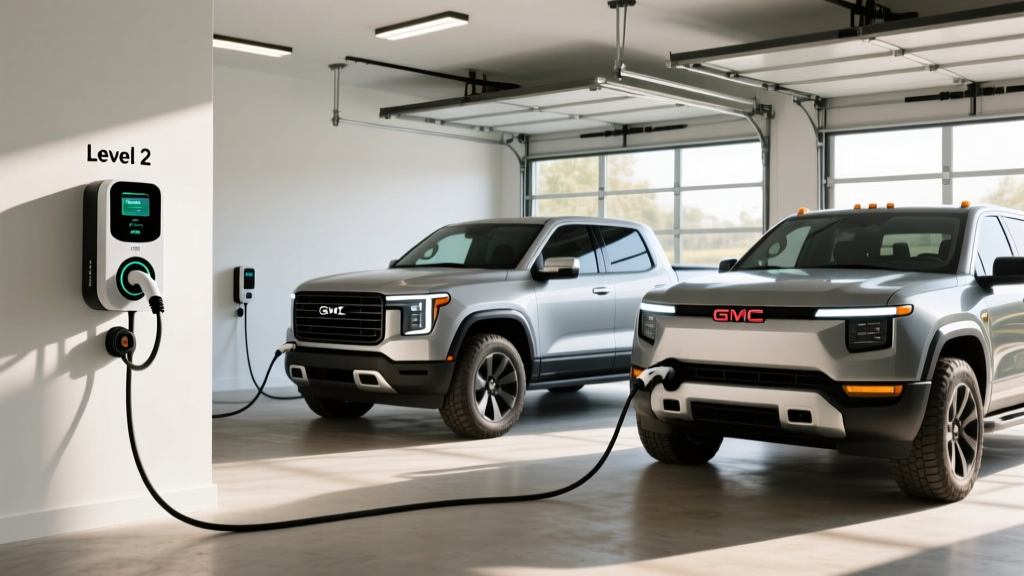
The solution is a hardwired Level 2 home charger rated for 48 amps or higher. For electric truck owners, a robust Level 2 setup isn't optional — it's the backbone of daily usability. This guide walks through the exact charging hardware, electrical requirements, installation costs, and connector compatibility you need to charge an electric pickup efficiently at home.
- Ford F-150 Lightning (Extended Range): EPA 320 mi — expect ~250-270 mi highway at 70 mph, ~210-230 mi in freezing temps
- Rivian R1T (Max Pack, Dual Motor): EPA 410 mi — expect ~330-350 mi highway, ~280 mi cold
- Chevrolet Silverado EV (4WT): EPA 440 mi — expect ~350-380 mi highway, ~300 mi cold
Towing cuts range dramatically — often by 40-50%. Plan accordingly.
Charging Levels Explained: Speeds in kW and Miles Per Hour
Understanding the difference between kW (power — how fast energy flows) and kWh (energy — how much the battery stores) is essential. Think of kW as the flow rate of a hose and kWh as the size of the bucket. A higher-kW charger fills the battery faster.
| Level | Voltage | Max Power (kW) | Miles Added/Hour | Best For |
|---|---|---|---|---|
| Level 1 | 120V AC | 1.4-1.9 kW | 3-5 mi/hr | Overnight top-ups, PHEVs, emergencies |
| Level 2 (40A) | 240V AC | 9.6 kW | 20-28 mi/hr | Minimum viable for electric trucks |
| Level 2 (48A) | 240V AC | 11.5 kW | 25-34 mi/hr | Sweet spot for most EV trucks |
| Level 2 (80A) | 240V AC | 19.2 kW | 42-56 mi/hr | Large-battery trucks, fastest home option |
| DC Fast Charge | 400-800V DC | 150-350 kW | 180-400+ mi in 20-30 min | Road trips, commercial fleets |
For context, a Ford F-150 Lightning with the 98 kWh extended-range battery charging on a 48A (11.5 kW) Level 2 unit will go from 10% to 80% state of charge in roughly 6 hours. On an 80A (19.2 kW) charger, that same session drops to about 3.5 hours. On DC fast charging, the Lightning peaks at 150 kW and reaches 10-80% in approximately 41 minutes (Ford F-150 Lightning specs).
Home Charger Installation: Electrical Requirements and Cost Breakdown
Installing a Level 2 charger for a truck-sized EV typically demands a dedicated 240V circuit on a 60A or 100A breaker (for 48A and 80A chargers respectively). The National Electrical Code requires circuits to be rated at 125% of the continuous load, so a 48A charger needs a 60A breaker, and an 80A charger needs a 100A breaker.
What Electrical Upgrades Might You Need?
Many homes built before 2010 have 100A or 150A main service panels. Adding an 80A EV charger circuit to a 150A panel that's already near capacity may require a panel upgrade to 200A — a significant expense. A licensed electrician will perform a load calculation to determine whether your existing panel can support the new circuit.
Homes with 200A panels usually have headroom for a 60A breaker (48A charger), but an 80A circuit on top of electric heating, A/C, and an electric range may still push limits. Some utilities offer managed charging or panel-integrated load management devices that avoid a full panel upgrade.
| Item | Typical Cost Range | Notes |
|---|---|---|
| Level 2 Charger (48A-80A, hardwired) | $500 - $1,200 | Smart Wi-Fi models cost more |
| Electrician labor (basic install, short run) | $600 - $1,500 | Under 30 ft from panel, no panel upgrade |
| Electrician labor (long run or complex) | $1,500 - $3,500 | Conduit through walls, attic, or underground |
| Permit and inspection | $100 - $400 | Varies by municipality |
| Electrical panel upgrade (if needed) | $2,000 - $5,000 | 100A → 200A service upgrade |
| Total (no panel upgrade) | $1,200 - $3,100 | Most common scenario |
| Total (with panel upgrade) | $3,200 - $8,100 | Older homes with 100A/150A panels |
The IRS Residential Clean Energy Credit (IRC §25C) covers up to 30% of home EV charger equipment and installation costs, capped at $1,000 per year. This can offset a meaningful chunk of your install. Always confirm eligibility with a tax professional — rules vary and are subject to legislative change.
Connector Compatibility: NACS, CCS, and What Your Truck Uses
The connector landscape shifted dramatically in 2024-2025 when most automakers adopted Tesla's North American Charging Standard (NACS) for new vehicles. Here's where each major electric truck stands for the 2025-2026 model years:
| Electric Truck | Model Year | Native Connector | Adapter Needed? |
|---|---|---|---|
| Ford F-150 Lightning | 2025+ | NACS (native) | No — charges at Tesla Superchargers directly |
| Ford F-150 Lightning | 2022-2024 | CCS1 | Ford-provided CCS-to-NACS adapter for Supercharger access |
| Rivian R1T | 2025+ | NACS (native) | No |
| Rivian R1T | 2022-2024 | CCS1 | Rivian NACS adapter included |
| Chevrolet Silverado EV | 2024+ | NACS (native) | No |
| Tesla Cybertruck | 2024+ | NACS (native) | No |
| GMC Hummer EV Pickup | 2022+ | CCS1 | GM CCS-to-NACS adapter for Supercharger access |
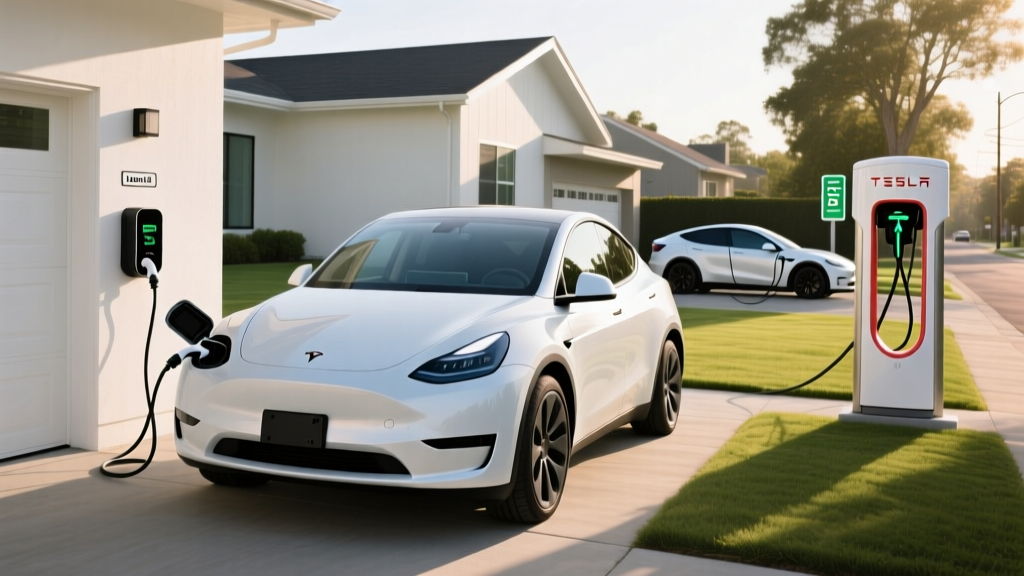
For home Level 2 charging, most chargers ship with a NACS connector (for 2025+ trucks) or a J1772 connector (which all non-Tesla EVs can use via adapter). If you own a 2022-2024 CCS-equipped truck and plan to keep it long-term, buy a charger with a J1772 plug — it's the universal AC standard and will work with any EV via the car's included adapter.
Level 2 Charger Recommendations for Electric Trucks
These chargers meet the power demands of large-battery electric pickups. All are hardwired for maximum safety and output, and all feature smart connectivity for scheduling and off-peak rate optimization.
ChargePoint Home Flex (up to 50A)
- Power: Up to 12 kW (50A on a 60A breaker)
- Connector: NACS or J1772 (select at purchase)
- Cable length: 23 ft
- Smart features: Wi-Fi, app scheduling, Alexa, utility rate integration
- Price: ~$650
- Best for: F-150 Lightning standard-range, daily commuting top-ups
Wallbox Pulsar Max (48A)
- Power: 11.5 kW (48A on a 60A breaker)
- Connector: NACS or J1772
- Cable length: 25 ft
- Smart features: Wi-Fi + Bluetooth, Power Sharing (daisy-chain two units on one circuit), Eco mode for solar
- Price: ~$599
- Best for: Two-EV households, budget-conscious truck owners
Tesla Wall Connector (48A)
- Power: 11.5 kW (48A on a 60A breaker)
- Connector: NACS (native), includes J1772 adapter in box
- Cable length: 24 ft
- Smart features: Wi-Fi, OTA updates, Power Sharing, load management with Tesla Gateway
- Price: ~$475
- Best for: Cybertruck and NACS-native trucks; best value at 48A
Ford Charge Station Pro (80A)
- Power: 19.2 kW (80A on a 100A breaker)
- Connector: NACS (2025+), CCS1 (older models)
- Cable length: 25 ft
- Smart features: Wi-Fi, FordPass integration, Pro Power Onboard coordination, bidirectional V2H capable (with Home Integration System)
- Price: ~$1,199 (plus ~$3,200 for Home Integration System for V2H)
- Best for: F-150 Lightning extended-range owners who want fastest home charging and backup power
If your truck supports 19.2 kW AC charging (the F-150 Lightning extended-range and Silverado EV both do), the 80A Ford Charge Station Pro cuts your overnight session nearly in half compared to a 48A unit. However, the 100A circuit requirement means a panel upgrade is more likely — factor that into your budget.
Cost to Charge an Electric Truck: Per-Mile vs. Gas
Electric trucks consume more energy per mile than sedans — typically 400-550 Wh/mi (watt-hours per mile) depending on payload, speed, and temperature. Here's how the per-mile cost compares to a gas truck getting 18 MPG combined on $3.40/gallon regular:
| Charging Scenario | Rate ($/kWh) | Cost Per Mile (at 480 Wh/mi) | Savings vs. Gas (per mile) |
|---|---|---|---|
| Home off-peak (utility TOU rate) | $0.08 - $0.12 | $0.038 - $0.058 | $0.13 - $0.15 |
| Home standard residential rate | $0.14 - $0.18 | $0.067 - $0.086 | $0.10 - $0.12 |
| Public Level 2 (ChargePoint, EVgo L2) | $0.25 - $0.40 | $0.12 - $0.19 | $0.00 - $0.07 |
| DC Fast Charge (Electrify America, EA Pass) | $0.35 - $0.55 | $0.17 - $0.26 | -$0.07 to $0.02 |
| Tesla Supercharger (non-member) | $0.28 - $0.40 | $0.13 - $0.19 | $0.00 - $0.06 |
| Gas equivalent (18 MPG, $3.40/gal) | — | $0.189 | Baseline |
The takeaway: home charging is where the savings live. An F-150 Lightning owner charging at $0.10/kWh off-peak spends roughly $0.05/mile — about $0.14/mile less than a comparable gas F-150. Over 15,000 miles/year, that's roughly $2,100 in annual fuel savings. Public DC fast charging, however, can exceed gas costs per mile — use it for road trips, not daily fueling.
Charging Time Examples for Common Truck Batteries
Here's how long a 10-80% charge takes for popular electric trucks on different home setups:
- F-150 Lightning (98 kWh, 11.5 kW charger): ~6 hours (10-80%)
- F-150 Lightning (98 kWh, 19.2 kW charger): ~3.5 hours (10-80%)
- Rivian R1T Max Pack (149 kWh, 11.5 kW charger): ~9 hours (10-80%)
- Rivian R1T Max Pack (149 kWh, 19.2 kW charger): ~5.5 hours (10-80%)
- Silverado EV (200 kWh, 19.2 kW charger): ~7.5 hours (10-80%)
Note: AC Level 2 charging maintains a flat power curve (no taper like DC fast charging), so the full rated kW output is sustained from 10% to approximately 95% SoC. This makes overnight charging highly predictable — plug in at 10 PM, wake up full.
Safety, Code, and Installation Best Practices
A high-amperage EV charger is a major continuous electrical load. Proper installation isn't just about code compliance — it's about fire safety and long-term reliability.
- Dedicated circuit: Your charger must be on its own dedicated breaker — never shared with other appliances. A 48A charger requires a 60A breaker; an 80A charger requires a 100A breaker.
- Hardwired over plug-in: For 48A and above, hardwired installation is strongly recommended (and required for 80A by most jurisdictions). NEMA 14-50 receptacles are rated for 50A but are only code-compliant for continuous loads up to 40A. Many 2022-2023 reports of melted 14-50 outlets from sustained 48A draws led to updated NEC guidance.
- GFCI protection: NEC 2020 and later require GFCI protection for outdoor receptacles. Hardwired chargers avoid this requirement and the nuisance tripping issues that GFCI breakers sometimes cause with EVSE units.
- Outdoor rating: If mounting outside, confirm the charger is NEMA 4 or IP56 rated for weather resistance. All chargers listed above meet this standard.
- Permit and inspection: Most jurisdictions require an electrical permit for new 240V circuits. The inspection ensures proper wire gauge, breaker sizing, grounding, and conduit. Skipping the permit risks insurance claim denials if a fire occurs.
- Wire gauge: A 60A circuit typically requires 6 AWG copper wire; a 100A circuit requires 3 AWG copper or 1 AWG aluminum. Your electrician will size this based on run length and local code.
Frequently Asked Questions
How much does it cost to install a home EV charger for a truck?
Expect $1,200-$3,100 for a standard installation (equipment, electrician, permit) without a panel upgrade. If your home needs a 200A service upgrade, total costs can reach $3,200-$8,100. The IRS §25C credit can offset up to $1,000 of the total.
How fast will each charging level add range to my electric truck?
Level 1 (120V) adds 3-5 miles per hour — impractical for daily truck use. Level 2 at 48A (11.5 kW) adds roughly 25-34 miles per hour. Level 2 at 80A (19.2 kW) adds 42-56 miles per hour. DC fast charging can add 180-300+ miles in 20-30 minutes, depending on the truck's peak charge rate.
Which connector and charger is compatible with my electric truck?
2025+ Ford F-150 Lightning, Rivian R1T, Chevrolet Silverado EV, and Tesla Cybertruck all use the NACS connector natively. Older 2022-2024 models use CCS1 and require an adapter for Tesla Superchargers. For home charging, buy a charger with the connector matching your truck — NACS for new trucks, J1772 for older CCS trucks (with the car's adapter).
How much does charging an electric truck cost per mile vs. gas?
At home on off-peak rates ($0.10/kWh), expect $0.04-$0.06 per mile — roughly 70-75% cheaper than a gas truck at 18 MPG and $3.40/gallon ($0.19/mile). Public DC fast charging at $0.45/kWh pushes costs to $0.17-$0.26/mile, sometimes exceeding gas. Home charging is the economic advantage.
What electrical upgrades might I need for an 80A truck charger?
An 80A charger requires a 100A breaker on a 240V circuit. Homes with 100A or 150A main panels will likely need a service upgrade to 200A ($2,000-$5,000). Homes with an existing 200A panel and moderate loads can usually accommodate a 60A breaker (48A charger) without an upgrade. Always have a licensed electrician perform a load calculation before purchasing equipment.
Sources: EPA Fuel Economy (fueleconomy.gov), Ford F-150 Lightning specifications, IRS Residential Clean Energy Credit, Rivian R1T specifications.