The Reality of Charging Electric Range Rovers at Home
If you own or are considering one of the growing lineup of electric Range Rovers — from the 2025 Range Rover Sport PHEV to the fully electric Range Rover expected for the 2026 model year — home charging is where the bulk of your "refueling" will happen. Public DC fast chargers are essential for road trips, but 80–90% of EV charging occurs at home, according to the U.S. Department of Energy. Getting your home setup right means understanding electrical requirements, choosing the right equipment, and budgeting for installation costs that can vary dramatically depending on your home's existing wiring.
This guide breaks down every aspect of charging electric Range Rovers in a residential setting: the three charging levels, real-world charge times for Land Rover's large battery packs, connector compatibility, installation cost breakdowns, and the per-mile cost compared to filling up a gas-powered Range Rover.
Charging Levels Explained: Speeds, Power, and Range Added
Before selecting equipment, it's essential to distinguish between kW (kilowatts — the rate of power delivery) and kWh (kilowatt-hours — the total energy stored in a battery). Think of kW as how fast water flows from a hose, and kWh as the total volume of the tank you're filling. A 100 kWh battery charged at 10 kW takes roughly 10 hours. The same battery at 20 kW takes about 5 hours. The battery size stays the same; only the flow rate changes.
Electric Range Rovers carry large battery packs — the Range Rover Sport P460e/P440e plug-in hybrids use a 38.2 kWh gross (31.8 kWh usable) lithium-ion pack, while the upcoming all-electric Range Rover (built on the MLA-Flex platform) is expected to carry a battery in the 100–120 kWh range. Larger batteries make faster Level 2 charging at home especially important.
| Charging Level | Voltage | Typical Power (kW) | Miles of Range Added per Hour | Best Use Case |
|---|---|---|---|---|
| Level 1 | 120V AC | 1.2–1.8 kW | 3–5 miles | Overnight top-off, PHEVs with small batteries |
| Level 2 | 240V AC | 7.2–19.2 kW | 20–60 miles | Daily home charging, primary EV refueling |
| DC Fast Charging | 400–800V DC | 50–350 kW | 150–1,000+ miles | Road trips, rapid top-ups (not for daily use) |
For a large-battery electric Range Rover, Level 1 charging is impractical as a primary method — adding only ~4 miles per hour means fully replenishing a 100 kWh pack would take over 60 hours. Level 2 at 11.5 kW (a common 48-amp home charger) adds roughly 35–40 miles of range per hour in a full-size electric SUV, making overnight charging entirely viable. DC fast charging is reserved for highway travel; the Range Rover Sport PHEV supports up to 50 kW DC, while the all-electric Range Rover is expected to support significantly higher peak rates on an 800V architecture.
Home Charger Installation: Electrical Requirements and Costs
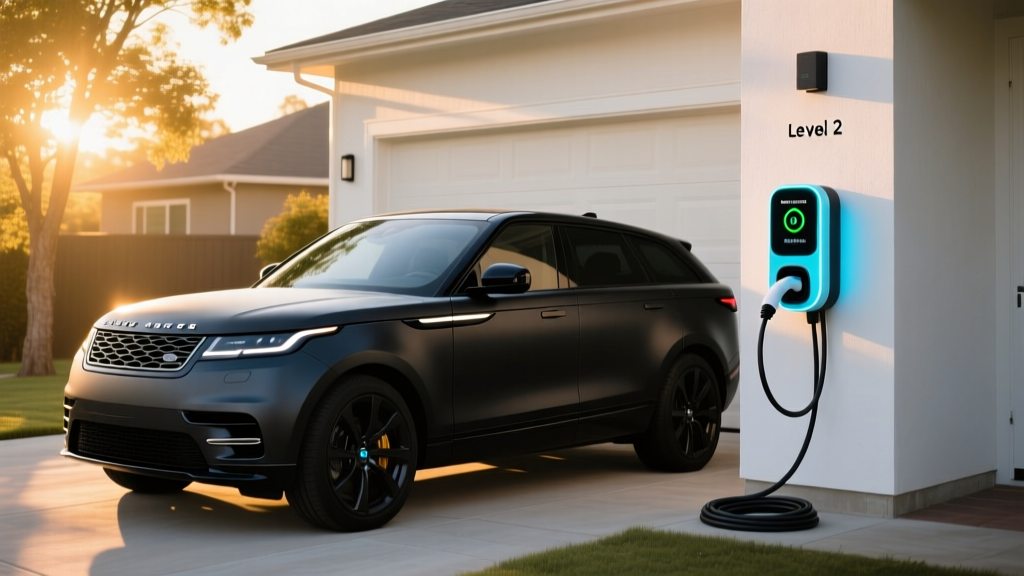
Installing a Level 2 home charger for an electric Range Rover is not a simple plug-and-play task. It requires a dedicated 240-volt circuit, professional electrical work, and in many cases, a permit from your local building department.
Core Electrical Specifications
- Voltage: 240V (same as a clothes dryer or electric oven)
- Amperage: 40A–60A circuit for a 32A–48A charger (National Electrical Code requires circuits rated at 125% of the continuous load — a 48A charger requires a 60A breaker)
- Wire gauge: 6 AWG copper for 60A circuits; 8 AWG for 40A circuits
- Outlet type: NEMA 14-50 (most common) or hardwired connection (preferred for 48A+ chargers and required by many jurisdictions for higher amperage)
- GFCI protection: Required by NEC 2020/2023 for receptacle-based EV circuits in garages; hardwired units may be exempt depending on local code
Panel Upgrade Considerations
Most modern homes have a 200-amp electrical panel. Adding a 60A dedicated circuit for an EV charger consumes a significant portion of that capacity. If your panel is already heavily loaded (electric heating, central AC, electric water heater, pool equipment), you may need a panel upgrade to 300A or 400A, or the installation of a sub-panel. Older homes with 100A service will almost certainly require an upgrade.
A smart alternative is a load-management device (such as the Emporia Smart Load Management or Tesla Wall Connector with Power Sharing), which dynamically throttles charger amperage based on the home's real-time electrical consumption — avoiding a costly panel upgrade while still providing adequate overnight charging.
| Cost Component | Low End | High End | Notes |
|---|---|---|---|
| Level 2 Charger (Equipment) | $350 | $750 | 40A–48A smart charger, 24–25 ft cable |
| Electrician Labor | $600 | $2,500 | Depends on run length from panel to garage/carport |
| Permit Fees | $50 | $300 | Varies by municipality; some waive EV permits |
| Electrical Materials (conduit, wire, breaker) | $150 | $500 | Longer wire runs and outdoor conduit increase cost |
| Panel Upgrade (if needed) | $2,000 | $5,000+ | 200A→300A/400A upgrade; not always required |
| Total (No Panel Upgrade) | $1,150 | $4,050 | Typical range for most homeowners |
| Total (With Panel Upgrade) | $3,150 | $9,050+ | Older homes or high-load homes |
Always hire a licensed electrician familiar with NEC Article 625 (Electric Vehicle Charging System Equipment). Some utilities offer rebates of $250–$1,000 for home charger installation — check with your local provider before scheduling work.
Connector Compatibility: What Electric Range Rovers Use
Connector standards have consolidated significantly as of 2026, but Land Rover's approach depends on the specific model and market.
| Connector Type | Used By | Notes for Range Rover Owners |
|---|---|---|
| CCS1 (Combined Charging System) | Most non-Tesla EVs sold in North America through 2024; Range Rover Sport PHEV | Standard for current Land Rover PHEVs; supports AC Level 2 and DC fast charging |
| NACS (North American Charging Standard / Tesla) | Tesla; Ford, GM, Rivian, Hyundai, and others from 2025+ | The all-electric Range Rover may adopt NACS for 2026+; check model-year specs |
| CHAdeMO | Nissan Leaf (legacy); largely phased out | Not used by any Land Rover product |
| J1772 (AC only) | All EVs for Level 2 AC charging (NACS vehicles use adapter) | CCS1 includes J1772 for AC; NACS vehicles need a J1772-to-NACS adapter |
Adapter needs: If you purchase the all-electric Range Rover and it ships with a CCS1 port, you'll need a CCS1-to-NACS adapter (~$200–$250 from Lectron or A2Z) to access Tesla Superchargers. Conversely, if it ships with NACS, a NACS-to-CCS1 adapter will unlock Electrify America and other CCS networks. Confirm your specific model-year connector before ordering a home charger — most Level 2 chargers sold in 2026 ship with either a J1772 or NACS plug, with adapters available for the other standard.
Charging Time Examples for Range Rover Battery Packs
Charge times depend on the vehicle's onboard charger capacity (which limits AC charging speed) and the battery's state of charge. Charging is not linear — speeds taper significantly above 80% state of charge to protect battery longevity. Here's what to expect with common Range Rover configurations:
| Vehicle / Battery | Charger Power | 10–80% Charge Time (Est.) | Notes |
|---|---|---|---|
| Range Rover Sport P460e PHEV (31.8 kWh usable) | 7.2 kW Level 2 | ~3 hours 15 min | Onboard charger limited to 7.2 kW AC |
| Range Rover Sport P460e PHEV (31.8 kWh usable) | 50 kW DC Fast | ~30 min (10–80%) | DC bypasses onboard charger limit |
| Electric Range Rover (~110 kWh est.) | 11.5 kW Level 2 (48A) | ~8–9 hours (10–80%) | Overnight charge; typical home setup |
| Electric Range Rover (~110 kWh est.) | 19.2 kW Level 2 (80A) | ~5.5–6 hours (10–80%) | Requires 100A circuit; rare residential |
| Electric Range Rover (~110 kWh est.) | 150+ kW DC Fast | ~25–35 min (10–80%) | Depends on peak charge rate and curve |
For the PHEV models, a standard 7.2 kW / 32A Level 2 charger is perfectly adequate — you'll wake up with a full battery every morning. For the all-electric Range Rover, a 48A charger delivering 11.5 kW is the practical home sweet spot, replenishing roughly 70% of the battery in a single overnight session.
Level 2 Charger Equipment Recommendations
Not all Level 2 chargers are created equal. For a premium vehicle like an electric Range Rover, you want reliable hardware with smart features (scheduling, load management, energy tracking) and sufficient cable length to reach the charge port regardless of parking orientation.
Emporia Vue Level 2 EV Charger
- Power Output: 11.5 kW (48A)
- Connector: J1772 (NACS adapter available)
- Cable Length: 24 feet
- Smart Features: Energy monitoring via Emporia app, solar integration, scheduled charging, load management with Emporia Smart Load Controller
- Installation: Hardwired or NEMA 14-50 plug
- Price: ~$399 (charger only)
- Best For: Budget-conscious owners who want robust energy tracking and solar integration
ChargePoint Home Flex
- Power Output: Up to 12 kW (50A) — adjustable down to 16A for lower-capacity circuits
- Connector: J1772 (NACS version available)
- Cable Length: 23 feet
- Smart Features: ChargePoint app scheduling, Alexa integration, flexible amperage adjustment, detailed session history
- Installation: NEMA 14-50 or hardwired
- Price: ~$699
- Best For: Flexibility — adjustable amperage works with nearly any home circuit
Wallbox Pulsar Plus
- Power Output: 11.5 kW (48A)
- Connector: J1772 (NACS adapter sold separately)
- Cable Length: 25 feet
- Smart Features: Wi-Fi and Bluetooth, Power Boost load management, myWallbox app scheduling, Power Sharing for dual-charger setups
- Installation: Hardwired (no plug option)
- Price: ~$649
- Best For: Homes needing load management without a panel upgrade
Tesla Wall Connector
- Power Output: 11.5 kW (48A)
- Connector: NACS native; J1772 adapter included
- Cable Length: 24 feet
- Smart Features: Wi-Fi updates, Power Sharing for multi-unit installs, access control, integrated cable management
- Installation: Hardwired only
- Price: ~$450
- Best For: NACS-equipped EVs; excellent value and build quality
For current Range Rover Sport PHEV owners with a CCS1 port, the ChargePoint Home Flex or Emporia Vue with J1772 connectors are the most straightforward options. If the all-electric Range Rover adopts NACS, the Tesla Wall Connector offers the best price-to-performance ratio. In either case, choose a 48A unit on a 60A circuit for maximum Level 2 speed.
Cost to Charge: Per-Mile Economics vs. Gas
One of the strongest ownership arguments for electric Range Rovers is the per-mile fueling cost. A gas-powered Range Rover averaging 18 MPG combined at $3.60/gallon costs roughly $0.20 per mile in fuel. Here's how electric charging compares across scenarios:
| Charging Scenario | Cost per kWh | Cost to Add 200 Miles (est.) | Cost per Mile |
|---|---|---|---|
| Home — Off-Peak Utility Rate | $0.08–$0.12 | $4.80–$7.20 | $0.024–$0.036 |
| Home — Standard Residential Rate | $0.14–$0.18 | $8.40–$10.80 | $0.042–$0.054 |
| Public Level 2 (ChargePoint, EVgo) | $0.25–$0.39 | $15.00–$23.40 | $0.075–$0.117 |
| DC Fast Charging (Electrify America, Tesla) | $0.35–$0.55 | $21.00–$33.00 | $0.105–$0.165 |
| Gas Range Rover (18 MPG, $3.60/gal) | — | $40.00 | $0.20 |
These estimates assume an electric Range Rover efficiency of approximately 2.5 miles per kWh (roughly 40 kWh per 100 miles) — a reasonable figure for a full-size luxury electric SUV. Actual efficiency will vary with driving style, temperature, and terrain. Cold-weather efficiency can drop 15–25%, pushing consumption to 3.0+ miles per kWh in sub-freezing conditions.
Even at the most expensive public DC fast-charging rates, an electric Range Rover costs less per mile than its gasoline counterpart. For home charging on off-peak utility rates, the savings are dramatic — roughly 80–85% less per mile than gasoline. Over 15,000 annual miles, that translates to $2,250–$2,700 in annual fuel savings with primarily home charging.
Safety, Code Compliance, and Practical Tips
EV charging infrastructure involves sustained high-current electrical loads, making code compliance and safety non-negotiable:
- Dedicated circuit: Your Level 2 charger must be on its own dedicated breaker — never shared with other appliances.
- GFCI protection: NEC 2020 and later require ground-fault circuit interrupter protection for receptacle-based EV chargers in garages and outdoor locations. Hardwired installations may be exempt in some jurisdictions — your electrician will confirm.
- Outdoor rating: If your charger is mounted outdoors (carport, driveway wall), ensure it carries a NEMA 4 or IP65 weather rating. All chargers listed above meet outdoor requirements.
- Cable management: Use a wall-mounted holster or cable reel to prevent tripping hazards and protect the cable from vehicle damage.
- Permit and inspection: Most jurisdictions require a permit for EV charger installation. Skipping the permit risks insurance claim denials and code violations discovered during a future home sale.
- Utility notification: Inform your electric utility of your EV charger installation — some offer time-of-use (TOU) rate plans that dramatically reduce charging costs during off-peak hours (typically 10 PM – 6 AM).
Frequently Asked Questions
How much does it cost to install a home EV charger for an electric Range Rover?
A typical Level 2 home charger installation (48A unit, 60A circuit, 240V) costs between $1,150 and $4,050 when no panel upgrade is required. This includes the charger ($350–$750), electrician labor ($600–$2,500), materials ($150–$500), and permit fees ($50–$300). If your home needs an electrical panel upgrade (common in homes with 100A service or heavy existing loads), add $2,000–$5,000+. Load-management devices can sometimes avoid the need for a panel upgrade entirely.
How fast will each charging level add range to my Range Rover?
Level 1 (120V) adds approximately 3–5 miles of range per hour — adequate only for the PHEV's smaller battery as an emergency backup. Level 2 (240V, 48A) adds 35–40 miles per hour in a full-size electric Range Rover, or enough to fully replenish the PHEV's 31.8 kWh battery in roughly 3.5 hours. DC fast charging at 150 kW can add 150+ miles in 15–20 minutes, though charge speed tapers significantly above 80% state of charge to protect the battery.
Which connector and charger is compatible with my electric Range Rover?
The current Range Rover Sport PHEV (P460e/P440e) uses the CCS1 connector for both AC Level 2 and DC fast charging. The upcoming all-electric Range Rover may adopt NACS, aligning with the broader industry shift toward Tesla's connector standard. Check your specific model year and trim. For home Level 2 charging, any J1772-equipped charger works with CCS1 vehicles, while NACS vehicles require either a NACS-native charger (like the Tesla Wall Connector) or a J1772-to-NACS adapter.
How much does charging cost per mile compared to gas?
Home charging at off-peak utility rates costs approximately $0.024–$0.036 per mile for a full-size electric Range Rover (assuming 2.5 mi/kWh efficiency). Standard residential rates push this to $0.042–$0.054/mile. Even the most expensive public DC fast charging ($0.105–$0.165/mile) undercuts gasoline. A gas Range Rover at 18 MPG and $3.60/gallon costs approximately $0.20 per mile in fuel — roughly 5–8x more than home Level 2 charging.
What electrical upgrades might I need for a home EV charger?
The most common upgrade is the dedicated 240V/60A circuit itself, which requires new wiring from your electrical panel to the charger location. If your panel is at or near capacity, you may need a panel upgrade from 100A or 200A to 300A or 400A service — this is particularly common in older homes or homes with multiple high-draw electric appliances. A load-management device ($200–$400 additional) can dynamically limit charger draw to avoid overloading your panel, potentially saving thousands on a panel upgrade. Always have a licensed electrician perform a load calculation before installation.
Sources: EPA Fuel Economy — Land Rover Range Rover Sport PHEV; U.S. Department of Energy — Home EV Charging; Land Rover USA — Range Rover Sport Specifications.